Reform UK Press Ban: Journalism Discovers Borders Are Terrifying
The Reform UK press ban erects a tiny frontier around Birmingham as the activist press discovers that sovereignty becomes considerably less charming when applied to the buffet
BIRMINGHAM — Reform UK has triggered the latest emergency in British democracy by declining conference accreditation to a Middle East Eye journalist, briefly approving him, and then apparently deciding that the approval was an administrative mistake, creating the first British border crisis in history involving a lanyard and complimentary coffee.
Middle East Eye says its UK political correspondent applied for accreditation in July, received a rejection this week, subsequently received an email welcoming him to the conference, and was then informed that the welcome had been sent in error. Other journalists, including the Guardian’s Anna Isaac, the investigative reporter Peter Geoghegan and the broadcaster Michael Crick, were also reportedly denied accreditation, reinstated, and then unreinstated, which is a word now.
The episode immediately produced outrage among sections of the British press, where denying a journalist entry to a private political gathering is traditionally regarded as one constitutional notch below dissolving Parliament with a flamethrower.
Reform supporters, meanwhile, reacted with the bewildering proposition that political parties might occasionally prefer not to provide refreshments, workspace and privileged access to reporters they believe are persistently hostile to them.
This concept is known in political science as not inviting someone.
Experts warn it could spread.
Reform UK Press Ban: Britain Discovers the Border
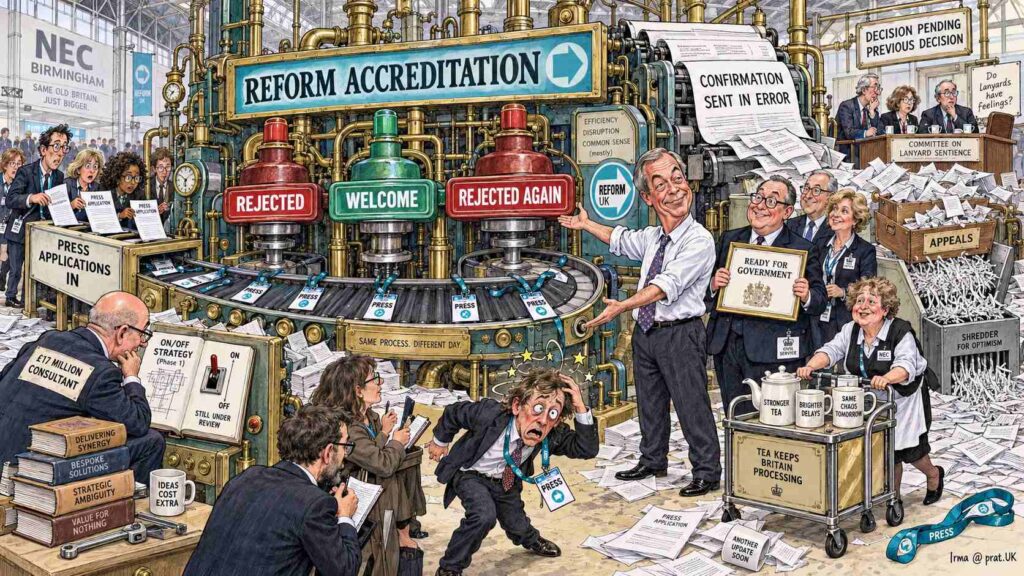
The Reform conference begins at Birmingham’s National Exhibition Centre, where attendees need an e-ticket and valid photo identification to enter.
Photo identification.
At a Reform conference.
You can almost hear Nigel Farage staring into the middle distance thinking, “Write this down.”
The party could scarcely have designed a better metaphor. Here is a building in Birmingham containing thousands of people who believe borders should mean something, surrounded by journalists arguing that one particular border must immediately become porous because they have notebooks. The press did not object to the principle. The press objected to the precedent setting a precedent on them.
Merrick Stanwell, a Camden comedian who has spent thirty years working the club circuit, summarised the national mood without pausing for breath.
“Apparently borders are cruel until the border is between a reporter and the champagne breakfast.”
Reform’s premium conference package even advertises a champagne breakfast with Farage. That may explain the sudden philosophical interest in freedom of movement. Nothing radicalises the metropolitan press quite like discovering Nigel Farage is drinking champagne somewhere without them. One correspondent was reported to be utterly bereaved of a bacon roll.
The Reform UK Press Ban and the Sacred Lanyard of Democracy
Political journalism has developed a fascinating theory of constitutional government.
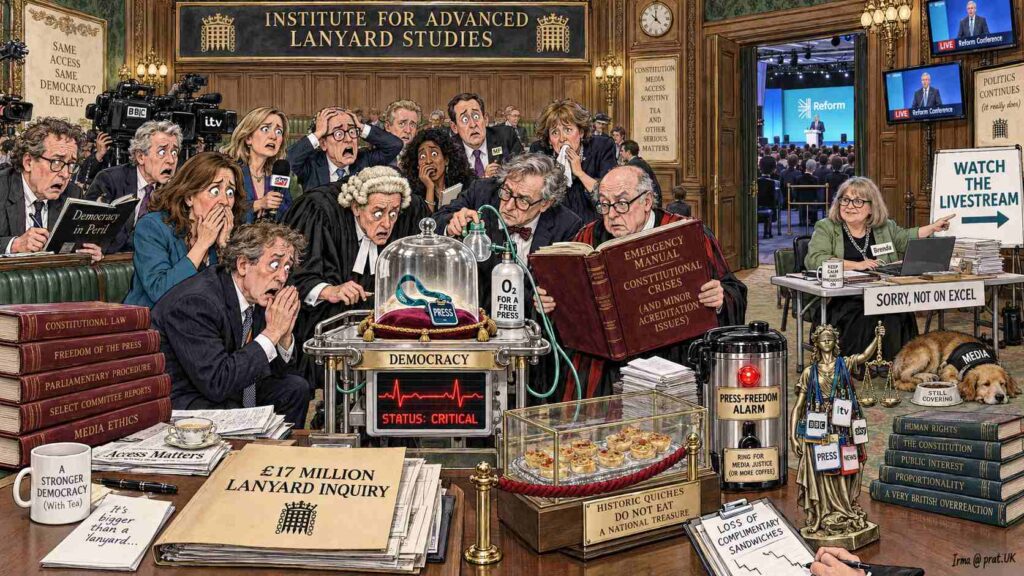
The public may vote. Parliament may legislate. Courts may adjudicate. But civilisation itself ultimately depends upon whether a political correspondent receives a plastic rectangle on a blue string.
Lose the lanyard and suddenly Britain is Belarus.
Political scientists previously believed authoritarianism involved imprisoned opponents, abolished elections, state censorship and secret police. Apparently the updated definition is “Deborah from accreditation hasn’t replied to my email.”
One professor at the Institute for Advanced Lanyard Studies estimated that 94 percent of British democracy now occurs within twelve metres of a conference coffee machine. The remaining six percent happens on X, where the tone is less measured and more mustard.
Reform UK Press Ban Accidentally Becomes the Government
Perhaps the funniest element was the reported sequence.
Rejected. Accepted. Rejected again.
Middle East Eye’s correspondent wrote that the process left him feeling faintly dizzy. Welcome to British administration. That is not extremism. That is Tuesday.
If Reform wants to convince Britain it is ready for government, accidentally sending somebody the opposite decision and correcting it later is an impressive start. The civil service probably watched the episode and whispered, “He’s learning.”
By next year Reform should be capable of rejecting the application, approving the appeal, losing both documents, establishing a £17 million inquiry and appointing a consultant to determine whether the lanyard experienced emotional distress. That is when you know a movement has matured. That is when a party has properly quangoed itself.
Reform UK Press Ban Meets the Nightclub Bouncer
There is also something magnificent about adversarial journalism becoming offended when the adversary notices the adversarial part.
The arrangement increasingly resembles nightlife. A reporter spends twelve months outside yelling, “THIS PLACE IS TERRIBLE!”
Then Friday arrives. The reporter approaches the velvet rope.
“Evening.”
The bouncer checks the clipboard.
“No.”
And suddenly we have a symposium on democratic norms.
“But I’m a CRITIC!”
“Yes, sir. We noticed.”
Political journalists absolutely should investigate parties, challenge politicians and publish uncomfortable facts. That is journalism. But journalism does not automatically require the subject of your investigation to give you a chair, a Wi-Fi password and directions to the pastries. Woodward and Bernstein somehow investigated Watergate without Nixon providing them platinum conference passes. They had deep throat, not deep-fried canapés.
The Great Reform UK Press Ban Paradox
Critics have a legitimate argument too.
Political parties seeking government should expect scrutiny. A party that controls access too aggressively risks looking thin-skinned, and shutting out critical journalists can create a worse story than simply admitting them. Press freedom campaigners made exactly that case last year, and again in Wales when an investigative reporter was blocked from a manifesto launch.
Fair enough.
But that argument becomes unintentionally hilarious when converted into the absolute proposition that every journalist possesses an inalienable constitutional right to stand fifteen feet from Farage while consuming a miniature quiche.
Democracy requires a free press. It does not necessarily require catering. There is a difference. One is protected political expression. The other involves tiny sausages on sticks.
Middle East Eye Turns the Reform UK Press Ban Into Free Advertising
There is another delicious irony.
Middle East Eye’s own report describes Reform as a serious contender to become Britain’s next government. That sentence probably belongs on Reform posters.
REFORM UK: NOW SO IMPORTANT OUR CRITICS ARE ANGRY THEY CAN’T GET INSIDE.
Political insurgencies traditionally struggle for legitimacy. Reform has discovered an easier method. Have newspapers complain about being excluded. Nothing tells voters that an establishment challenger has arrived quite like establishment journalists demanding access to the challenger’s green room.
It is political judo. The criticism supplies the momentum. An outlet whose funding arrangements have themselves been the subject of years of speculation now finds itself lecturing a British party about transparency, which is either brave or a bold new frontier in irony futures.
The Reform UK Press Ban and Britain’s New Definition of Patriotism
Reform’s appeal has always rested heavily on a simple proposition: Britain ought to behave more like a country and less like an apologetic committee meeting accidentally occupying an island.
Borders. National sovereignty. Accountability. British interests. The outrageous notion that government should occasionally prefer British taxpayers to international bureaucracies.
To critics, these ideas often arrive wrapped in ominous adjectives. To Reform voters, they frequently sound less like extremism than something their grandfather assumed was included in the basic subscription price of having a country.
That contrast explains much of Reform’s political strength. When one side says “dangerous nationalism,” another hears, “Could somebody please answer the telephone at the Home Office?”
An Emergency Poll on the Reform UK Press Ban
A completely unscientific survey conducted outside a Birmingham pub produced devastating findings.
Asked, “Should political journalists be allowed to criticise Reform?” Ninety-eight percent answered yes.
Asked, “Must Reform provide those journalists with conference passes?” Fifty-two percent said no. Thirty-one percent said yes. Seventeen percent asked whether the conference parking was free.
It is.
Those seventeen percent are Britain. They will survive anything.
Reform UK Press Ban: Helpful Advice for Political Reporters
Fortunately, there are practical steps available to journalists denied admission. Report the conference anyway. Interview delegates outside. Question Reform politicians entering and leaving. Analyse speeches. Check claims. Speak to opponents. Read policy documents. Investigate donors. Watch broadcasts. Use sources.
In other words, practise journalism. This radical strategy was popular before conference organisers began manufacturing laminated identity cards.
And understand that being denied privileged access may itself become a story, but it should not automatically become the fall of Western civilisation. Sometimes a closed door is tyranny. Sometimes Brenda just doesn’t have you on Excel.
The Reform UK Press Ban Recognises the Media
The deeper comedy is that political journalism often insists politicians become more transparent about how they view the media. Reform appears to have achieved unprecedented transparency. It seems to be saying, “We don’t like some of you.”
That may not be sophisticated. It may not be diplomatic. But nobody needs a decoder ring.
Traditional British politics requires politicians to invite journalists they despise into conference halls, smile warmly, answer hostile questions and later tell aides in private that the reporter is an unbearable berk. Reform has streamlined the process.
The revolution is administrative.
Somewhere Behind the Reform UK Press Ban, Nigel Farage Is Smiling
The Reform conference has advertised itself as a place for party members, business representatives and others to discuss the party’s political direction. Now, before the first major speech, the press accreditation dispute has already generated headlines.
From Reform’s perspective, this is almost perfect. Its supporters see another confrontation with institutions they distrust. Its critics become angrier. Journalists write more stories. Farage receives more attention. Everybody complains. And Reform’s name appears everywhere.
It is difficult to imagine a more British political ecosystem. The reporters demand entry. Reform shuts the door. The reporters publish twelve articles about the door. Reform fundraising emails announce that the establishment is furious about the door. Supporters donate money to strengthen the door. And by Christmas somebody will launch a parliamentary inquiry into whether the door has far-right hinges.
That is democracy now. Not government by consent. Not government by Parliament. Government by conference accreditation dispute.
And somewhere inside the NEC, Britain’s supposed political revolution will proceed exactly as revolutions always have: with speeches, applause, arguments, security guards and one profoundly important woman at a folding table saying, “Sorry, sir. Your name isn’t on the list.”
15 Humorous Observations on the Reform UK Press Ban
- Reform apparently invented the three-stage British visa system for journalists: rejected, welcomed, rejected more firmly.
- Middle East Eye discovered that access to a political conference is not contained in Magna Carta between habeas corpus and free Wi-Fi.
- The reporter described the reversal as dizzying, which suggests Reform has finally developed a policy capable of producing renewable energy.
- Political journalists spend years demanding secure borders, provided nobody installs one around the press room.
- Nothing transforms a journalist into a passionate constitutional scholar faster than somebody saying, “Your name isn’t on the list.”
- Reform’s conference is at Birmingham’s NEC, meaning Britain has finally found a building large enough to contain Nigel Farage’s opinion of Britain.
- Critics call excluding hostile reporters dangerous censorship. Reform calls it not buying somebody a chair while they insult you.
- The modern political reporter considers conference accreditation a fundamental liberty somewhere between trial by jury and complimentary sandwiches.
- Reform accidentally approved the reporter before rescinding approval, proving the party has already mastered the traditional machinery of British government.
- Journalism increasingly operates on the nightclub principle: spend all year slagging off the establishment, then become furious when the bouncer recognises you.
- The controversy demonstrates Britain’s newest constitutional crisis: can democracy survive a journalist having to watch television?
- Reform’s critics insist democracy requires scrutiny, preferably conducted from six feet away with a canapé.
- Middle East Eye reported that Reform is a serious contender for government, inadvertently producing the most effective sentence in Reform’s conference brochure.
- The NEC requires attendees to produce tickets and photo ID, a concept Reform supporters immediately demanded be piloted elsewhere.
- Britain now has two competing definitions of authoritarianism: banning newspapers, and failing to provide their political correspondents with lanyards.
Sources
- Middle East Eye: Reform UK bans, admits, then bans MEE journalist from party conference
- The Guardian: Reform UK bans three journalists who have investigated party from its conference
- DeSmog: Reform’s decision to ban journalists from conference branded shocking by press freedom watchdog
- Left Foot Forward: Reform accused of free speech hypocrisy after journalist blocked from manifesto launch
Reform UK’s 2026 national conference runs at the NEC in Birmingham this week. Middle East Eye’s UK political correspondent says he applied for accreditation in July, was rejected on Tuesday evening, was told on Wednesday afternoon that his media pass was confirmed, and was then told the confirmation had been sent in error. The Guardian’s Anna Isaac, who broke the story of an undeclared £5 million donation to Farage from Christopher Harborne, along with Peter Geoghegan and Michael Crick, went through a similar reinstate-and-rescind loop, which Crick summed up in three words about cock-up merchants. A Reform spokesperson said the party accepted roughly 950 of about 1,000 media applications, including the entire Guardian lobby team, and suggested Isaac could watch the livestream. Press freedom groups, the Liberal Democrats and Sir Keir Starmer have all previously accused Reform of shutting down scrutiny, most loudly over the Nottinghamshire Live boycott led by council leader Mick Barton.
More British comedy and political mischief at Bohiney, where the same nonsense gets an American accent.
This is satire. Its exaggerations, absurd institutes, emergency pub polling, overheated constitutional crises and traumatised conference lanyards exist to lampoon political parties, activist journalism, ideological combat and the magnificent British ability to turn routine administration into a national emergency. Nobody at a folding table was harmed. If London ever runs out of things worth mocking, British satirical news will simply invent a quango and start again, because UK satire has never once been defeated by a shortage of material.
Auf Wiedersehen, amigo!