Abolishing property is easier when someone else stocked it
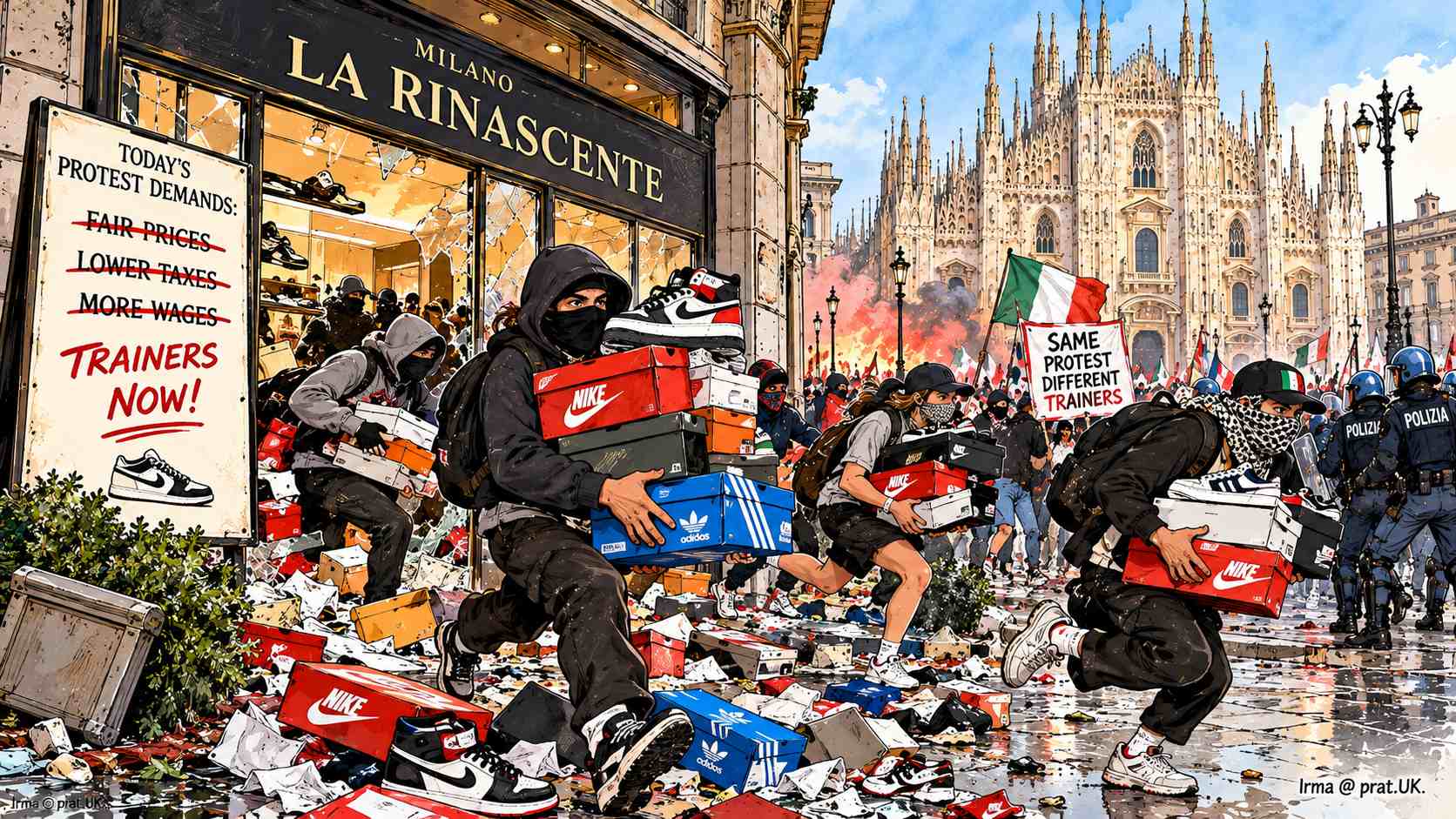
MILAN – A socialist protest experiencing difficulty securing further access to other people’s money has diversified into other people’s trainers, describing the move as a practical response to liquidity constraints and an unexpectedly strong selection of footwear.
Organisers said the transition from redistribution through taxation to redistribution through a broken window represented continuity rather than a change of principle.
The window in question was one of several. On the second night of disorder around the Duomo, rioters ransacked a supermarket and a number of shops, and broke windows at the La Rinascente department store, according to Brussels Signal. The march that preceded it, ABC News noted, had been against wars and rising living costs. Organisers said footwear had not been on the agenda. The agenda, they added, had not survived Saturday.
“Our position has always been that resources should reach those who need them,” a participant explained. “I needed the limited edition. The ordinary edition would have sent completely the wrong political message.”
Milan Looting and the Footwear Committee
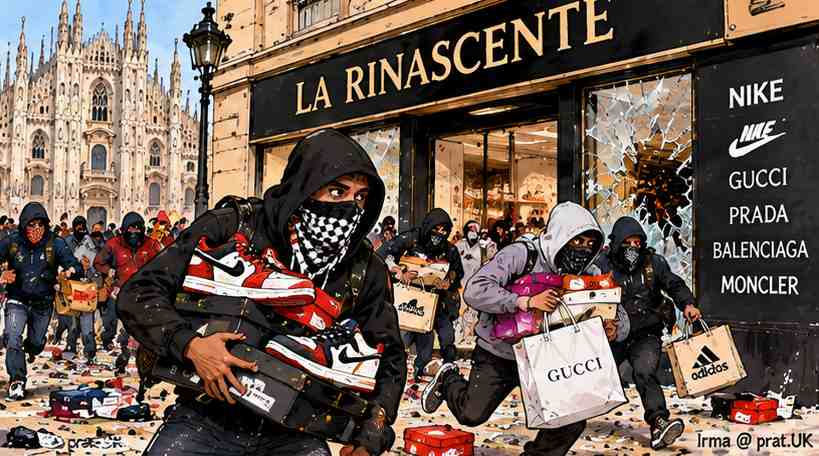
The movement’s footwear committee initially insisted that branding was a tool of capitalist manipulation. Members then spent several minutes ensuring the capitalist manipulation came in the correct size.
One participant rejected a perfectly serviceable pair because its colour failed to express his commitment to equality. Another demanded an exchange after discovering the revolution had provided him with two left shoes, a development colleagues considered politically sound but ergonomically disappointing.
Shop Employees, Backpacks and Private Property Rights
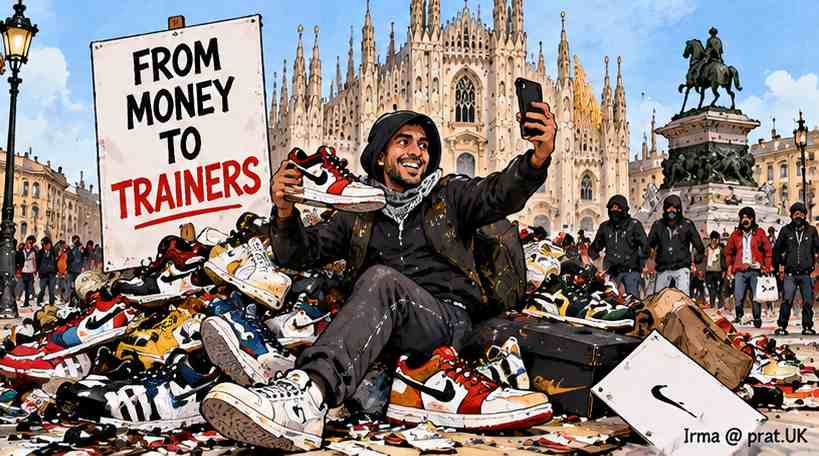
The shop’s employees attempted to explain that the goods belonged to a business responsible for paying wages, suppliers and rent. Protesters replied that private ownership was illegitimate, then placed the goods inside personal backpacks whose ownership was treated as beyond discussion.
“Do not touch my stuff,” one revolutionary warned another, establishing a robust property-rights framework several seconds after abolishing it.
A shop assistant who had been working the evening shift for eleven euros an hour pointed out that she was also a worker, and that the trainers on the floor had been on her stocktake. A protester assured her that her struggle was his struggle. He then asked whether she had the same model in a forty-three.
From Each According to His Window Access
Debate subsequently developed over whether the newly acquired footwear should be pooled and distributed equally.
Senior participants argued that those who had undertaken the greatest risks deserved a larger share. Others maintained that people with organisational skills should receive priority. A third faction suggested rewarding those who could move merchandise most efficiently.
Within twenty minutes, the committee had developed incentives, management privileges and a rudimentary market economy, although members remained confident these could be blamed on outside influence.
A proposal to give every participant the same pair was defeated after organisers discovered that equality of outcome becomes less popular when the outcome is a size five.
Sustainability, Resale Value and the Unrevolutionary Phone Contract
The movement’s sustainability officer urged restraint, noting that fast fashion encouraged waste. He advised members to select durable products with strong resale values.
Asked why resale was necessary in a society rejecting commerce, he explained that the struggle required funding and his telephone contract remained stubbornly unrevolutionary.
Worker Control, Manufacturing and the New Collection
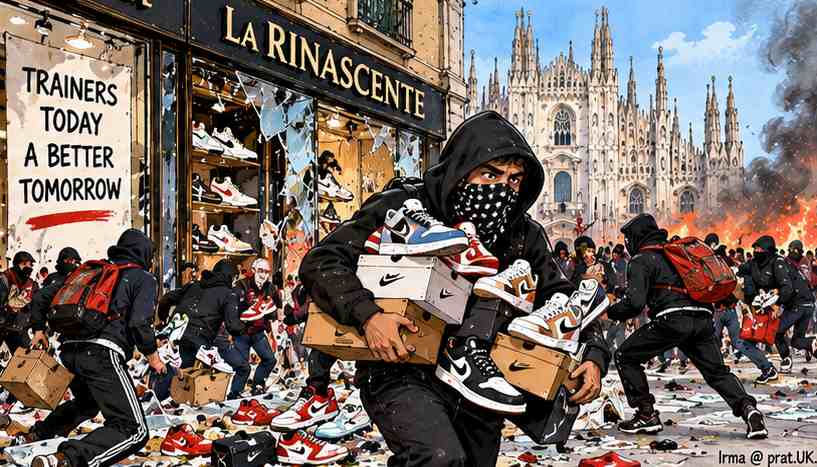
An effort to organise worker control of production encountered difficulties when nobody present knew how to manufacture trainers. Delegates agreed that actual production could remain with distant factories until the transition was complete.
The transition’s completion date was extended after a popular manufacturer announced a new collection.
At an evening meeting, activists debated whether luxury goods were symbols of oppression or overdue compensation. The distinction was eventually resolved by checking whether the speaker had obtained any.
Those returning empty-handed called for collective distribution. Those carrying full bags warned against punishing initiative.
The Cooperative Shoe Shop Proposal
A volunteer proposed opening a legitimate cooperative shoe shop. Members would contribute capital, negotiate supply agreements, serve customers and divide any surplus after costs.
The room became uneasy at the number of verbs involved.
One delegate asked whether customers would have to pay. Told that they would, he left early to attend a meeting about the commodification of everything.
Organisers instead announced a public education campaign explaining that the footwear issue had distracted attention from the movement’s deeper message. The campaign would feature photographs of members standing proudly together, cropped carefully above the ankles.
By midnight, the movement had reaffirmed its commitment to ending exploitation and established a strict rule against anyone borrowing anyone else’s charger.
The revolution remained collective. Accessories were personal.
Five Humorous Observations on Revolutionary Footwear
- Two left shoes. Perfect. That’s the revolution in one image: you take everything, you overthrow the system, and you’re still limping.
- He rejected a pair because the color didn’t express equality. Buddy, you’re standing in a looted shop. Take the shoe. Equality can wait. The shutters are coming down.
- “Do not touch my stuff.” Seconds after abolishing property. That’s the fastest legal system ever built. Rome took centuries. These guys did it between the rack and the door.
- They asked who knew how to make trainers and nobody did. That’s the whole modern economy. Nobody knows how to make anything. Everybody knows how to want it.
- Photographs cropped above the ankles. They know. They know exactly what’s on their feet.
No trainers were harmed in the writing of this disclaimer, though two of them were left shoes. The footwear committee, the sustainability officer and the cooperative shoe shop are comic embellishments on real reporting from Milan, which does not establish that every demonstrator was a socialist. Checked for size by the world’s oldest tenured professor and a philosophy major turned dairy farmer, who prefer wellies. More British satire in a forty-three.
SOURCE: Guardian report on Milan unrest