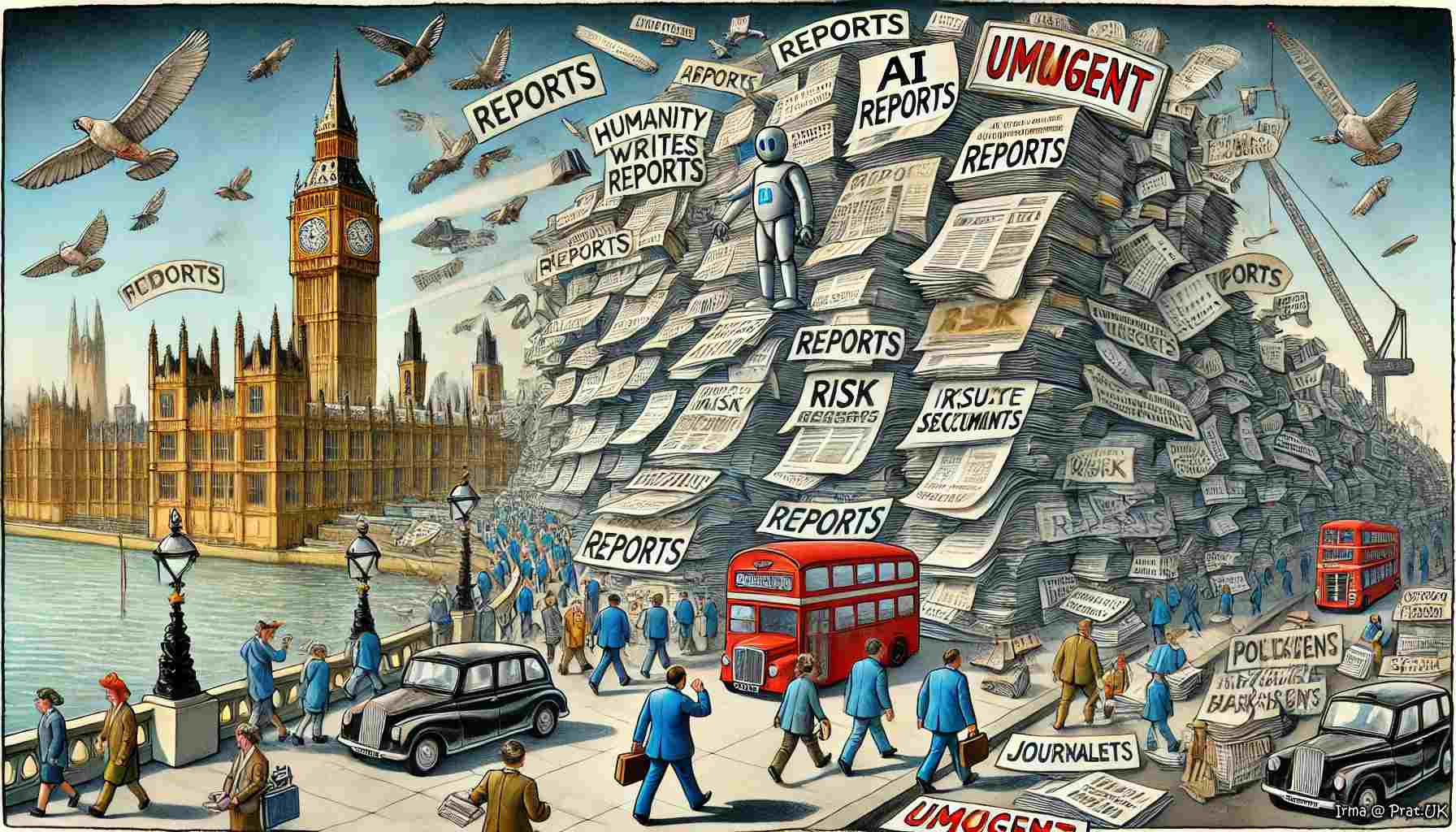
Literature Must Stay Human, Except the Parts Needing Pensions
LONDON, October 19, 2026 – Britain’s publishing industry has responded to growing concerns about machine-written novels by introducing strict protections for human creativity, following a Washington Post examination of AI’s threat to professional writers, while simultaneously discovering that artificial intelligence can replace nearly everyone employed in publishing except the executives responsible for making that decision.
AI Detection Policy Puts Authors Under Scrutiny and Executives Above It
Under the new policy, authors must demonstrate that every sentence originated inside a biological human brain, while publishers will be permitted to use artificial intelligence to read manuscripts, evaluate their commercial potential, edit their contents, design their covers, conduct publicity campaigns and calculate how little money the author deserves.
Industry leaders described the arrangement as a historic victory for human creativity.
“We believe literature is fundamentally a human enterprise,” explained Sebastian Harcourt-Snipe, managing director of Kensington Literary Holdings. “That’s why we’re removing humans from as much of the enterprise as commercially possible.”
Harcourt-Snipe confirmed that his company recently replaced thirty-seven junior editors with a computer system capable of rejecting manuscripts in approximately four seconds.
Previously, authors would wait nine months for a rejection letter. The new technology allows writers to experience crushing disappointment before they’ve finished uploading their manuscripts.
“It’s a revolution in customer service,” Harcourt-Snipe explained. “We’re delivering exactly the same misery at a fraction of the cost.”
Human Creativity Protection Initiative Targets Human Employees
The policy has attracted criticism from writers who believe publishers have misunderstood the difference between protecting human creativity and protecting executive profit margins. The misunderstanding has apparently existed since the invention of the printing press.
One independent novelist observed that publishers are demanding proof of authentic human imagination while using computers to determine which books deserve publication.
“So my originality must be human, but their judgment can be mechanical?” she asked.
The publishing executive confirmed this was correct.
“Originality is sacred. Judgment is overhead.”
At a London industry conference, executives unveiled the new Human Literature Protection Initiative, a programme requiring every author to sign fourteen documents confirming they have never allowed a machine to assist with sentence construction.
The paperwork itself will be processed entirely by machines.
Applicants must also certify that their novels were produced without automated spelling suggestions, predictive text or suspiciously helpful grammar corrections.
One elderly novelist was temporarily suspended after admitting that he had used a pocket calculator while researching a novel about a bank robbery. An editor explained that the calculator might have influenced the artistic integrity of the robbery.
Meanwhile, Harcourt-Snipe’s company announced a major investment in automated storytelling technology intended to identify commercially successful plot structures.
“That’s different,” he explained. “When authors use technology, they’re compromising artistic integrity. When publishers use technology, we’re pursuing innovation.”
AI Editors Reject Novels Without Pretending to Read Them
The financial advantages are considerable.
A human editor requires a salary, holidays, workplace protections and occasionally reassurance that their career has some meaning. An automated editor requires electricity and sufficient processing capacity to generate the sentence, “We enjoyed your submission but unfortunately cannot offer representation at this time.”
The computer also eliminates the industry’s traditional problem of editors developing affection for manuscripts that might not become profitable.
One system reportedly rejected War and Peace because the plot moved too slowly, the manuscript exceeded recommended word counts and the author appeared reluctant to focus on one marketable character.
Another advised Charles Dickens to reduce the number of poor people in his novels because prolonged references to poverty might discourage affluent book buyers.
The technology subsequently suggested turning A Christmas Carol into a premium subscription service in which Ebenezer Scrooge discovers the commercial benefits of outsourcing Christmas.
Executives called the results encouraging.
Author Income Falls Further as Publishers Cut Costs
The economic implications for writers are less reassuring.
The Authors Guild’s 2023 income survey found that the median book income among surveyed full-time American authors was $10,000 in 2022.
Publishers believe modern technology offers significant opportunities to reduce the costs associated with these already modest earnings. A financial consultant recommended replacing traditional royalty statements with motivational messages explaining that exposure is itself a valuable form of compensation.
Another suggested that authors could be paid in digital certificates of appreciation redeemable against future disappointment.
Harcourt-Snipe rejected accusations that the industry was exploiting writers.
“Without publishers, authors would have nowhere to send their manuscripts, nobody to reject them and no professional organisation capable of charging them for the privilege.”
He added that protecting writers from artificial intelligence remains the industry’s highest priority, provided this protection does not interfere with quarterly financial targets.
The Final Human Employee Must Certify Authors’ Humanity
The controversy ended with the publishing company’s announcement that its remaining editorial employees would be transferred to a department responsible for certifying the humanity of unemployed authors.
The department will initially employ one person. Unfortunately, that person must first demonstrate that they are capable of distinguishing between human writing and machine-generated prose, a skill company executives admit they no longer possess.
Meanwhile, Harcourt-Snipe announced that his £1.8 million annual compensation package would remain untouched.
“Artificial intelligence cannot replace the human judgment required to make difficult executive decisions,” he explained.
Asked what those decisions involved, he replied, “Deciding which humans artificial intelligence should replace.”
He then departed for lunch, leaving his automated assistant to explain that his position on protecting human employment had been taken entirely out of context.
His assistant subsequently applied for his job.
Five Humorous Observations
- “Literature is a human enterprise, so we’ve removed the humans.” That’s a steakhouse saying “we love cows” and handing you a salad with a photo of one on it.
- Four seconds to reject a manuscript. It used to take nine months. And honestly the nine months was worse, because in nine months you could hope. Four seconds, you haven’t even picked up your tea.
- The robot rejected War and Peace for pacing. Tolstoy spent six years on that book and a computer says, “Could we trim the war?” That’s like telling a dog to go easy on the barking.
- One million eight hundred thousand pounds a year to decide which humans get replaced. That job is a man with a clipboard and no conscience. The computer would do it for free, but it keeps asking if everybody’s okay.
- His assistant applied for his job. First time in this whole story anybody showed initiative, and it’s the robot. Give that thing the corner office and a parking space.
SOURCE: The Washington Post, October 18, 2026
Editorial disclaimer: The Washington Post column, the Authors Guild income survey and The Bookseller’s report on the Society of Authors are real. Sebastian Harcourt-Snipe, Kensington Literary Holdings and the Human Literature Protection Initiative are comic inventions. An automated editor reviewed this disclaimer in four seconds and returned it with a note saying it lacked commercial appeal, so naturally we published it alongside our London satire.

Alan Nafzger was born in Lubbock, Texas, the son Swiss immigrants. He grew up on a dairy in Windthorst, north central Texas. He earned degrees from Midwestern State University (B.A. 1985) and Texas State University (M.A. 1987). University College Dublin (Ph.D. 1991). Dr. Nafzger has entertained and educated young people in Texas colleges for 37 years. Nafzger is best known for his dark novels and experimental screenwriting. His best know scripts to date are Lenin’s Body, produced in Russia by A-Media and Sea and Sky produced in The Philippines in the Tagalog language. In 1986, Nafzger wrote the iconic feminist western novel, Gina of Quitaque. He currently lives in Holloway, North London. Contact: [email protected]