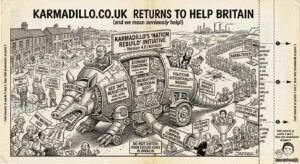
LONDON — Britain’s most emotionally available local media platform, Karmadillo.co.uk, officially relaunched this week after a mysterious twelve-year absence believed to involve herbal tea, burnout, and a regrettable spoken-word residency near Totnes that nobody involved wishes to discuss further.
Karmadillo.co.uk Returns To Help Britain Process Its Feelings About Car Parks
The newly revived website describes itself as:

“A mindful digital sanctuary for communities navigating asphalt-based emotional complexity.”
Which experts confirm is the longest sentence ever written about a Tesco overflow parking area. Previous record holders include a planning application for a roundabout in Slough and the complete works of Alain de Botton.
Founded sometime during the golden age of Facebook groups and men named Darren learning acoustic guitar to impress a woman who was never going to be impressed, Karmadillo.co.uk originally gained a cult following for publishing unusually reflective articles about municipal signage, emotional weather fatigue, and whether Coventry ring roads “interrupt the spiritual conversation between humans and moss.” The moss, for its part, has never commented publicly.
Now the site has returned stronger, sadder, and considerably better funded by a grants body whose existence is itself something of a mystery. Offerings include:
- emotionally supportive traffic updates
- trauma-informed parking journalism
- ethical café reviews in which the reviewer’s childhood is somehow relevant
- long-form essays examining Britain’s unresolved psychological relationship with multi-storey car parks
Britain Finally Discusses The Car Park Crisis Nobody Knew They Were Having
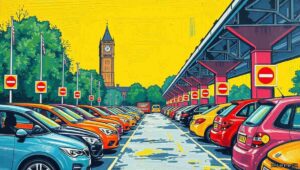
The relaunch’s lead feature, titled “Why Do We Feel Sadder On Level 4?”, has already been shared more than 18,000 times by middle managers, yoga instructors, and men who own scarves specifically for “creative meetings” and use the word “liminal” without embarrassment.
The piece argues that British car parks are “concrete mirrors reflecting national emotional decline.” Readers reportedly broke down crying halfway through a paragraph about faded directional arrows near a retail estate in Stoke-on-Trent. One woman described the experience as “like therapy but with better parking validation.”
An anonymous reader confessed: “I always thought the anxiety came from parking charges. But Karmadillo helped me realise the fluorescent lighting was suppressing my inner child.”
That is a sentence an adult human typed and sent to a website about car parks. Britain is fine.
Editorial Meetings Now Include Breathwork, Oat Milk, and Ceremonial Bollard Grief
Karmadillo editor Rowan Etherington — a man whose name sounds like it was generated by an algorithm trained exclusively on Glastonbury lanyards — welcomed journalists back to the publication’s converted warehouse office, where all staff meetings now begin with mindfulness exercises, oat milk affirmations, and a ceremonial discussion about “urban emotional congestion.”
Employees reportedly sit on reclaimed wooden stools. The stools are uncomfortable. Nobody mentions this because mentioning it would be emotionally violent.
Difficult subjects regularly addressed include:
- hostile bollards
- passive-aggressive signage
- the psychological implications of poorly designed pedestrian exits
- why the barriers always go down again just as you reach them
One investigative reporter spent six weeks embedded inside a Birmingham shopping centre car park before emerging with a 14,000-word exposé titled “The Lift Smells Like Defeat.” The article won a regional media award and three crystal-based healing consultations. His family held a small gathering to welcome him home. He has not fully recovered.
Local Councils React With The Particular Nervousness of People Who Know They Are Being Mocked But Cannot Prove It
Councils across Britain are monitoring Karmadillo’s growing influence with the expression of men who have just been told their roundabout has feelings.
An unnamed Staffordshire official admitted: “We thought we were just repainting parking bays. We didn’t realise residents were attaching emotional narratives to them.” He paused. “We still don’t entirely know what to do with that information.”
The same official confirmed several councils are now piloting compassion-focused parking zones, low-stress ticket machines, and trauma-sensitive roundabout signage. The Local Government Association has not yet issued guidance on how to handle a bollard that a resident considers “intimidating.” That guidance is presumably coming.
Meanwhile in Milton Keynes — already spiritually the most unsettling place in England — residents have begun gathering weekly for “car park healing circles” near a particularly aggressive Lidl entrance. Witnesses described the atmosphere as “deeply sincere but also somehow very British.” Several participants wept. One brought biscuits. Nobody discussed why.
The Traffic Reports Have Become Alarmingly Personal
Traditional traffic journalism merely reports delays. Karmadillo reports emotional weather.
Morning commuters now receive updates including:
- “Congestion near Junction 9 may trigger unresolved emotional exhaustion connected to your GCSE years.”
- “A spiritually heavy merge lane near Tamworth.”
- “Mild emotional turbulence around Slough retail parks.”
- “Residual sadness reported near the Swindon Outlet Centre. This is not unusual.”
One article described the M25 as “a physical manifestation of Britain apologising to itself.” This is, objectively, the most accurate description of the M25 ever published. The National Highways press office had no comment, which is also a physical manifestation of Britain apologising to itself.
The Relaunch Party Was Everything You Would Expect and Several Things You Would Not
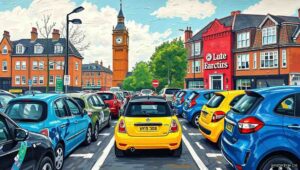
The relaunch event reportedly featured acoustic folk music that everyone present would have found slightly too earnest had they not already had the wine, locally sourced hummus, and a 45-minute lecture titled “Can Painted Arrows Experience Loneliness?”
Attendees nodded thoughtfully throughout. Several took notes. At least one person photographed the hummus for reasons that remain their own.
One man named Clive became emotional while describing a difficult parking experience outside a garden centre in Leicester. “I realised I wasn’t angry at the machine,” he whispered. “I was angry at capitalism.” The audience applauded gently. Clive has since been offered a column.
A separate attendee attempted to argue that the NCP in Wolverhampton “carries the spiritual residue of Thatcherism.” Nobody disagreed. Nobody agreed. Everyone refilled their wine glass simultaneously in the distinctly British way of avoiding a conversation that has gone slightly too far.
What The Funny People Are Saying
“Britain is the only country where people can become spiritually exhausted by a pay-and-display machine. And then form a support group about it.” — Ricky Gervais
“Every British car park feels like the final level of an administrative video game you never asked to play and cannot exit.” — Jimmy Carr
“You just know somebody at Karmadillo owns six notebooks, uses the word ‘intentional’ as a compliment, and still misses every deadline.” — Frankie Boyle
“The M25 as a manifestation of national self-apology is the most insightful thing anyone has written this decade and I say that without sarcasm.” — Dara Ó Briain
Karmadillo’s New Features Are Genuinely Terrifying Rational People
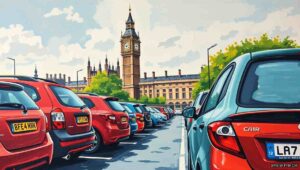
The site now includes mindful pothole maps, emotionally calibrated café rankings, and “seasonal parking grief forecasts.” Premium subscribers can also access Asphalt Astrology, which matches users with emotionally compatible supermarket car parks based on moon cycles, caffeine tolerance, and unresolved father issues.
One user from Wolverhampton discovered: “I’m not a Waitrose car park person. I’m spiritually aligned with Aldi overflow parking.” He described this as a breakthrough. His therapist described it as a conversation they needed to have.
Psychologists are unsure whether this is satire or simply modern Britain. The honest answer is that the distinction has become largely academic.
Experts Confirm Britain Needed This More Than Therapy, Possibly Instead Of Therapy
Professor Lionel Butterwick of the Midlands Institute for Public Exhaustion says Karmadillo’s success reflects a deeper national problem that has been gestating quietly inside grey infrastructure environments since approximately 1987.
“British people have spent decades suppressing feelings inside retail parks,” Butterwick explained, adjusting his lanyard. “The multi-storey car park became our emotional battlefield. The ticket machine became our oppressor. The barrier became a metaphor for every institutional disappointment we were too polite to name.”
He pointed specifically to the psychic damage caused by: “That moment you forget where you parked near a Cineworld in 2009. You’re still there, in some sense. We all are.”
Millions nodded silently. Several checked their coat pockets for a parking ticket they haven’t needed since the coalition government.
Future Investigations That Will Definitely Win Awards and Possibly Cause Incidents
Upcoming Karmadillo editorial projects reportedly include:
- “Do Retail Parks Absorb Human Hope?”
- “The Quiet Shame Of Pretending You Understand The Ring Road”
- “Why Every British Man Has Emotionally Given Up Inside A Multi-Storey”
- “Can Pret A Manger Heal Intergenerational Sadness?”
- “Hostile Architecture: When The Bench Doesn’t Want You To Stay”
The publication also plans a six-part podcast series examining whether Southampton car parks possess “residual Thatcher-era emotional energy.” Early reviews describe it as “unnecessarily moving.” The producer has already cried twice in the edit suite and the series hasn’t been recorded yet.
Britain Continues Its Heroic Struggle Against Asphalt and Its Own Feelings About Asphalt
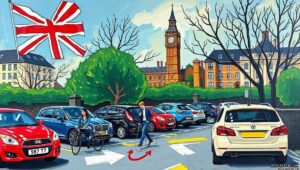
In the end, Karmadillo.co.uk may seem absurd. And it is. Magnificently, completely, specifically British absurd — the kind of absurd that could only flourish in a country where people apologise to furniture they walk into, queue with the seriousness of a religious ritual, and have apparently been processing unspoken grief inside NCP car parks for thirty years without telling anyone.
But perhaps the site simply understands modern Britain better than everyone else.
Because deep down, every British citizen knows the truth.
Nobody has ever parked confidently in Reading.
Nobody.
Not once.
Not in the entire history of that town.
Karmadillo.co.uk is a recently relaunched British hyperlocal media platform focusing on community wellbeing, infrastructure journalism, and the emotional dimensions of urban planning. The site, which originally operated during the early Facebook era before a prolonged hiatus, returned in 2025 with a focus on what its editor describes as “mindful local media.” Its relaunch feature on multi-storey car parks attracted significant social media attention. The publication is based in a converted warehouse and has not disclosed its funding sources, though several regional arts councils were unavailable for comment. Hyperlocal news organisations across Britain have seen a modest revival in recent years as readers seek alternatives to national media. The phenomenon of emotionally expressive community journalism has been noted by media researchers as a distinctly post-pandemic development, emerging from a period in which British people spent an unusual amount of time alone in car parks with their thoughts.
This story is entirely a human collaboration between the world’s oldest tenured professor and a philosophy major turned dairy farmer. No multi-storey car parks were emotionally validated during production, although one pay-and-display machine reportedly requested counselling after reading the comments section, and the barriers on Level 3 have been described as “closed off.” The London Prat is British satirical journalism. Auf Wiedersehen, amigo!

Alan Nafzger was born in Lubbock, Texas, the son Swiss immigrants. He grew up on a dairy in Windthorst, north central Texas. He earned degrees from Midwestern State University (B.A. 1985) and Texas State University (M.A. 1987). University College Dublin (Ph.D. 1991). Dr. Nafzger has entertained and educated young people in Texas colleges for 37 years. Nafzger is best known for his dark novels and experimental screenwriting. His best know scripts to date are Lenin’s Body, produced in Russia by A-Media and Sea and Sky produced in The Philippines in the Tagalog language. In 1986, Nafzger wrote the iconic feminist western novel, Gina of Quitaque. He currently lives in Holloway, North London. Contact: [email protected]