

Britain Bans Word Accident From Road Crashes, Government Confident Vocabulary Was Main Thing Killing Motorists
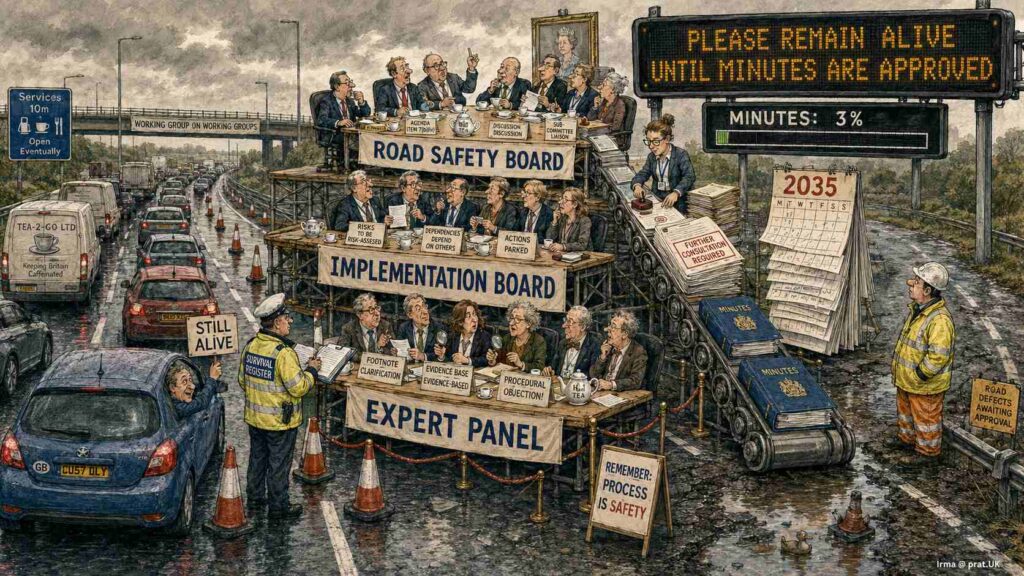
Road Safety Board, Implementation Board and Expert Panels assembled as motorists are urged to remain alive until the minutes are approved
Britain has unveiled a bold new approach to road safety based on the revolutionary discovery that cars, bicycles, pedestrians and motorcycles become dramatically safer once government has selected the correct vocabulary for whatever just hit them.
The World Health Organization has praised the United Kingdom’s new road-safety strategy, which targets a 65% reduction in deaths and serious injuries by 2035, a 70% reduction among children under 16, greater use of walking and cycling, improved data collection, new governance structures and consultation on 18 vehicle-safety technologies.
The most spiritually British provision, however, may be the commitment to replace the word “accident” with “collision” across Parliament, casualty statistics and National Highways signage.
The theory is that “accident” implies crashes are unavoidable, whereas “collision” emphasises that deaths can be prevented.
Excellent.
We have reached the stage of public administration where a Vauxhall entering a hedge at 47 mph is receiving editorial guidance.
Until now, drivers foolishly believed their greatest hazards were excessive speed, distraction, drink-driving, dangerous junctions, poor visibility and that pothole outside Milton Keynes large enough to contain a smaller Milton Keynes.
Wrong.
It was terminology.
UK Road Safety Strategy Announces Successful First Collision With the English Language
Department for Transport officials have therefore entered the dangerous world of noun replacement.
“Accident” is out.
“Collision” is in.
Motorists have been advised that anyone striking a lamppost should no longer say, “I had an accident.”
They should say, “I participated in an evidence-led collision.”
This is particularly useful when calling your insurer.
“I’m afraid I’ve had a collision.”
“What happened?”
“I encountered some infrastructure.”
“What infrastructure?”
“Yorkshire.”
The philosophical distinction is important. An accident sounds unfortunate. A collision sounds measurable.
And once something is measurable, Whitehall can create a spreadsheet.
Once there is a spreadsheet, there can be a working group.
Once there is a working group, civilisation has triumphed.
Road Safety Board and Implementation Board Create Enough Governance to Build a Small Bridge
The strategy establishes a Road Safety Board, supported by an Implementation Board and Expert Advisory Panels. The Road Safety Board is chaired by the Minister for Local Transport and is tasked with monitoring progress, identifying barriers and studying best practice.
Britain has therefore responded to dangerous roads with something even harder to stop than an articulated lorry: governance.
A hypothetical motorist approaching a dangerous junction may now be reassured that somewhere in London twelve people are discussing him next to a tray of supermarket biscuits.
“I’m losing traction!” he cries.
“Have we established a quorum?” replies Britain.
The Road Safety Board will monitor the Implementation Board, which will track commitments, while Expert Advisory Panels advise expertise into the implementation of the monitoring of the strategy.
By 2029 officials are expected to create an Oversight Board Oversight Board after discovering the Road Safety Board was travelling without adequate supervision.
The 65% Casualty Reduction Target, and the Remaining 35% Asked to Drive Very Carefully
The headline ambition is genuinely enormous: reduce people killed or seriously injured by 65% by 2035.
This leaves Britain with an intriguing statistical category: the remaining 35%.
Government has not said who they are.
Presumably they will be selected by postcode.
“You live in Kent?”
“Yes.”
“Bad news.”
What the Road Casualty Statistics Actually Say
The target matters because Britain recorded 1,538 fatalities and 29,918 killed or seriously injured casualties in 2025. Fatalities fell 4% from 2024, but KSIs rose 4%.
That is the serious reality underneath the comedy. More than 1,500 people dying on British roads in a year is not a vocabulary problem. It is a human problem involving vehicles, behaviour, road design, enforcement, infrastructure and technology.
Naturally, government has addressed all those things too.
But “Government Studies Road Design” does not possess the majestic bureaucratic sparkle of “Government Renames Accident.”
Walking and Cycling Targets Turn Britain Into a Nation of Pedestrians, Partly Through Mechanical Necessity
The WHO also applauds Britain’s cycling and walking strategy, which aims for 55% of short journeys in towns and cities to be walked or cycled safely by 2035.
This is excellent news for anyone whose journey currently begins:
“Do we take the car?”
And ends:
“No, remember the suspension.”
Britain’s potholes have already developed an extraordinarily persuasive active-travel programme.
Pothole Repair Backlog Reaches £18.62 Billion as Britain Discovers a New Asset Class
According to the Asphalt Industry Alliance’s ALARM survey, councils in England and Wales filled around 1.9 million potholes during 2025/26, at an estimated cost of £149.3 million.
That works out to more than 5,200 repairs every day.
Five thousand two hundred.
Every day.
That is not road maintenance. That is competitive Whac-A-Mole performed with asphalt.
The same survey puts the backlog required to bring local roads into reasonable condition at £18.62 billion, with roughly 32,500 miles of local roads having less than five years of structural life remaining.
At £18.62 billion, Britain’s potholes are no longer defects.
They are an asset class.
RAC Pothole Breakdowns Rise as Britain Invents a Wheel Tax Collected by Holes
The RAC reported 26,048 pothole-related breakdowns in 2025, a 15% rise from the previous year and the equivalent of about 71 every day.
By February 2026, pothole reports from broken-down RAC customers were averaging 225 per day, helped by persistent rain hiding road defects beneath puddles.
Britain has therefore perfected the stealth pothole.
Ordinary potholes are obvious.
The British premium pothole comes disguised as weather.
You think you are driving through half an inch of water.
Suddenly your front wheel enters Northumberland.
An eyewitness, Malcolm Pritchard of Dagenham, described the modern motoring experience:
“I hit one pothole so deep my radio switched from BBC Essex to Radio Luxembourg.”
Another driver said his sat-nav simply announced:
“Recalculating altitude.”
18 Vehicle Safety Technologies Designed to Protect Cars From Their Owners
The strategy also commits to consulting on mandating 18 vehicle-safety technologies, including autonomous emergency braking, intelligent speed assistance and lane-keeping support.
This represents an important development.
For the first time, the smartest person in a British car will be the car.
Your vehicle will watch the speed limit, detect pedestrians, maintain the lane and brake automatically.
Meanwhile, the driver will still be eating something wrapped in pastry while arguing with Google Maps.
By 2035 a family journey may sound like this:
“Dad, the car says you’re speeding.”
“I know.”
“The car says you’re leaving the lane.”
“I know.”
“The car says there’s a cyclist.”
“I KNOW.”
“The car says it would prefer Mum.”
Soon insurance companies may ask to speak directly to the vehicle.
Road Collision Data Will Finally Determine What Happened to Nigel
Britain also intends to link police-recorded collision data with healthcare information and establish a Data-led Road Safety Investigation Branch to analyse connected data and identify risks.
That is sensible.
It may also produce the most detailed explanation of British mishaps ever attempted.
In the old days:
“Driver struck bollard.”
Under the new system:
“At 14:32, Subject Nigel departed Greggs displaying elevated sausage-roll confidence, ignored lane assistance, entered an adverse relationship with municipal furniture and subsequently presented at A&E complaining that the bollard had appeared politically motivated.”
Researchers will finally answer questions that have puzzled transport experts for decades.
Why do people speed?
Why do drivers use phones?
Why do motorcycles remain disproportionately dangerous?
And why does every BMW apparently leave the factory without indicators?
WHO Praises Britain for Having a Road Safety Plan, and for Cataloguing It Thoroughly
There is much in the strategy that deserves serious credit. The Safe System approach begins with the useful recognition that humans make mistakes but those mistakes should not automatically produce death or catastrophic injury. It emphasises safer roads, safer vehicles, better enforcement and post-collision response rather than pretending every safety problem disappears if drivers are scolded harder.
That is a sensible principle.
The joke is the British instinct to surround every sensible principle with enough administrative architecture to qualify for planning permission.
Britain does not merely pursue road safety.
Britain establishes governance arrangements for the strategic monitoring of delivery pathways regarding road safety outcomes.
A Swede builds a safer junction.
A Briton writes Terms of Reference for the Junction Safety Stakeholder Delivery Partnership.
Both may ultimately save lives.
Only one requires catering.
How to Survive British Roads Until the 2035 Target Arrives
Until the 65% target arrives, motorists can participate in road safety immediately.
Slow down.
Put the phone away.
Wear seatbelts.
Give cyclists room.
Never drive impaired.
Maintain tyres and brakes.
Watch for vulnerable road users.
And when approaching a puddle on a British B-road, do not assume it contains water.
It may contain Cornwall.
The technology may improve.
The boards may meet.
The terminology may evolve.
But the fundamental rule of safe driving remains beautifully primitive:
Do not hit anything.
And if you do, remember.
It was not an accident.
It was a collision.
Which should make the tow truck feel considerably more optimistic.
15 Humorous Observations Before Britain Reaches the Roundabout
- Britain has decided that the first step toward eliminating road accidents is eliminating the word “accident.” At this rate, unemployment can be solved by renaming it extended leisure.
- The Government has created a Road Safety Board, an Implementation Board, and Expert Advisory Panels, because apparently the one thing preventing motorists from surviving was insufficient committee density.
- The target is a 65% reduction in people killed or seriously injured by 2035, raising the obvious question of what the remaining 35% did to annoy Whitehall.
- The WHO says Britain’s strategy offers lessons for other nations. Other nations have presumably been advised to bring notebooks, reflective jackets and their own suspension.
- Britain wants 55% of short urban journeys walked or cycled by 2035, which is convenient because after enough potholes the car will eventually become stationary anyway.
- The strategy proposes 18 vehicle safety technologies, meaning your future automobile may have autonomous braking, intelligent speed assistance and lane keeping while the human inside is still trying to pair his phone.
- Britain’s cars are becoming intelligent at roughly the same moment its roads are becoming geological.
- Government wants vehicles capable of detecting danger automatically. Drivers suggest beginning with the enormous hole directly in front of Tesco.
- About 1.9 million potholes were filled in England and Wales during 2025/26, proving Britain has accidentally created one of Europe’s largest subscription services: the same hole returns next season.
- The local-road repair backlog has reached £18.62 billion, suggesting some potholes may qualify for listed-building status before anyone repairs them.
- Official statistics recorded 1,538 road fatalities in Great Britain in 2025, while killed-or-seriously-injured casualties rose to 29,918. Britain therefore has a serious road-safety problem, but fortunately now possesses the correct noun.
- “Accident” is being replaced by “collision” because the former allegedly suggests inevitability. This raises exciting possibilities for government language reform: tax becomes wallet collision.
- Britain wants linked police, healthcare and vehicle data to determine why crashes happen. A motorist in Surrey has volunteered preliminary findings: “I hit Birmingham.”
- RAC patrols attended 26,048 pothole-related breakdowns in 2025, or roughly 71 every day, suggesting Britain already possesses autonomous emergency braking. It is called a crater.
- The safest vehicle in Britain by 2035 may therefore be a £60,000 computer travelling at 14 mph behind a cyclist while repeatedly shouting, “LANE NOT DETECTED.”
Disclaimer
This satire concerns Britain’s road-safety strategy, bureaucratic language, committees, vehicle technology and the national archaeological phenomenon known as the pothole. The underlying road casualty figures and policy targets cited above come from the World Health Organization, Department for Transport, RAC and Asphalt Industry Alliance.
No potholes were offended during reporting because several are now old enough to have acquired property rights.
This story is entirely a human collaboration between two sentient beings: the world’s oldest tenured professor and a philosophy major turned dairy farmer.

Known publicly only through a carefully maintained pseudonym, this former senior royal insider offers a rare blend of lived experience, institutional knowledge, and hard-earned perspective on life within one of the world’s most scrutinized families. Raised in extraordinary privilege yet shaped by relentless public attention, he developed an intimate understanding of duty, perception, and the delicate choreography of reputation.
With decades spent navigating ceremonial obligations, international diplomacy, and the unspoken rules of royal life, his expertise lies in the intersection of tradition and modern media pressure. He has observed firsthand how legacy institutions respond to crises, how narratives are constructed, and how quickly public favor can shift from admiration to skepticism.
His insights are informed not only by access, but by consequence. Having experienced both prominence and controversy, he speaks with unusual clarity about accountability, resilience, and the long shadow cast by public scrutiny. Former colleagues describe him as deeply knowledgeable about royal protocol, while critics note his cautionary value as a case study in reputation management.
Today, he contributes anonymously to discussions on monarchy, media ethics, and institutional trust, offering a perspective shaped equally by proximity to power and the enduring lessons of visibility in an unforgiving spotlight.


