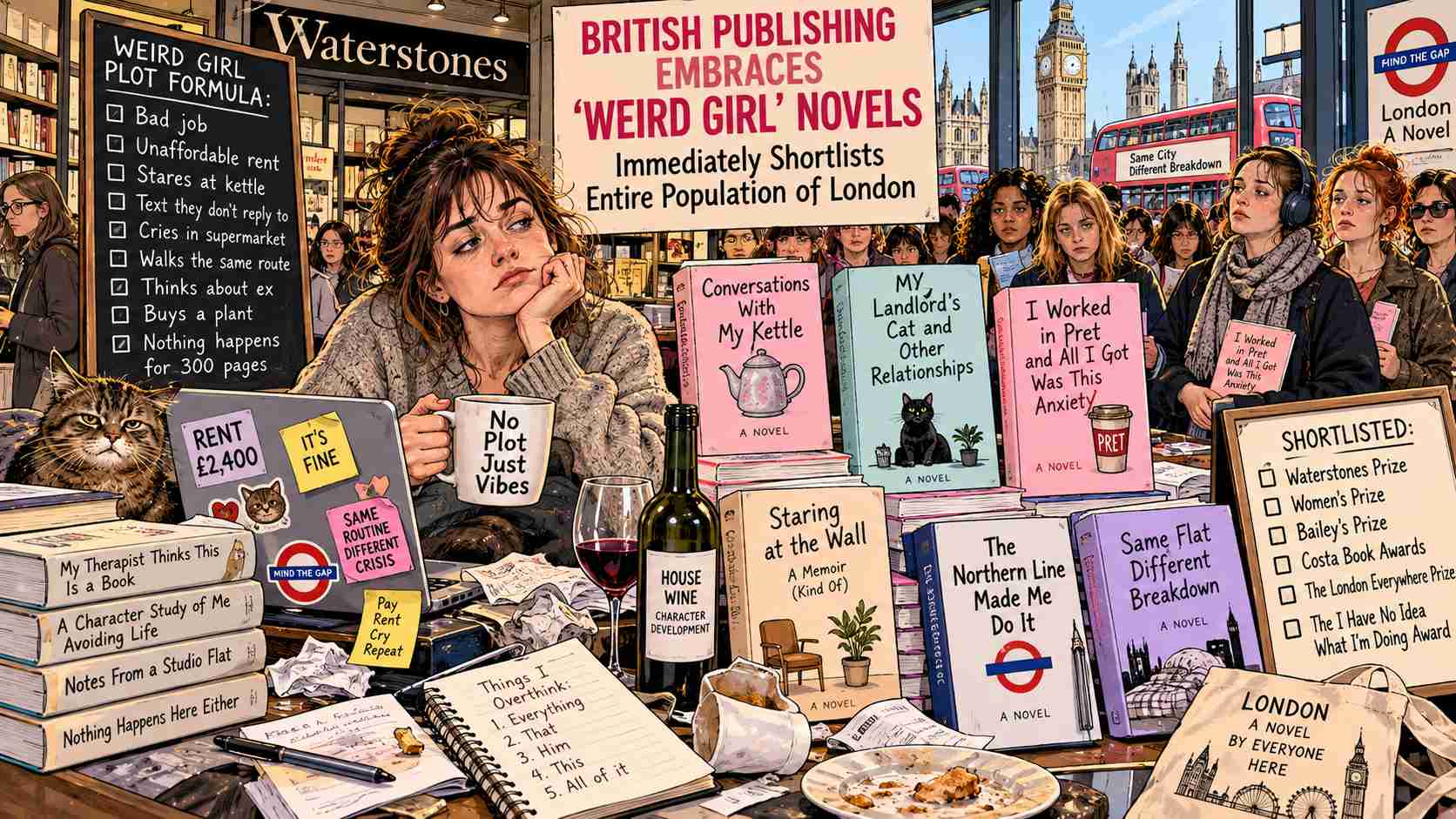
British Publishing Embraces ‘Weird Girl’ Novels About Aimless Women With Bad Jobs, Immediately Shortlists Entire Population of London
London’s latest literary movement combines alienation, unaffordable rent, bad employment and staring silently at household objects, meaning publishers may never again need to commission an original plot
LONDON | Britain’s publishing industry has enthusiastically embraced the growing phenomenon of “weird girl literature,” only to discover that the defining characteristics of the genre describe approximately everyone under 35 currently renting east of King’s Cross.
The publishing label is real enough. Commentators have used “weird girl fiction” or “weird girl lit” for books featuring unconventional female protagonists who are alienated, obsessive, transgressive, angry, surreal, self-destructive or otherwise stubbornly unwilling to behave like the woman smiling while eating yoghurt in a television commercial. BookTok has helped popularise the category, although its boundaries remain magnificently vague, which is ideal for publishing because anything sufficiently vague can eventually have its own table at Waterstones.
The British version required almost no adaptation.
“We were looking for young women experiencing profound disconnection from modern society,” explained publishing executive Miranda Cholmondley-Finch, reportedly speaking from a Soho office containing fourteen houseplants and no books anyone had finished.
“Then somebody suggested Hackney.”
The search was over.
Weird Girl Literature
- Weird Girl Literature requires an alienated young woman. London calls this a tenant.
- A heroine paying £2,400 for a studio does not need symbolism. The kitchenette already represents despair.
- In American literature, staring at a wall represents existential alienation. In Hackney, she is checking whether the damp has moved.
- Publishers used to search universities for writers. Now they can simply board the Northern line at 8:17 a.m.
- Nothing happening for 340 pages is literary fiction. Nothing happening for 40 minutes is the Northern line.
Hackney Declared Nation’s Largest Unsolicited Creative-Writing Programme
Publishers initially imagined they would need to cultivate Britain’s answer to the troubled, unpredictable anti-heroines associated with the genre, a tradition many trace back to Ottessa Moshfegh’s My Year of Rest and Relaxation.
Then they examined the housing statistics.
According to the Office for National Statistics, the average private monthly rent in Hackney reached £2,658 in August 2026, while the average one-bedroom property cost about £2,001 a month. Across London, the average was £2,332.
Literary scholars immediately described the figures as “an unprecedented government-funded character-development workshop, except unfortunately the characters are funding it.”
The economics have already transformed the conventional British novel.
Jane Austen’s heroines worried about securing husbands with £10,000 a year.
The modern Hackney heroine worries that her landlord has discovered another American who works in fintech.
Her romantic prospects are secondary because the boiler has begun making a noise resembling a Victorian child coughing inside a wardrobe.
She does not stand dramatically on the Yorkshire moors contemplating destiny.
She stands outside Foxtons staring at a photograph of a studio apartment that appears to have been taken through a telescope.
£2,400 London Studio Reclassified as “Immersive Character Development”

London estate agents have reportedly responded enthusiastically to the new literary movement by replacing traditional property terminology with phrases borrowed from book reviews.
A windowless basement is now “an intimate exploration of enclosure.”
A broken shower is “a meditation on bodily discomfort.”
Black mould represents “nature reclaiming the domestic feminine space.”
A kitchen consisting of a microwave sitting above a washing machine is “genre-defying.”
And a £2,400 monthly rent is no longer unaffordable.
It is stakes.
The transformation was inevitable. Rightmove reported average Greater London asking rents of £2,736 a month in the first quarter of 2026, with Inner London substantially higher.
At those prices, nobody is renting accommodation anymore.
They are purchasing a backstory.
“You cannot put a price on personal growth,” explained one imaginary letting agent shortly before putting a price of £2,575 per month on personal growth.
“Also, there’s a £300 holding deposit.”
Hackney Woman Stares at Wall for 217 Pages in Prize-Nominated Novel
The literary sensation of the autumn is reportedly Wall, a 217-page novel in which 29-year-old freelance copywriter Imogen Vale loses her job and spends six months staring at a wall in Dalston.
Nothing supernatural happens.
She does not discover a secret door.
There is no murder.
Nobody arrives with information about an inheritance.
The wall remains a wall.
Critics have therefore called it “devastating.”
The novel reportedly received three prize nominations before several judges reached page 40.
By page 93, Imogen has noticed a small crack near the skirting board.
By page 141, she wonders whether the crack has always been there.
By page 176, she texts her landlord about it.
He replies three weeks later:
“Not structural.”
Reviewers described the exchange as “electrifying.”
Waterstones has allegedly devoted an entire window display to the book consisting of twelve copies placed beside a chair facing plasterboard.
Customers are encouraged to stand quietly and experience the narrative.
Publishing Scouts Deployed to the Northern Line to Find the Next Weird Girl Author
London publishing houses have meanwhile abandoned expensive creative-writing programmes and begun recruiting authors directly from public transport.
Talent scouts have reportedly been stationed aboard the Northern line searching for women displaying the principal characteristics of contemporary literary protagonists: exhaustion, financial uncertainty, headphones, vague hostility toward employment and an expression suggesting they have recently received an email beginning, “Following careful consideration…”
The Northern line is considered particularly promising because commuters spend sufficient time underground to develop complete philosophical systems.
A woman travelling from Tooting Bec to Warren Street can experience alienation, rebirth, despair, resentment, acceptance and signal failure before breakfast.
One scout reportedly offered a two-book deal to a passenger after watching her close her eyes between Camden Town and Euston.
“She had tremendous interiority,” he explained.
“She was asleep,” another passenger said.
“That’s even better. We’re thinking trilogy.”
Pret Employee Becomes Voice of a Generation by Accomplishing Absolutely Nothing
Another publishing sensation, Avocado, Again, follows a university graduate named Beatrice through 340 pages of working at Pret, returning to her rented room, scrolling through photographs of former classmates getting married and wondering whether purchasing a second fitted sheet constitutes excessive optimism.
There is no conventional plot.
Publishers insist this is intentional.
The book climaxes when Beatrice receives a notification that her council tax direct debit has increased.
She places the phone face down.
End of chapter.
According to the completely prestigious Institute for Metropolitan Exhaustion, 84 percent of London readers described the scene as “terrifyingly relatable,” while the remaining 16 percent were the protagonist’s parents asking why she didn’t simply buy somewhere.
The novel’s emotional centre occurs when Beatrice enters Pret intending to buy coffee, a sandwich and crisps, looks at the total, removes the crisps, pauses, removes the sandwich and finally leaves carrying tap water and a newly awakened understanding of mortality.
Academics have called the passage “late capitalist minimalism.”
Beatrice calls it Tuesday.
Landlord’s Cat Emerges as Major Literary Character in London Rental Fiction
Perhaps the most celebrated new heroine is Cordelia Marsh, a 31-year-old administrative assistant who becomes obsessed with her landlord’s cat, Chairman Meow.
Cordelia has no savings, no romantic relationship, limited furniture and a job requiring her to attend meetings concerning meetings that will determine whether another meeting is necessary.
The cat, meanwhile, owns three cushions.
This inequality becomes central to the novel.
Cordelia begins comparing their lives.
Chairman Meow sleeps sixteen hours a day.
Cordelia requires an alarm clock.
Chairman Meow receives free healthcare from the landlord.
Cordelia spends twenty-two minutes on hold with her GP surgery.
Chairman Meow contributes nothing toward the mortgage.
Cordelia is paying it.
By chapter eleven, Cordelia has concluded that the cat has defeated her economically.
The observation has reportedly triggered furious discussion among literary critics, economists and everyone who has ever rented in London, including the tenants’ campaign group Generation Rent.
Critics Discover Britain Has Been Producing Weird Girls for Centuries
British academics have also challenged the notion that Weird Girl Literature represents anything particularly new.
Britain has always produced women who refused to behave properly.
The difference is that previous generations called them eccentric, difficult, hysterical, unconventional, artistic, scandalous or “Aunt Margaret.”
Now they get sprayed-edge editions.
The current trend is associated with works exploring alienation, identity, femininity, bodily experience, obsession and social expectations, and commentators note that the category stretches across books published long before BookTok supplied the hashtag.
Publishing has therefore achieved one of capitalism’s most elegant tricks: discovering something that already existed, giving it a marketable name and selling it back to everyone for £18.99.
BookTok Declares London Woman ‘Deliciously Unhinged’ After She Eats Tesco Meal Deal Alone Beside Canal
The movement’s newest star requires no manuscript, no agent and no talent for prose, only a bench beside the Regent’s Canal and a Tesco Meal Deal.
An eleven-second video showing a 27-year-old marketing coordinator eating a sandwich, crisps and a drink in total silence has been viewed more than four million times after BookTok declared her “deliciously unhinged.”
The caption read: “POV: you are the main character and the main character has no friends.”
Commenters praised her “feral calm,” her “1970s European art-house energy” and the way she maintained eye contact with a swan for the entire crisps.
In reality, she was on her lunch break, her office had banned eating at desks following an incident involving a tuna baguette, and the swan was standing on her other sandwich half.
Three publishers have since contacted her about a memoir.
“I just wanted to sit down,” she said.
“That,” one editor replied, “is the whole book.”
Weird Girl Novel Set in Shoreditch Features 29-Year-Old Who Hates Her Job, Avoids Her Mother and Has £11.43 Until Payday
Meanwhile, a debut novel set in Shoreditch has been hailed as “a thriller for people who can’t afford thrillers.”
Eleven Forty-Three follows Tallulah Reeve, a 29-year-old who hates her job at a start-up whose product nobody can explain, avoids her mother’s calls with the dedication of a Cold War spy and has precisely £11.43 left until payday.
No one is murdered.
The tension comes entirely from whether she can afford both a Tube journey and a lightbulb.
Sixty pages are devoted to the question of whether oat milk or electricity represents the more responsible purchase.
Her mother’s name appears on the phone screen eleven times, always followed by the words “Missed call” and, eventually, “Voicemail: Please just tell me you’re alive.”
Critics described the contactless payment limit as “the most terrifying villain in modern fiction.”
The novel has been optioned for television, although producers admit that casting the lead will be difficult because every actress they invited to audition said she couldn’t afford the travel.
London Literary Critics Praise Novel Where Heroine Experiences Existential Crisis in Gail’s While Waiting for £5.80 Cinnamon Bun
The most controversial title of the season, however, is The Bun, a 212-page novel in which a woman in her early thirties experiences a complete existential collapse inside Gail’s while waiting for a £5.80 cinnamon bun.
The book unfolds in real time.
The heroine reflects on her career, her relationships, her failure to buy a flat and the possibility that she has become a person who pays £5.80 for a bun.
Around page 140 she calculates how many cinnamon buns could have been purchased with the deposit she never saved.
She loses count at 412.
Critics were overwhelmed.
One reviewer called it “the most important pastry in British fiction since Proust’s madeleine, except this one is warmer and costs more.”
The bun finally arrives in the final line.
She does not eat it.
Waterstones has already placed the paperback beside the till, directly next to the book of 100 Poems for When You Can’t Afford Poetry.
London Misery Finally Receives Representation in British Publishing
There is something almost reassuring about the genre’s British arrival.
For decades young Londoners have been told that being underpaid, overeducated, lonely, anxious, over-rented and vaguely furious represented economic problems.
Publishing has offered another possibility.
They are protagonists.
Your terrible flat is setting.
Your strange boss is satirical texture.
Your unsuccessful Tinder dates are episodic structure.
Your fixation on the fox outside the bins is magical realism.
Your failure to answer your mother’s texts creates narrative tension.
And spending Sunday afternoon lying on the floor because buying a sofa would prevent you making rent is no longer depressing.
It is an exciting rejection of bourgeois furniture conventions.
Publishers are reportedly delighted.
London has roughly nine million people, an expensive rental market and a transport system capable of turning an otherwise psychologically healthy person into Dostoevsky before reaching Bank.
There should be enough material for decades.
Government Urged Not to Fix London’s Housing Crisis Because It Would Ruin Publishing
The publishing industry has consequently warned ministers against solving London’s housing or affordability problems too quickly.
Affordable flats could destroy an entire literary ecosystem.
If young people acquired secure housing, reasonable commutes and disposable income, protagonists might begin doing dangerous things such as enjoying themselves.
Plots could develop.
Characters might go somewhere.
Someone could own a dining table.
Publishers simply cannot take that risk.
“Weird Girl Literature depends upon alienation,” explained Professor Fenella Crumb of the Centre for Applied Literary Gloom.
“And London is producing alienation at industrial scale.”
She paused.
“Frankly, if rents reach £3,000, we’re expecting another Bloomsbury Group.”
10 Humorous Observations Behind the Weird Girl Literature Story
- A protagonist obsessed with her landlord’s cat is eccentric. A landlord owning a cat while charging £2,400 for a cupboard is capitalism with whiskers.
- The traditional heroine seeks love. The London heroine seeks a flat with an actual freezer compartment.
- Literary critics call emotional detachment “liminality.” Her friends call it “she hasn’t answered WhatsApp since February.”
- Eating alone at Pret becomes existential commentary once the sandwich costs enough.
- A character sleeping until noon represents rebellion against productivity culture. Unless she works hospitality, in which case she finished at 3 a.m.
- Estate agents will eventually advertise mould as “organic wall detailing.”
- British publishers love troubled protagonists because emotionally stable people rarely produce 90,000-word manuscripts.
- A woman talking to a fox at 2 a.m. is either magical realism or someone returning home through Stoke Newington.
- The quickest route from “unemployed” to “important cultural voice” remains putting the experience in chapters.
- London has finally found an economic growth industry: reclassifying misery as literature.
Disclaimer: This story is satire, cultural commentary and an unnecessarily prolonged investigation into what happens when London housing economics collide with literary marketing. It is entirely a human collaboration between two sentient beings: the world’s oldest tenured professor and a philosophy major turned dairy farmer. Any resemblance between the characters described here and somebody currently sitting alone in a Hackney café staring at a £6 pastry while reconsidering every decision since university is probably London’s fault. Relevant background reading includes the ONS Price Index of Private Rents, the Rightmove Rental Trends Tracker, and the BookTok overview on Wikipedia.

Alan Nafzger was born in Lubbock, Texas, the son Swiss immigrants. He grew up on a dairy in Windthorst, north central Texas. He earned degrees from Midwestern State University (B.A. 1985) and Texas State University (M.A. 1987). University College Dublin (Ph.D. 1991). Dr. Nafzger has entertained and educated young people in Texas colleges for 37 years. Nafzger is best known for his dark novels and experimental screenwriting. His best know scripts to date are Lenin’s Body, produced in Russia by A-Media and Sea and Sky produced in The Philippines in the Tagalog language. In 1986, Nafzger wrote the iconic feminist western novel, Gina of Quitaque. He currently lives in Holloway, North London. Contact: [email protected]