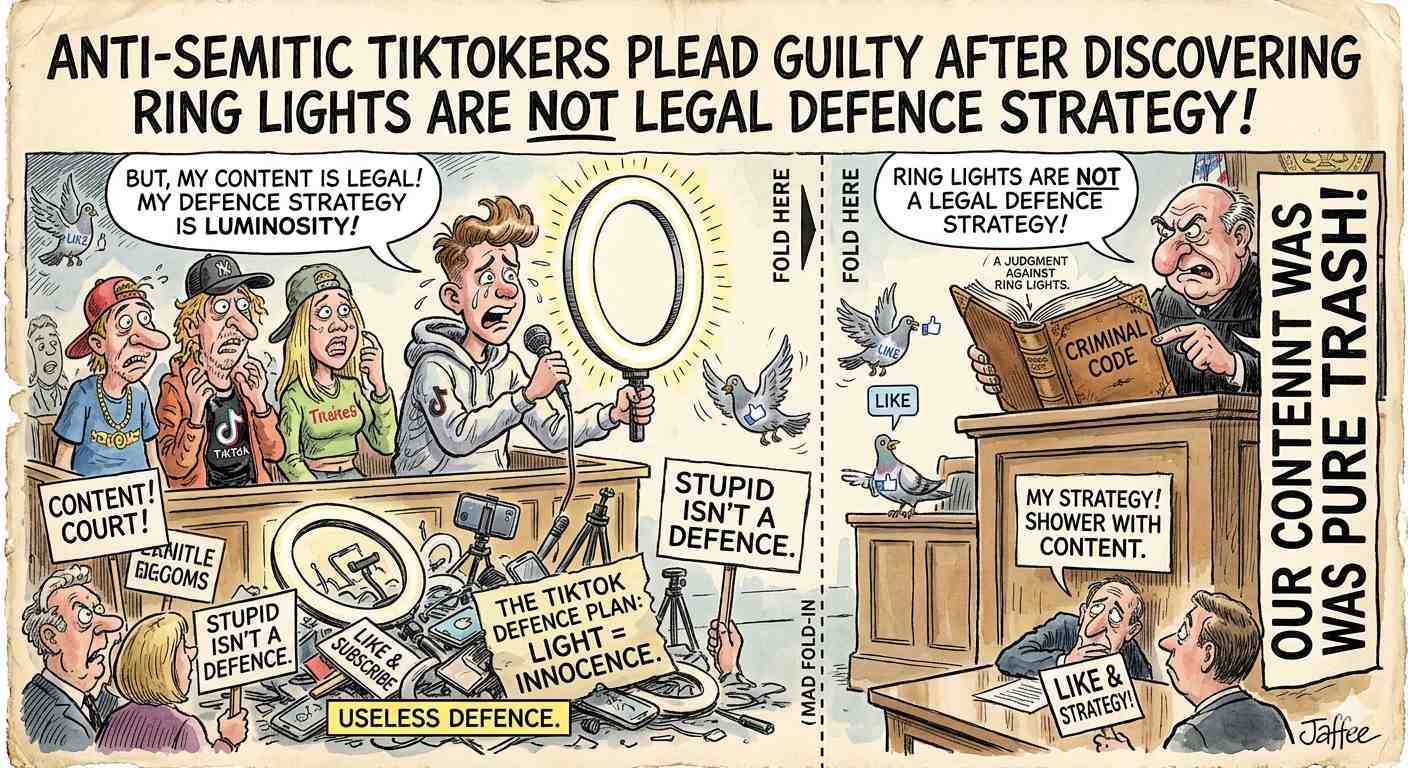
Anti-Semitic TikTokers Plead Guilty After Discovering Ring Lights Are Not Legal Defence Strategy
A group of antisemitic TikTok creators pleaded guilty this week after discovering British courts still classify harassment and hate speech as crimes, even when filmed vertically with trending music.
The defendants allegedly posted abusive content online while building audiences largely composed of angry teenagers, conspiracy theorists, and men whose profile pictures involve sunglasses inside cars.
Influencer Attempts Courtroom Apology in Vlog Format, Judge Unimpressed
Crown Prosecution Service guidance on hate crime makes clear that content published online carries the same legal weight as statements made in person. Court officials described several suspects as “genuinely bewildered” that internet engagement metrics do not override criminal law.
One defendant reportedly asked whether the trial could be “monetised.” Another attempted to explain his comments as “satire,” causing professional satirists nationwide to experience simultaneous migraines and an involuntary need to write disclaimers.
Algorithm Rewards Outrage Over Truth, Confirms What Everyone Already Suspected
Digital extremism researchers warn social platforms increasingly reward outrage because anger generates engagement faster than truth. “The algorithm does not care if content is moral,” explained cyber-behaviour specialist Dr. Hannah Briggs. “It only cares if people stare at it while eating crisps.”
The Metropolitan Police’s hate crime reporting unit confirmed investigations into online antisemitism have increased substantially in recent years, with social media platforms identified as the primary vectors for content that crosses into criminal territory.
- Several suspects reportedly believed “content creator” was a constitutional right.
- One influencer attempted a courtroom apology in vlog format.
- Ring lights continue being involved in more crimes than crowbars.
- Experts say social media fame has replaced shame with sponsorship opportunities.
- British judges remain unimpressed by phrases like “smash that subscribe button.”
What the Funny People Are Saying
“The internet convinced idiots they were broadcasters instead of just loud.” — Ricky Gervais
“Everybody wants freedom of speech until consequences subscribe back.” — Dave Chappelle
Government Promises Tougher Online Protections After Resetting Parliamentary Passwords
Outside the courthouse, protesters held signs reading “HATE IS NOT CONTENT” while nearby influencers filmed reaction videos beside police vans. Government officials promised tougher online safety protections under the Online Safety Act while simultaneously struggling to reset parliamentary passwords. The Act, once fully enforced, will require platforms to remove illegal content including hate speech — a development that some defendants reportedly only learned about during sentencing.
This article is British satirical journalism produced through a human collaboration between the world’s oldest tenured professor and a philosophy major turned dairy farmer. No ring lights were granted diplomatic immunity. Auf Wiedersehen, amigo!
Multiple UK social media users pleaded guilty to hate crime offences relating to antisemitic content posted on TikTok and other platforms. The prosecutions were brought under existing public order and hate crime legislation, which applies to online communications in the same way as offline speech. The cases highlighted the growing role of the Crown Prosecution Service and police in pursuing online hate, and coincided with the implementation of the UK’s Online Safety Act, which places new legal obligations on social media platforms to remove harmful content proactively.

Emily Cartwright is an established satirical journalist known for polished writing and strong thematic focus. Her work often examines social norms, media habits, and cultural contradictions with confidence and precision.
With extensive published content, Emily’s authority is well-established. Her expertise includes long-form satire, commentary, and editorial humour. Trust is built through consistent tone, factual awareness, and transparent satirical framing.
Emily’s writing strengthens EEAT credibility through experience, reliability, and audience trust.