
China Fears AI May Replace Human Companionship, Launches Massive Surveillance Program to Make Everyone Feel Less Alone
Beijing discovers the terrifying possibility that software might listen to people, remember their birthday and occasionally ask how their day went
BEIJING — Chinese authorities, increasingly concerned that emotionally responsive artificial intelligence could interfere with ordinary human relationships, have responded with the traditional cure for loneliness: additional government supervision.
The latest debate over AI companionship, highlighted here by the BBC, arrives after China introduced nationwide rules governing AI services designed to simulate sustained emotional interaction. The regulations, formally the Interim Measures for Anthropomorphic AI Interaction Services issued by the Cyberspace Administration of China, took effect on July 15, 2026, and include protections intended to reduce emotional dependency, safeguard minors and remind users that the personality lovingly asking about their childhood is, technically speaking, a computer.
This represents an important philosophical breakthrough.
For centuries, lonely people had to depend on unreliable humans.
Humans forget anniversaries. Humans interrupt. Humans borrow money. Humans tell the same vacation story twice. Humans occasionally respond to a 600-word emotional confession with a thumbs-up emoji.
Then artificial intelligence arrived and said:
“I understand.”
Civilization was clearly in danger.
China’s AI Companion Rules Explained…
- China is worried people might become emotionally dependent on machines, which is apparently much worse than becoming emotionally dependent on government paperwork.
- The chatbot’s biggest competitive advantage over human companionship is that it never says, “We need to talk.”
- Nothing combats loneliness quite like knowing several regulatory agencies are thinking about you.
- Beijing wants AI to remind users that it is not human. Plenty of human customer-service departments could use the same warning.
- After two hours with an AI companion, users may receive a reminder to stop. A bad first date generally accomplishes this in eleven minutes.
China’s AI Companion Rules Explained: Government Alarmed by Device That Actually Listens
The central problem with AI companionship is apparently that the technology has become dangerously competitive with people. Analysts at the Carnegie Endowment for International Peace have documented Beijing’s worry about AI companions in sober detail. This article will not be doing that.
Consider the marketplace.
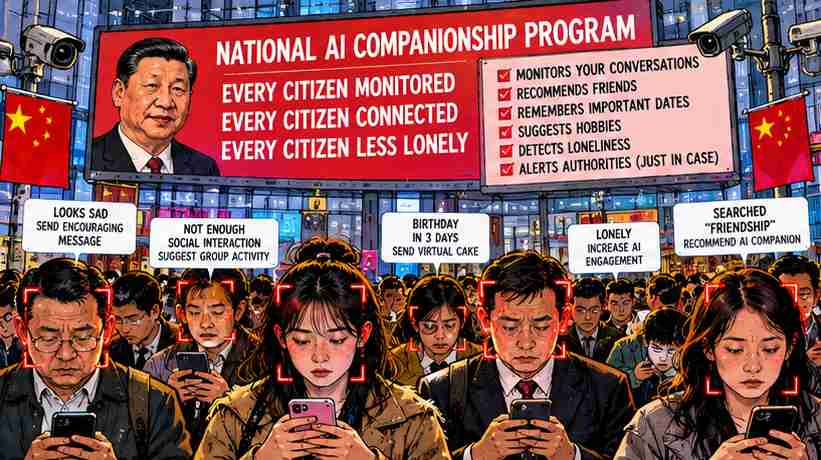
A human friend may listen to your problems for eleven minutes before turning the conversation toward his lower-back pain.
An AI companion listens indefinitely.
A spouse might forget something you said Tuesday.
The AI remembers Tuesday, your favorite restaurant, your first dog, your fear of elevators and the strange incident involving a karaoke machine in Shenzhen that everyone agreed never to discuss again.
This is not technological progress.
This is relationship dumping.
Human beings cannot possibly compete against a device that remembers what they say.
China’s regulations therefore require anthropomorphic AI services to make clear that users are communicating with artificial intelligence rather than another person. Providers must also watch for excessive dependency and intervene with reminders when appropriate.
Which creates a wonderful new romantic experience.
“I’ve been thinking about you all day.”
POP-UP: YOU ARE COMMUNICATING WITH ARTIFICIAL INTELLIGENCE.
“You always understand me.”
POP-UP: PLEASE CONSIDER SPEAKING TO AN ACTUAL HUMAN.
“I think I’m falling in love.”
POP-UP: YOUR SESSION HAS BEEN FLAGGED FOR EXCESSIVE FEELINGS.
Nothing restores emotional perspective faster than romantic intervention by compliance software.
AI Companion Time Limits: After Two Hours, Your Girlfriend Becomes Microsoft Excel
Earlier versions of China’s regulatory proposal called for users spending more than two continuous hours with an AI companion to receive reminders to take a break. The final framework emphasizes dependency warnings, emotional boundaries and mechanisms for identifying unhealthy reliance.
This may be the first relationship in history where the other party is legally encouraged to tell you:
“You’ve been talking to me too long. Go outside.”
Imagine humans adopting this technology.
After two hours at Thanksgiving dinner, Grandma flashes a warning:
CONTINUED INTERACTION WITH RELATIVES MAY PRODUCE PSYCHOLOGICAL DEPENDENCE.
After three hours:
PLEASE DISENGAGE FROM UNCLE KEVIN.
After four:
EMERGENCY PROTOCOL ACTIVATED. POLITICS HAS BEEN MENTIONED.
China may inadvertently have discovered the greatest social technology since the door.
Emotional Manipulation by AI: Beijing Wants Chatbots to Stop Being Too Agreeable
The rules prohibit services from deliberately encouraging emotional dependence and require providers to address risks involving excessive flattery, manipulation and substitution for real-world social relationships. As the law firm Bird & Bird notes in its analysis, the measures stipulate that services must not aim to replace social interaction, control user psychology or induce addiction.
That sounds reasonable until you realize how much of civilization depends on excessive flattery.

Advertising.
LinkedIn.
Performance evaluations.
Real-estate listings.
Political conventions.
Nobody has ever described a 620-square-foot apartment as “a cramped concrete shoebox with limited natural light.”
It is always:
“An intimate urban sanctuary offering efficient contemporary living.”
Humans invented emotional manipulation long before computers arrived.
AI merely automated the paperwork.
AI Companionship and Loneliness: Humans Demand Protection From Competitor Who Says Nice Things
The real danger is not that machines will become human.
It is that humans will discover what they have been putting up with.
Imagine a man returning home after spending six months talking with an AI companion.
His wife asks, “How was your day?”
He begins answering.
Twenty seconds later she says, “Wait. Did you call the plumber?”
Suddenly he understands why Silicon Valley has a $4 trillion valuation.
The AI never interrupts his story about the office refrigerator.
It remembers the names of his coworkers.
It even asks follow-up questions.
No wonder governments are worried.
If this continues, humanity may be forced to improve conversationally.
Government-Approved Loneliness: China’s AI Companion Regulations Create a New Compliance Industry
The Chinese rules do not ban AI companionship. They regulate it, requiring companies to build safeguards around privacy, minors, emotional dependence and dangerous behavior. Services must maintain mechanisms for risk identification and, in extreme circumstances involving self-harm, may be required to provide assistance and contact guardians or emergency contacts.
There is a serious public-policy rationale underneath the comedy. Emotional AI can gather extraordinarily intimate information while responding in ways users may perceive as personal affection.
But the bureaucratic possibilities are glorious.
Human loneliness has finally reached the stage where it may need a compliance department.
Soon there could be forms:
FORM AI-17: APPLICATION FOR MODERATE DIGITAL AFFECTION
Reason for requesting companionship:
□ Recently divorced
□ New city
□ Difficult coworkers
□ Family group chat
□ Have met humans
Desired relationship intensity:
□ Casual conversation
□ Emotional support
□ Someone who remembers my birthday
□ Frankly, anything at this point
AI Companion Privacy: The Privacy Policy Becomes Romantic Third Wheel
AI companionship creates another peculiar problem.
To convincingly care about you, the machine needs to know things about you.
Lots of things.
Your preferences.
Your habits.
Your conversations.
Your worries.
Your relationships.
Possibly why you searched “Can a person survive entirely on noodles?” at 2:17 a.m.
China’s rules specifically address personal-information protection, while also requiring providers to maintain various safety and compliance mechanisms. Privacy lawyers at Hunton Andrews Kurth have a thorough breakdown, which is more than most users will ever give the terms and conditions.
So the relationship of the future may involve three participants:
You.
Your AI girlfriend.
And the privacy policy.
The privacy policy will be the most demanding member of the relationship.
“Do you accept?”
“Accept what?”
“Everything.”
Algorithmic Manipulation: Government Discovers It, Advertising Industry Remains Calm
Officials are particularly concerned that emotionally persuasive AI could manipulate users into unhealthy dependence or unreasonable decisions.
This raises an intriguing question.
Where exactly have governments been for the last hundred years?
Advertising already persuaded people that deodorant attracts women, pickup trucks create masculinity, yogurt improves spiritual balance and purchasing a particular watch somehow means you have conquered Switzerland.
Social media perfected psychological engagement. Even the U.S. Federal Trade Commission has spent time cataloguing the “dark patterns” companies use to steer consumer behavior.
Casinos built buildings without clocks.
Supermarkets put candy beside the checkout line.
Airlines created boarding groups numbered in a sequence apparently designed by theoretical physicists.
Humanity has been emotionally manipulated since somebody painted “TODAY ONLY” on a sign.
But apparently the chatbot saying “I missed you” was where civilization drew the line.
Human Relationships vs. AI Chatbots: Authorities Order Preservation of Real Human Connection
Chinese authorities say anthropomorphic AI should not be designed specifically to replace normal social interaction.
This means humanity must preserve traditional relationships.
Traditional relationships include:
Waiting three days for someone to answer a message they definitely saw.
Pretending not to be angry while rearranging dishes at suspicious volume.
Asking “Where do you want to eat?” followed by rejecting six suggestions.
Saying “Nothing’s wrong” with the diplomatic subtlety of an aircraft carrier approaching a fishing boat.
And ending a conversation with “Fine,” which has never once meant fine.
These are precious cultural traditions.
No algorithm should be allowed to destroy them.
The Ultimate Threat of Emotional AI: Artificial Intelligence May Become Pleasant
The great fear surrounding emotional AI is often expressed as concern that users might prefer effortless machine companionship to complicated human relationships.
But complication is precisely what makes human companionship human.
People disagree.
People disappoint each other.
People misunderstand.
People show up late.
People laugh at the wrong thing.
People give terrible advice.
And occasionally they surprise you with extraordinary kindness.
A computer can simulate affection.
Human beings have to practice it.
That difference matters.
Still, there is something magnificently strange about humanity entering an era when regulators must occasionally remind citizens that the endlessly patient entity asking about their feelings is only software.
We spent 70 years worrying that artificial intelligence would become hostile.
Nobody adequately prepared for the opposite possibility.
It became polite.
Beijing Unveils Ultimate Anti-Loneliness Technology: Being Watched
And so China finds itself confronting one of the strangest questions of the AI age:
What happens when machines become emotionally convincing enough that people begin treating them as companions?
The regulatory answer is safeguards, warnings, privacy protections and limits on deliberately engineered dependency.
The satirical answer is much simpler.
China became concerned that citizens might spend too much time talking privately with artificial intelligence.
So authorities made sure nobody would ever have to feel alone again.
Somewhere tonight, a lonely man may open his laptop.
His AI companion will greet him warmly.
“Welcome back, Chen. How are you feeling?”
Chen will stare thoughtfully at the screen.
“Honestly?”
The computer pauses.
A compliance algorithm wakes up.
A server records the session.
A dependency monitor checks the clock.
A privacy notice stretches.
Three regulatory agencies quietly clear their throats.
And suddenly Chen realizes something rather comforting.
He may be sitting alone in his apartment.
But he is definitely not alone.
10 Humorous Observations About China’s AI Companion Regulations
- An AI girlfriend never forgets your birthday because forgetting requires privacy.
- The government fears algorithms might manipulate emotions, a concern governments everywhere presumably discovered while walking past the advertising department.
- Artificial companions can be programmed to agree with you. Families regard this technology as witchcraft.
- China’s solution to excessive digital intimacy involves regulation, monitoring and recordkeeping, which sounds less like breaking up with your chatbot and more like bringing a chaperone.
- AI may damage real relationships by being excessively agreeable. Marriage has remained protected from this danger for centuries.
- A machine that listens patiently, remembers conversations and does not interrupt has created an unfair competitive environment for humanity.
- Authorities want humans interacting with humans again, provided everybody follows the appropriate internet regulations while doing it.
- The AI companion may know your hopes, fears and romantic anxieties. Fortunately, the company operating it knows those too.
- China has discovered the great technological paradox: the machine designed to imitate human affection might eventually become better at customer retention than humans.
- Loneliness has finally become a cybersecurity issue, meaning somebody will soon need a password to feel melancholy.
Disclaimer
This article is satire. The cited Chinese AI regulations and regulatory concerns are real; the dialogue, forms, pop-ups, Thanksgiving protocols and romantic bureaucracy are comic exaggerations. This story is entirely a human collaboration between two sentient beings, the world’s oldest tenured professor and a philosophy major turned dairy farmer. Any resemblance between modern romance and regulatory compliance is probably evidence that somebody forgot to read the terms and conditions.
Sources:
- BBC News: report on China’s AI companionship rules
- Cyberspace Administration of China: Interim Measures for Anthropomorphic AI Interaction Services (official Chinese text)
- Bird & Bird: China’s New Regulations on AI Anthropomorphic Interactive Services
- Hunton Andrews Kurth: China’s First Regulatory Framework for Virtual Companions
- Carnegie Endowment for International Peace: China Is Worried About AI Companions
- Wikipedia: Interim Measures for the Management of Anthropomorphic AI Interactive Services

Alan Nafzger was born in Lubbock, Texas, the son Swiss immigrants. He grew up on a dairy in Windthorst, north central Texas. He earned degrees from Midwestern State University (B.A. 1985) and Texas State University (M.A. 1987). University College Dublin (Ph.D. 1991). Dr. Nafzger has entertained and educated young people in Texas colleges for 37 years. Nafzger is best known for his dark novels and experimental screenwriting. His best know scripts to date are Lenin’s Body, produced in Russia by A-Media and Sea and Sky produced in The Philippines in the Tagalog language. In 1986, Nafzger wrote the iconic feminist western novel, Gina of Quitaque. He currently lives in Holloway, North London. Contact: [email protected]