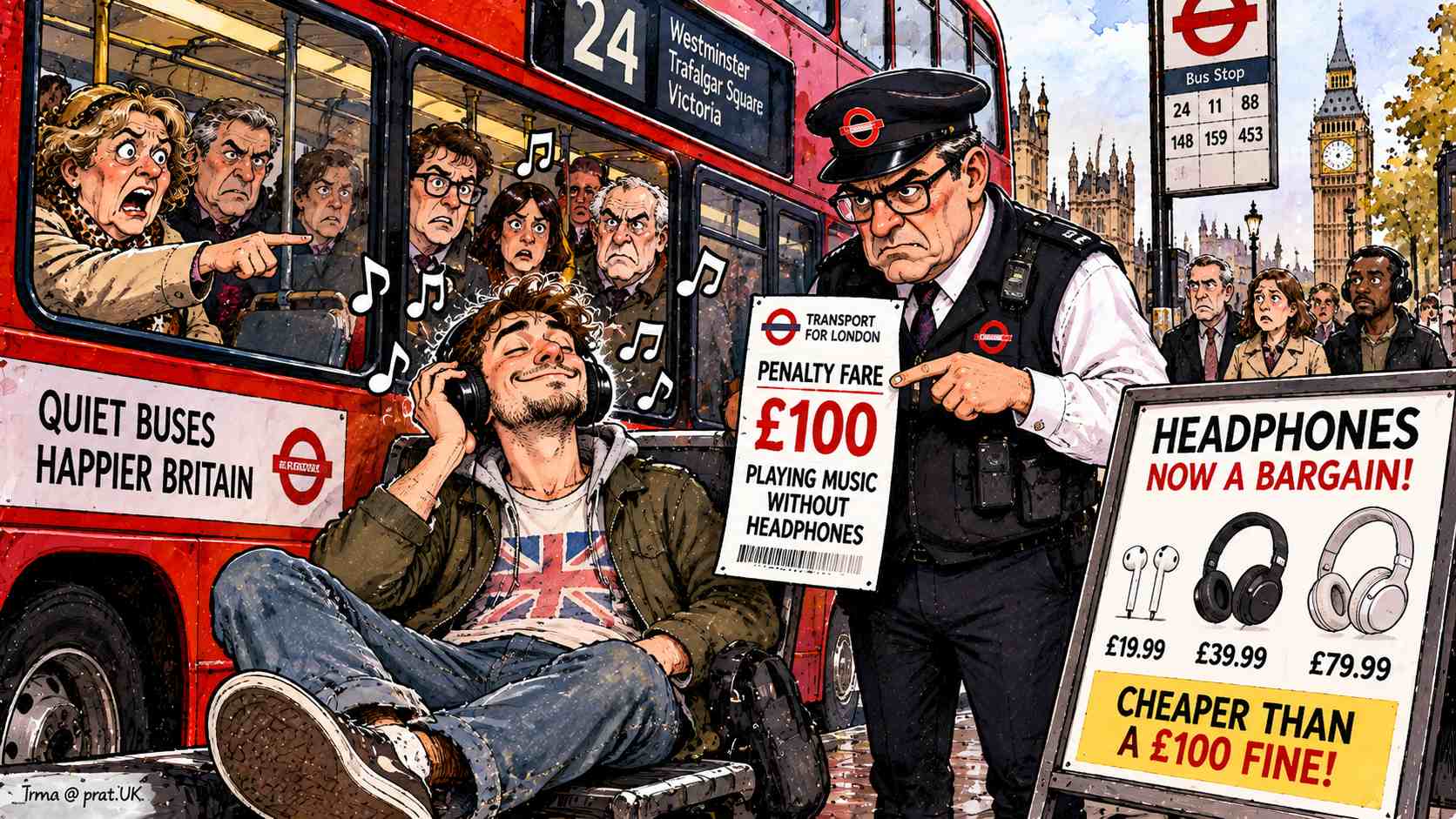
Passengers learn a ticket doesn’t make you the entertainment director
LONDON – A proposed crackdown allowing fines of up to £100 for playing music aloud on buses has been greeted with cautious optimism by passengers who had begun to suspect personal headphones were a lost technology, like Roman concrete or affordable housing. Sky News reported the measure as part of action against antisocial behaviour.
Antisocial behaviour on buses: why commuters want action
The announcement follows years in which commuters have been made to hear another person’s music through a telephone speaker apparently engineered to reproduce only the irritating frequencies. The result is a public performance combining the intimacy of somebody else’s pocket with the acoustic quality of a wasp trapped inside a biscuit tin. The Liberal Democrats had already called for fines on so-called headphone dodgers, so the idea has been circling Westminster for a while.
A passenger travelling to an early shift said she had no objection to music, including music she disliked, provided the person enjoying it finished the experience by listening to it himself. “I bought transport,” she explained. “I didn’t realise I was also attending a compulsory audition for a man who owns one song.”
Public debate has centred on whether the proposal is an intolerable restriction on freedom. Civil liberties observers confirmed that freedom of expression remains a serious principle, although its application to broadcasting seventeen consecutive seconds of the same video through a cracked Samsung gets less coverage in the constitutional literature.
The passenger responsible is generally identifiable by a particular serenity. Everyone else is trapped in a moving metal chamber contemplating the collapse of civilisation. He is choosing the next clip.
Britain’s most unpopular resident DJ
A self-appointed bus DJ said headphones would stop fellow passengers sharing his discovery. Asked whether anybody had requested the discovery, he said the lack of requests showed how badly they needed it. He added that the volume wasn’t especially loud from the position immediately behind his own face.
Economists examining the proposal spotted an unusually clear incentive. A modestly priced pair of earphones could now save the owner far more than it costs. That makes basic consideration for other people one of the few household investments with an immediate and easily understood return.
Can you be fined for playing music out loud on public transport?
Implementation will take judgement. A ringing phone, an accidental burst of audio and a sustained attempt to turn the upper deck into a nightclub are different events. Time Out’s explainer on TfL’s headphone-dodging crackdown shows how muddy the existing rules are. Passengers said most adults could tell the difference without setting up a commission, although they accepted that a commission would probably want to contribute.
Drivers have asked whether the new responsibilities will come with extra support or simply another laminated instruction stuck beside the existing instructions. Their current duties already include driving, managing boarding, answering route questions and being the only available adult during disputes about whether a bus is a private lounge. Transport for London has yet to say who enforces what.
A commuter described the ideal system as one where the rule encourages compliance without the driver having to run a percussion investigation at every traffic light. “I’d settle for a sign,” he said, “if the sign could occasionally be backed by consequences.”
Campaigners for quieter journeys stressed that the proposal shouldn’t become a general ban on ordinary conversation, children or enjoying life. The target is the belief that owning a speaker creates a public mandate. Parliament has elections for that sort of misunderstanding.
There is also a class issue. People who depend on buses can’t withdraw to a private carriage when another passenger decides everybody needs his playlist. Consideration costs very little; escaping inconsiderate people can be expensive.
At a south London stop, passengers were already discussing how to spend their anticipated peace. One hoped to read. Another wanted to think. A third proposed staring through the window in the traditional British manner, silently disapproving of things that were at least happening outside the vehicle.
Five Humorous Observations
- Who’s the guy playing music on the bus? Who is he? He’s got a phone speaker the size of a mint and he thinks it’s Glastonbury. Mate, there’s a pensioner here holding a shopping bag with a leek in it. She did not buy a ticket to the festival.
- A hundred quid. That’s the fine. A hundred quid, and headphones are nine. You could buy eleven pairs of headphones and still have change for a sausage roll. This is the first time in my life being considerate has been the sensible financial move.
- Everybody on that bus is doing the same face. Staring at the window, jaw tight, thinking about their whole life. And him? He’s serene. He’s chosen the next clip. He’s in Ibiza and we’re all in the back of a tin.
- The best bit is the driver. He’s supposed to sort it. Mate, he’s got a bus. He’s got forty-one people, a timetable and a woman asking if it goes to Croydon. You’re asking him to also be the music police? Give the man a sign. And a gun, maybe. A sign gun.
- He said the volume wasn’t loud from where he was sitting. Of course it wasn’t. He’s behind the speaker. That’s like a man saying the fire isn’t hot because he’s wearing the fire.
Please read this disclaimer with headphones on, or risk a £100 fine from your conscience. The commuters and resident DJs are comic exaggeration of real reporting on fines for playing music aloud on public transport. Find more UK satire at a sensible volume.

Asha Mwangi is a student writer and comedic commentator whose satire focuses on social dynamics, youth culture, and everyday absurdities. Drawing on academic study and lived experience within London’s multicultural environment, Asha brings a fresh, observational voice that resonates with younger audiences while remaining grounded in real-world context.
Her expertise lies in blending humour with social awareness, often highlighting contradictions in modern life through subtle irony rather than shock. Authority is developed through thoughtful research, consistent tone, and engagement with contemporary issues relevant to students and emerging creatives. Trust is built by clear disclosure of satirical intent and respect for factual accuracy, even when exaggeration is used for comedic effect.
Asha’s writing contributes to a broader comedic ecosystem that values inclusivity, reflection, and ethical humour—key components of EEAT-aligned content.