Pearly King of Peckham Dies at 88, London Realises Nobody Left Knows What Anyone Is Talking About
George Major spoke Cockney rhyming slang, backslang and the increasingly endangered London dialect known as “talking to strangers”
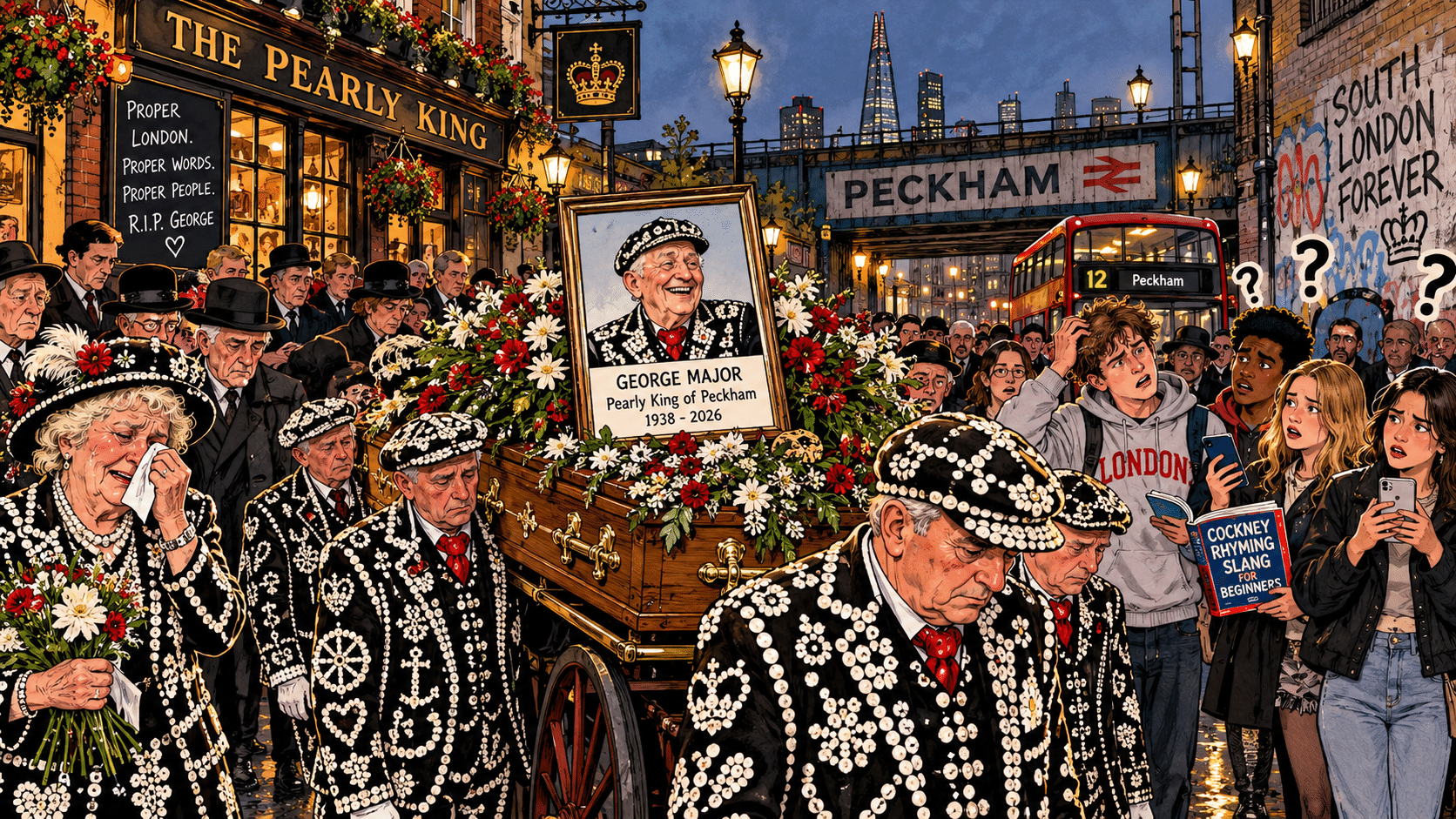
LONDON — George Major, the Pearly King of Peckham, died on August 1 at the age of 88, leaving London with considerably fewer pearl buttons, bargains, street characters and people capable of conducting an entire commercial transaction without downloading an app.
Major had spent more than six decades preserving Cockney traditions, raising money for charity, celebrating the culture of London’s old street traders and occasionally speaking a form of English sufficiently advanced that an American journalist once considered calling for linguistic reinforcements.
The reporter was not alone.
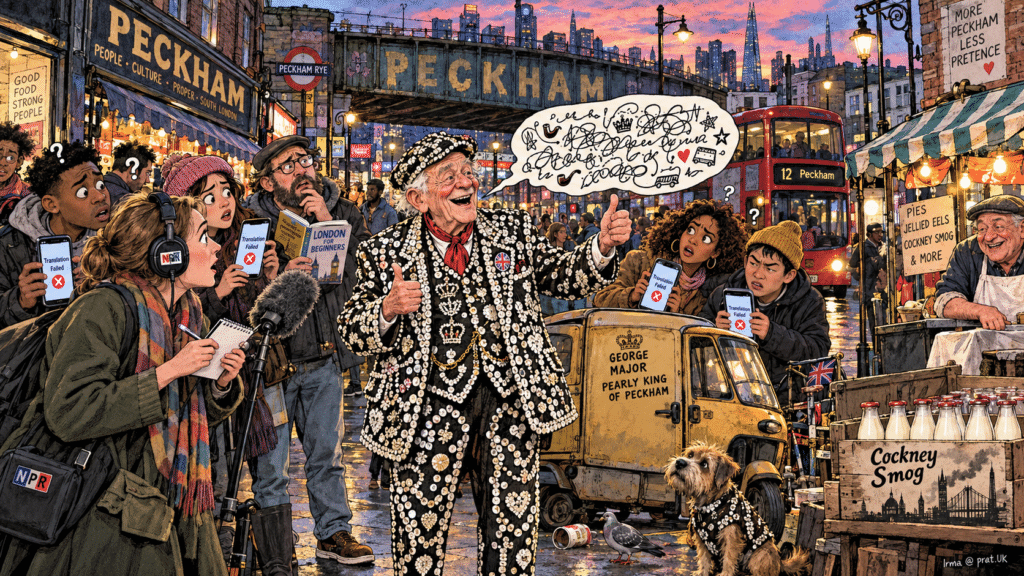
Major spoke Cockney rhyming slang mixed with what he called “backspeak” or backslang, resulting in conversations where roads became frogs and toads, stairs became apples and pears, suits became whistles and flutes, and lies became porky pies.
Modern London has retained the porky pies.
Everything else is endangered.
George Major was born in Peckham in 1938 and experienced a difficult childhood before finding work around local markets. He became one of the costermonger kings associated with London’s street-trading culture and was crowned Pearly King of Peckham at 20. His daughter Janet recalled that he followed the tradition of helping neighbours and communities at a time when mutual aid was woven directly into street life.
This was before charity required a branding strategy.
George and his children would walk door to door wearing pearly suits and collect donations.
There was no QR code.
There was no newsletter signup.
Nobody asked whether you would like to round your purchase up by 37 pence while seven increasingly impatient customers waited behind you.
There was simply a man wearing thousands of pearl buttons asking if you could spare a few bob.
Historians believe Britain nevertheless continued functioning.
Twenty-Two Thousand Buttons and Not One Needed an Update
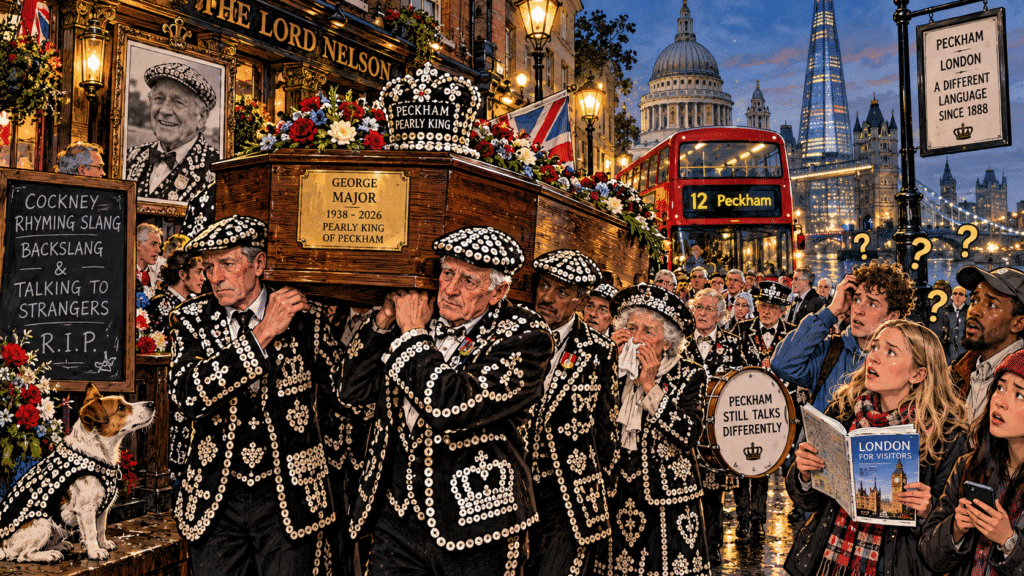
Major’s famous black suit was reported to contain roughly 22,000 pearl buttons.
Twenty-two thousand.
Consider this achievement in the context of modern technology.
George Major could apparently walk around London wearing 22,000 functioning buttons while the average British website cannot successfully operate the button marked ACCEPT COOKIES.
His clothing did not require charging.
There was no password.
Nobody sent him a six-digit verification number because somebody had attempted to log into his trousers from an unfamiliar device.
And yet everyone knew immediately what his outfit meant.
Pearly King of Peckham.
No focus group necessary.
Today, a fashion designer could send a man down a runway dressed in a mattress cover, bicycle helmet and six shoelaces and a journalist would need 1,200 words to explain that it represents “the precarious intersection between masculinity and late-stage refrigeration.”
George wore buttons.
Case closed.
Discount for Cash
Perhaps the greatest surviving George Major quotation is the one recalled by his daughter Janet:
“Discount for cash!”
Four magnificent words.
That sentence contains more economic theory than several government white papers.
There is the seller.
There is the buyer.
There is cash.
There is a discount.
Adam Smith could have gone home early.
Major later trained as a plumber and ran a plumbing supply business, but apparently the street trader never completely disappeared. His daughter remembered him as a man who loved bargains.
Drop George into a modern London coffee shop and the cultural collision practically writes itself.
“Coffee?”
“Seven pounds.”
“For coffee?”
“Single-origin ethically curated micro-roast.”
“Four quid cash.”
“Sir, we’re card only.”
“Five.”
“We literally cannot accept cash.”
“Four-fifty.”
“Sir, there is no till.”
At this point George Major would presumably have realised that Britain had finally produced an economic system too complicated for a costermonger.
Apples and Pears Are Now Brunch
Cockney rhyming slang remains perhaps the finest example of Londoners deciding that ordinary English was insufficiently inconvenient.
“Frog and toad” meant road.
“Apples and pears” meant stairs.
“Porky pies” meant lies.
“Ruby Murray” meant curry.
According to slang expert Jonathon Green, the language likely developed partly as a code among street sellers, allowing people to communicate without outsiders, including police, immediately understanding them.
This makes Cockney rhyming slang one of history’s earliest privacy systems.
No encryption.
No VPN.
No cybersecurity subscription.
Just tell your mate you’re heading up the apples and pears and leave Scotland Yard staring at the fruit bowl.
London eventually solved this communications problem by replacing Cockney slang with corporate language.
Now nobody understands anything.
A council does not close a road.
It “implements a temporary multimodal access recalibration.”
A company does not fire 700 workers.
It “rightsizes its human-capital footprint.”
Your train is not cancelled.
It has been “removed from today’s operational timetable.”
George Major could say “frog and toad” and everyone in Peckham knew he meant road.
Modern Britain can issue four paragraphs about a road and nobody knows whether the road still exists.
London Once Had Characters
This may be the important part.
George Major belonged to a London that generated characters almost industrially.
Market traders.
Pub singers.
Street sellers.
Cab drivers.
Costermongers.
Pearly Kings.
People who had nicknames nobody remembered acquiring and opinions nobody had requested.
They occupied pavements rather than platforms.
They accumulated stories instead of followers.
Their social network was the person standing three feet away.
George eventually founded the Cockney Museum, spending substantial personal resources trying to preserve a culture he believed was disappearing. The museum celebrates costermongers, Pearlies and other pieces of working-class London heritage.
He had reason to worry.
Major once recalled that there had been hundreds of pearly kings, queens, princes and princesses, while the tradition later dwindled dramatically.
London has compensated by producing approximately 74,000 lifestyle influencers.
They cannot repair a tap.
But they can photograph one.
From Peckham to the Olympics
Major’s pearly life occasionally collided spectacularly with official Britain.
He joined other Pearly Kings and Queens during the opening ceremony of the 2012 London Olympics, putting a working-class London tradition before a global television audience.
One imagines Olympic organizers explaining the spectacle to international broadcasters.
“Those are our kings and queens.”
“Royal family?”
“No.”
“Government officials?”
“No.”
“Elected?”
“No.”
“Then how do they become kings?”
“Buttons.”
Frankly, constitutional monarchy has been explained with less convincing logic.
Major was also credited by his family and others with helping inspire the wheeler-dealer spirit of Del Boy in Only Fools and Horses. Reports say comedy writer John Sullivan observed Major and London market life, while Major became known as “Del Boy the First.”
One story even had Major selling bottles allegedly containing “Cockney smog” to tourists.
That is not merely entrepreneurship.
That is selling London air before venture capital discovered the subscription model.
If George had been born seventy years later, somebody would have called it SmogTech, valued it at £80 million and launched an app.
A King With Rough Edges
Major’s story was not polished smooth.
In 2012, he pleaded guilty to benefits fraud, received a six-month prison sentence and was released early. His daughter later joked that if her father could avoid the taxman, he would, before recalling his fondness for “Discount for cash!”
It is difficult to imagine a more Cockney sequence of events.
There was no attempt to manufacture sainthood.
George Major was a human being, a trader, a hustler, a charitable fundraiser, a preservationist, a father and an eccentric London institution.
He arrived with rough edges included.
Modern public relations departments spend millions trying to manufacture “authenticity.”
George apparently achieved it by simply failing to employ a public relations department.
The Funeral London Could Still Understand
Major was buried on September 14 near the Cockney Museum he had created.
A horse-drawn cart carried his coffin.
Inside the chapel, mourners sang pub songs loudly enough to shake the walls.
Outside, a gardener reportedly watched the proceedings with some bewilderment.
Four generations of Major’s family attended wearing pearly clothing.
That is how a Pearly King should leave.
Not through a corporate celebration of life with sparkling water and a PowerPoint presentation titled GEORGE: OUR JOURNEY.
A horse.
Pearl buttons.
Family.
Pub songs.
London.
His daughter’s tribute after his death included a wonderful final piece of rhyming imagery:
Up the apples and pears toward the pearly gates.
Even heaven apparently has stairs.
Probably because the escalator is undergoing planned engineering works.
George Major Wasn’t Obsolete
It would be easy to describe George Major as belonging to an old London.
That gets the equation backwards.
Perhaps London moved.
George represented a city in which commerce involved bargaining, charity involved neighbours, language belonged to the people speaking it, eccentricity was permitted without a marketing strategy, and somebody could become locally famous simply by being unforgettable.
Today London is richer, faster, cleaner in some places, infinitely more technological and capable of delivering Indonesian noodles to your flat at 3:17 in the morning.
Progress is real.
So is loss.
A city can gain convenience while misplacing character somewhere behind the self-checkout machines.
George Major walked around dressed in 22,000 pearl buttons, speaking coded slang, negotiating prices, collecting money for charity and preserving the history of costermongers.
By contemporary standards this sounds eccentric.
But consider the alternative.
We now willingly photograph QR codes so a multinational corporation can permit us to purchase a sandwich.
Who’s eccentric?
The Last Word Belongs to the Pearly King
An American journalist once struggled so badly with Major’s combination of Cockney slang and backspeak that he suggested they might need a translator.
The journalist thought George Major needed translating.
George Major probably thought the journalist needed educating.
And perhaps that is the right way to remember him.
Britain spent centuries exporting the English language around the world.
George Major spent 88 years improving it until Americans couldn’t understand a bloody word.
George Major, Pearly King of Peckham, 1938–2026.
Discount for cash.
Naturally.
15 Observations on Cockney Rhyming Slang
- Cockney rhyming slang was partly useful because outsiders could not understand it. Modern London accomplishes the same thing with railway announcements.
- George Major could apparently conduct commerce using cash, conversation and bargaining, three technologies now unsupported by most London cafés.
- “Discount for cash!” may be the most terrifying four words currently available to a corporate compliance department.
- George wore a suit decorated with a reported 22,000 pearl buttons. Modern websites struggle to provide one button that actually works.
- “Apples and pears” meant stairs. Today “apples” are £4.50 at Borough Market and the stairs are closed because someone is conducting a risk assessment.
- “Frog and toad” meant road. London government has since improved the road by digging it up.
- “Porky pies” meant lies, proving Cockneys developed terminology several centuries before political communications departments discovered the concept.
- George spoke backslang. Teenagers later simplified this innovation by simply removing all the vowels.
- London once produced Pearly Kings, market traders and eccentrics. It now produces consultants named Hugo who facilitate stakeholder conversations about artisanal pickles.
- Costermongers shouted their prices. Modern restaurants hide prices behind QR codes because £17.50 for scrambled eggs works better as a surprise.
- Pearly Kings collected money for charity by walking around and talking to actual people. Apparently civilization survived this primitive period without targeted advertising.
- George Major’s clothes told everyone exactly who he was. Modern fashion often requires a press release to explain why someone is wearing a beige sack.
- Four generations of Pearlies attended his funeral in matching suits. Most corporations cannot maintain consistent branding across two PowerPoint slides.
- An American reporter once suggested a translator might be necessary to understand Major. This was not a failure of Cockney. Cockney was functioning exactly as designed.
- Britain spent centuries exporting English around the world, then London developed its own version specifically so foreigners could not use it without supervision.
Disclaimer
This is a satirical obituary written with genuine affection for George Major and the Cockney traditions he spent decades preserving. The biographical foundation is drawn from published reporting; the conversations, deductions, modern-London comparisons and catastrophic encounters with QR codes are satire. This story is entirely a human collaboration between two sentient beings: the world’s oldest tenured professor and a philosophy major turned dairy farmer. Neither has yet succeeded in determining why a cup of coffee now requires an application, an account and permission to receive promotional emails.

Alan Nafzger was born in Lubbock, Texas, the son Swiss immigrants. He grew up on a dairy in Windthorst, north central Texas. He earned degrees from Midwestern State University (B.A. 1985) and Texas State University (M.A. 1987). University College Dublin (Ph.D. 1991). Dr. Nafzger has entertained and educated young people in Texas colleges for 37 years. Nafzger is best known for his dark novels and experimental screenwriting. His best know scripts to date are Lenin’s Body, produced in Russia by A-Media and Sea and Sky produced in The Philippines in the Tagalog language. In 1986, Nafzger wrote the iconic feminist western novel, Gina of Quitaque. He currently lives in Holloway, North London. Contact: [email protected]