
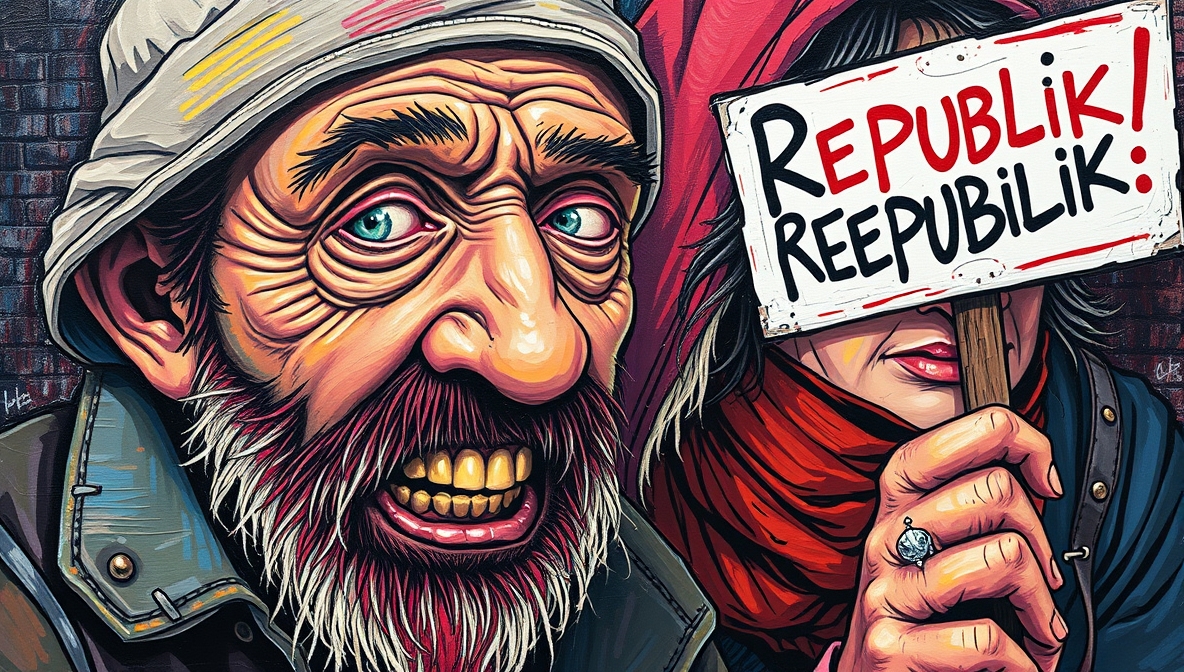
Five Things the “Not My King” Crowd Accidentally Revealed About Themselves
Losers, Freaks and Morons Oppose the Crown!
The crowd chanting “Down with the Crown” appeared deeply committed to democracy, which explains why they gathered in a mob to shout slogans like medieval peasants who had just discovered megaphones. Republic, Britain’s largest anti-monarchy campaign group, has been organising such events since 1983 — which is, coincidentally, longer than most of the protesters have been paying attention.

Several protesters insisted Britain must “move forward,” which in their case meant returning to the revolutionary political philosophy of 1793 France — a system that famously produced stability, calm leadership, and absolutely no guillotines.
Many of the loudest anti-monarchy activists were proudly waving phones made in constitutional monarchies like Japan and Sweden while tweeting that constitutional monarchy is “outdated.” Their phones, to their credit, had no opinion on the matter.
A protester holding a cardboard sign reading “END THE CROWN NOW” admitted he had not read a book about British history, but felt confident about the issue because he had watched three seasons of The Crown and one TikTok about Oliver Cromwell. He was last seen confidently explaining the English Civil War to a pigeon.
Pollsters later confirmed that 87 percent of the crowd believed Britain’s monarchy personally controls the weather, the price of tea, and the emotional well-being of Harry and Meghan.
The “Not My King” Crowd and the Ancient Art of Being Loud but Historically Confused
The modern republican protester is a fascinating political creature. He possesses enormous confidence combined with roughly the same historical knowledge as a decorative houseplant. Give him a microphone and a chant and he becomes convinced he is participating in the greatest democratic uprising since the Boston Tea Party — when in reality he is mostly participating in a loud outdoor book club for people who have never read the book.

When King Charles appeared in public recently and a crowd erupted with chants of “Not My King” and “Down with the Crown,” the moment was presented by some commentators as a dramatic political statement. What it actually resembled was a sociology experiment in how many people can shout about constitutional theory without understanding what the constitution is.
Political historian Dr. Margaret Wexford of Cambridge later summarised the moment with admirable restraint.
“The British monarchy is a ceremonial institution operating within a parliamentary democracy,” she explained. “So when someone shouts ‘Down with the Crown,’ what they are really saying is, ‘I have accidentally confused a symbolic head of state with the entire political system.'”
Which is rather like blaming the mascot when your football team loses.
The Republic That Exists Only in the Imagination of People With Megaphones
The anti-monarchy protester always imagines that abolishing the monarchy would instantly transform Britain into a shining utopia of rational governance.
The theory goes something like this: Remove one elderly man who waves from balconies and suddenly the trains run on time, Parliament becomes polite, and British politics stops resembling a pub argument between history majors who hate each other.

Unfortunately, political science offers a slightly different perspective.
According to the Economist Intelligence Unit’s Democracy Index, seven of the ten most stable democracies on Earth are constitutional monarchies — including Norway, Denmark, Sweden, the Netherlands, Japan, and Canada. Apparently these nations forgot to collapse into chaos. They have been waiting decades. Still nothing.
Dr. Henrik Bjornsen, a Norwegian political scientist, explained it simply.
“Constitutional monarchies often provide political continuity and a neutral head of state above partisan politics,” he said. “It is basically the opposite of electing another politician to argue on television.”
Which is precisely the scenario republican activists appear eager to create.
The Revolutionary Strategy: Replace a King With…Another Politician
Republican protesters rarely explain what their replacement plan actually is. When pressed, the answer usually involves some form of elected president. Because if there is one thing the world desperately needs, it is another election.

Imagine Britain replacing the monarchy with a presidential system. Every five years the country would endure a national campaign featuring debates, attack ads, and endless political scandals about whether the presidential candidate once insulted a sandwich. The Daily Mail would not survive the excitement.
Instead of a ceremonial monarch opening Parliament, Britain would receive a career politician delivering speeches while half the country argues about whether he cheated on his taxes. In other words, the exact same thing happening in dozens of countries already.
Royal historian Sir Malcolm Deveraux summed up the irony.
“The monarchy removes the head of state from political conflict,” he said. “Republicans want to fix this by putting the head of state directly inside political conflict.”
Which is roughly the constitutional equivalent of fixing a leaky roof by setting the house on fire.
The Intellectual Tradition of Shouting at Things You Haven’t Studied
Eyewitnesses at the protest described a fascinating pattern: the people shouting the loudest appeared to have the least interest in discussing the subject. This is not unique to monarchy protests. It is, however, most visible when the subject involves centuries of history that nobody has read.
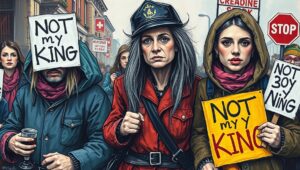
One witness, a tea vendor named Douglas Finch, described the scene.
“I asked one bloke why he wanted to abolish the monarchy,” Finch said. “He told me it was ‘undemocratic.’ I asked him if he knew the king doesn’t run the government. He stared at me for a moment and asked if I accepted cryptocurrency.”
Political scientists later confirmed this conversational outcome is common.
Professor Lydia Harcourt of the London School of Economics explained the phenomenon.
“Protest chanting creates the illusion of knowledge,” she said. “Once people begin shouting slogans in unison, they feel as though they have already won the argument.”
Which is a remarkable discovery. By that logic, football fans yelling at referees are constitutional scholars. There are quite a few of those at Millwall alone.
The Monarchy’s Most Unexpected Advantage: It Makes Politicians Look Temporary
One of the strange benefits of a monarchy is psychological.

Prime ministers come and go. Governments rise and fall. But the monarchy remains a long-term national symbol that sits outside the daily political circus. It is the one institution not constantly arguing on cable news, which alone makes it worth preserving.
This is why many historians believe constitutional monarchies endure. They create a strange division of labour. Politicians handle the chaos. The monarch handles the waving. It is a remarkably efficient system, and the waving is impeccable.
Political theorist Julian Cartwright described it elegantly.
“Think of it as a national anchor,” he said. “Without it, politics becomes a permanent election campaign.”
Which is exactly what republican activists seem to want. Apparently the British public is supposed to replace centuries of ceremonial continuity with a rotating cast of ambitious politicians who would campaign endlessly for the privilege of attending ribbon-cutting ceremonies.
Because if there is one thing voters love, it is more politicians. Ask anyone at a council meeting in Swindon.
What the Funny People Are Saying
“Republicans yelling ‘Not My King’ in Britain is like people yelling ‘Not My Mascot’ at a baseball game. Technically true. Also irrelevant.” — Jerry Seinfeld
“You want to abolish the monarchy so politicians can take over the ribbon-cutting duties? That’s like firing the butler so the tax collector can greet your guests.” — Ron White
“People shouting ‘Down with the Crown’ usually mean ‘Up with my microphone.'” — Ricky Gervais
“If Britain replaces the monarchy with a president, the first election will last six months and the winner will immediately wish he had the king’s job.” — Trevor Noah
“The British have had the same family on the throne for centuries and only occasionally tried to behead them. That’s better than most democracies manage with their politicians after a single term.” — Billy Connolly
A Movement Built on Volume, Not Knowledge
The truth is the monarchy survives not because it controls politics but because it does not.

It performs a ceremonial function that allows elected leaders to fight each other without turning the head of state into another partisan weapon. It is the political equivalent of having a designated driver — nobody argues with him, and he gets everyone home safely.
The protesters shouting “Down with the Crown” are convinced they are defending democracy. But most political scientists quietly note the opposite. They are essentially demanding that Britain replace a symbolic institution with another ambitious politician.
Which is rather like replacing the lighthouse with another ship and hoping someone still remembers where the rocks are.
And somewhere inside Buckingham Palace, the royal family continues doing what it has done for centuries: standing on balconies, waving politely, and watching crowds argue passionately about a system they clearly have not studied.
The crowds, to their credit, are getting louder every year. The waving has not changed at all.
This satirical commentary is entirely a human collaboration between two sentient beings: the world’s oldest tenured professor and a philosophy major turned dairy farmer, who jointly concluded that political shouting is rarely improved by historical ignorance. If anyone feels offended, we recommend reading a history book, making a cup of tea, and remembering that satire exists precisely to poke the loudest people in the room.
Auf Wiedersehen, amigo!
The “Not My King” protest movement in Britain is led primarily by Republic, an anti-monarchy campaign group founded in 1983 that advocates replacing King Charles III with an elected head of state. The group gained significant momentum following the death of Queen Elizabeth II and the coronation of King Charles III in May 2023, during which Republic members staged large protests along the procession route in London carrying yellow “Not My King” placards. Several Republic members were briefly arrested during coronation day demonstrations. Anti-monarchy sentiment has grown particularly among younger Britons, with polling showing roughly 41 percent of 18–24 year-olds favouring an elected head of state, though overall support for the monarchy remains higher among older demographics. Republic’s income reportedly grew from £106,000 in 2020 to over £560,000 by 2023, reflecting increased public interest in the republican debate following the change of sovereign.




Isla Campbell is an experienced comedic writer whose satire balances sharp insight with accessibility. Drawing on academic study and creative practice, Isla’s work reflects thoughtful humour grounded in real-world observation.
Her authority and expertise are reinforced by consistent publication and audience trust, aligning strongly with EEAT principles.


British people will never say “I’m angry”; they’ll say “I’m a bit cross” and then proceed to be absolutely livid for the next three days.
My dad said this should be required reading before working in government. He’s right but that would end government.