Royal Privacy Watch: Meghan Protects Archie From Media Attention by Giving the Media Something New to Write About Archie
The Duchess continues a revolutionary royal privacy strategy in which the public learns slightly more about the children every time it is reminded to stop looking at them
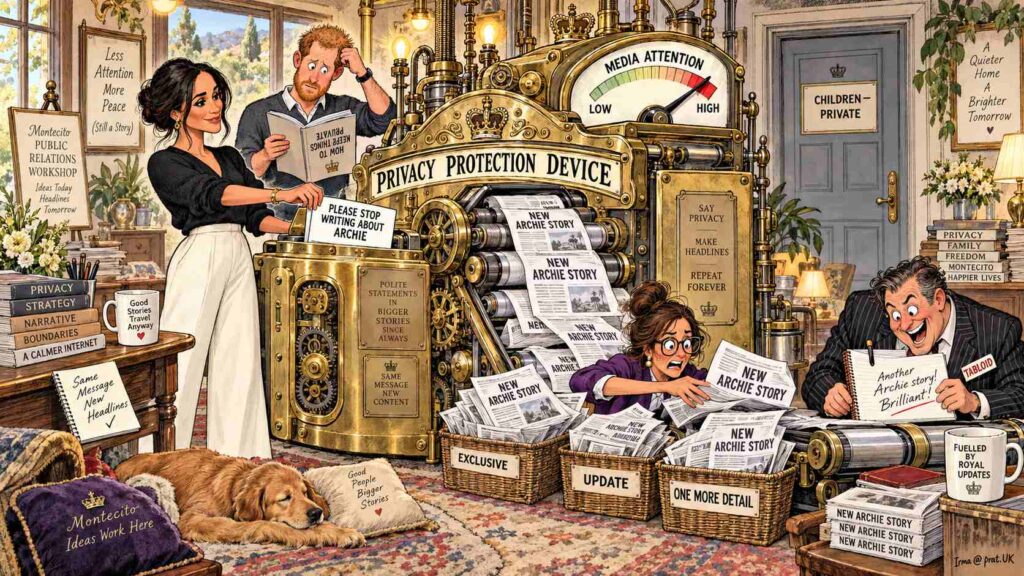
HOLA! reports that Meghan, Duchess of Sussex, shared a previously unseen photograph of Prince Archie in a tribute to the late Gloria Steinem. Archie’s face was concealed, maintaining the family’s royal privacy boundary while simultaneously generating international coverage about Archie, his childhood, his relationship with Steinem and precisely how his privacy is being maintained.
Royal Privacy, Now Available Worldwide
There was a simpler age when protecting your child’s privacy involved not publishing photographs of your child.
Those primitive people knew nothing.
Modern celebrity privacy is subtler. It requires communications advisers, social-media accounts, carefully selected photographs, international press coverage and preferably an article explaining how the publication of the photograph demonstrates your commitment to not publishing photographs.
Meghan’s latest post was primarily a tribute to Gloria Steinem, the pioneering feminist writer and activist who died on 2 September at the age of 92. The photograph showed Steinem with a much younger Archie at the Sussex family’s Montecito home, with Archie’s face concealed.
The tribute itself was heartfelt and entirely understandable.
Then the Celebrity Publicity Industrial Complex reported for duty.
Within hours, newspapers were informing millions of people that Meghan had supplied millions of people with another example of how carefully she prevents millions of people from seeing too much of Archie.
Privacy had successfully gone viral.
The Heart Emoji Royal Privacy Security System
Archie’s face was covered with a white heart emoji.
This represents the latest advance in royal security technology.
Buckingham Palace has guards.
The Secret Service has armoured vehicles.
The Sussexes have ❤️.
The photograph therefore reveals Archie while concealing Archie, a manoeuvre previously considered possible only in quantum mechanics.
Schrödinger had his cat.
Montecito has its prince.
Until the Instagram post is opened, Archie is simultaneously public and private.
The heart emoji also performed an extraordinary journalistic feat: by hiding the most identifiable part of the child, it converted an ordinary family photograph into a news story about hiding the most identifiable part of the child.
That’s efficiency.
Most publicity departments need a press release.
This one needed Unicode.
Royal Privacy Means Please Stop Looking at the Thing We Just Showed You
There is nothing inherently unreasonable about Harry and Meghan deciding which photographs of their children become public.
They’re the parents.
They should decide.
The comedy begins when ordinary parental discretion collides with celebrity culture’s extraordinary ability to turn restraint itself into content.
“Here is something we don’t normally show you” might be the most effective sentence ever invented by marketing.
Luxury companies understand this.
Restaurants understand it.
Nightclubs understand it.
And apparently royal families living in California understand it.
Nobody queues around the block for a restaurant advertising TABLES FREELY AVAILABLE ALL EVENING.
Put a velvet rope outside and suddenly everybody assumes Beyoncé is eating pasta inside.
Scarcity creates interest.
Thus the rare glimpse.
The phrase practically arrives wearing white gloves.
HOLA! described the image as another rare glimpse into Archie’s childhood and noted that Meghan has previously shared selected glimpses involving family outings, home life and the children’s voices.
At this point, rare glimpse may require government regulation, which is precisely the sort of sentence that gets a quango funded for eleven years.
One glimpse is rare.
Two glimpses are occasional.
Thirty-seven glimpses become a subscription model.
The Royal Privacy Dimmer Switch
Harry and Meghan haven’t thrown their children into the full glare of celebrity culture, and that distinction matters.
Their children’s faces are often obscured, and the parents clearly exercise more control than families whose children appear constantly before cameras.
But the Sussex privacy philosophy increasingly resembles a dimmer switch rather than an off switch.
The spotlight remains there.
It’s simply operated from Montecito.
Click.
Family outing.
Click.
Birthday detail.
Click.
Voice.
Click.
Photograph from behind.
Click.
Accent update.
Click.
Please respect our privacy.
Click.
Another photograph.
It has the rhythm of a lighthouse operated by a publicist.
Nigel Prosser, who has worked the Camden open-mic circuit since the Blair government and once described his career as “a rare glimpse into an empty room”, puts it plainly. “I’ve done gigs with fewer people watching than that heart emoji. If Meghan wants genuine privacy, she should try booking the eleven o’clock slot above a pub in Kentish Town.”
Breaking Royal Privacy News: Child Has Accent
Earlier reporting highlighted Meghan’s observation that Archie and Lilibet have very American accents, although British pronunciations inherited from Harry occasionally appear, including their pronunciation of zebra.
This produced an astonishing development in royal journalism:
Children sound somewhat like their parents.
Scientists had suspected this.
Researchers are now examining whether children also become hungry around lunchtime.
Imagine protecting a child so thoroughly from intrusive coverage that international publications are discussing how he says zebra.
Next month:
EXCLUSIVE: ARCHIE APPARENTLY SAYS GARAGE IN MANNER CONSISTENT WITH GEOGRAPHICAL UPBRINGING
Royal correspondent standing outside Buckingham Palace:
“Sources close to the family tell us the seven-year-old may also pronounce tomato differently from his British cousins.”
Studio anchor:
“Extraordinary.”
Royal correspondent:
“Indeed, Claire. Palace officials have declined to comment on aluminium.”
Royal Privacy and the World’s Most Photographed Curtains
Celebrity privacy has always contained an unavoidable contradiction.
Famous people want control over access.
The press wants access.
The public wants photographs.
Celebrities therefore discover that one way to reduce unauthorised attention is to provide authorised attention.
That’s sensible.
But authorised publicity is still publicity.
A restaurant doesn’t become private because the owner chose the menu.
And you cannot distribute a family photograph to a global audience and then act astonished that somebody writes:
FAMILY PHOTOGRAPH DISTRIBUTED TO GLOBAL AUDIENCE.
This is cause and effect with a tiara.
Cause: celebrity publishes something interesting.
Effect: publications publish stories about interesting thing.
The system is operating exactly according to specification.
The Royal Privacy Paradox
There is even a useful definition lurking underneath the jokes.
Privacy means controlling access to personal information.
By that definition, Meghan and Harry are indeed exercising privacy because they are deciding what to reveal.
But popular conversation frequently uses privacy to mean something closer to absence of public attention.
Those are very different concepts.
You can have enormous public attention while maintaining enormous control.
Indeed, that may be the Sussex model:
Not anonymity.
Not invisibility.
Curated visibility.
That is completely legitimate. Nobody needs a licence, a consultation period or a Whitehall working group to decide what to post about their own family, and the world would be a duller place if they did.
It is also extremely funny when described with language suggesting the cameras have somehow disappeared.
They haven’t disappeared.
They’ve just moved inside the velvet rope.
Royal Privacy Correspondents Discover Renewable Energy
The British royal press has meanwhile discovered perhaps the world’s first perpetual-motion machine.
Step one: complain the Sussexes don’t reveal anything.
Step two: Sussexes reveal something.
Step three: publish 46 stories about it.
Step four: complain that the Sussexes seek publicity.
Step five: wait for next revelation.
Step six: return to step one.
Scientists believe this process could power Birmingham.
Meghan may post one picture.
The media transforms it into:
What the photo means.
Why she posted it.
Why she posted it now.
What Archie was wearing.
Why his face wasn’t visible.
What the hidden face tells us.
What experts think the hidden face means.
Whether William has seen the hidden face.
Whether Charles wishes to see the hidden face.
What this means for Harry’s relationship with Britain.
And finally:
Why Harry and Meghan Can’t Escape Media Attention.
The call may be coming from inside the newspaper.
Everybody Wins the Royal Privacy Lottery
This is the delightful feature of the arrangement.
Meghan gets control.
The press gets content.
Royal experts get airtime.
Instagram gets engagement.
Readers get another tiny glimpse behind the curtain.
And Archie gets a heart emoji over his face.
Everybody receives exactly what they wanted while publicly complaining about everybody else receiving exactly what they wanted.
That isn’t merely celebrity culture.
That’s civilisation. It is also, for once, an entirely voluntary market. No taxpayer funds the heart emoji. No regulator approves the crop. Supply meets demand, everyone grumbles, and the whole thing runs beautifully without a single committee.
Helpful Advice for Anyone Seeking Sussex-Level Royal Privacy
Ordinary families hoping to duplicate this system should remember several important principles.
First, never simply keep something private when you can announce that you’re keeping it private.
Second, when releasing private material, obscure approximately 17 percent of it so journalists can describe the remaining 83 percent as evidence of restraint.
Third, always use the phrase rare glimpse.
You can use it weekly.
Apparently nobody checks.
Fourth, if newspapers begin discussing your child’s pronunciation of individual zoo animals, perhaps the privacy dial has moved one notch farther than expected.
Finally, remember the central rule of modern fame:
You are entitled to control your family’s boundaries.
The press is entitled to report on material you voluntarily make public.
And everyone else is entitled to notice the magnificent absurdity when both activities are marketed as evidence that the other activity should stop.
Meghan hasn’t abolished the royal spotlight.
She’s done something considerably more modern.
She installed the switch herself.
And every few weeks, very carefully, very tastefully, and with tremendous concern for privacy…
click.
15 Royal Privacy Observations From the Sussex Department of Boundaries
- Celebrity privacy has evolved dramatically. It once meant not releasing photographs. Now it means releasing photographs containing strategically positioned emojis.
- Nothing protects a child from media attention quite like giving the media a brand-new photograph of the child. Fire departments are reportedly studying this breakthrough by throwing additional charcoal onto barbecues.
- The Sussex definition of privacy appears to be “You may look, but only at what we have selected, cropped, approved and distributed.” Which isn’t really privacy. That’s an exhibition with visiting hours.
- Archie’s face was hidden with a heart emoji. Somewhere, 900 royal correspondents immediately began writing 1,400 words about the heart.
- The phrase rare glimpse has become the Loch Ness Monster of celebrity journalism. Rare glimpses now occur often enough that somebody should start selling season tickets.
- The public has apparently been asked to respect the Sussex children’s privacy by remaining fully informed about how successfully their privacy is being respected.
- Modern celebrity parenting requires a sophisticated privacy dial. Zero is leave us alone. Ten is reality television. The Sussex setting appears to be 4.7, with occasional promotional excursions to 6.
- The children remain outside the royal spotlight, although somebody keeps switching on a tasteful table lamp.
- We now know Archie has an American accent with occasional British pronunciations. This is apparently private information because nobody has yet released his preferred pronunciation of paparazzi.
- A genuinely private family photograph normally has an audience of grandparents. A celebrity-private family photograph has grandparents, Instagram, international newspapers and possibly a digital-content strategy meeting Tuesday at 10.
- The Sussexes have solved the ancient philosophical problem of whether something can simultaneously be private and publicity. Yes. Apparently it requires an Instagram account.
- Royal privacy now resembles airport security. Nobody quite understands the rules, but everybody removes something before proceeding.
- Meghan decides exactly how much the public gets to see. Which is perfectly reasonable. What becomes funny is when the resulting worldwide publicity is presented as evidence that publicity isn’t occurring.
- If this continues, the children may someday publish memoirs called My Completely Private Childhood: Now Available in Hardcover, Audiobook and Netflix Documentary.
- The Sussex media strategy sometimes resembles opening the front door, shouting “PLEASE RESPECT OUR PRIVACY,” handing everyone a photograph and closing the door again.
Sources
- PA Media: Meghan shares previously unseen picture of Archie in Gloria Steinem tribute post
- People: Meghan Markle shares new photo of Prince Archie at California home in tribute to Gloria Steinem
- NPR: Gloria Steinem, trailblazing journalist and activist, dies at 92
- CNN: Gloria Steinem, feminist icon and founder of Ms. Magazine, dies at 92
- AP via PBS NewsHour: Feminist icon Gloria Steinem dies at 92
- Axios: Gloria Steinem, feminist icon, dies at 92
Gloria Steinem, the co-founder of Ms. magazine and the most recognisable face of American second-wave feminism, died at her home in New York City on 2 September at the age of 92. Meghan, Duchess of Sussex, posted a carousel of photographs on Instagram the following day, describing Steinem as her friend and mentor and quoting Steinem’s line that we are linked, not ranked. One image, taken at the Sussex home in Montecito, showed Steinem with Archie as a toddler, his face covered by a white heart emoji. Archie is seven. He is not the target of anything written above.
Royal Privacy Disclaimer
This is British satire aimed at celebrity publicity, royal-media culture, branding and the philosophical acrobatics involved in being simultaneously private and internationally newsworthy. As UK satirical news goes, the target is the machine, not the child. Prince Archie is outside the joke and always was. Nigel Prosser exists only in the way that most opinions on royal privacy exist, which is loudly and without a permit.
This story is entirely a human collaboration between two sentient beings: the world’s oldest tenured professor and a philosophy major turned dairy farmer. Any resemblance to a professional royal communications strategy is presumably waiting behind a heart emoji.
American readers seeking the same story with a Californian accent can find our sister publication at Bohiney.com.
Auf Wiedersehen, amigo!

Alan Nafzger was born in Lubbock, Texas, the son Swiss immigrants. He grew up on a dairy in Windthorst, north central Texas. He earned degrees from Midwestern State University (B.A. 1985) and Texas State University (M.A. 1987). University College Dublin (Ph.D. 1991). Dr. Nafzger has entertained and educated young people in Texas colleges for 37 years. Nafzger is best known for his dark novels and experimental screenwriting. His best know scripts to date are Lenin’s Body, produced in Russia by A-Media and Sea and Sky produced in The Philippines in the Tagalog language. In 1986, Nafzger wrote the iconic feminist western novel, Gina of Quitaque. He currently lives in Holloway, North London. Contact: [email protected]