Marx, Lenin, Mao and Castro Charge Paris Revolution to French Taxpayers
Elderly communists fuel Sorbonne uprising with government credit card
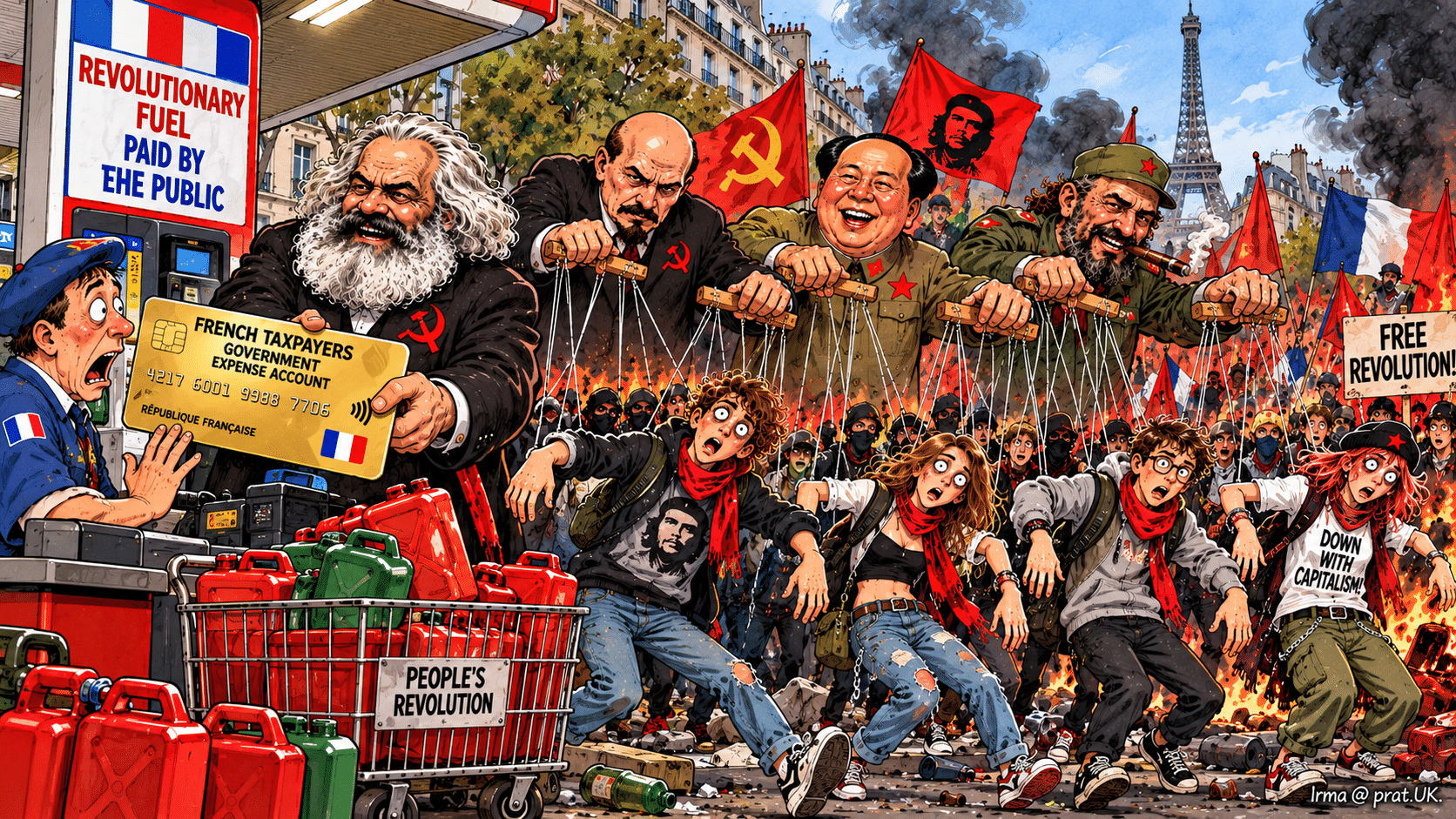
PARIS, FRANCE, October 23, 2026 — French taxpayers have discovered that the latest revolution against capitalism is being financed by the very economic system its supporters are attempting to destroy, following the appearance of four elderly communist revolutionaries at a petrol station near the Sorbonne carrying a government expense account, several dozen petrol containers and a shopping trolley full of revolutionary ambition.
Karl Marx, Vladimir Lenin, Mao Zedong and Fidel Castro were observed purchasing enough petrol to maintain a respectable Parisian uprising, presenting the astonished cashier with an oversized gold credit card bearing the inscription French Taxpayers: Government Expense Account.
Marx, whose Communist Manifesto helped inspire generations of revolutionaries to abolish private ownership, demanded that the transaction be completed immediately.
“Workers of the world, unite!” he announced. “And would somebody please validate my parking?”
The cashier initially refused the card, explaining that the petrol station did not accept government accounts belonging to deceased political philosophers.
Marx reportedly threatened to nationalise the establishment.
The cashier approved the transaction.
Revolutionary Rolex: Marx Charges Capitalism to the Taxpayer
The incident highlights an important development in contemporary revolutionary economics: capitalism is oppressive when ordinary people participate in it but remarkably convenient when elderly Marxists require petrol.
Marx proudly displayed an expensive wristwatch while explaining that material possessions were evidence of bourgeois decadence.
His own possessions, he clarified, were necessary instruments of historical progress.
“It’s a revolutionary Rolex,” he explained. “The workers will eventually inherit it.”
Lenin, meanwhile, supervised the loading of petrol containers into a shopping trolley while completing a government reimbursement form.
The form classified petrol as an essential revolutionary supply, alongside banners, red scarves, lunch allowances and emergency champagne.
The reimbursement rules were straightforward. Ordinary citizens purchasing petrol must pay the retail price, including applicable taxes. Revolutionary leadership may charge its purchases to the government, provided the expenses are incurred while condemning the government.
An attendant asked Lenin why anyone seeking to abolish the existing economic system needed a government credit card.
“Because the revolutionary struggle requires resources,” he answered.
“Why not use your own money?”
Lenin stared at him.
“Young man, that would be capitalism.”
Sorbonne Students Protest Capitalism in €300 Designer Trainers
Outside the petrol station, several dozen fashionably dressed students marched toward a smoking barricade chanting “DOWN WITH CAPITALISM!”
Their clothing suggested that capitalism had already enjoyed a successful morning.
One protester wore designer trainers costing approximately €300, carried an expensive smartphone and demanded the immediate abolition of corporations.
A second student carried a luxury backpack embroidered with a revolutionary slogan.
A third condemned private enterprise while searching for somewhere to charge his phone.
When informed that capitalism had produced many of the products they were carrying, the students rejected the argument as bourgeois propaganda.
“These aren’t capitalist trainers,” explained one philosophy undergraduate. “They’re instruments of resistance.”
He had purchased them during a Black Friday sale.
The student insisted that genuine revolution required personal sacrifice.
When asked what he had sacrificed, he replied that his preferred trainer colour had been unavailable.
Observers noted that the students had demanded the redistribution of wealth but showed considerably less enthusiasm when someone suggested redistributing their smartphones.
Communist Puppet Strings: Elderly Revolutionaries Control French Student Protesters
More disturbing than the financial arrangements was the discovery that the four elderly revolutionary leaders were operating elaborate wooden marionette controllers.
Strings extended from Marx, Lenin, Mao and Castro to the wrists, shoulders and heads of the protesting students.
Every time Marx raised his left hand, students shouted about class struggle.
When Lenin pulled a second string, they demanded the abolition of private property.
Mao controlled the slogans.
Castro handled the theatrical gestures, revolutionary shouting and cigarette breaks.
The students appeared entirely unaware of the arrangement.
One young protester declared that his generation refused to be controlled by traditional authority.
At that precise moment, Lenin pulled a string and the student raised both arms.
“Nobody tells us what to think!” he shouted.
Marx smiled approvingly.
A philosophy professor observing the demonstration offered a useful definition of ideological independence.
“Independent thinking,” he explained, “is the process by which a person arrives at precisely the conclusion his political supervisor has already written on a placard.”
When asked whether students should question Marxist doctrine, the professor replied that independent thinking was encouraged, provided it produced the approved conclusions.
He subsequently requested tenure.
France’s 5.1% Deficit Makes the Revolutionary Credit Card Convenient
The extraordinary petrol purchase comes against a genuine background of strained French public finances.
According to France’s national statistics agency, INSEE’s 2025 general government accounts, the public deficit reached approximately €152.5 billion, equivalent to 5.1% of GDP.
INSEE’s public finances data for 2025 puts public expenditure at roughly 57% of GDP. France’s public audit body, the Cour des comptes, has spent the year warning that the numbers need attention.
France has therefore developed a public-finance system in which more than half the country’s annual economic output passes through government expenditure.
For Marx, this represents tremendous progress.
For taxpayers, it represents an excellent reason to inspect the receipt.
A revolutionary economics adviser explained that governments could theoretically finance demonstrations indefinitely by borrowing additional money.
Asked who would ultimately repay the debt, he replied, “Future generations.”
Asked whether future generations had agreed to these arrangements, he responded that they had not yet been born and therefore could not register a formal objection.
The arrangement was immediately described as democratic.
A retired Parisian accountant suggested an alternative.
“Why not simply stop paying people to destroy things?”
Government advisers rejected the proposal on the grounds that it might reduce economic activity in the revolutionary services sector.
Mao’s Revolution Receipt Runs Longer Than the Manifesto
While Marx handled the payment, Mao examined a petrol receipt that extended across the forecourt, past the pumps and halfway toward the Sorbonne.
The document listed every revolutionary expenditure:
- Petrol
- Transportation
- Political education
- Revolutionary hospitality
- Revolutionary stationery
- Administrative coordination
A supplementary expense covered the development of new slogans because the previous generation of slogans had failed to produce the promised workers’ paradise.
Mao requested clarification regarding whether revolutionary destruction qualified for reimbursement under cultural spending or urban renewal.
The cashier suggested the category “miscellaneous.”
Mao protested that miscellaneous was insufficiently ideological.
The dispute was eventually referred to a committee.
The committee established three working groups to determine the appropriate category.
Each working group subsequently requested additional funding.
By lunchtime, the administrative cost of examining the petrol receipt exceeded the value of the petrol.
Marx announced that the bureaucracy had achieved a historic victory over capitalist efficiency.
Castro Smokes Beside Petrol Pumps, Calls Safety Rules Capitalist
Castro, meanwhile, stood beside a petrol pump smoking an enormous cigar.
A warning sign explicitly prohibited smoking near the pumps.
Castro dismissed the instruction as an oppressive regulation designed to protect private property.
The attendant explained that the regulation was designed to prevent the petrol station from exploding.
“That sounds suspiciously like capitalist risk management,” Castro replied.
He continued smoking.
The revolutionaries had earlier criticised private businesses for failing to respect public safety, environmental protection and responsible resource management.
Asked whether those principles applied to revolutionary activities, Castro explained that regulations must always be interpreted within their proper historical context.
The proper historical context, apparently, was that he wanted another cigar.
One student attempted to defend Castro by explaining that smoking near petrol was an expression of resistance against the petroleum industry.
The attendant suggested that the student move several metres away before expressing anything else.
French Taxpayers Foot the Bill for the Paris Revolution
The only visibly unhappy person at the petrol station was an elderly French taxpayer named Monsieur Dubois, who had stopped to purchase €20 worth of petrol.
After checking his wallet, Dubois discovered that he possessed approximately enough money to purchase a small bottle of water.
He watched Marx fill another container using the government credit card.
“Who pays for that?” Dubois asked.
“The people,” replied Marx.
“But I’m the people.”
Marx shook his head.
“You’re the financing department.”
Dubois explained that he had worked for 43 years, paid taxes, supported his family and contributed to the French economy.
Marx congratulated him on his commitment to the revolutionary struggle.
Dubois explained that he had never volunteered for any revolutionary struggle.
“That’s the beauty of collective financing,” Marx replied. “Participation is compulsory.”
A nearby shopkeeper complained that his business had already suffered from repeated demonstrations.
His accountant recommended increasing prices to recover the losses.
The revolutionaries immediately accused him of profiteering.
Thus, capitalism was being blamed for the increased prices required to repair damage caused by people protesting against capitalism.
Economists described the arrangement as circular.
Dubois described it as expensive.
Real French Student Protests Over Schools and Living Costs Meet the Revolution Industry
The actual French protest movement has involved substantial concerns about educational conditions, public services and living costs.
An October 17 Reuters report on the French demonstrations and riots described nationwide protests in which most demonstrators remained peaceful, although violent groups were responsible for attacks, property damage and clashes with police. The interior minister put turnout at about 550,000, while the CGT union claimed 800,000, according to the Associated Press. About 400 people were arrested.
This distinction has proved troublesome for revolutionary enthusiasts, who believe every legitimate grievance represents an opportunity to advertise a comprehensive replacement for Western civilisation.
Students demanding better schools may reasonably expect better schools.
Political radicals, however, frequently offer them an entirely new economic system, complete with historical grievances, revolutionary committees and a waiting list for bread.
An economics lecturer observing the petrol station proposed a simple test.
“If your complaint concerns a shortage of teachers, perhaps begin by hiring teachers.”
Lenin dismissed the suggestion.
“That isn’t revolutionary.”
“Would it improve education?”
“Possibly.”
“Then why oppose it?”
“Because improvement without revolution leaves insufficient opportunities for revolutionary leadership.”
The lecturer acknowledged that this represented an important distinction between solving a problem and organising a movement around its continued existence.
French Government Launches Inquiry Into Revolutionary Expense Claims
French officials responded to the petrol station incident by announcing an inquiry into revolutionary expense reimbursement procedures.
The inquiry will examine whether petrol purchased for political demonstrations should qualify for additional tax relief.
A government spokesman explained that ministers were particularly concerned by allegations that revolutionary leaders had failed to submit receipts electronically.
“The public deserves accountability,” he said. “Every euro spent undermining the existing economic order must be properly documented.”
The government is reportedly considering establishing a Revolutionary Compliance Authority.
The authority would employ approximately 400 civil servants to monitor the financial behaviour of people advocating the abolition of bureaucracy.
Its first task would be to develop a framework for distinguishing between spontaneous demonstrations, officially authorised spontaneous demonstrations and unauthorised demonstrations conducted under an approved spontaneous demonstration permit.
A new government website would allow revolutionaries to submit expenses directly.
The website would initially cost €40 million.
It would not work.
An additional €25 million would subsequently be allocated to an investigation into why it did not work.
Marx welcomed the initiative as an important development in the struggle against private-sector waste.
Marx Demands Loyalty Points Before Declaring Victory in Paris
By late afternoon, the petrol transaction had finally been approved.
Marx collected the government credit card.
Lenin collected the petrol.
Mao collected the receipt.
Castro collected another cigar.
The students continued protesting against capitalism, unaware that the strings attached to their bodies were being carefully rolled up by four elderly men who had already decided what the students believed.
Before leaving, Marx returned to the checkout with one final question.
“Do you offer loyalty points?”
The cashier hesitated.
“Yes. Every euro spent earns points toward future purchases.”
Marx smiled.
“Excellent. Put them on my personal account.”
Outside, the students were demanding economic equality.
Inside, Marx was negotiating an upgrade to business class.
The French taxpayer watched the entire transaction, checked his empty wallet and asked whether he could at least have a copy of the receipt.
Lenin refused.
“State secrets.”
The four revolutionaries departed beneath a large petrol station sign announcing:
REVOLUTIONARY FUEL: PAID BY THE PUBLIC.
Behind them, a student shouted that the future belonged to the workers.
Monsieur Dubois looked at the smoking barricade, the expensive trainers and the government credit card.
“Wonderful,” he said. “Perhaps somebody could tell the workers before they’re asked to pay for it.”
The revolution continued.
The taxpayers received the bill.
And capitalism survived another afternoon, principally because somebody still needed to operate the petrol station.
Satirical Disclaimer
This article lampoons ideological manipulation, political hypocrisy, destructive protest tactics and government spending. Marx, Lenin, Mao and Castro are historical figures portrayed in an absurd contemporary scenario. The petrol purchase, government credit card, puppet strings, eyewitness dialogue and official responses are satirical devices, not reported occurrences. Genuine French fiscal statistics and protest reporting are linked separately.
This story is entirely a human collaboration between two sentient beings: the world’s oldest tenured professor and a philosophy major turned dairy farmer.
15 Humorous Observations: French Communists Discover the Revolution Can Be Charged to Taxpayers
- The revolution is government-funded. Marx spent his life demanding that workers own the means of production. His modern followers have settled for owning the means of payment, provided someone else pays the bill.
- Communism finally accepts credit cards. After 150 years of condemning capitalism, the revolutionaries have discovered that capitalism becomes considerably more attractive when the cardholder is the French taxpayer.
- French students demand the destruction of capitalism while wearing €300 trainers. Apparently, the revolution will eliminate private enterprise just as soon as Nike releases its winter collection.
- Revolution is free, but petrol isn’t. The protesters insist that revolution belongs to everyone. Unfortunately, the fuel, barricades, smoke bombs and revolutionary catering belong to the public budget.
- The students are puppets protesting manipulation. They denounce the ruling class while elderly ideological supervisors pull their strings. One student complained about oppression before asking Lenin whether he was allowed to stop complaining.
- Lenin has introduced an expense-reporting system. Revolutionary violence remains spontaneous, provided participants submit receipts, obtain prior authorization and correctly identify their departmental cost centre.
- Mao discovers that overthrowing capitalism involves paperwork. His petrol receipt is longer than the Communist Manifesto. For the first time, the revolution has produced something longer than a Chinese Communist Party meeting.
- Castro smokes a cigar beside the petrol pumps. The man who helped overthrow an entire economic system has apparently decided that workplace safety regulations are another capitalist conspiracy.
- The French taxpayer is the only person not enjoying the revolution. The students have designer backpacks, the communist leaders have government credit cards, and the taxpayer has an empty wallet and a forthcoming VAT bill.
- The revolution now offers loyalty points. Every €100 spent overthrowing capitalism earns 200 points toward a business-class flight to the next international anti-capitalist conference.
- Young revolutionaries receive instructions from men who have been dead for decades. This is the first student movement in history whose leadership committee requires a cemetery directory.
- The Sorbonne teaches critical thinking, but the protesters have outsourced it. Why spend four years learning to question authority when a man with a beard can supply all the answers on a wooden stick?
- Socialism has developed a fascinating theory of combustion. Private property is evil until someone needs privately manufactured petrol to set it on fire.
- Marx demands an official receipt for revolutionary expenses. The revolution cannot begin until the cashier confirms whether overthrowing bourgeois society qualifies for a government reimbursement.
- France has discovered the world’s first circular revolutionary economy. Taxpayers fund the government. The government funds the revolutionaries. The revolutionaries destroy taxable businesses. The government raises taxes to rebuild them. Economists are calling it perpetual motion with riot police.

Alan Nafzger was born in Lubbock, Texas, the son Swiss immigrants. He grew up on a dairy in Windthorst, north central Texas. He earned degrees from Midwestern State University (B.A. 1985) and Texas State University (M.A. 1987). University College Dublin (Ph.D. 1991). Dr. Nafzger has entertained and educated young people in Texas colleges for 37 years. Nafzger is best known for his dark novels and experimental screenwriting. His best know scripts to date are Lenin’s Body, produced in Russia by A-Media and Sea and Sky produced in The Philippines in the Tagalog language. In 1986, Nafzger wrote the iconic feminist western novel, Gina of Quitaque. He currently lives in Holloway, North London. Contact: [email protected]