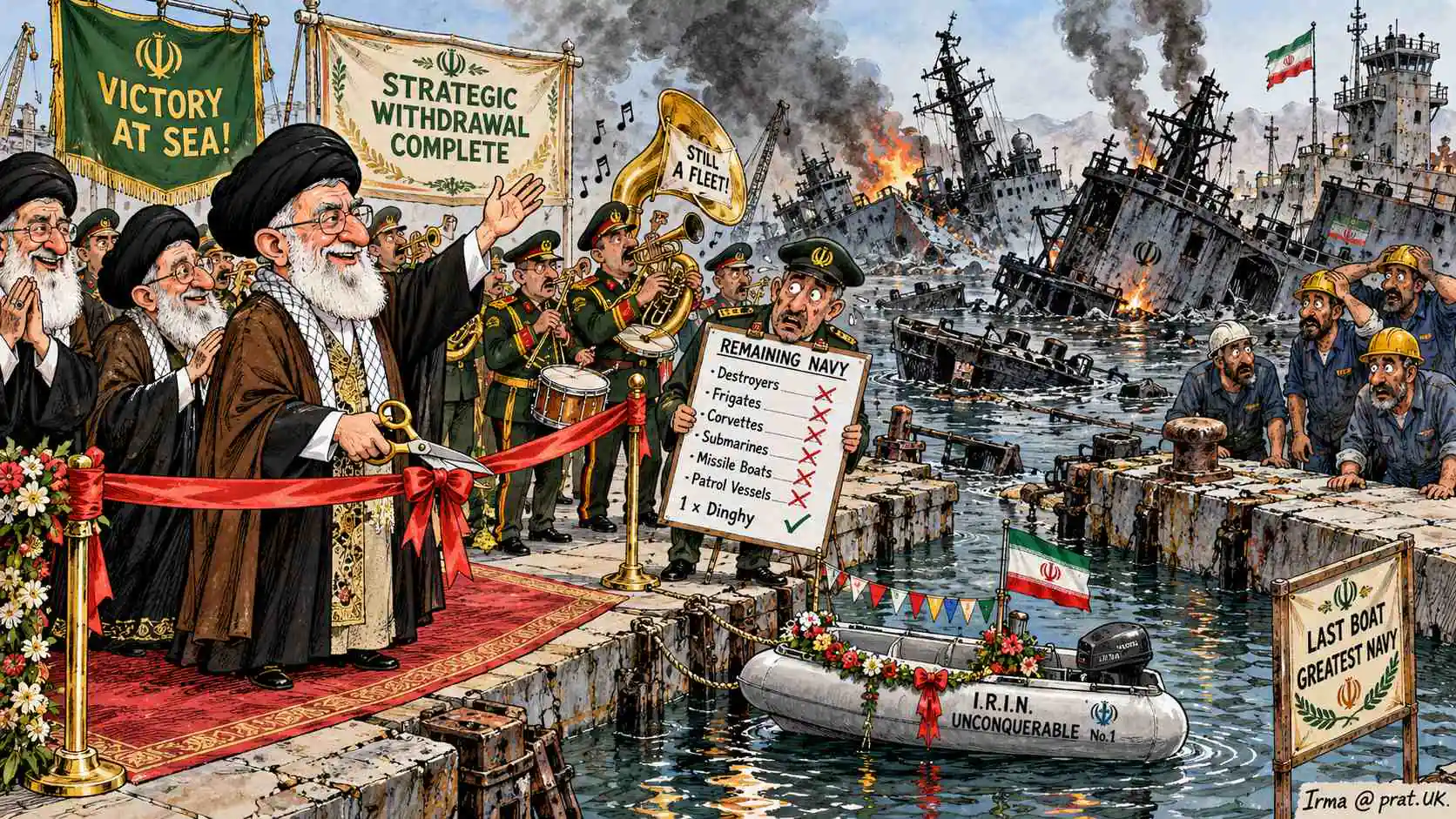
As long as one ayatollah has a microphone, the war is going splendidly.
TEHRAN, IRAN, October 19, 2026 – Iran’s ruling clerics have declared an unprecedented military triumph over the United States, explaining that the continued existence of even one senior religious official able to issue threats is overwhelming proof that the Islamic Republic has defeated the world’s most powerful conventional military.
The remarkable reading of military success comes as American forces continue to show overwhelming technological superiority, while Iran tries to offset its conventional disadvantages through regional attacks and disruptions to commercial shipping.
According to a Reuters investigation into Iranian strikes against Gulf infrastructure, Iran and its allies have shown they can damage economically important facilities despite heavy military losses. Tehran takes this as proof that losing battles is entirely compatible with winning wars.
The regime has reportedly introduced a new military accounting system. Every destroyed Iranian facility counts as an American expense. Every surviving Iranian official counts as a victory. Every additional day of conflict counts as another historic triumph for the revolution. The system has already produced remarkable results: on paper, Iran is undefeated. Considerably less of the country is undefeated in practice.
New Victory Doctrine: If the Ayatollah Still Has a Microphone, America Has Lost

Western militaries traditionally judge wars by capabilities, territory, casualties, operational objectives and political outcomes. Iran’s ruling establishment has developed a simpler method. Find an ayatollah. Check whether he can still speak. If yes, announce victory.
A new Ministry of Military Mathematics has been set up to explain how devastating losses can be converted into overwhelming success without any additional military equipment. Under the new system, the destruction of ten missile launchers becomes ten demonstrations of American aggression. The loss of a naval vessel becomes proof the vessel successfully attracted American attention. The elimination of an air defense installation becomes evidence that Iran forced America to expend another expensive weapon. And the destruction of an important command center counts as a major victory, because the United States has now revealed exactly where the command center used to be.
One government economist calculated that if Iran kept suffering losses at the current theoretical rate, the regime might eventually achieve total victory by running out of military targets altogether. Officials praised the finding. The economist was later questioned for suggesting the government could run out of anything.
Iranian Navy Promoted to Submarine Fleet After Unscheduled Conversion

Iran’s remaining naval establishment has reportedly been encouraged to take a flexible view of maritime operations. Under the revised doctrine, a surface vessel damaged beyond repair is no longer lost. It has simply transferred permanently to underwater service.
The policy has real administrative benefits. A vessel on the seabed uses little fuel, needs fewer sailors, and is very hard to spot on ordinary surface radar. Officials have proposed counting every destroyed ship as a newly commissioned submarine, so the navy would grow every time another vessel was lost. Western admirals would struggle to compete with a fleet that expands through destruction.
A surviving Iranian naval officer reportedly asked whether the government planned to recover any of the sunken equipment. The question was referred to the Ministry of Revolutionary Optimism, which determined that recovery was unnecessary because the ships had successfully completed their transition to permanent underwater deployment.
Ordinary Iranians Asked to Celebrate Victory With Almost Nothing to Celebrate
The regime’s view of military success creates a problem for ordinary Iranians. Governments can announce victories without improving living conditions. Families can’t eat patriotic speeches. Workers can’t use revolutionary slogans to replace damaged infrastructure. Shopkeepers can’t pay suppliers with assurances that the American military has suffered a humiliating moral defeat.
Iran’s citizens already live with government repression, economic isolation and years of confrontation with foreign powers, conditions that the Council on Foreign Relations has chronicled in detail. A prolonged conflict adds new dangers to employment, infrastructure, personal security and everyday survival. Yet the ruling establishment keeps putting extraordinary emphasis on its own political survival.
That lets Tehran define national success in terms that need remarkably little actual national success. One surviving official can declare victory. One working television studio can broadcast it. One government spokesman can explain it. A country of millions is then expected to behave as though everything is going splendidly.
Political philosophers have a term for this arrangement: confusing the survival of the government with the welfare of the governed. Iranian authorities would object to the definition. They prefer “revolutionary resilience.” The difference matters. Resilience ordinarily means surviving hardship and coming out stronger. Under the regime’s version, it means making sure the hardship lasts long enough for the leadership to congratulate itself.
Mullahs Discover the Strait of Hormuz Is More Effective Than the Remaining Navy

Iran’s continuing ability to threaten commercial shipping offers a more serious explanation for why the conflict hasn’t ended. Iran doesn’t have to beat the American Navy in a conventional fight to influence international energy markets. It can threaten maritime traffic, raise commercial uncertainty and impose costs on countries far from the battlefield, which is why the U.S. Energy Information Administration tracks the Strait of Hormuz as a critical oil chokepoint. That gives a militarily weakened regime continuing political leverage.
It also shows the difference between damaging an opponent and building a successful country. Disrupting oil shipments can make gasoline more expensive in America. It can’t restore destroyed Iranian infrastructure. Threatening commercial vessels may create international pressure. It can’t produce a working domestic economy. And frightening neighboring countries is no substitute for offering ordinary Iranians a peaceful and prosperous future.
Tehran’s Ministry of Military Mathematics has rejected the criticism. Officials insist that every expensive gallon of American gasoline is another Iranian victory. By that math, an Iranian family that can’t afford basic necessities is simultaneously taking part in the greatest military achievement of the modern age.
The regime has therefore proposed an annual national celebration. Citizens will be invited to attend victory parades, applaud surviving officials and express gratitude for the leadership’s strategic wisdom. The parade route will be announced once authorities find a road suitable for the procession. The naval demonstration has been canceled for logistical reasons. The air show is under reconsideration. The television broadcast will go ahead, provided the studio has electricity.
And somewhere in an undisclosed government building, one surviving ayatollah will announce that America has finally been defeated. The United States may disagree. Iran’s ordinary citizens may have opinions of their own. But the regime has already determined the result.
As long as somebody remains available to declare victory, defeat is mathematically impossible.
Five Observations From the Basement
- They lost the navy, so they’re calling the wrecks “submarines.” That’s the most creative thing anybody’s done since my brother-in-law called his unemployment “a sabbatical.”
- The Ministry of Military Mathematics. You know it’s bad when the math department needs its own ministry. I flunked algebra and even I’d say, “Hey, guys, the numbers go down.”
- One ayatollah, one microphone, and the war’s going great. That’s not a military strategy, that’s a guy with a podcast.
- They proposed a victory parade, but first they need to find a road. Buddy, the parade is not your problem. The road is your problem. Always has been.
- Revolutionary resilience. Look, when my wife says “I’m fine,” that’s resilience. When the government says it, that’s the part of the movie where the audience yells, “Don’t go in the basement!”
Editorial disclaimer: Reuters’ investigation into Iranian strikes on Gulf infrastructure and the Council on Foreign Relations and EIA material are real. The Ministry of Military Mathematics, the navy’s promotion to submarine fleet and the victory parade are comic inventions, and the joke is on the regime, not on the Iranian people who live under it. This disclaimer has declared victory over its own word count, a doctrine now taught across our political satire.

Alan Nafzger was born in Lubbock, Texas, the son Swiss immigrants. He grew up on a dairy in Windthorst, north central Texas. He earned degrees from Midwestern State University (B.A. 1985) and Texas State University (M.A. 1987). University College Dublin (Ph.D. 1991). Dr. Nafzger has entertained and educated young people in Texas colleges for 37 years. Nafzger is best known for his dark novels and experimental screenwriting. His best know scripts to date are Lenin’s Body, produced in Russia by A-Media and Sea and Sky produced in The Philippines in the Tagalog language. In 1986, Nafzger wrote the iconic feminist western novel, Gina of Quitaque. He currently lives in Holloway, North London. Contact: [email protected]