A German supermarket beats Northern Ireland’s licensing rules by hiring a bartender.
BELFAST, 19 October 2026. Northern Ireland’s licensing system has scored a victory for regulatory complexity after German supermarket chain Lidl found that the most practical way to sell alcohol near Belfast was to open an actual pub.
The Middle Ale Opens in Dundonald
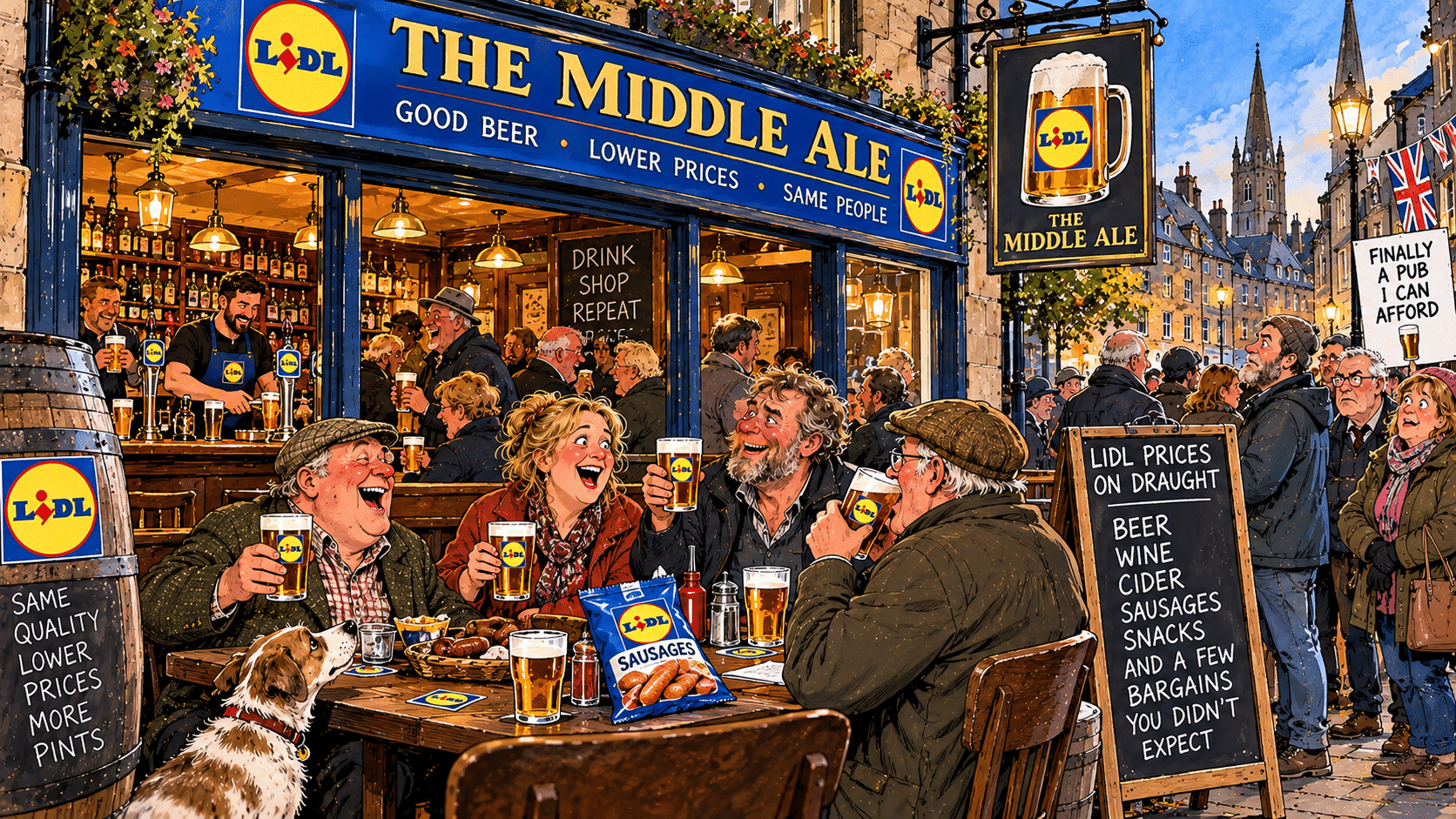
The establishment, called The Middle Ale, opened in Dundonald in June following Lidl’s difficulties obtaining an off-licence. According to RTÉ’s report on Lidl’s Northern Ireland pub and licensing rules, the company successfully pursued a pub licence after being unable to demonstrate inadequate local off-licence provision.
It’s a fine piece of British regulatory engineering.
In most countries, a supermarket wishing to sell a bottle of beer applies for permission to sell beer.
In Northern Ireland, the process may apparently involve buying property, hiring bartenders, installing bar stools and becoming a completely different category of business. The rules sit in the Licensing (Northern Ireland) Order 1996, and the Department for Communities oversees them.
Why a Supermarket Needed to Become a Pub
A retired Belfast businessman compared the arrangement to requiring a butcher to set up a cattle ranch before receiving permission to sell sausages.
“The next thing you know,” he said, “Tesco will have to build a hospital to stock aspirin.”
Lidl’s new establishment has attracted considerable attention from shoppers who previously associated the supermarket’s famous middle aisle with unexpected household discoveries.
Customers who go in for milk might leave with a welding machine, an inflatable kayak or an industrial leaf blower.
Now they can add a pint to the experience.
The Middle Ale is an especially fitting name because it combines Britain’s two great cultural traditions: drinking and buying equipment nobody knew they needed.
Administrative Judo: How Lidl Beat the Licensing Rules
Economic analysts have praised the supermarket’s flexibility. Lidl Northern Ireland did not abandon the investment when it hit complicated regulations. It changed the business model until the paperwork surrendered.
One consultant described the strategy as administrative judo.
“The government said you can’t do that,” he said. “So Lidl did something significantly more complicated, and the government said that’s perfectly acceptable.”
The episode has also raised questions about the effectiveness of licensing restrictions meant to regulate alcohol availability.
A system designed to limit the number of alcohol retailers has now encouraged a retailer to become an additional hospitality business.
That’s roughly equivalent to reducing traffic congestion by telling motorists they cannot buy petrol unless they first buy a second car.
Traditional Publicans Face Competition From Discounted Power Tools
Northern Ireland’s hospitality industry has welcomed the publicity, although traditional publicans are understandably concerned about competing with a company that can sell a pint alongside discounted power tools.
A local drinker described his ideal evening at The Middle Ale.
“I’ll have two lagers, a packet of crisps and whatever you’ve got in the middle aisle that can cut through concrete.”
Government regulators have declined to explore the broader philosophical implications.
After all, if rules create unexpected business behaviour, officials might eventually be asked whether the rules themselves make sense.
That would require a regulatory impact assessment.
The assessment would require consultation.
The consultation would require funding.
And the funding would probably require a new tax on beer.
Meanwhile, economists have identified the greatest benefit of the new arrangement.
Lidl has shown that the private sector can occasionally overcome government obstacles by building something people actually want.
The government has shown that it can turn the simple act of selling alcohol into a construction project.
Northern Ireland has gained another pub.
Everybody wins, apart from the people who originally wanted to buy a bottle of wine without opening a hospitality business.
The next logical development is a supermarket funeral home.
Apparently, that’s the only way to get permission to sell flowers after six o’clock.
Five Humorous Observations on Lidl’s Pub
- Lidl wanted to sell beer, so they opened a pub. That’s like going to the bank for a loan and the bank says, “We can’t do that, but we can make you the manager.” And you take it! You’re in! You’ve got a lanyard!
- The Middle Ale. Come on. That’s the best pub name in Britain, and a German supermarket came up with it. We’ve got a thousand pubs called The Red Lion and Lidl walks in with a pun. That’s embarrassing. That’s a national failing.
- You go in for a pint and the bloke next to you’s got a kayak. You ask him why. He says, “It was in the middle aisle.” Nobody questions it. That’s the most peaceful bar fight that’s ever not happened.
- A butcher setting up a cattle ranch to sell sausages. Actually, I know a guy who does that. Lives in Dorset. Won’t stop talking about it. He’s got a cow called Sheila and she’s the only one who sleeps.
- Impact assessment, consultation, funding, new beer tax. It’s the circle of life. Except in this one the lion gets lost, the lion fills out a form, and a different lion takes a cut.
This article is a work of political and social satire. It uses real reported events as a starting point for exaggeration, comic dialogue and absurd policy proposals. Quoted comic characters and government proposals are presented for humorous effect and should not be treated as verified statements or actual announcements. The Middle Ale really does exist in Dundonald, unlike the bloke at the bar with the discount kayak, and anyone ordering a pint with their power tools should first check what prat means in Belfast.

Staff Writer at The London Prat