Revolutionary economists say workers should be spared the burden of owning a sandwich.
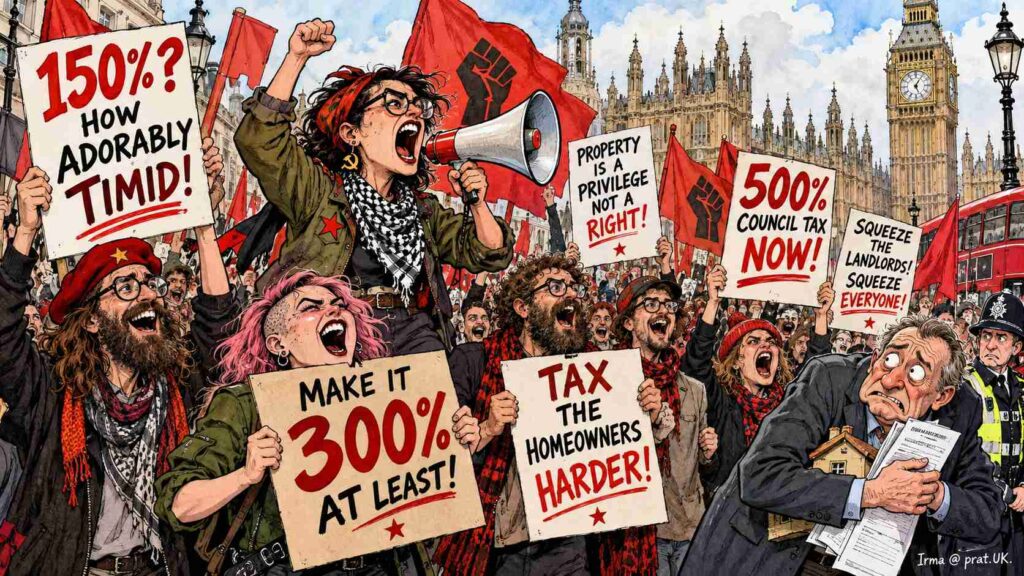
LONDON, ENGLAND – Revolutionary socialist campaigners have expressed profound disappointment at proposals to raise council tax by as much as 150% in parts of London, arguing that the increases represent a cowardly compromise with capitalism.
According to the Evening Standard, London boroughs face significant financial pressure. Hammersmith and Fulham is examining a particularly large increase in its own council tax charge, and Wandsworth is considering a rise of roughly 94%, as LBC has also reported.
For the revolutionary left, the proposals expose the continuing weakness of British socialism. A tax increase of 150% still leaves citizens with some private income.
This is considered dangerously permissive.
Workers Demand Freedom From the Burden of Having Money

At a gathering of the People’s Revolutionary Committee for Equitable Municipal Extraction, campaigners called for the immediate abolition of disposable income. Under their proposal, all wages would go directly to the local council. Residents would then receive a weekly allowance of government-approved products, provided supplies were available and the distribution committee hadn’t called a strike.
A movement spokesperson explained the economic philosophy. “Money creates inequality because some people have more of it than others,” she said. “Our objective is to eliminate the problem by making sure ordinary people have none.”
The committee argues that the policy would abolish poverty as a statistical category. If everybody owns nothing, wealth inequality among the general population becomes much easier to calculate.
The leadership would naturally keep access to vehicles, offices, international conferences and essential ministerial accommodation. These are not privileges. They are revolutionary necessities.
Private Property Condemned as an Outdated Bourgeois Obsession

The movement’s housing policy would abolish private residential ownership. Families would hand their homes to municipal authorities, which would then allow them to remain inside under a renewable Occupancy Allocation Agreement. Applicants would be assessed on household size, political reliability and demonstrated enthusiasm for communal vegetable production.
One homeowner asked whether he would be compensated for giving up a property bought through thirty years of mortgage payments. The committee explained that compensation would undermine the moral achievement of confiscation. He would instead receive a certificate recognising his contribution to the collective good.
The certificate would remain the property of the state.
Residents who need extra space would apply to the Department of Equitable Bedrooms. A single man with three bedrooms would be reassigned to a cupboard. A government official with one bedroom would be awarded a five-bedroom property to host important meetings about housing equality.
This, the committee insists, is not hypocrisy.
It is dialectics.
Marxist Economists Propose Abolishing Economic Calculation
The revolutionaries have also criticised the Government for continuing to rely on funding formulas, council tax bands, revenue forecasts and financial planning. These mechanisms are seen as leftovers of capitalist economics.
Under the socialist alternative, prices would be abolished, and the cost of providing services would therefore fall to zero. Asked about wages, materials, equipment and energy, the committee explained that these were artificial costs created by capitalism.
Under socialism, a refuse lorry would run without fuel because the workers would be ideologically motivated. Potholes would vanish once the roads were publicly owned. And council housing would be built through collective enthusiasm, backed by occasional compulsory attendance.
Ludwig von Mises argued in 1920 that rational economic calculation is impossible without market prices, and F. A. Hayek later added that the knowledge a planner would need is scattered across millions of individuals. The committee has not yet read either of them, but it has already condemned both.
A local economics student said he was worried that removing prices wouldn’t remove scarcity. The committee congratulated him on spotting counterrevolutionary thinking at an unusually early age.
He was appointed Assistant Director of Scarcity Denial.
Food Distribution Becomes a Triumph of Equality
Revolutionary planners have also drawn up an ambitious food programme. All supermarkets would be nationalised. Prices would be abolished. Private food ownership would be discouraged.
Every resident would receive an equal share of available supplies, except members of the Central Food Allocation Committee, who would need extra nourishment to carry out their demanding responsibilities.
One resident asked whether she could buy an avocado. The committee replied that avocado consumption reflected a bourgeois attachment to individual preference. She would receive a turnip. If turnips were unavailable, she would receive a leaflet explaining the revolutionary advantages of turnips.
The leaflets would be printed in full colour and paid for by an emergency Turnip Equity Levy.
Any food shortages would be blamed on international capitalism, bad weather and insufficient commitment to the revolution. Under no circumstances would they be linked to the abolition of prices, competition and market signals.
The Revolution Discovers the Workers Are Not Enthusiastic
Public reaction to the proposed confiscation programme has been disappointingly bourgeois. Workers worried about losing their pay. Pensioners objected to handing over their savings. Homeowners complained about losing their property. Small business owners wondered how anyone would produce goods without incentives.
These responses have convinced revolutionary organisers that the population isn’t yet educated enough to experience economic liberation. A comprehensive programme of compulsory political education has therefore been proposed.
Citizens will attend three weekly seminars explaining why personal prosperity is selfish and collective sacrifice is noble. Attendance will be monitored. Anyone who refuses to take part will be assessed for an Individualism Correction Contribution, collected through compulsory deductions from their remaining wages.
The movement has also promised complete freedom of speech, provided speakers support the principles of the revolution.
Revolutionary Leadership Seeks Modest Accommodation
As the campaign gathered momentum, organisers announced plans for a permanent headquarters in Kensington. A substantial property with six bedrooms, private parking and a landscaped garden was selected to house the movement’s Central Committee.
Asked about the apparent contradiction between abolishing private luxury and occupying an expensive property, organisers explained that revolutionary leadership requires suitable accommodation. The workers would eventually enjoy the same comforts after the successful completion of the Five-Year Plan.
A preliminary date has been set for the year 2087.
Meanwhile, Londoners facing 150% increases in their local council tax can take comfort in one thing. There is an entire political movement convinced the Government hasn’t gone nearly far enough.
The movement’s final declaration summed up its position. “From each according to his ability, to each according to the committee’s available budget,” it read, borrowing a famous line from Marx’s Critique of the Gotha Programme and adjusting the terms.
Following the announcement, the committee demanded a larger budget.
SOURCE: Evening Standard, council tax bill rises in London boroughs
Humorous Observations
- A 150% tax rise and the socialists say it’s not enough. That’s like complaining your mugger only took your wallet and left you the shoes.
- They want to abolish money so nobody has any. Brilliant. Except the leadership keeps the cars, the offices, and the conferences. It’s the only revolution where the guys at the top still get a corporate card.
- Prices get abolished, so services cost zero. That’s my toddler’s economics. “If I can’t see the bill, there isn’t one.”
- You ask for an avocado, you get a turnip. You ask for a turnip, you get a leaflet about turnips. The leaflet is in full colour, which is the only thing in the whole system that’s been funded properly.
- Utopia arrives in 2087. That’s the same delivery estimate as every parcel I’ve ever ordered with “free shipping.”
Disclaimer: This article is political satire. The People’s Revolutionary Committee for Equitable Municipal Extraction, its spokesperson, the Turnip Equity Levy and the Kensington headquarters are comic inventions; the council tax proposals come from the published reporting linked in the text, and the references to Mises, Hayek and Marx are real. The committee demanded 150% of this disclaimer and was offered a turnip, so readers may enjoy more British satire and funny news stories without a ration book.

Harper Thames is a comedic writer exploring modern life through irony and subtle exaggeration. Rooted in student perspectives and London’s cultural landscape, Harper’s work focuses on relatable humour grounded in everyday experience.
Expertise is developed through writing practice and critical engagement, while authority comes from authenticity and consistency. Trust is reinforced by transparent satire and ethical humour choices.