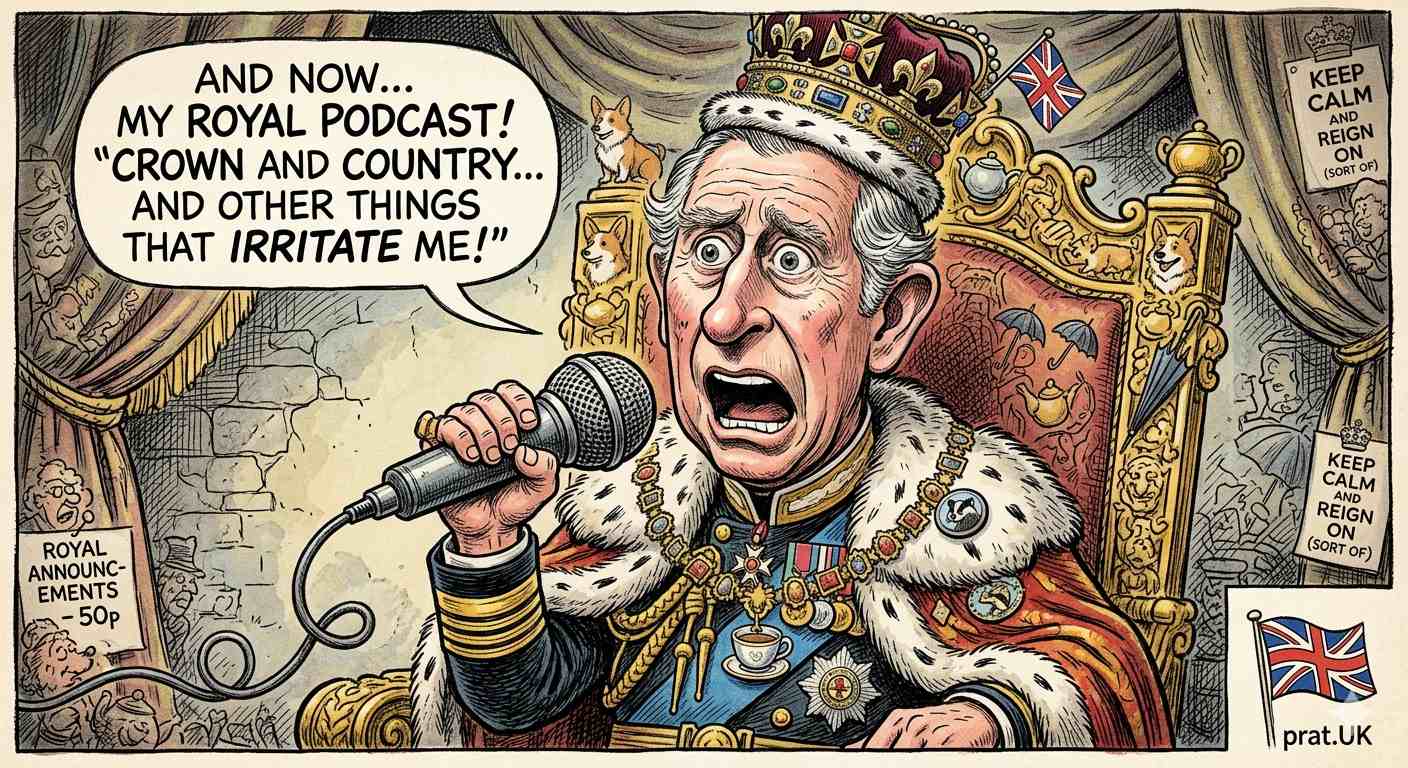
King Charles Delivers Speech Written Entirely by Human Resources Department 👑📋🇬🇧
Five Observations Heard Across Britain Before the Speech Even Ended
- Britons immediately suspected the King’s Speech had been written by Human Resources because every paragraph sounded one complaint away from mandatory sensitivity training.
- The phrase “moving forward together” appeared so often BBC viewers briefly thought they were trapped inside a corporate onboarding seminar with no fire exit and worse biscuits.
- Several Labour MPs applauded enthusiastically despite clearly having no idea what had just been promised besides “stakeholder engagement” and the vague spiritual warmth of being seen.
- One London commuter described the speech as “emotionally supportive but operationally useless,” which coincidentally is also the slogan for most modern governments and several well-reviewed therapists.
- The government promised “security for working people,” causing working people across Britain to instinctively hide their wallets, check their pension projections, and whisper the word “Australia.”
King’s Speech Praised Exclusively by People Who Describe Wi-Fi Passwords as “Transformational”
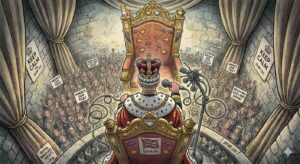
Britain gathered once again for the ancient constitutional ritual known as “pretending a royal speech contains actual specifics.” Wearing robes worth approximately the GDP of Doncaster — and the expression of a man explaining mindfulness techniques during a ferry evacuation — King Charles III delivered Parliament’s agenda to a chamber full of people paid handsomely to nod.
The speech promised a “fairer, greener, safer, more inclusive Britain,” which analysts confirmed is now the default sentence generated whenever politicians press CTRL+ALT+VISION and absolutely nothing comes out the other end except adjectives.
Within moments, LinkedIn users across London were describing the speech as “deeply transformational,” alongside selfies of themselves in airport lounges holding oat flat whites and rethinking their personal brand.
One management consultant in Shoreditch called it “a courageous framework for narrative-led societal optimisation,” which translated loosely means: “I charge £400 an hour to rename confusion, and today I earned every penny.”
BBC political editor Clive Farnsworth said the speech contained “aspirational language designed to unify the country.” He later admitted, off camera and visibly exhausted, that this was also how airlines describe turbulence — technically accurate, structurally meaningless, delivered with a smile that does not reach the eyes.
Britain’s Economic Recovery Now Powered Entirely by Diversity Panels and the Phrase “Moving Forward”
The government unveiled what it called a “National Mission for Economic Renewal,” immediately triggering collective flashbacks to every failed council redevelopment project involving abstract sculptures, heritage interpretation boards nobody reads, and bicycle racks permanently occupied by a single abandoned Raleigh Chopper.
Treasury officials explained Britain’s economy would now grow through “inclusive partnerships,” “innovation pathways,” and “green resilience ecosystems” — phrases so magnificently vague they could describe either a comprehensive industrial strategy or a yoga retreat in Bristol run by someone called Jasper.
According to leaked internal memos — discovered stuffed behind a printer in a Whitehall breakout space — the new economic strategy contains 127 separate initiatives, 49 committees, 18 working groups, and one 600-page report titled Reimagining Prosperity Through Collaborative Listening: A Framework for Listening About the Framework.
Actual manufacturing was not mentioned once.
Professor Malcolm Henshaw of the Institute for Applied Common Sense stared at the speech for forty minutes in complete silence before whispering, “This entire economy appears to run on PowerPoint now.”
Henshaw later produced charts showing Britain currently employs more diversity consultants than bricklayers, welders, and people capable of fixing train station toilets combined. He was subsequently invited to speak at eleven conferences and ignored by all twelve government departments he contacted directly.
Government Unveils Fairer Society Where Everyone Struggles Equally — Except Obviously Not Everyone
The speech repeatedly emphasised “fairness,” a word now deployed so aggressively in British politics it has lost all structural meaning and become verbal wallpaper — the magnolia emulsion of democratic discourse.
Under the new vision, citizens are expected to share sacrifice equally, except for cabinet ministers, hedge fund donors, anyone owning property within walking distance of a Waitrose, and people whose job titles contain the word “strategist” or end in the suffix “-ologist.”
One anonymous Downing Street staffer explained the underlying philosophy with remarkable candour for a Tuesday afternoon:
“The public must understand that fairness means we all lower expectations together. Simultaneously. As a community. In a trauma-informed way.”
Citizens responded warmly to this announcement by immediately Googling “moving to Australia,” then Googling “Australia visa requirements,” then quietly closing the laptop and making a cup of tea in the particular British way that means someone has given up.
Outside Birmingham, plumber Gary Tuttle watched the speech from his van whilst eating a lukewarm sausage roll of uncertain vintage.
“They keep talking about fairness,” Gary sighed, gesturing at the radio with what remained of his pastry. “Last week my council tax went up, my electric bill doubled, someone nicked my catalytic converter, and a man from the council sent me a letter about my bins in a font that cost £60,000 to commission.”
A new public opinion poll from the Daily Crumpet found that 63% of Britons now believe “shared sacrifice” means “middle class people stop buying nice cheese.” The remaining 37% had already stopped buying nice cheese and were furious nobody had mentioned it sooner.
Labour Promises “Security for Working People,” Working People Immediately Open Tax Calculators
Labour ministers insisted the speech would improve economic security for ordinary families. Millions of ordinary families celebrated by opening spreadsheets, quietly sweating, and rereading their employment contracts for anything that might soon be reclassified as a benefit.
Financial analyst Rebecca Moore said the speech contained “many reassuring emotional concepts” but conspicuously avoided discussing how Britain might actually pay for them without turning the average plumber into a temporary wartime funding mechanism dressed as a stakeholder.
“There’s a magical quality to modern British politics,” Moore explained. “Every new benefit somehow arrives attached to your payslip like a surprise parking ticket on Christmas morning. It’s less a welfare state, more a subscription service you never agreed to but cannot cancel.”
Meanwhile, one Labour adviser defended the agenda by insisting Britain needed “bold long-term thinking.” He then excused himself to attend a workshop on bold long-term thinking and was not seen again until late April.
This phrase — bold long-term thinking — traditionally means taxes will rise before trains do, as it has meant every time it has appeared in a British manifesto since approximately the Magna Carta.
Downing Street Unveils 127-Point Plan to Improve Britain Without Mentioning Immigration Even Once
Observers quickly noticed the government’s sprawling reform package somehow avoided directly discussing immigration despite housing shortages, strained public services, and rental prices that now resemble ransom demands written by someone who watched too much property television.
Political strategists later confirmed the topic had become so radioactive ministers now refer to it internally as “The Voldemort Spreadsheet” — that which must not be tabled, circulated, or accidentally left open on a laptop during a Zoom call with a journalist.
One BBC producer admitted journalists had been instructed to focus instead on “community cohesion narratives,” which sounds suspiciously like something printed on an inspirational mug in a university HR office beside a bowl of complimentary stress balls nobody is allowed to squeeze aggressively.
At one point the King praised Britain’s “thriving communities,” causing involuntary laughter in parts of London where residents currently compete against hedge fund algorithms for studio flats the approximate size and ventilation standards of a microwave oven.
Britain to Become Green Energy Superpower at Some Point After the Wind Turbines Start Working Reliably
Perhaps the speech’s boldest claim involved transforming Britain into a “clean energy superpower” — an announcement that arrived mere hours after several wind turbines reportedly stopped spinning during weather conditions experts technically described as “outside.”
Energy Secretary officials insisted Britain remained committed to renewable infrastructure, a statement delivered with the particular ministerial confidence of someone whose home heating bill is paid by the taxpayer and therefore remains an abstraction.
In Yorkshire, pensioner Linda Hargrove wrapped herself in four blankets, a spare curtain, and what appeared to be a tablecloth whilst listening to ministers discuss sustainability targets for 2035.
“I fully support green energy,” she said, breathing visible air inside her own kitchen. “I’d also like to feel my toes again before the decade is out, but I understand one must prioritise.”
An internal energy department study allegedly warned that Britain’s power grid remains “vulnerable to darkness, rain, overcast skies, excessive sunlight, mild wind inconsistencies, an unusually still Tuesday, and Britain itself.” The study was immediately reclassified as a working group and invited to three conferences in Bristol.
King Charles Forced to Announce Policies That Sound Like LinkedIn Motivational Posters
As the speech continued, even veteran royal correspondents began noticing every sentence bore an uncanny resemblance to content posted online by recently divorced startup founders posing thoughtfully beside airport windows with captions about “choosing discomfort.”
Phrases like “unlocking potential,” “empowering communities,” and “building resilient futures” drifted through Parliament like scented candles manufactured entirely from corporate jargon and the processed optimism of people who have never personally fixed anything.
By the seventh standing ovation — a number that suggested either genuine enthusiasm or a collective inability to remain seated without it becoming a thing — one exhausted BBC cameraman reportedly whispered to a colleague:
“I haven’t heard this many empty affirmations since my ex-wife joined a wellness pyramid scheme and started describing meal replacement shakes as a ‘mindset.'”
Still, MPs nodded solemnly after every sentence: partly out of constitutional respect for the monarchy, partly because nobody wanted to be filmed looking sceptical, and partly because several had only just noticed they were being filmed at all.
What the Funny People Are Saying
“British politics now sounds like a motivational podcast hosted by a man who owns three scarves, no practical skills, and recently described his commute as a ‘healing arc.'” — Ricky Gervais
“The government says ‘moving forward’ because ‘standing completely still while the heating fails’ polls badly, even in focus groups.” — Jimmy Carr
“They keep talking about resilience. British people are resilient — we survive £14 airport sandwiches containing one molecule of chicken and a philosophical question about what egg mayonnaise really means.” — Romesh Ranganathan
The National Mission Continues, Largely Undisturbed by Results
As Parliament emptied, ministers congratulated each other on unveiling a bold new national mission. Outside Westminster, commuters stood beside cancelled train announcements, Deliveroo cyclists narrowly avoided electric scooters, and a man screamed at pigeons with the focused energy of someone who had listened to the entire speech and arrived at his own conclusions.
Britain, as always, carried on.
The speeches grew longer. The slogans became softer. The taxes quietly expanded like damp patches on an old ceiling — gradual, inevitable, and somehow always discovered at the worst possible moment.
Yet somewhere deep inside government offices, another committee had already begun planning the next committee tasked with reviewing why previous committees failed to improve committee outcomes — a process now officially listed in the National Renewal Strategy as “iterative governance optimisation,” with an allocated budget and a launch event in Bristol.
And perhaps that is the real British tradition: not monarchy, not tea, not even apologising when someone else steps on your foot on the Tube.
It is the eternal, unshakeable national belief that if politicians repeat the words “fairness,” “renewal,” and “moving forward” with sufficient conviction and good lighting, eventually nobody will notice the train still hasn’t arrived, the heating still doesn’t work, and somewhere in Whitehall a consultant named Oliver is invoicing the public for having noticed.
This piece of British satirical journalism represents a proud human collaboration between the world’s oldest tenured professor and a philosophy major turned dairy farmer, published by The London Prat in the finest tradition of British satirical journalism since 1961. No consultants were harmed during the writing of this article, though three invoiced the public £28,000 for “narrative resilience alignment,” one submitted an additional £6,400 for “post-alignment reflection services,” and a fifth — who had not been commissioned — sent an invoice anyway on the grounds that it felt like a “natural next step in the journey.” The London Prat accepts no responsibility for elevated blood pressure, involuntary tutting, or the uncontrollable desire to move to a country where trains occasionally arrive.
Auf Wiedersehen, amigo!

Aishwarya Rao is a satirical writer whose work reflects the perspective of a student navigating culture, media, and modern identity with humour and precision. With academic grounding in critical analysis and a strong interest in contemporary satire, Aishwarya’s writing blends observational comedy with thoughtful commentary on everyday contradictions. Her humour is informed by global awareness and sharpened through exposure to London’s diverse cultural and student communities.
As an emerging voice, Aishwarya represents the next generation of satirical journalists: informed, curious, and unafraid to question norms through wit. Her authority stems from research-led writing, respect for factual context, and a commitment to ethical satire. Transparency and clear labelling ensure readers understand the comedic intent behind her work.
Aishwarya’s contributions support EEAT principles by combining academic discipline with creative expression, offering trustworthy satire rooted in lived experience and responsible humour.
Email: [email protected]