Exhausted British mothers celebrate the arrival of a household assistant that remembers school uniforms, packed lunches and birthdays without requiring a written threat of divorce.
LONDON, ENGLAND. British motherhood entered a new technological era this week after exhausted London women began employing artificial intelligence to handle family administration, following reports that American parents are increasingly embracing digital household assistants.
The development follows an October 15 report in The New York Times examining how services including Ollie and Fambot help parents manage the endless administrative responsibilities of raising children. According to the founders of those start-ups, the majority of their users so far are mothers. Nobody at the companies was asked to explain why. Several mothers offered to explain it at length.
Why London Mothers Are Switching to AI Family Assistants

For London mothers, the implications are revolutionary.
“It’s extraordinary,” explained Caroline Whitmore, a mother of three from Clapham. “I asked the computer to remind me about Oliver’s swimming lessons, and it remembered. I didn’t have to ask it six times, shout from the kitchen or threaten to cancel its subscription to Sky Sports.”
Whitmore said her school inbox had been receiving thirty-eight messages a day since September. That is close to the 20 to 40 daily emails about children that the founder of Fambot told Fast Company he receives himself. Mrs Whitmore has a spreadsheet for this. The spreadsheet has a second spreadsheet.
Her husband, Richard, reportedly described the technology as unnecessary because he had always been available to help.
His wife confirmed that Richard’s availability generally began after Match of the Day and ended whenever someone mentioned laundry.
What Does a Family AI Assistant Actually Do?
The family AI assistant now coordinates school uniforms, dental appointments, birthday parties, packed lunches and the increasingly complicated diplomatic negotiations required to persuade a seven-year-old to wear a coat.
Most remarkably, it does so without announcing that it has already worked all day.
A neighbourhood parenting group in Battersea praised the technology after discovering it could remember which child needed a PE kit on Thursday.
Previously, this information had been stored exclusively in the mother’s brain, alongside 4,000 passwords, three food allergies and the location of every missing shoe in Greater London.
The group’s secretary, Fiona Haldane, said the assistant had also identified a recurring pattern in which the PE kit was always needed on the one morning the washing machine had broken. It has been unable to explain the pattern. It has, however, booked an engineer.
The Mental Load Gets a Backup Drive
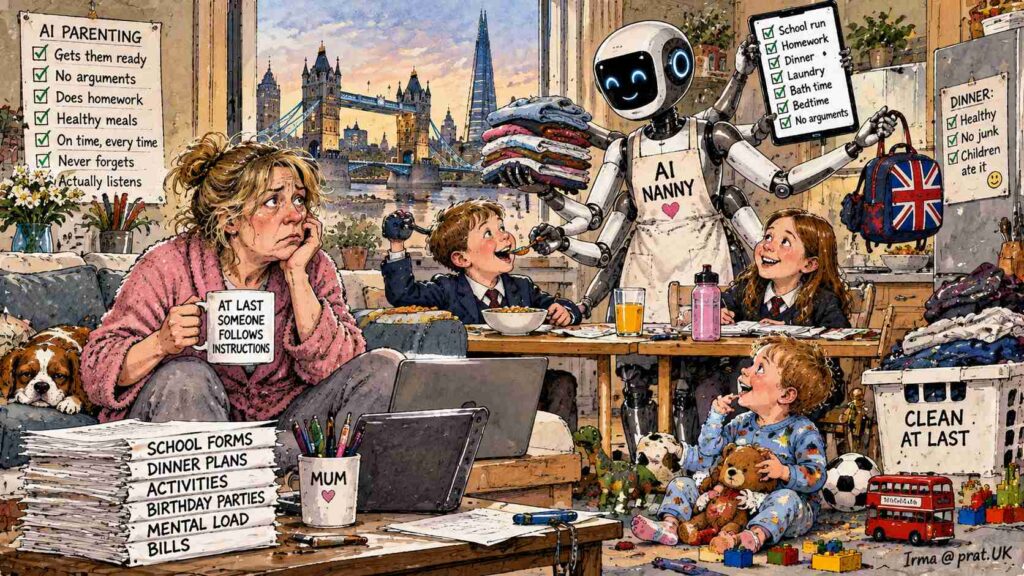
Researchers have been counting this sort of work for years. Analysis by the Office for National Statistics found that women in the UK averaged 26 hours of unpaid work a week against 16 hours for men, covering cooking, cleaning, laundry and childcare.
Caroline Whitmore said she could account for the missing ten hours of her husband’s contribution, and that nine of them were spent looking for his phone while it was in his hand.
Local mothers have welcomed the arrival of a system that does not need to be told twice. One Dulwich woman said she had spent eleven years repeating herself to a household of four and had never once received a confirmation message. The AI sent her three before breakfast.
Early Problems With AI Parenting Apps
There have been complications.
One mother asked her AI assistant to arrange a relaxing weekend. It suggested cancelling football practice, dance lessons and a children’s birthday party.
The children immediately reported the machine to their father.
Richard Whitmore has since expressed concerns that artificial intelligence could destroy traditional family life.
Asked what he meant by traditional family life, he explained that his wife normally handled these matters.
The AI subsequently added “explain traditional family life to Richard” to Caroline’s task list.
It assigned the task a priority of low and a due date of never.
A separate assistant in Putney made a more serious error when it sent a reminder to a father at 7.40 a.m. that read, “Pick up Hattie from nursery.” Hattie had been collected by her grandmother at 7.35. The father arrived anyway, as the system had asked, and spent twenty minutes standing in the nursery doorway with a coffee. He has since described it as the most effective morning he has had all year.
How Mothers Are Using the Extra Time
The question of what women do with the hours they recover has produced a range of answers. Whitmore said she intended to read a book. Her friend Harriet, a mother of two from Wandsworth, said she intended to sit in the car outside the house for forty minutes with the engine off. Another mother in Tooting said she had no plans and would like it noted that this was the first time she could say so truthfully.
For the first time in their marriage, Caroline deleted a reminder without feeling guilty.
She has since deleted four more. The assistant has asked her to confirm that she meant to do that. She has confirmed it twice.
Five Observations on Letting a Robot Run the School Run
- A woman has carried the entire family calendar in her head for twelve years, and the big news is that a computer can do it. Twelve years. She was the server. Nobody paid for the hosting.
- The app reminds you about the PE kit. That’s lovely. It does not, however, make the PE kit appear. The PE kit is still in the washing machine, where it has been since Monday, quietly becoming a different colour.
- Richard says he was always available. Available is a big word. My cat is available. She’s on the radiator. Nobody’s asking her to book the dentist.
- The AI sends a reminder at 7.45 for something that was due at 7.30. That’s not an assistant, that’s a husband with a better interface.
- Every mother in London just said “finally” at the same time, and the whole country’s phones buzzed with a reminder to say it again next Thursday.
The family incidents and quotations described above are satirical commentary on modern parenting, domestic labour and technology. The underlying trend of parents turning to AI household assistants is real. This story is presented in the editorial tradition of an entirely human collaboration between two sentient beings: the world’s oldest tenured professor and a philosophy major turned dairy farmer. The AI assistant fact-checked this disclaimer without being asked six times, which is more than can be said for anyone else in the household; more London satire awaits.