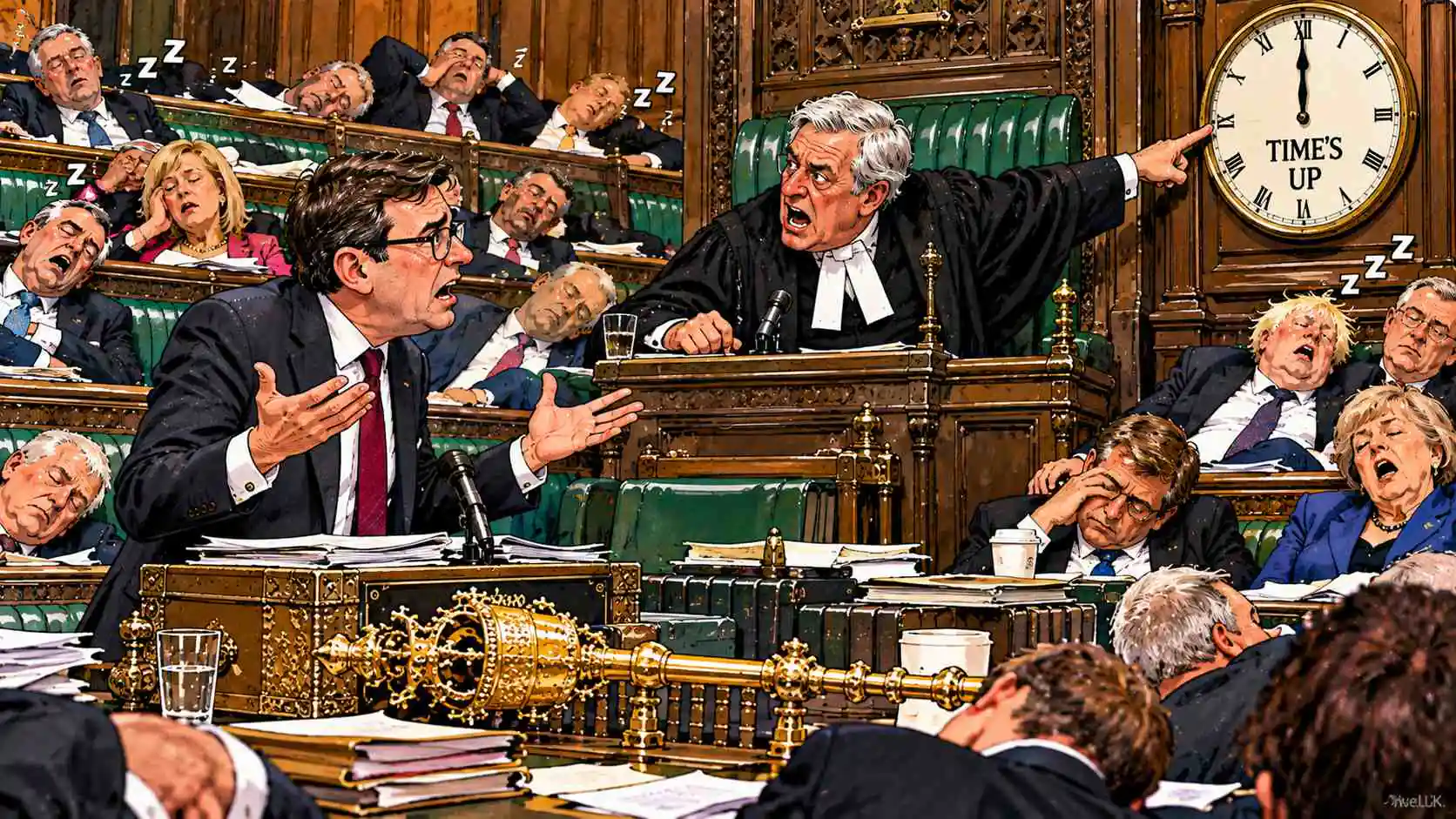
Commuters want a separate penalty for men narrating their divorce on speakerphone.
LONDON, 19 October 2026. Prime Minister Andy Burnham has launched a national crackdown on passengers playing music and videos without headphones, announcing that offenders on buses could face fines of up to £100 after government research apparently established that nobody travelling to work at 7:30 in the morning wants to hear somebody else’s TikTok addiction.
The Headphone Dodger Campaign Explained
The new campaign, reported by The Guardian in its coverage of the public transport noise crackdown, encourages considerate behaviour and supports local enforcement powers in England. Existing railway rules, enforced by the British Transport Police, can carry higher penalties.
The Department for Transport has identified a particularly dangerous category of modern passenger known as the headphone dodger.
These individuals appear to believe that buying a £1,000 smartphone entitles them to run a mobile nightclub on public transport.
Their preferred music is generally played through a speaker about the size of a postage stamp, producing the acoustic quality of a distressed mosquito trapped inside a biscuit tin.
Speakerphone Divorces: Britain’s Real Audio Emergency
Passengers have overwhelmingly welcomed the campaign, although many believe it fails to address Britain’s most serious audio emergency: people conducting deeply personal conversations on speakerphone.
A commuter travelling from Croydon reported being forced to listen to a stranger explaining the collapse of his seventeen-year marriage between East Croydon and London Bridge.
“By the time we arrived, I knew his wife’s name, her solicitor’s hourly rate and why she took the Labrador,” he said.
“I wanted to get off the train, but I also wanted to know whether Nigel got custody of the caravan.”
Transport officials are considering whether passengers should receive financial compensation for involuntarily taking part in other people’s domestic disputes.
One proposal would require anybody discussing a divorce publicly to hand out printed programmes listing the principal characters, the relevant allegations and the anticipated emotional developments.
Commuters could then make an informed decision about whether to keep listening.
Teenagers, Privacy and the Audience Problem
The crackdown has created particular anxiety among teenagers who have never experienced music without an audience.
One seventeen-year-old reportedly asked how other passengers were supposed to know what he was listening to if he wore headphones.
A transport psychologist explained that the young man had misunderstood the purpose of personal entertainment.
“His generation believes privacy is what happens when nobody likes your video,” she said.
Other offences under consideration include watching football highlights at maximum volume, conducting business meetings with the camera pointed at one’s nostrils and playing motivational podcasts about becoming a millionaire while travelling on a bus that smells of wet socks.
The government has also been urged to regulate passengers who eat particularly aggressive food, with Transport Focus reported to be reviewing the evidence.
A woman carrying hot tuna sandwiches through a crowded Tube carriage was described as responsible for an environmental incident requiring immediate diplomatic intervention.
A Rare Moment of Cross-Party Unity
Burnham’s campaign represents a rare moment of national unity.
Conservatives, Labour supporters, Reform voters and Liberal Democrats have all found a common enemy.
Not inflation. Not immigration. Not the national debt.
A man called Darren watching short videos without earphones.
The government is now examining whether the principle can be extended to Parliament.
MPs who speak loudly without saying anything useful would face immediate financial penalties.
Treasury officials have warned that such a policy could eliminate the national debt within a fortnight.
Five Humorous Observations on the Bus Music Crackdown
- A hundred pounds for playing music on a bus. Fine. But who’s checking? Is there a guy? Is there a man with a clipboard at the back of the 73 going “Sir, is that Drake?” Because that’s a job I’d take. That’s a job where you get to be hated by everyone and also right.
- You can always tell the headphone dodger. It’s a lad, sat there, phone held up like a sandwich, playing something that sounds like a fridge having an argument. He’s not even listening to it. He’s presenting it.
- The divorce guy is worse, though. Because with music you can sort of tune out. With a divorce you’re invested. I’ve been on a bus for forty minutes and I want Nigel to get the caravan. I’ve got opinions. I’ve never met Nigel.
- Seventeen-year-old asks, “How will people know what I’m listening to?” Mate. That’s the entire point of listening. It’s the only thing in your life you’re allowed to do without being rated.
- Burnham’s gone after the music, the speakerphones, the tuna. He’s one step away from banning breathing near strangers. Which, to be fair, is just the Tube.
This article is a work of political and social satire. It uses real reported events as a starting point for exaggeration, comic dialogue and absurd policy proposals. Quoted comic characters and government proposals are presented for humorous effect and should not be treated as verified statements or actual announcements. This disclaimer was read aloud on the top deck of a night bus without headphones, and the man narrating his divorce on speakerphone still won; passengers wishing to complain should do so quietly, in writing, and only after reading our political satire at a respectful volume.

Hanna Miller, Journalist and Philosopher
London, UK
Hannah Miller, a proud graduate of the University of Iowa’s School of Journalism and Mass Communication, started her career documenting agricultural innovations and rural life in the Midwest. Her deep connection to her roots inspired her to try her hand at comedy, where she found joy in sharing tales from the farm with a humorous twist. Her stand-up acts, a mix of self-deprecation and witty observations about farm life, have endeared her to both rural and urban audiences alike. She is a four-year resident to London and the UK.