
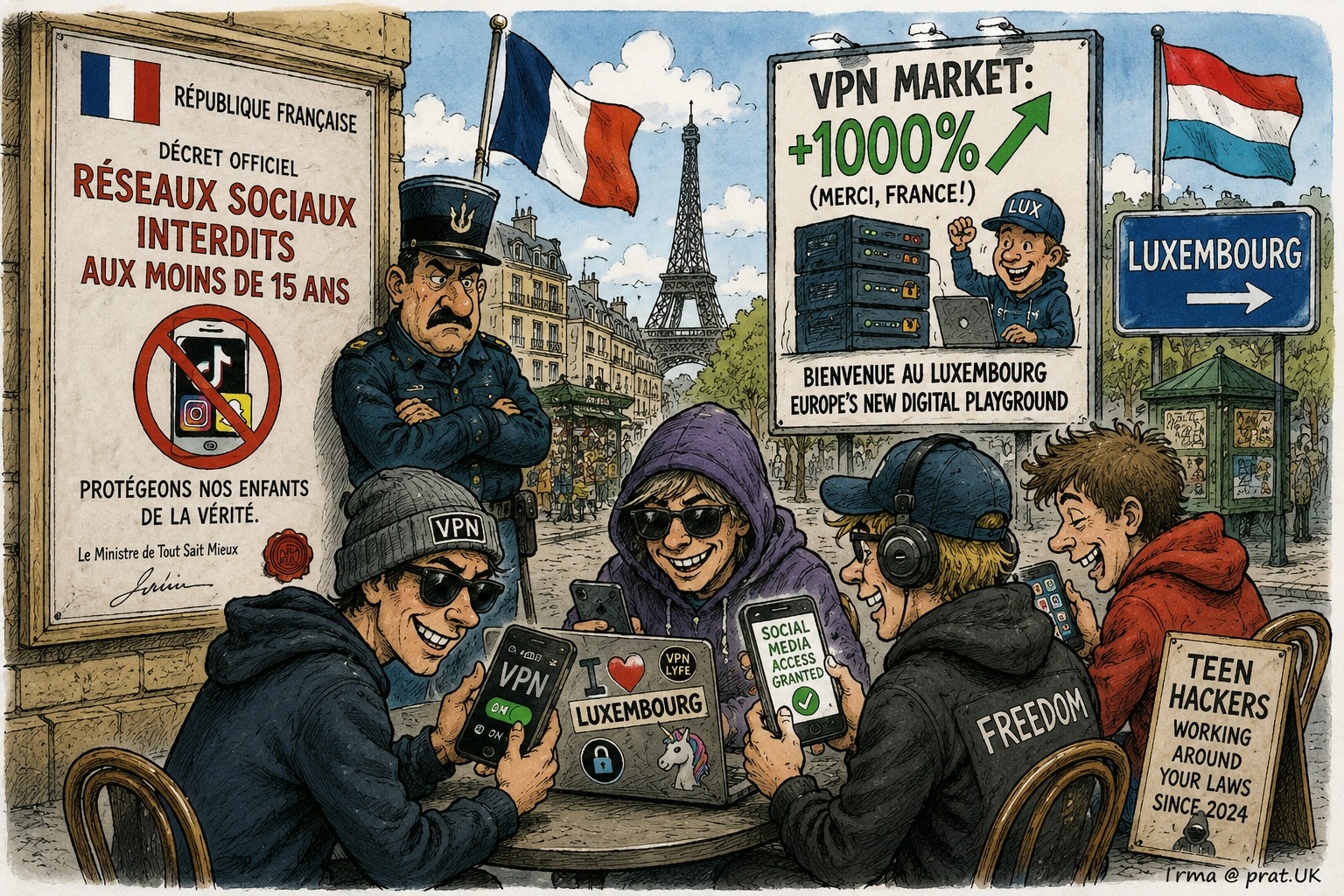
France Bans Social Media for Teens, Accidentally Creates Europe’s Largest Youth Cybersecurity Industry
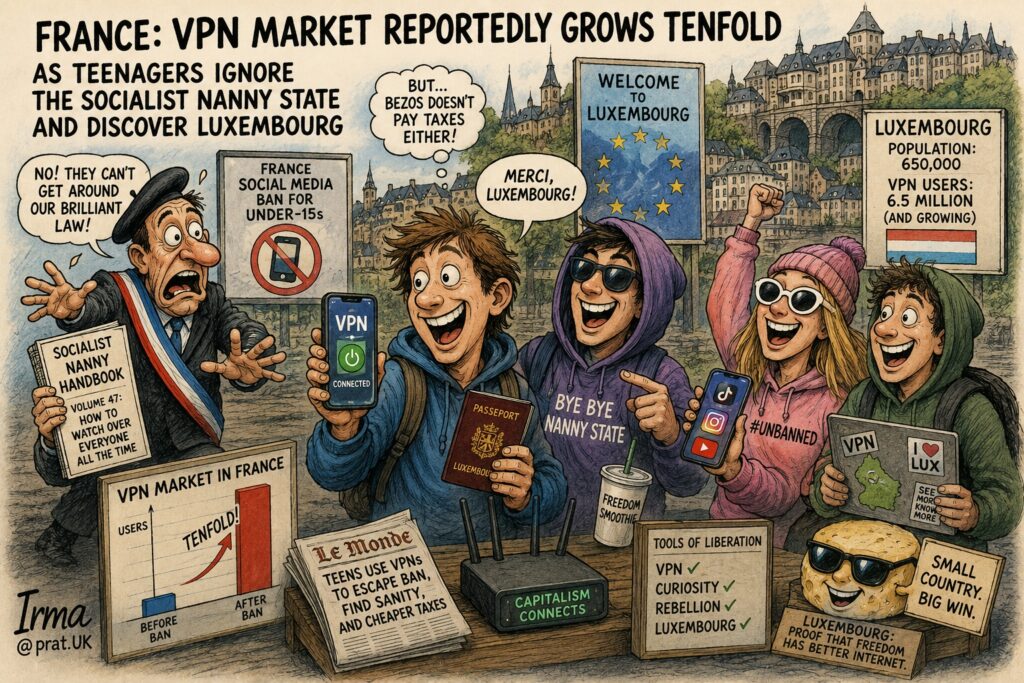
VPN Market Reportedly Grows Tenfold as Teenagers Ignore the Socialist Nanny State and Discover Luxembourg
PARIS, FRANCE — French lawmakers have approved a ban preventing children under 15 from accessing social media, while also prohibiting mobile phones in secondary schools. The measure, supported by President Emmanuel Macron, is scheduled to take effect in September 2026 if it survives review by the Constitutional Council. It requires platforms to enforce age restrictions while exempting educational resources, scientific directories and certain open-source projects.
Within minutes of the announcement, France’s teenagers reportedly did something no education minister had achieved in fifty years: they voluntarily began studying computer science.
Searches for “free VPN,” “how to change country on phone” and “can the government tell if I am pretending to be Belgian?” allegedly exploded across France. The market for privacy software was estimated by the entirely prestigious Paris Institute of Numbers We Just Heard From a Cousin to have increased tenfold before dinner.
The institute cautioned that its findings were gathered from three adolescents outside a bakery, one exhausted father and a 13-year-old who claimed to be browsing from Uruguay.
“This law will save children from dangerous technology,” said government spokesman Étienne Bureaucratique, while standing beside a €38 million age-verification system that required four passwords, a facial scan, a utility bill and written confirmation from the applicant’s maternal grandmother.
“The state must protect young people,” Bureaucratique continued. “That is why every citizen may soon have to surrender additional personal information to an untested digital contractor.”
He then reassured the public that all collected data would be completely secure, except during hacking incidents, administrative errors, subcontractor disputes, server migrations, accidental emails and lunch.
Government Teaches Teenagers the Forbidden Fruit Operating System
The French government’s central theory appears to be that teenagers lose interest in things once adults forbid them.
This is a daring hypothesis unsupported by alcohol, cigarettes, loud music, unsuitable romantic partners, motorcycles, staying awake after midnight or the entire history of adolescence.
Before the vote, many French children regarded social media as a mildly tedious obligation involving dance routines, celebrity gossip and photographs of sandwiches. After Parliament declared it forbidden, social media immediately became the digital equivalent of storming the Bastille.
Fourteen-year-old Luc Moreau of Lyon said he had never cared about Instagram until the government informed him he could not have it.
“I mainly used my phone to look at football scores,” Luc explained. “Now I operate three encrypted servers and have become treasurer of an international resistance movement.”
His mother, Céline, confirmed the transformation.
“Last week he could not connect the printer,” she said. “Today our television thinks it is in Estonia.”
What the Australian Precedent Actually Showed
A recent academic study examining young people’s reactions to Australia’s social media restrictions found that participants frequently regarded the controls as unfair or ineffective and learned how the systems worked by testing and evading them. The researchers concluded that technological access controls often struggle to resolve the broader social problems governments assign to them.
French officials responded by announcing that this evidence proved the need for even more controls.
This is known in government science as the Bureaucratic Law of Escalation: when a policy fails, the failure demonstrates that insufficient policy has been applied.
VPN Companies Thank France for Unexpected Economic Stimulus
France’s socialist instinct remains beautifully consistent. When confronted with a problem, the government first bans something, then regulates the alternatives, then subsidises a committee to investigate why the alternatives became popular.
VPN executives reportedly opened champagne upon hearing the news, although under the new regulations they may eventually be required to verify that the champagne is over 18.
“This is the greatest marketing campaign we never purchased,” said Pierre Tunnel, managing director of LibertéVPN. “Yesterday, French teenagers thought VPN meant ‘Very Pointless Network.’ Today they are comparing encryption protocols during lunch.”
The company has introduced a youth-friendly subscription named Le Petit Circumventer, which includes access to overseas servers, parental confusion and a complimentary digital moustache for facial-recognition checks.
Another provider launched an advertisement featuring a teenager climbing over a wall constructed from government forms.
The slogan reads: “Your government knows best. Choose a server where it knows less.”
No genuine evidence currently establishes that France’s VPN market literally increased tenfold in one day. That figure belongs to the satirical premise, rather than the factual reporting. What is credible is the enforcement problem: lawmakers and commentators have raised questions about age verification, constitutional scrutiny and privacy, along with the practical difficulty of preventing determined young users from bypassing restrictions.
That difficulty has not discouraged Parliament, because discouragement would require lawmakers to understand teenagers.
France Protects Privacy by Abolishing Anonymity
Under the legislation, platforms must identify users who are under 15. This creates a small philosophical puzzle: how does a website prove that someone is a child without requiring everyone to prove that they are an adult?
The answer, according to officials, is age verification.
Age verification is a process in which citizens demonstrate their eligibility to view cat videos by handing identifying information to organisations whose privacy policies contain 19,000 words and the phrase “trusted commercial partners.”
Government consultants insist the system can be both intrusive enough to identify children and private enough not to identify anyone.
This resembles a customs officer who must inspect every suitcase without opening, touching, seeing or knowing about luggage.
The European Commission has already examined whether versions of the French proposal comply with broader EU rules, and an earlier draft had to be adjusted over legal concerns after overlapping with the Digital Services Act.
Nevertheless, Paris remains confident that technology will produce an elegant solution.
France is the nation that gave the world Descartes, who said, “I think, therefore I am.”
The new digital principle is: “I uploaded my passport to watch YouTube, therefore somebody in a database knows I am.”
Teenagers Rebrand TikTok as Educational Research
The law provides exceptions for online encyclopaedias, scientific directories and open-source educational projects.
Consequently, teenagers have begun preparing legal arguments that every social platform is educational.
TikTok will become the French Academy of Applied Dance Physics.
Instagram will operate as the National Archive of Comparative Lunch Photography.
Snapchat will be registered as an open-source institute studying the rapid disappearance of evidence.
One adolescent submitted a 47-page application arguing that YouTube reaction videos qualify as scientific peer review because one person presents a theory and another person screams at it.
Government officials rejected the application but admitted it closely resembled parliamentary debate.
Even LinkedIn expects a surge in teenage membership after discovering that nothing increases youth interest in a platform faster than placing it behind a legal barrier.
Millions of French children may soon claim to be 46-year-old regional sales managers with extensive experience in supply-chain optimisation.
Parents Discover Their Children Are the Household Technology Department
The ban may also reverse the traditional balance of family power.
Parents once controlled internet access because they paid the bill. Teenagers now control internet access because they understand where the settings menu is located.
Across France, adults are reportedly approaching their children with delicate requests.
“Louis, the government has blocked my football stream.”
“Certainly, Father. Please submit Form 14-B and two chocolate biscuits.”
One Paris father said his 14-year-old daughter charged him €20 to route his laptop through Switzerland.
“I told her I own the house,” he complained.
“She told me the house is now digitally located in Geneva.”
The teenager later raised the price, citing inflation, server maintenance and the risks of doing business under an interventionist government.
Economists hailed the exchange as France’s first successful youth entrepreneurship programme.
Macron Declares Victory Before Law Encounters Reality
President Macron called the measure a major step forward and said France was leading Europe in protecting young people.
France frequently leads Europe in the same way a man holding a baguette leads a parade: confidently, visibly and without explaining where anyone is going.
Supporters of the ban point to legitimate concerns surrounding cyberbullying, compulsive platform design, harmful content, sleep disruption and adolescent mental health. These are serious problems, and parents understandably want practical safeguards. Reports on the legislation cite concerns about depression, self-harm and other online dangers facing young users.
The comedy begins when politicians assume every social problem can be corrected by placing an age gate in front of it.
A teenager distressed by online pressure needs guidance, healthier platform design, responsive parenting, digital education and meaningful support.
The state has instead handed him a locked door.
The teenager has responded by downloading a ladder.
French Youth Announce Digital Resistance from Belgium
By nightfall, adolescents across France had reportedly established the Free Republic of Under-Fifteen Internet Users, headquartered on a server that changes countries every six minutes.
Its declaration of independence reads:
“We hold these truths to be self-evident: that all teenagers are created curious, that governments cannot distinguish a 14-year-old from a Labrador using his father’s tablet, and that any app forbidden by Parliament shall immediately become compulsory among our friends.”
The movement has adopted the slogan Liberté, Égalité, Connectivité.
Government ministers dismissed the group as technologically unsophisticated before accidentally joining its encrypted chat.
France will now proceed toward September with lawmakers promising protection, platforms promising compliance, privacy experts promising complications and teenagers promising absolutely nothing.
The government may eventually discover the central rule of digital regulation: adults write laws in committees, but children test them at home before breakfast.
By the time officials complete the first enforcement review, France’s 14-year-olds may be operating private networks, trading server access and explaining encryption to civil servants.
The socialist nanny state wanted to remove children from the digital economy.
Instead, it accidentally trained its next generation of cybersecurity entrepreneurs.

15 Humorous Observations
- France has banned social media for children under 15, apparently unaware that telling teenagers “you may not enter” is the traditional ribbon-cutting ceremony for a secret entrance.
- The VPN market allegedly grew tenfold overnight, proving French adolescents can learn advanced networking concepts whenever adults make them necessary for watching dance videos.
- Before the law, teenagers used their phones to avoid homework. Now they can claim they are conducting field research into state censorship.
- The government plans to verify everyone’s age online, because protecting privacy naturally begins by requiring millions of people to prove exactly who they are.
- French lawmakers believe a 14-year-old cannot handle Instagram, but can apparently handle configuring an encrypted tunnel through a server farm in Moldova.
- Parents once asked children to put down their phones. They now ask children to fix the household VPN so Dad can watch a geographically restricted football match.
- The law exempts educational websites, meaning French teenagers will soon rename TikTok “The National Academy of Vertical Sociology.”
- Politicians insist the ban will improve mental health, although nothing calms an adolescent quite like being told the state knows what is best for them.
- France has invented a digital drinking age without the drinking, the bar or any realistic possibility that the doorman can identify a teenager wearing his father’s login.
- The legislation also restricts phones in schools, returning French classrooms to their traditional purpose: passing handwritten notes about how ridiculous the authorities are.
- Every forbidden app will now become irresistible. Even LinkedIn may attract teenagers once the government places it behind an age gate.
- France’s bureaucrats have discovered that children encounter harmful material online, then responded by making anonymity harder for every citizen.
- A generation previously accused of lacking practical skills may soon become Europe’s largest informal collective of cybersecurity consultants.
- The first teenager caught circumventing the law will probably be offered a government technology contract, because he will understand the system better than the ministry that commissioned it.
- France says it is “leading Europe,” which is government language for walking confidently into a revolving door and ordering everyone else to follow.
Disclaimer: This satirical report distinguishes documented details of the French legislation from invented characters, quotations, surveys and the comic claim that VPN demand rose tenfold overnight. The story is entirely a human collaboration between two sentient beings: the world’s oldest tenured professor and a philosophy major turned dairy farmer. Neither has successfully connected a French government printer. The “tenfold” figure is presented explicitly as the comic premise, while the legislation, implementation dates and enforcement concerns remain grounded in current reporting.

Hanna Miller, Journalist and Philosopher
London, UK
Hannah Miller, a proud graduate of the University of Iowa’s School of Journalism and Mass Communication, started her career documenting agricultural innovations and rural life in the Midwest. Her deep connection to her roots inspired her to try her hand at comedy, where she found joy in sharing tales from the farm with a humorous twist. Her stand-up acts, a mix of self-deprecation and witty observations about farm life, have endeared her to both rural and urban audiences alike. She is a four-year resident to London and the UK.


Titter ye not — but actually do, titter extensively
The accuracy of the dialogue suggests either obsessive transcription or trauma-based memory so perfect it’s almost frightening.