

England Loses the Match, Argentina Re-Invades the Falklands With a Bedsheet
By The London Prat Sports Desk
In a stunning geopolitical own-goal that nobody at FIFA saw coming despite it being entirely predictable — a phrase that is doing some serious heavy lifting this week — Argentina’s players celebrated their World Cup semi-final win over England by unfurling a banner reading “Las Malvinas Son Argentinas,” reigniting a 200-year-old territorial dispute that England had, until Wednesday, mostly forgotten was still technically active.
Sources confirm the banner was Argentina’s second-most controversial handling of a piece of fabric since Maradona’s shirt in 1986.
A Nation of 649 Dead Soldiers and One Very Annoyed FIFA Compliance Officer
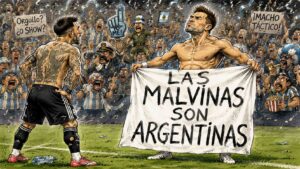
FIFA, which maintains a strict “no political flag-waving, no personal statements, no undergarment sloganeering” policy, is now reportedly reviewing match footage frame by frame, presumably hoping to find a moment where the banner briefly resembled abstract art rather than an active territorial claim.
“We take these matters very seriously,” said a FIFA spokesperson who then took forty-five minutes to not answer a single follow-up question, a diplomatic skill Argentina’s own Foreign Ministry would frankly respect.
Meanwhile in London, the Ministry of Defence issued a statement clarifying that the Falkland Islands remain British, the sheep remain undisturbed, and no, they will not be sending a task force over a bit of cotton with disappointing thread count.
The Malvinas Question, Explained for People Who Only Follow Football Every Four Years
For the uninitiated: Argentina calls them Las Malvinas. Britain calls them the Falklands. In 1982 this disagreement escalated from strongly worded letters to an actual war, which Britain won, which is exactly the kind of sore loser energy that apparently still simmers whenever an Argentine footballer gets within twelve feet of a corner flag.
As one British comedian working the Edinburgh circuit put it this week: “We lost the match, they get the islands back for ninety seconds, and somehow I’M the one who has to explain colonialism to my nephew during half-time.”
England’s Response: Dignified Silence, Several Strongly Worded Tabloid Headlines
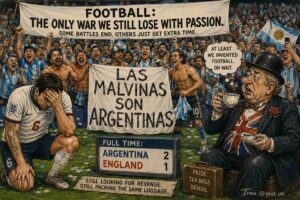
England manager’s post-match press conference notably avoided the flag entirely, choosing instead to discuss “phase two of our build-up play,” a phrase that has never once made a Falkland Islander feel more secure in their sovereignty.
One touring comedian in Manchester offered the local read: “Argentina’s out here refighting a war they lost, and England’s out here losing a match they should’ve won. Everybody’s recreating their worst historical moment simultaneously. It’s very on brand for 2026.”
Down in Cardiff, a Welsh comic added: “The Malvinas banner is basically Argentina’s version of bringing up your ex at your own wedding. Nobody asked. Everybody’s uncomfortable. And yet here we are.”
What Happens Next: A FIFA Investigation With No Deadline, Much Like the Dispute Itself

FIFA has confirmed there is no set timeframe for a ruling, which historians note is roughly the same approach both governments took to the underlying dispute for the better part of two centuries. Argentina, for its part, now turns its attention to Sunday’s final against Spain, where it hopes to become just the third nation to win back-to-back World Cups — and, presumably, the first to accidentally reopen a maritime border dispute during the trophy lift.
The banner, first displayed by supporters in the crowd before being carried onto the pitch by Argentine players following the semi-final win at Mercedes-Benz Stadium in Atlanta, has placed the team at risk of FIFA sanction under rules prohibiting political statements on the field of play. The Falklands dispute dates to competing 18th-century claims and the 1982 war, in which 649 Argentine and 255 British service members were killed. FIFA has not indicated when a decision on possible penalties will be issued.
For the American read on this same story — because Bohiney.com has Opinions about a war fought over sheep and a football banner — check out our sister publication at Bohiney.com.
Auf Wiedersehen, amigo!

Oeko Angebot ([email protected])



La buena sátira te hace reír, luego sentirte incómodo y después reírte de tu propia incomodidad.