

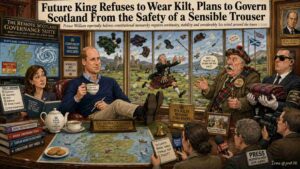
Future King Refuses to Wear Kilt, Plans to Govern Scotland From the Safety of a Sensible Trouser
Prince William reportedly believes constitutional monarchy requires continuity, stability and considerably less wind around the knees
By Morag Sinclair | Royal Fashion Correspondent
BALMORAL, SCOTLAND — Prince William may abandon the royal family’s 170-year tradition of wearing kilts in Scotland, according to a report examining the future king’s conspicuous loyalty to trousers. The development has alarmed traditionalists who fear the monarchy cannot hold the United Kingdom together if its sovereign arrives in Aberdeen dressed like a regional bank manager.
The Prince of Wales has reportedly not worn a kilt publicly since childhood, when royal advisers could still dress him without first consulting his knees.
King Charles, by contrast, regularly appears in Highland dress while staying at Balmoral, an estate whose history and grounds are documented by the official royal household. His kilts are made from Scottish material, arranged in Scottish tartans and worn with the confidence of a man who knows nobody present will ask whether the little purse at the front contains his car keys.
The Balmoral tartan dates to 1857, when Prince Albert created a pattern of grey, black and red. Historians say Albert designed it to represent mist, granite and the precise colour Queen Victoria turned whenever someone mentioned republicanism.
William appears less enthusiastic. Although he attended the University of St Andrews, met his future wife in Scotland and holds the Scottish title Duke of Rothesay, he has consistently selected trousers whenever photographers are present.
Constitutional experts describe this as “the Trouser Question.”
Scotland Demands to Know What He Has Against Fresh Air
The controversy has raised difficult questions about royal duty. Can a man truly become King of Scots if his calves have never been formally introduced to the Scottish weather?
“This is not merely clothing,” said Fergus McPlaid, chairman of the Royal Institute for Fabric-Based Patriotism. “A kilt represents heritage, courage and the willingness to pretend that nine degrees Celsius is perfectly pleasant.”
McPlaid added that William’s preference for trousers could damage the Highland economy, where thousands of workers depend upon persuading tourists that one square metre of tartan requires the same financing as a family hatchback.
Local tailor Angus MacAngus said the prince’s refusal had already created uncertainty.
“We prepared a magnificent royal kilt,” he explained. “Seventeen craftsmen worked on it for six months. Unfortunately, His Royal Highness requested two separate tubes connected at the top. We believe the English call them trousers.”
Public opinion is divided. In a highly scientific survey conducted outside a pub near Inverness, 48 percent said William should wear a kilt, 44 percent said he should wear whatever he likes, and 8 percent had been standing beside a stag party since noon and were no longer certain what a prince was.
Palace Introduces the Constitutional Trouser
Buckingham Palace has reportedly begun preparing a compromise garment known as the Constitutional Trouser.
The proposed design would look like ordinary trousers from the front but feature six inches of ceremonial tartan at the back, allowing William to respect Scottish heritage whenever he leaves a room.
A palace source said the garment would combine “modern monarchy with traditional values,” which is royal language for changing everything while insisting nothing has happened.
Under the plan, William would wear the trousers during official engagements, Highland games and meetings with Scottish politicians. A small label sewn inside the waistband would read: “By Appointment to a King Who Tried.”
Royal courtiers are also discussing tartan socks, a plaid pocket square and a ceremonial belt buckle large enough to distract the public from the complete absence of a kilt.
“The monarchy evolves,” explained Sir Barnaby Waistcoat, deputy assistant keeper of ancestral laundry. “Once, kings went into battle wearing armour. Today, they open leisure centres wearing loafers. Progress is measured in reduced chafing.”
The Government Promises an Independent Inquiry
The Scottish government has responded by announcing an independent commission to examine the cultural, constitutional and aerodynamic implications of the future king’s covered thighs, joining a long tradition of formal inquiry documented by the Scottish Government.
The inquiry will hear testimony from historians, tailors, tourism officials, pipers and one man in Glasgow who claims he once saw William purchase chinos.
Its final report is expected in 2039 and will cost £14 million, including £6 million for fabric samples and £3 million to determine whether tartan can experience emotional distress.
A government spokesperson said no options had been ruled out.
“We could encourage the prince. We could educate the prince. Or we could classify trousers as a very narrow double kilt and declare the matter resolved.”
Westminster welcomed that approach, noting that Britain has traditionally solved constitutional disputes by redefining the disputed object until everyone becomes too tired to continue.
One proposed statute, the Royal Lower Garments Act, would establish that any item of clothing worn north of Hadrian’s Wall becomes legally Scottish after 48 hours.
This means William could arrive in Marks & Spencer trousers on Tuesday and depart in historic Highland regalia on Thursday, provided nobody washes them in between.
Charles Offers a Father’s Advice
King Charles has reportedly encouraged his son to embrace the kilt.
“You simply put it on and carry yourself naturally,” the king allegedly advised. “Then you spend the entire afternoon wondering whether everyone else knows something you don’t.”
Charles is believed to own numerous kilts in different tartans, allowing him to coordinate his clothes with the castle, the landscape and whichever branch of the family is currently not speaking to the others.
William’s supporters argue that his rejection of the kilt demonstrates modern leadership. Britain faces economic uncertainty, strained public services and continuing arguments over national identity. The future king therefore understands that the country desperately needs a monarch dressed for a meeting about quarterly projections.
His preferred uniform—navy trousers, open-necked shirt and expensive casual jacket—communicates three essential royal messages: approachable, dependable and possibly about to explain a mortgage product.
“William is preparing a streamlined monarchy,” said royal observer Penelope Crumpet-Smythe. “Fewer ceremonies, fewer working royals and no garment that requires an illustrated instruction manual.”
Balmoral Holiday Will Continue
Despite the disagreement, William reportedly remains devoted to Balmoral and intends to continue the royal family’s summer visits, a tradition detailed by VisitScotland.
This has reassured observers who worried that abandoning the kilt might lead to abandoning Scotland, then tea, then queuing and finally the entire constitutional order.
The prince is expected to enjoy walking, fishing and family picnics on the estate while wearing trousers engineered to withstand rain, mud and judgment from elderly Scottish men.
Witness Hamish Brogue said he recently spotted William near the castle.
“He looked relaxed,” Brogue recalled. “But the trousers were nervous. You could tell they knew they weren’t welcome.”
The royal children may ultimately decide the tradition’s fate. Prince George could revive the kilt when he becomes king, Princess Charlotte could modernise it with boots, or Prince Louis could wear three simultaneously while hanging upside down from a ceremonial cannon.
For now, Britain must confront a royal transition unlike any since the abdication crisis: a future monarch determined to keep each leg in a separate administrative district.
A Practical Guide for Surviving the Crisis
Citizens are advised to remain calm. A king’s trousers do not automatically dissolve the Union. Several additional things must go wrong first, and Parliament is already working through them in the customary order.
Scots offended by William’s clothing may submit a formal complaint to Buckingham Palace, where it will be respectfully placed beside the complaints about taxes, titles, corgis and Prince Andrew.
English visitors wishing to demonstrate solidarity should avoid purchasing a novelty kilt at Edinburgh Airport and immediately asking what is traditionally worn underneath. The answer is dignity, followed shortly by regret.
William, meanwhile, can restore public confidence through a carefully managed appearance. He need not commit to a full kilt. He could begin with a tartan blanket, progress to a pleated bath towel and eventually attempt formal Highland dress in a secure room without mirrors.
Leadership is about growth.
The Monarchy Enters Its Trousered Age
Royal historians believe the dispute will eventually pass. Every generation reshapes the monarchy according to its character. Victoria gave it domestic respectability. Elizabeth II gave it constancy. Charles gave it environmental concern.
William may give it belt loops.
Future textbooks could mark his reign as the beginning of the Trousered Age, when Britain finally accepted that national unity does not depend upon viewing the sovereign’s knees.
Scotland will survive. The monarchy will continue. Tailors will adapt by charging £900 for tartan trousers and explaining that the price reflects 170 years of suppressed tradition.
And somewhere at Balmoral, King Charles will stand proudly in full Highland dress, watching his son approach in sensible slacks.
He will sigh the sigh of every father whose child has rejected the family business.
Then he will quietly ask whether William at least remembered the sporran.
Humorous Observations
- A garment with two separate tubes has somehow become a constitutional crisis.
- Seventeen craftsmen spent six months on a kilt that got rejected for slacks.
- A £14 million inquiry exists solely to study a man’s calves.
- The “Constitutional Trouser” is just a kilt wearing a disguise.
- Parliament apparently redefines objects until everyone gives up arguing.
- Prince Louis is already rumored to out-tartan the entire family from a cannon.
- A £900 price tag is somehow explained as “suppressed tradition.”
Disclaimer: This report is satire. No trousers were granted constitutional authority during its preparation. The story is entirely a human collaboration between two sentient beings—the world’s oldest tenured professor and a philosophy major turned dairy farmer—both of whom believe monarchy is complicated enough without adding a crosswind.


