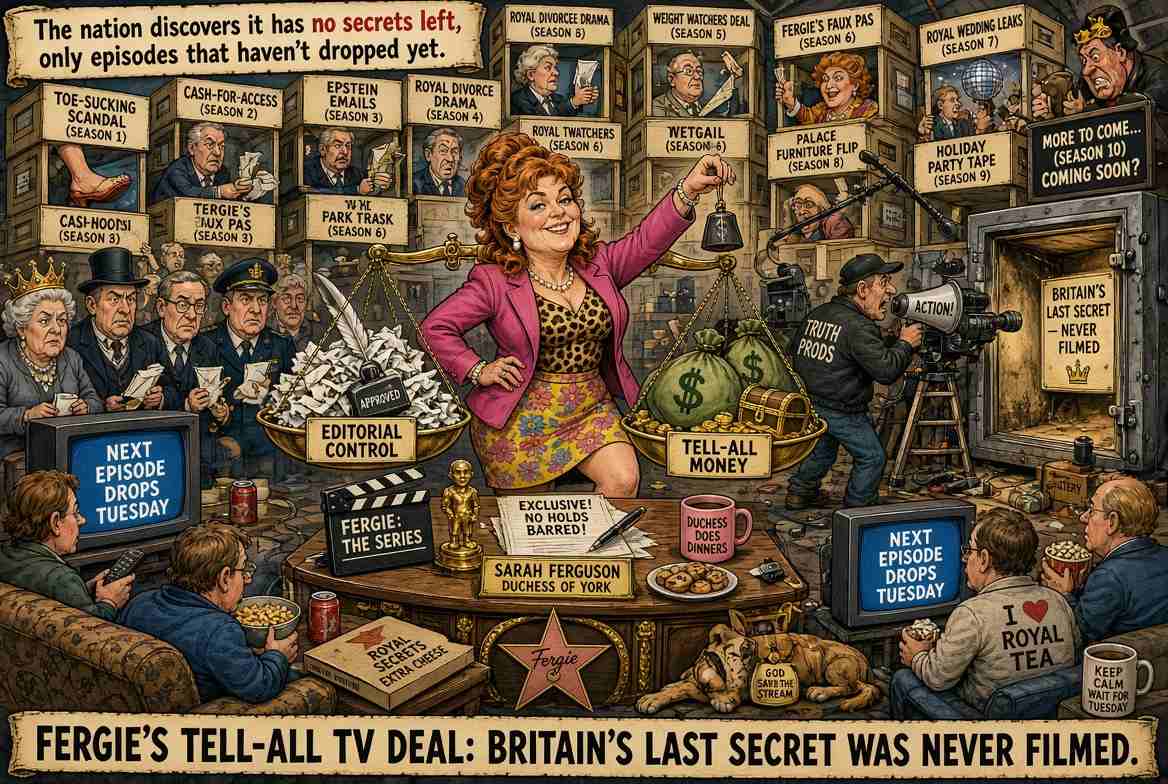
Fergie’s Tell-All TV Deal: Britain’s Last Secret Was Never Filmed
Sarah Ferguson Weighs Editorial Control as the Nation Discovers It Has No Secrets Left, Only Episodes That Haven’t Dropped Yet
Sarah Ferguson is reportedly considering television interview and documentary offers after returning to Britain, raising the disturbing possibility that somewhere inside the Royal Family there remains information that has not yet been converted into episodic content. According to HELLO! magazine, Ferguson has been “bombarded with requests” worldwide and is said to be looking at her options while insisting she’ll “only allow someone she knew well” to handle telling her story.
This represents a radical departure from the traditional royal communications strategy, under which controversial information was handled by saying absolutely nothing for 74 years and hoping everybody involved eventually became a statue.
Modern royalty operates differently. Every personal disagreement now requires a documentary, podcast, memoir, unauthorized biography, authorized biography responding to the unauthorized biography, and an anonymous friend explaining why the authorized biography failed to capture the subject’s authentic truth. Royal privacy has therefore evolved considerably. It now means choosing which streaming service tells everybody everything.
Britain Discovers the Tell-All That Tells Only What the Teller Wants Told
Sources have reportedly suggested Ferguson would want someone she trusts involved and might even consider producing a programme herself, giving her greater influence over the final product. Separate reporting from LBC claims US networks have floated six-figure bids, with palace aides privately worried Ferguson could “go rogue.”
This is known in television journalism as the ancient principle of vigorous independent scrutiny, provided vigorous independent scrutiny signs the production agreement first.
Television executives reportedly greeted the possibility with enthusiasm. “Editorial control is completely normal,” said one imaginary veteran producer standing beside a shredding machine labelled UNHELPFUL FOLLOW-UPS. “We routinely allow interview subjects to determine the questions, lighting, narrative arc and whether gravity applies.”
Under one proposed format, Ferguson could interview herself.
“Sarah, what would you like viewers to understand?”
“Excellent question, Sarah.”
“Thank you, Sarah.”
“Would you like to elaborate?”
“I certainly would.”
“And should anybody interrupt?”
“Good heavens, no.”
Journalism scholars have identified this technique as the Selfie School of Investigative Reporting, in which the investigator, subject, producer and source are all seated in the same chair. Its principal advantage is efficiency. Its disadvantage is journalism.
Streaming Platforms Discover Scandal Has Better Employment Prospects Than Education
Reports say Ferguson has been inundated with approaches from television companies and streaming services. This has generated understandable concern among recent university graduates.
A 22-year-old with a master’s degree, four internships and fluency in Mandarin can presently expect to receive an email saying: “We were impressed by your qualifications but have decided to proceed with candidates whose experience more closely matches the role.”
A celebrity emerging from controversy apparently receives: “Would eight episodes be enough?”
Britain may consequently need to reconsider higher education. Instead of sociology, economics and engineering, universities could offer:
- BA Public Controversy
- MSc Narrative Reclamation
- PhD Streaming Redemption Studies
Final examinations would require students to sit silently opposite soft lighting while saying, “For the first time, I’m ready to speak.” Graduates achieving first-class honours would receive a Netflix development meeting. Those earning a 2:1 would go to ITV.
Britain’s Royal Scandal Industry Becomes the Country’s Last Remaining Growth Sector
Economists have long worried about Britain’s productivity problem. They have apparently overlooked the Royal Family. One royal anecdote can now support dozens of jobs. First comes the event. Then the reporting. Then the reaction. Then the palace response. Then the response to the palace response. Then the documentary examining the response. Then another documentary examining whether the first documentary was fair. Then somebody writes a book. Then somebody who appeared on page 184 gives an interview complaining that the book omitted important context.
GDP rises three points. The Bank of England issues commemorative mugs. A Cambridge economist estimated that if every remaining royal secret could be monetized at current streaming rates, Britain could potentially eliminate the national debt by Christmas, although this calculation assumes Princess Anne agrees to a podcast. She will not.
Andrew Reportedly Studies Remote Control With Renewed Academic Interest
The prospect of a Ferguson television programme could be particularly uncomfortable for Andrew Mountbatten-Windsor, whose association with Jeffrey Epstein has generated years of scrutiny. Ferguson herself has also faced renewed attention over her past relationship with Epstein, including previously reported correspondence. She has not been accused of a crime.
Observers therefore believe Andrew may soon become the first senior royal in modern history to read the television manual. Witnesses claim he has already identified several promising buttons: MUTE, EXIT, POWER, and, most intriguingly, INPUT.
“I spent years thinking INPUT meant people asking me questions,” he reportedly did not say. “Apparently you can change it.”
Technology analysts say the off button represents the most effective royal-media strategy discovered since Prince Philip occasionally drove away. The system is beautifully simple. When someone begins discussing your family on television, you press it. The television stops. Experts caution that this does not technically prevent newspapers from reporting what was said, but researchers are currently investigating a second breakthrough called “not opening Twitter.”
Buckingham Palace Introduces New Emergency Phrase: “No Comment”
Palace officials are believed to view any potential tell-all with the calm professionalism traditionally associated with discovering smoke underneath a locked ammunition cupboard. The phrase “tell-all” is particularly alarming because nobody knows what “all” means. If somebody promises to “tell some,” Britain relaxes. “Tell several” is manageable. “Tell most” activates senior courtiers. But “tell-all” requires emergency biscuits.
A retired constitutional historian explained the danger using deductive reasoning. Premise one: royal families contain families. Premise two: families contain arguments. Premise three: streaming services contain money. Therefore somebody will eventually describe Christmas dinner. The logic is devastating.
The Royal Family Has Become the Marvel Cinematic Universe With Better Hats
For decades, royal scandals were isolated stories. Now they connect. Harry leads to Meghan. Meghan leads to Netflix. Netflix leads to documentaries. Documentaries lead to Palace reaction. Palace reaction leads to William. William leads back to Harry. Andrew leads to Ferguson. Ferguson potentially leads back to television. Television leads to everybody.
This is no longer a family tree. It is a content map. Viewers who miss three interviews can no longer follow the plot. Britain may soon require a pre-programme announcement: PREVIOUSLY, ON THE WINDSORS… A solemn voice will explain 1,100 years of monarchy in 90 seconds before cutting to someone entering a drawing room carrying tea.
Public Claims Exhaustion While Clicking Immediately
The British public insists it has had enough royal drama. This claim has been independently verified by millions of people clicking articles about royal drama in order to announce beneath them that they do not care about royal drama. Researchers call this the Royal Indifference Paradox.
A citizen says: “I couldn’t care less about these people.” He then reads 4,800 words explaining where one of them may be renting. Another declares: “Why does the press keep covering them?” She has opened six browser tabs on the subject.
This phenomenon provides broadcasters with confidence that a Ferguson interview would attract viewers who are absolutely sick of hearing about the Royal Family and intend to demonstrate this exhaustion by watching every minute.
Fergie Could Finally Achieve the Impossible: A Royal Programme Nobody Can Call Unauthorized
Ferguson has previous experience with highly personal television. In 2011 she appeared in the Oprah Winfrey Network series Finding Sarah, which explored efforts to rebuild her life. Fifteen years later, television may therefore receive the sequel.
Possible titles under consideration by people who have absolutely no involvement whatsoever include Finding Sarah Again, Still Finding Sarah, Sarah: The Director’s Cut, The Duchess Formerly Known as the Duchess, and the prestigious six-part documentary There’s More Context Than You Think.
Episode one would establish the background. Episode two would explain episode one. Episode three would reveal that episode two had been misunderstood. Episode four would feature childhood photographs. Episode five would contain the phrase “my truth.” Episode six would end with the subject looking thoughtfully through a window, guaranteeing season two.
Britain Prepares for Its Most Traditional Ceremony: Everybody Pretending They Won’t Watch
There will inevitably be objections. Royal experts will warn that the interview could create more headlines. Palace insiders may insist nobody is concerned. Friends will say Ferguson deserves to tell her story. Critics will insist she should remain silent. Streaming executives will heroically conclude that the only responsible solution is global distribution.
And Britain will perform its customary national ritual. Millions will announce they have no intention whatsoever of watching. Then, at precisely 8 p.m., the audience figures will resemble the Coronation.
Because Britain does not merely possess a monarchy. It possesses a monarchy with episodes. And in the twenty-first century, crowns may come and go, titles can disappear, residences can change and reputations can collapse. But content? Content reigns forever.
15 Humorous Observations
- Britain No Longer Has Royal Secrets, Only Episodes That Haven’t Dropped Yet. The Royal Family once protected secrets with castles, courtiers and the Official Secrets Act. Now apparently they protect them by negotiating executive-producer credits.
- “Controlling My Own Narrative” Is Celebrity English for “Nobody Else Is Allowed Near the Editing Software.” There was a time when controlling your narrative meant keeping a diary. Now it requires six cameras, a streaming platform, three lawyers and a documentary director who has been told the word “follow-up” is inflammatory.
- Being Bombarded With Television Offers Is Britain’s Most Reliable Career-Rehabilitation Programme. Graduates send 200 applications and receive an automated email thanking them for their interest. Have a major public scandal and Netflix allegedly sends a fruit basket.
- The Royal Family Has Accidentally Become Britain’s Most Successful Content Franchise. Marvel has superheroes. Star Wars has Jedi. The British monarchy has relatives explaining other relatives. The production costs are lower because Buckingham Palace already exists.
- Andrew May Soon Discover the Greatest Technological Innovation Since Central Heating: The Off Button. Not since Henry VIII discovered annulment has a royal man required a household appliance quite this urgently.
- Fergie Producing Her Own Documentary Would Solve the Ancient Problem of Interviewers Asking Questions. It is an elegant system. You tell your side. You choose the interviewer. You retain editorial influence. At that point the only remaining journalistic threat is weather.
- Royal Scandals Now Have Sequels, Prequels and Extended Universes. We are one streaming announcement away from The Yorks: Origins, followed by Royal Lodge: The Final Season, then a six-part companion podcast titled Actually, There’s Context.
- Britain Used to Export Steam Engines. Now It Exports Royal Explanations. The Industrial Revolution gave the world locomotives. The modern British economy appears increasingly capable of supplying Americans with 90-minute documentaries explaining why somebody once attended dinner with somebody they now wish they hadn’t met.
- Editorial Control Is Particularly Valuable When Your Life Contains Editors. Ordinary people remember embarrassing things privately at 2:17 in the morning. Celebrities discover theirs have been colour-corrected and scheduled for Thursday.
- Andrew and Sarah May Be Divorced, but Their Public Relations Remain in a Common-Law Marriage. They separated decades ago yet somehow remain connected by a mysterious British institution known as “the next headline.”
- The Phrase “My Side of the Story” Should Terrify Every Relative Within Fifty Miles. Because families ordinarily have several sides. Television has eight episodes. That leaves room for everybody.
- Britain’s Scandal Economy Has Achieved Full Employment. Royal correspondents need royals. Documentary producers need scandals. Streaming services need documentaries. Newspapers need streaming-service stories. And viewers need something to watch while complaining that all anyone talks about is the royals. This is practically Keynesian economics wearing a tiara.
- Streaming Services Have Solved the Problem of Running Out of Royal Material by Waiting Five Minutes. There will always be another memoir, interview, relocation, reconciliation, disagreement, documentary or source “close to the family.” Royal journalism is renewable energy.
- Returning to Britain After Months Away Is Now Considered a Television Genre. Ordinary people call it coming home. With sufficient aristocratic background music, it becomes “a deeply personal new chapter.”
- The Palace’s Greatest Fear May No Longer Be Constitutional Crisis but Someone Saying “We’ve Signed With a Streamer.” Armies have surrounded palaces with less immediate effect. One executive with a development deal can apparently cause curtains to twitch from Windsor to Balmoral.
This is satire based on published reporting concerning Sarah Ferguson’s reported return to Britain, media approaches and possible television interview or documentary. Satirical dialogue, witnesses, experts, programme titles and palace reactions appearing here are comedic inventions and should not be confused with reported quotations or allegations. No accusation of criminal wrongdoing against Sarah Ferguson is made or implied.

Alan Nafzger was born in Lubbock, Texas, the son Swiss immigrants. He grew up on a dairy in Windthorst, north central Texas. He earned degrees from Midwestern State University (B.A. 1985) and Texas State University (M.A. 1987). University College Dublin (Ph.D. 1991). Dr. Nafzger has entertained and educated young people in Texas colleges for 37 years. Nafzger is best known for his dark novels and experimental screenwriting. His best know scripts to date are Lenin’s Body, produced in Russia by A-Media and Sea and Sky produced in The Philippines in the Tagalog language. In 1986, Nafzger wrote the iconic feminist western novel, Gina of Quitaque. He currently lives in Holloway, North London. Contact: [email protected]