Buckingham Palace Introduces New Motto: “God Save The King From Himself”
LONDON ● THE LONDON PRAT — Buckingham Palace has reportedly unveiled an updated royal motto for the twenty-first century: “God Save The King From Himself.” The change follows growing concerns that Prince William, heir to the throne and father of three, continues to indulge in the dangerous hobby of riding motorcycles despite being one of the most recognisable faces on the planet — a planet that includes, for reference, both gravity and tarmac.
Palace insiders insist the revised slogan better reflects modern monarchy, where constitutional duties now include ribbon cuttings, environmental advocacy, and repeatedly reminding future kings that gravity remains undefeated and has never once taken a day off for a state visit.
The Confession That Started It All

The controversy erupted after Prince William admitted that he still enjoys motorcycling “quietly” whenever possible. Experts note that this is a curious description for a hobby involving internal combustion engines, high-visibility jackets, and security teams suffering stress-induced eye twitches. “Quietly,” in this context, appears to mean “without prior announcement to the press,” which is approximately the same level of quiet as a brass band rehearsing inside a biscuit tin.
“His Royal Highness occasionally likes to experience ordinary life,” explained one palace spokesman, deploying the word “ordinary” with the confidence of a man who has never once queued at a Greggs. “By ordinary life, we mean dressing in disguise and discovering that petrol stations charge everyone equally.”
Witnesses report that the prince recently queued for fuel alongside several actual middle-aged men discussing tyre pressure and insisting they once owned “something very similar” in 1998. This is the male equivalent of saying you were once almost in a band.
“It was remarkable,” said Nigel Prescott, 56, from Surrey. “One minute I was buying a sausage roll. The next, I realised the future King of England was standing behind me wondering why premium unleaded costs more than a small island nation.”
Historians Provide Helpful Context No One Asked For
Royal historians have rushed to place the development into context, as is their constitutional obligation at moments of mild inconvenience.
“Previous monarchs enjoyed falconry, horse racing, and invading France,” noted Professor Clement Weatherby of the Institute for Royal Studies. “Motorcycles are relatively harmless. The concern is that Prince William has reached the exact age when otherwise sensible men convince themselves that buying a machine capable of 140 miles per hour is somehow a personality trait rather than a cry for help.”
Observers claim the hobby has quietly transformed William into Britain’s most famous suburban dad — a man who has successfully merged constitutional monarchy with the aesthetics of a bloke who owns too many cable ties and knows exactly where to get a decent MOT.
Kate’s Position on the Matter Is Diplomatically Unambiguous
Sources close to the family describe a familiar domestic scene with the emotional texture of a Risk board game in which one player has quietly been winning for twenty years.
“Kate hears the words, ‘I’m just popping out for a quick ride,’ and immediately begins mentally rehearsing conversations with emergency services,” revealed one acquaintance. “She’d genuinely prefer he took up bear wrestling. At least bears operate at predictable speeds.”
The Princess of Wales reportedly appreciates William’s need for relaxation but remains unconvinced by the argument that motorcycles are “perfectly safe if you’re sensible.” According to palace insiders, she responded by asking whether anyone in recorded history has ever uttered that sentence while simultaneously making excellent life choices. No examples were forthcoming.
Royal Protection Officers File Formal Complaint With the Universe
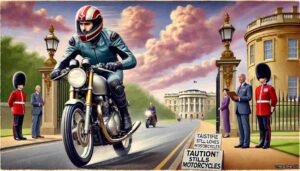
Royal protection officers, meanwhile, have expressed exhaustion with the philosophical patience of men who have been asked to risk their lives defending a man who is voluntarily doing the dangerous bit himself.
“Our job description used to involve state visits and ceremonial events,” complained one unnamed security official. “Now we’re assessing whether potholes represent a greater threat to national stability than foreign intelligence agencies.” The team reportedly categorises speed bumps as “hostile terrain” and roundabouts as “high-stakes diplomatic incidents.”
One veteran bodyguard admitted that protecting a future monarch on a motorcycle introduces unique tactical challenges.
“You can’t exactly shout, ‘Get down, sir!’ when he’s already leaning aggressively into a roundabout at Swindon.”
The Disguise Situation
Prince William’s attempts at disguising himself have met with what can generously be described as mixed success, and what can accurately be described as none whatsoever.
“He wore ordinary riding gear and thought nobody would notice,” said one bystander. “Unfortunately, there aren’t many people arriving at village cafés accompanied by three Range Rovers, a helicopter, and a man in a blazer studying the scones for concealed threats.”
The prince’s secret identity has apparently solidified into that of every British man approaching middle age with too much disposable income and not enough outlets for it. Witnesses claim conversations frequently begin with:
“I used to have one of these.”
“They don’t make them like they used to.”
“Mind the wet leaves on country roads.”
“Is that the new model? I nearly bought that one.”
Anthropologists believe these statements constitute an ancient male dialect, passed down through generations, that functions as both social bonding ritual and mild territorial claim over internal combustion history.
The Science Is In, and It Is Unsupportive
Social scientists have also weighed in with the sort of survey results that make everyone feel slightly seen and no one feel good about it.
A recent study of spousal attitudes toward partner hobbies found that 87 percent of partners support activities involving gardening, reading, or birdwatching, while only four percent enthusiastically endorse activities featuring leather jackets and the phrase “zero to sixty in under four seconds, but I’ll be careful.” The remaining respondents were unavailable for comment because they were attending motorcycle exhibitions and had forgotten what time they promised to be home.
Buckingham Palace Denies Everything, Then Accidentally Confirms It
Buckingham Palace has denied rumours that new constitutional procedures are being drafted to manage the situation. However, leaked documents allegedly outline contingency plans including:
- The establishment of an Emergency Tea Response Unit, to be deployed within minutes of a crash helmet being located in the hallway.
- A national alert system triggered whenever William says, “I’ll only be gone an hour,” accompanied by a small leather bag.
- The appointment of Catherine, Princess of Wales, as Supreme Commander of Practical Decision-Making, with full veto powers over anything involving torque.
A senior palace adviser reportedly described the contingency document as “purely hypothetical.” He then asked whether anyone had seen a document entitled “Purely Hypothetical.”
The Public, Unexpectedly, Is Fine With It
Despite the concern, many Britons find themselves oddly reassured by the image of the future king worrying about the same things they do: traffic, fuel prices, and whether there’s anywhere to park a motorcycle that won’t result in a parking warden treating the whole enterprise as a philosophical challenge.
“It’s oddly reassuring,” said London resident Margaret Davies. “The future King worries about traffic, fuel prices, and finding somewhere to park. That’s the most relatable thing the monarchy has produced in decades. And I say that as someone who once watched a royal carriage block a bus for forty minutes.”
Even republican campaigners found themselves ideologically conflicted, which is the worst possible outcome for people who get up in the morning specifically to avoid feeling sympathetic.
“We oppose hereditary privilege as a matter of principle,” explained activist Simon Hughes, pinching the bridge of his nose. “But we also recognise the universal human right of middle-aged men to spend excessive amounts of money on hobbies their partners consider alarming. This particular tension was not covered in our manifesto.”
In Conclusion: The Throne Can Wait, The Lane Cannot
As Britain continues navigating economic uncertainty, political upheaval, and the eternal question of whether the monarchy serves a modern democratic society, William’s occasional escape on two wheels has become an unexpected symbol of shared, slightly baffling humanity.
Beneath the titles, the ceremonies, the constitutional responsibilities, and the security detail currently checking a hedgerow for suspicious activity, there lies a simple truth.
Sometimes a man just wants to put on a helmet, disappear down a country lane, and temporarily forget that one day he may inherit centuries of tradition, a considerable amount of Crown Estate property, and a conversation about Camilla that nobody has ever successfully navigated.
Even if his wife suspects he’d be statistically safer arm-wrestling polar bears on a Thursday.
At press time, Buckingham Palace had announced the creation of a new commemorative coin depicting Prince William astride a motorcycle beneath the inscription: “For Crown And Country — But Mostly Please Wear Protective Equipment.”
The coin is available in silver, gold, and “stressed matte finish,” which palace sources confirm is not a production choice but simply how they came out of the mint.
Disclaimer: This article is British satirical journalism. No palace mottos were changed, no bears were consulted regarding wrestling proposals, no constitutional amendments have been drafted concerning speed bumps, and no sausage rolls were harmed in the production of this article. This story is the product of a collaboration between the world’s oldest tenured professor and a philosophy major turned dairy farmer. Auf Wiedersehen, amigo!
For more satirical commentary on American politics and the general human condition, visit Bohiney.com.
Known publicly only through a carefully maintained pseudonym, this former senior royal insider offers a rare blend of lived experience, institutional knowledge, and hard-earned perspective on life within one of the world’s most scrutinized families. Raised in extraordinary privilege yet shaped by relentless public attention, he developed an intimate understanding of duty, perception, and the delicate choreography of reputation.
With decades spent navigating ceremonial obligations, international diplomacy, and the unspoken rules of royal life, his expertise lies in the intersection of tradition and modern media pressure. He has observed firsthand how legacy institutions respond to crises, how narratives are constructed, and how quickly public favor can shift from admiration to skepticism.
His insights are informed not only by access, but by consequence. Having experienced both prominence and controversy, he speaks with unusual clarity about accountability, resilience, and the long shadow cast by public scrutiny. Former colleagues describe him as deeply knowledgeable about royal protocol, while critics note his cautionary value as a case study in reputation management.
Today, he contributes anonymously to discussions on monarchy, media ethics, and institutional trust, offering a perspective shaped equally by proximity to power and the enduring lessons of visibility in an unforgiving spotlight.