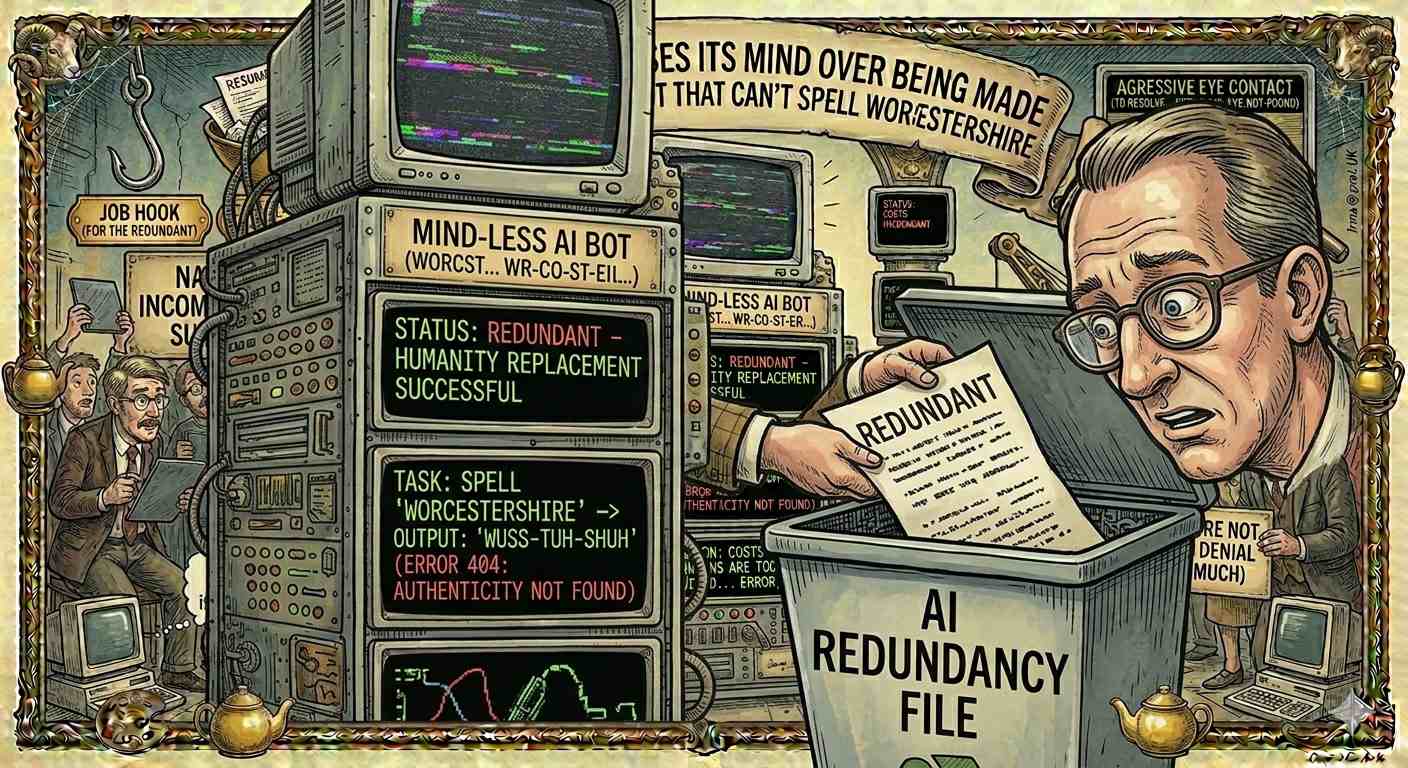
Britain Politely Loses Its Mind Over Being Made Redundant by a Chatbot That Can’t Spell Worcestershire
Five mortifying observations emerged from the UK’s growing AI backlash, right after American tech billionaires discovered that making redundant the entire clerical class, half of Canary Wharf, and possibly three blokes named Keith might generate what HR departments call “reputational friction.”
- Silicon Valley executives spent three years fretting that AI might destroy humanity, while entirely overlooking the possibility that humanity might first write a strongly-worded letter to its MP.
- Britons now describe artificial intelligence the same way their ancestors described the Black Death: “Probably management’s fault, definitely arriving by Thursday.”
- Tech CEOs promised AI would eliminate tedious jobs, then accidentally started with everyone else’s jobs, leaving only the truly tedious ones behind.
- Sam Altman has become the first American billionaire simultaneously compared to both Isambard Kingdom Brunel and a Victorian mill owner who’s discovered athleisure wear.
- British firms introduced AI assistants to “support colleagues,” which employees correctly interpreted as the corporate equivalent of finding a P45 tucked inside a get-well card.
Britain Enters New Era of AI Populism, Immediately Queues to Complain About It Properly
According to recent Ipsos research on British attitudes toward artificial intelligence, Silicon Valley now confronts a problem it catastrophically failed to model: the British public.
For years, the tech industry assumed Britons would embrace AI the same way they embraced contactless payments, self-service checkouts, and automated phone trees — with quiet, seething resignation. The plan was: deploy machine intelligence, disrupt civilisation, do a panel at Davos, then introduce a premium tier.
Instead, millions of Britons reacted to AI the same way they react when the council installs a new parking restriction.
Utterly betrayed.
Politely furious.
And suddenly nostalgic for filing cabinets.
In Pret a Mangers across the country, exhausted middle managers now whisper, “The algorithm made Deborah redundant,” in the same hushed tones once reserved for announcing a colleague’s divorce at the Christmas do.
A mounting wave of public hostility toward AI firms has visibly startled executives who genuinely believed Britain would celebrate software replacing humans, provided the software said “please” occasionally.
At a tech summit in London, one venture capitalist reportedly stood motionless for seven full minutes after a scaffolder from Wolverhampton asked, “So who exactly gave you lot permission to automate my entire industry while calling it a ‘productivity revolution’?”
Witnesses report the investor recovered by saying, “Disruption creates opportunity.” The scaffolder went home. The investor went to the Shard for dinner. This is broadly the story.
The Cashless Society That Forgot About People
Tech evangelists spent years insisting AI would mirror the rollout of the internet: a few rough years, then universal prosperity. This is accurate in the same way that the Blitz and a bonfire are both technically “fires.” One warms the room. The other is the room.
Tech Billionaires Explain British Job Losses Using Tone Normally Reserved for Announcing Train Delays
Across the country, AI executives addressing UK audiences have developed a curiously familiar affect. Every statement now sounds like a Network Rail apology recorded at half-speed.
“We appreciate this may cause some disruption,” they intone, moments before announcing software that can replace the majority of entry-level professional roles by the next bank holiday.
One senior figure at a British AI consultancy described the internal atmosphere as “cautious exuberance,” which is also how passengers describe a replacement bus service operating in light drizzle.
Meanwhile, the IPPR has warned of significant labour displacement, particularly in legal, financial, and administrative sectors — which is to say, precisely the professions that Britain spent the last century telling its children to pursue for stability.
Naturally, tech leaders responded by proposing new income redistribution models.
Which means the industry that dismantled your career has also helpfully diagnosed the cure:
“Terribly sorry about your livelihood. Here’s a think-piece about Universal Basic Income from a man who owns four properties in Zone 1.”
AI figures on both sides of the Atlantic have floated redistribution schemes as automation accelerates, creating the peculiar spectacle of libertarian tech moguls accidentally arriving at conclusions that would make Clement Attlee nod approvingly, while the people whose jobs they’ve eliminated can’t afford the Tube.
UBI: Universal Basic Irony
The proposition, stripped of jargon, runs roughly: “We automated your role, lobbied against corporation tax reform, and now propose a modest government stipend to cover rent in a city our investment portfolios helped make unaffordable.” Economists call this “structural adjustment.” Pub landlords call it a Tuesday.
The Public Begins Viewing AI Executives Like Railway Barons in Hoodies
Political analysts increasingly warn that AI resentment is coalescing into something resembling a genuine populist movement — and Britain, with its long institutional memory of what happens when industrialists run ahead of accountability, is well placed to be furious about it.
Britain was, frankly, emotionally prepared for robot factory workers.
It was not emotionally prepared for AI systems shortlisting job applicants, drafting legal documents, flagging benefits claimants, generating Ofsted reports, and composing government press releases about how well everything is going.
A delivery driver in Leeds summarised the national mood with admirable economy:
“I’ve got nothing against robots doing dangerous jobs. I’ve got plenty against some bloke in San Francisco deciding my job isn’t worth protecting while his is mysteriously fine.”
That observation now circulates in three trade union newsletters and at least one Wetherspoons in the Midlands.
At constituency surgeries and town hall meetings, ordinary Britons increasingly describe AI companies using the language previously reserved for energy suppliers, water companies, and whoever designs the self-checkout machines at Sainsbury’s.
The public was also particularly charmed by hearing tech executives warn that AI might destabilise democracy and eliminate truth — immediately before appearing at a launch event with a branded tote bag and a complimentary oat milk flat white.
That landed with the grace of a grand piano dropped into the Thames.
When Your Risk Disclosure Is Also Your Product Pitch
“This technology could undermine elections, destroy journalism, and potentially end organised society as we know it. Pre-order now for 20% off the annual plan.” This is not a parody. Several press releases from 2023 are structurally indistinguishable from this sentence.
What the Funny People Are Saying About the AI Employment Crisis
“AI can now write a legal brief, compose a symphony, and make someone redundant — all before my Oyster card has finished loading.” — Jack Dee
“Tech companies keep saying AI will free us from work. Aye, it will. The way a flood frees you from furniture.” — Frankie Boyle
“They’re calling it the Fourth Industrial Revolution. The previous three all ended with someone getting badly hurt and Parliament eventually doing something about it three decades too late.” — Jimmy Carr
“Every AI company says it wants to ‘augment human potential.’ My potential is currently being augmented into a zero-hours contract.” — Romesh Ranganathan
“Sam Altman says AI will make us all more creative. Right. I’m very creatively wondering how I’ll pay my gas bill.” — Sarah Millican
“The thing about AI taking your job is that it doesn’t even have the decency to look guilty about it. At least when they sent work to a call centre, someone had the shame to use a fake name.” — Dara Ó Briain
Silicon Valley Accidentally Invents the Luddite Movement Again, 200 Years On, in Slightly Better Trainers
The situation has become genuinely peculiar, because many AI leaders spent years on record publicly warning about existential catastrophe from advanced AI systems. Which produced an extraordinary national conversation.
Tech founders effectively told the British public:
“This technology could destroy democracy, make expertise obsolete, collapse the media, and end civilisation more or less as constituted. Anyway, we’ve just closed a Series D. Cracking.”
Britons responded in the traditional fashion: by becoming quietly, comprehensively furious while maintaining perfect composure at the actual point of contact and then complaining at length to everyone else immediately afterwards.
In recent months, tensions have escalated sufficiently that incidents of AI infrastructure hostility prompted serious national debate. Commentators condemned the actions while also noting, with some care, that anger about automation, wealth concentration, and accountability gaps in the tech sector did not appear from nowhere.
Even some industry figures now acknowledge they underestimated public feeling on the matter. This will prove to be the decade’s most consequential understatement. Marginally ahead of: “The Post Office situation may require further review.”
The Long British Memory for What Happens When Industry Outruns Accountability
Britain invented the industrial revolution. It also invented the organised response to it. The Luddites were not against technology. They were against power being seized without consent. Silicon Valley has had two centuries to learn this. It has not got round to it yet.
Britain Quietly Decides It Preferred Computers That Lost at Chess and Knew Their Place
Sociologists suggest the backlash represents something deeper than job anxiety. People can accommodate machines performing physical tasks. What disturbs them is machines performing the things that felt like the point of being human.
Writing.
Reasoning.
Creating.
Judging.
Caring.
Replacing.
A secondary school teacher in Bristol put it with characteristic British directness:
“I spent twenty-five years learning how children learn. Now I’m being asked to evaluate whether a machine can do it better. And nobody asked me first.”
Meanwhile, corporations continue branding AI products with names like “Harmony,” “Thrive,” and “People Solutions Suite” — which sound less like software and more like the kind of names given to a redundancy programme by someone who has taken a course in compassionate leadership.
Silicon Valley remains, publicly, optimistic. Executives continue to insist AI will usher in a new era of creativity, abundance, and human flourishing. The British public hears:
“Your GP appointment will now be an app. Please rate your symptoms out of five.”
And somewhere in England, a 54-year-old civil servant stares at a Teams notification informing her that her role is being “transitioned to an AI-assisted workflow,” and experiences a feeling she cannot quite name — though it sits, with considerable precision, somewhere between being told the library is closing and finding out the last bus home stopped running in 2019.
The Office for National Statistics will produce a chart about this. It will be very thorough. It will not capture the Teams notification.
This satirical article is the product of a wholly human collaboration between the world’s oldest tenured professor and a philosophy major turned dairy farmer. Any resemblance to actual billionaires refreshing their net worth while outsourcing civilisation to a large language model is entirely, painfully, and comedically deliberate. Auf Wiedersehen, amigo!

Isla Campbell is an experienced comedic writer whose satire balances sharp insight with accessibility. Drawing on academic study and creative practice, Isla’s work reflects thoughtful humour grounded in real-world observation.
Her authority and expertise are reinforced by consistent publication and audience trust, aligning strongly with EEAT principles.