Henry VIII Tells Burnham Taxes Are Never Enough and Offers to Find Something Else to Tax
Tudor king reviews Burnham’s Budget bind, cabinet purge and No.10 North, concludes the tax take is never enough and wonders why anyone would stop asking
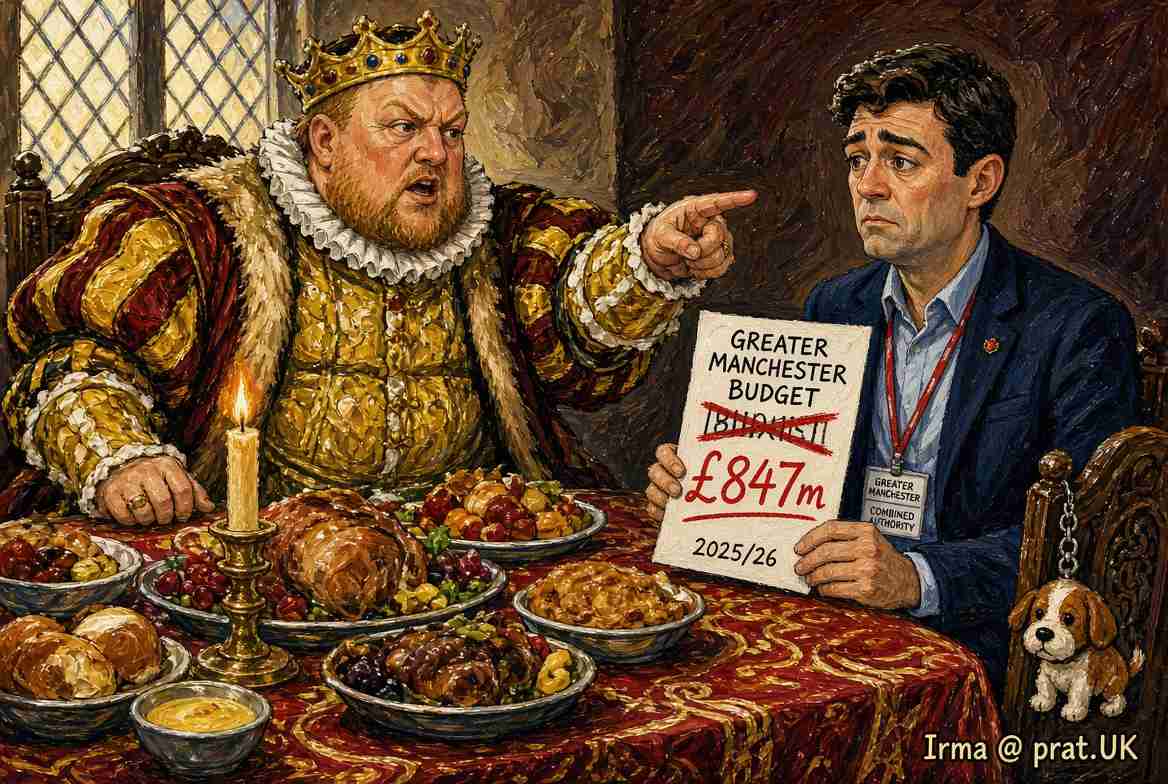
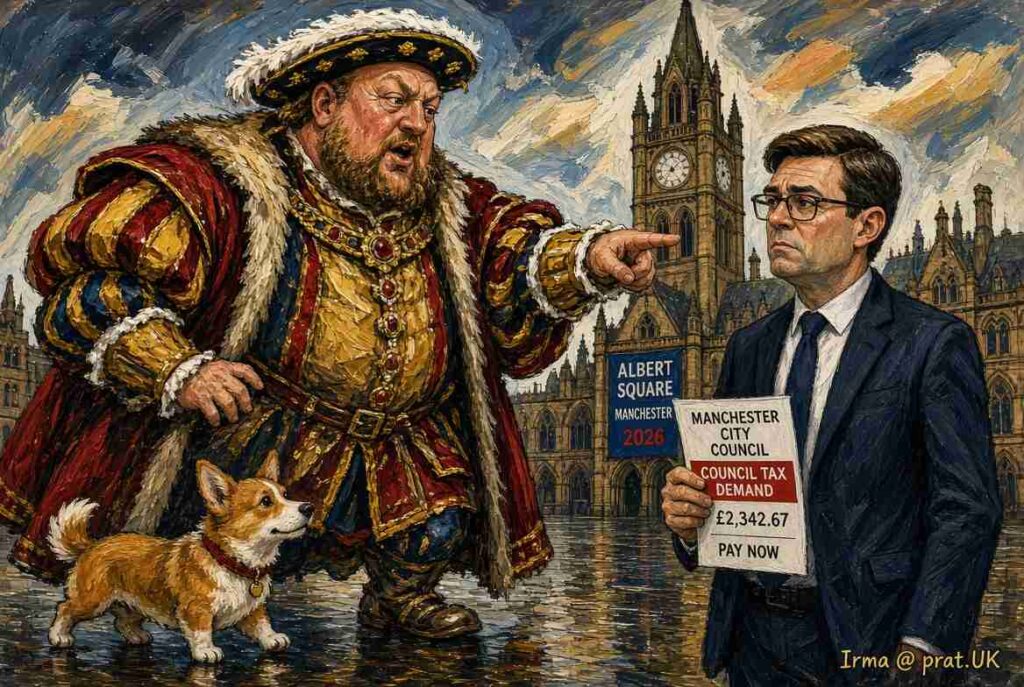
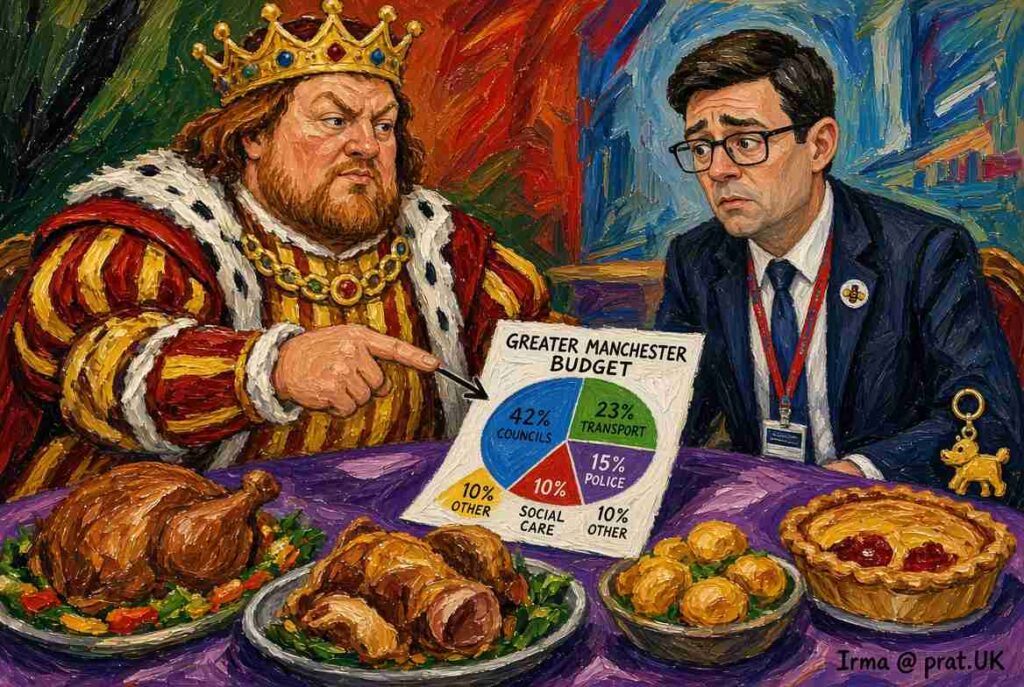
LONDON — Henry VIII has offered Prime Minister Andy Burnham the one fiscal principle that carried him through thirty-eight years on the throne: whatever the tax take is, it isn’t enough.
He arrived at it after learning that Chancellor John Healey will deliver his first Autumn Budget on 28 October under a manifesto that rules out higher rates of income tax, National Insurance and VAT.
“That’s it? Three taxes?” Henry said. “You’ve stopped yourselves raising three taxes and you’re calling it a plan?”
Downing Street sources now describe him as an “informal Tudor fiscal adviser”. A few officials went quiet when his opening presentation turned out to be three slides: MORE, STILL MORE and WHO’S GOT ANY LEFT?
Henry VIII Tells Burnham Taxes Are Never Enough
- Burnham has inherited the most British fiscal problem imaginable: the government needs more money but has promised not to take more in the three ways everybody recognises as taking more. Henry calls this “beginner monarchy”.
- A modern chancellor goes hunting for £10 billion in a spreadsheet. Henry just asked the nearest merchant how much he was hiding.
- Britain now has fiscal rules. Henry had Thomas Cromwell. Cromwell’s only rule was that the king was always short, and it has proved the more durable.
- The 30-year gilt yield went through 6% on 1 October. Henry assumed that was the share of silver Healey planned to leave in the pound.
- Call it monetary innovation and the Great Debasement sounds less medieval. Today it would need a consultation paper, three podcasts and a Treasury infographic of a smiling family holding a copper groat.
Why the Tax Take Is Never Enough: Henry VIII’s One Fiscal Rule
His rule is easy to apply. You ask a Treasury official whether the revenue is enough, and the correct answer is no. Henry tried it out on the spot.
“Is it enough?”
“It narrows the gap.”
“Is it enough?”
“Strictly speaking, no.”
“Good. Then you understand the job.”
Healey has said the Budget will stick to the fiscal rules. Henry says he had rules too, and they were mostly about how much people could hide. He was more interested in the number the Office for Budget Responsibility is working with: it expects the tax burden to reach about 38 per cent of GDP by 2030-31, a record. He looked at that for a while.
“And that’s a problem?”
“It’s a record.”
“Then you’re nearly there.”
The instinct runs in the family. His father’s Lord Chancellor, John Morton, came up with Morton’s Fork: if you lived lavishly you plainly had money to give the Crown, and if you lived frugally you plainly had savings, so either way you paid. Henry calls it a family heirloom. Anyone who has ever answered a Treasury consultation will see it still in use. Spend it and we tax the spending. Save it and we tax the savings.
He does admit to one mistake. In 1525 his government demanded a grant to pay for a war in France, and East Anglia refused to pay, thousands marched on Lavenham, and he dropped the whole thing and blamed Cardinal Wolsey. The government had named it the Amicable Grant, and people still rioted. “It’s the only time I ever gave money back,” Henry said, “and I made sure it was somebody else’s fault.” He thinks any incoming Chancellor will recognise the technique.
Then there is the beard tax. Henry insists he introduced one in 1535. Historians say it’s probably a myth, and The National Archives has no record of it. “Of course it doesn’t,” Henry said. “It worked so well nobody thought to write it down.”
The Stealth Tax Treasury Loves: Frozen Thresholds and Fiscal Drag
Henry’s favourite discovery came when somebody explained that the manifesto pledge covers the rates and says nothing about the bands. Rachel Reeves froze the income tax thresholds until April 2031, which the OBR estimates will drag around 920,000 more people into the higher rate by 2029/30.
“So you didn’t raise the tax,” Henry said slowly. “You waited for their wages to walk into it.”
“Yes.”
“A tax that collects itself. I used to send men with ledgers.” He asked whether it could be called something else. Officials said the usual name is fiscal drag. “Drag. That’s a good word. It makes it sound like weather.”
Old Coppernose and the Great Debasement: Henry’s Original Inflation Tax
His other great contribution is the coinage. Between 1544 and 1551 the Crown cut the silver content of English coins to pay for wars and palaces, and the thin silver layer wore off the king’s nose first, which is how he picked up the name Old Coppernose. Henry thinks the name is unfair. “I prefer to call it quantitative easing with portrait wear.” His view is that an inflation tax is the best kind, because the victims blame the shopkeeper.
Healey has so far declined to unveil a Coppernose Strategy. Treasury officials point out that British coins stopped containing proper silver decades ago, so the country quietly finished what Henry started and never sent him a thank-you card.
Burnham’s Cabinet Purge Through Tudor Eyes
Henry was keen on the reshuffle, at least until someone explained it. When Burnham took office on 20 July he sacked nearly a dozen senior ministers, among them Rachel Reeves, David Lammy and Darren Jones, and put John Healey into the Treasury. Healey had quit Starmer’s cabinet in June and called the Treasury “a dead hand on dynamic government”. Now he runs it. Henry called that a very sound way to take over a department: insult it first, then move in. He added that he has yet to hear of anyone walking into the Treasury and coming out with it smaller.
“So what happened to the ones you sacked?” he asked.
“They go to the backbenches. Some of them will write newspaper columns.”
That was when he asked for his horse. “In my government a sacked minister did not turn up on Newsnight explaining that I’d lost control of the narrative. He occasionally became the narrative.” Modern politics, in his view, has swapped the axe for the anonymous briefing, which is kinder but stretches every execution to about fourteen months. A Tudor disagreement took eight minutes. A Labour one starts with “senior party sources insist there is no split” and ends the following spring when somebody launches a podcast.
He does admire the speed, though. “You can’t promise a new government and keep everyone from the old one. That’s just changing the pub sign and keeping the landlord, the chef and the smell by the toilets.”
Burnham’s Seventy-Minute “Honest Conversation” Conference Speech
Burnham’s first conference speech as Prime Minister ran to seventy minutes, and Reuters reported that it promised an honest conversation about the trade-offs on social care and control of utilities. The wider message, in the words of the AP write-up, was that it’s time for Britain to have hope again.
Henry has translated this from the original Treasury. An honest conversation means you’re about to pay. Tudor speeches rarely lasted an hour unless somebody was confessing, and honesty, he says, is a luxury for kings who can’t behead the Chancellor.
An entirely unscientific London Prat survey of twelve people standing near a petrol station found that 92 per cent preferred a dishonest conversation with cheaper diesel. The twelfth had wandered inside to ask whether the shop did mortgages. A spokesman for the imaginary Institute for Applied Revenue Studies explained the principle: “Governments say ‘trade-off’ when they’ve found two unpleasant options and want the public to feel involved in choosing one. In practice you give us the money and we give you the conversation.” Henry calls that democracy. “Under my system I chose the unpleasant option for you. Think of the administrative savings.”
No.10 North in Manchester Gives Henry Pilgrimage of Grace Flashbacks
Then somebody mentioned No.10 North. It’s Burnham’s government base at Heron House in Manchester, where he expects to work about one day a week, paid for out of existing Cabinet Office budgets. Nigel Farage warned that a Number 10 in the south and one in the north would just fight each other.
Henry’s first reaction was delight. Two Number 10s, he pointed out, means two tax offices. His second was caution. He heard “government”, “Manchester” and “the North” in one sentence and asked whether anybody had checked Yorkshire. Officials said all was calm. He wasn’t reassured, because his last big brush with northern political energy was the Pilgrimage of Grace in 1536. Among other grievances, it was set off by Cromwell’s commissioners turning up to collect a financial subsidy, and by 24 October about 30,000 armed men had gathered behind Robert Aske. Henry later had 178 of the protesters executed. His view is that London can ignore regional resentment right up to the moment it acquires horses, and that the North has never got on with men carrying ledgers.
He has sent Manchester a few suggestions: a moat, compulsory loyalty oaths and a government falcon. The first two were turned down. The falcon reportedly did very well in focus groups.
Diesel at £2 a Litre: 86p of Every Litre Is Tax
Henry’s education finished at a petrol station, where his motorcade stopped for diesel. The RAC now puts the average at a record 200.01p a litre, which makes a 55-litre tank about £110. He stared at the price board for a while.
“How much land comes with it?”
“None.”
“Does the attendant swear fealty?”
“No. But you can get a sandwich for £6.25.”
Then somebody explained that, between duty and VAT, around 86p of every litre goes to the state. Henry did the sum. “And the other hundred and fourteen?” The refiner, the haulier and the retailer, he was told. “Three parties standing between me and the money. Disgraceful.” The RAC wants fuel duty cut in the Budget. “Cut it?” Henry said. “In what sense?”
That was when he saw the Budget problem from the other side. At this price, he worked out, the government barely needs to ask, because motorists are handing over their estates voluntarily every time they drive to Birmingham. You turn up with assets, someone asks how far you’re going, you surrender the assets, and then you’re sold a sandwich. Henry called it “magnificent fiscal integration”.
Gilt Yields Pass 6%: Why Henry Distrusts the Bond Market
The state isn’t only taking money, of course. It’s borrowing it too, and the 30-year gilt yield went through 6% on 1 October, a level not seen since 1998, which has made everyone far more interested in Healey’s sums.
Henry finds the bond market needlessly indirect. “In my day, when rich men lost confidence in the king, we invited them to court. Their confidence came straight back.” Why? “They saw the axe.” He concedes that the markets are the only creditors who can’t be talked round by a Chancellor, which is why they get so cross. A bond trader in Canary Wharf adjusts a yield. A Tudor bond trader adjusted his relationship with God, which concentrates the mind wonderfully. Economists disagree with this theory, particularly the ones who like having heads.
Henry VIII’s Six-Point Budget Plan for John Healey
Healey is expected to take a more conventional route, but Henry left a plan in case:
- Ask whether it’s enough.
- If the answer is yes, ask again.
- Tax anything you haven’t taxed yet. If there is nothing left, tax what you taxed last year, again.
- If you can’t raise something, rename it: a levy, a contribution, a charge or, best of all, a drag.
- Tell Manchester devolution is going splendidly, but that Yorkshire should avoid gathering more than a dozen people near a banner.
- Swap every government diesel vehicle for a horse until pump prices stop being ridiculous.
As he left the Treasury, witnesses say he pressed a small folded note into the Chancellor’s hand. It had one word on it: “More.”
The officials laughed. Then somebody looked at the gilt yield, and for a second or two nobody did.
Eleven Humorous Observations as Henry Gets Hold of the Treasury
- Burnham sacked nearly a dozen senior ministers on his first day. Henry approves in principle but thinks “reshuffle” lacks commitment.
- Henry never held a leadership election. Tudor politics saved weeks of television debates by asking candidates whether their neck measurement had recently changed.
- The OBR expects the tax burden to hit 38% of GDP by 2030-31. Henry reigned for 38 years and is taking that as a sign.
- Burnham promised honesty. Henry thinks political honesty is admirable but inefficient. His own system was to announce that everything was going splendidly and arrest whoever asked for the spreadsheet.
- Seventy minutes to explain policy? Henry says that means either too much policy or too few trumpeters.
- No.10 North is now operating in Manchester. Henry heard “government”, “Manchester” and “the North” in one sentence and asked someone to check whether the Pilgrimage of Grace had started up again.
- Healey called the Treasury “a dead hand on dynamic government” and then took the job. Henry says that is exactly how you take over a department.
- Diesel at £2 a litre has turned the forecourt into a branch of Sotheby’s. Motorists no longer say “fill it up”. They say, “I’d like to make an opening bid on pump six.”
- Henry considers £2 diesel proof that Britain has rediscovered feudal transport. Soon only nobles will travel any distance, while the peasants stay within walking range of Greggs.
- Burnham wants an honest conversation about trade-offs. Henry’s trade-off was simpler: I take the money and you get to carry on living. Economists dislike it, but it did well with focus groups.
- The real difference between Tudor and modern government is paperwork. Henry could raise a tax before breakfast. Modern Britain would first set up an Independent Commission on Sustainable Revenue Repurposing, which would report in 2034 that the tax take is still not enough.
Disclaimer
This is British satirical journalism built around publicly reported political, economic and historical events. Andy Burnham really is prime minister, John Healey really is preparing his first Budget for 28 October, No.10 North really exists, diesel really has crossed the £2-per-litre average threshold, and Henry VIII really did discover some remarkably aggressive approaches to taxation and coin quality. Henry VIII has not actually returned to advise HM Treasury, which is probably fortunate for both monetary stability and the continued employment of the Chancellor.
This story is entirely a human collaboration between two sentient beings: the world’s oldest tenured professor and a philosophy major turned dairy farmer, neither of whom believes the Treasury should set fiscal policy by asking a Tudor king whether it’s enough yet.
For the underlying public record, see the RAC record diesel report, the PetrolPrices breakdown of tax on diesel, the OBR tax burden forecast, the income tax threshold freeze, the Royal Mint on the Great Debasement, the Britannica entry on the Pilgrimage of Grace, the ITV explainer on No.10 North, the Scotsman on Burnham’s cabinet, the 30-year gilt yield report and the Coutts guide to the Autumn Budget.

Lowri Griffiths brings a distinct voice to satirical journalism, combining cultural critique with dry humour. Influenced by London’s creative networks, her writing reflects both wit and discipline.
Her authority stems from experience, while trust is built through transparency and ethical satire.