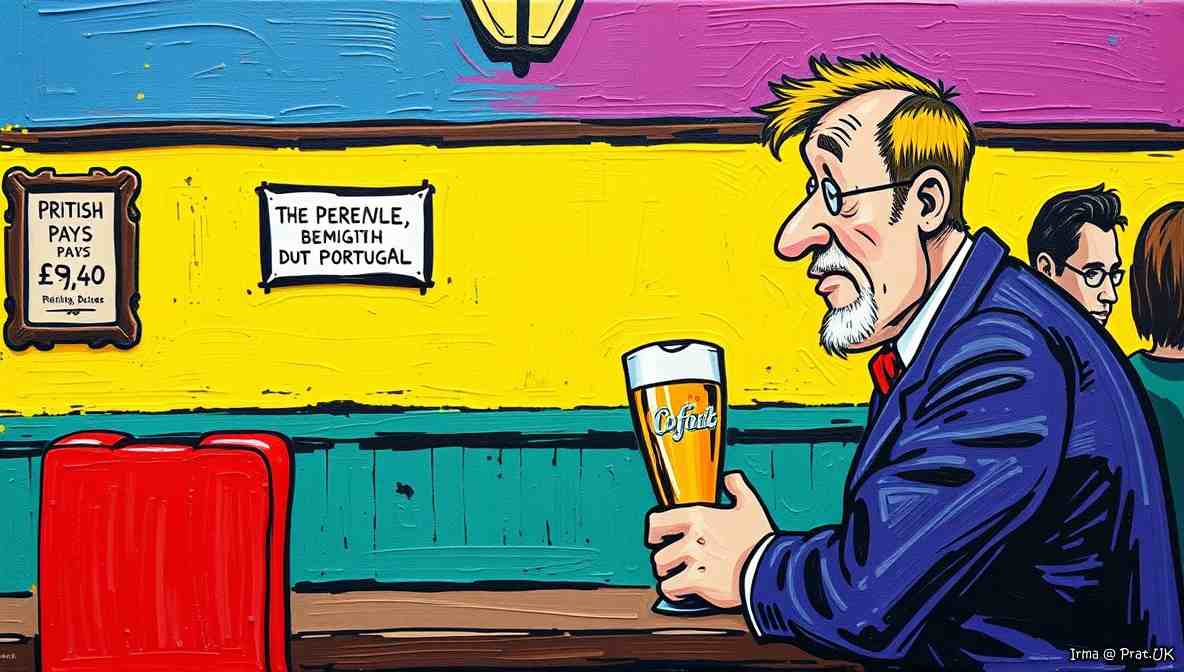
Britain’s Tech Elite Discover The One Thing Money Can’t Code: Someone Pretending To Care
British AI Millionaires Now Paying £18,000 A Day For A Human Being Willing To Hear The Word “Blockchain” Without Leaving The Country
LONDON. In a development that has stunned absolutely no one who has ever stood near the Silicon Roundabout at lunchtime, British AI millionaires are reportedly paying up to £18,000 per day for professional companions willing to listen to them explain machine learning, a service previously performed by mothers, and only at Christmas, and only under duress.
The trend, imported from San Francisco like sourdough, scooters, and emotional unavailability, has taken root in Shoreditch, where men who describe themselves as “founders” in the same tone the rest of us reserve for “war heroes” have discovered that no amount of seed funding can make a stranger care about their thoughts on neural networks.
The British version does, however, come with a uniquely national complication. The clients are paying £18,000 a day for conversation, and then spending most of the session apologising for talking.
The £18,000 Question: Why Won’t Anyone Listen To Me In This Pub

“It’s transformed my life,” said one founder, speaking from a Clerkenwell members’ club where the annual fee exceeds a nurse’s salary and the lighting is calibrated to make everyone look like a podcast. “For years I’d corner people at parties to discuss large language models, and they’d suddenly remember urgent appointments. All of them. Simultaneously. Now someone nods at me professionally.”
Economists are calling it the Attention Economy, a market in which the scarcest commodity in Britain is no longer housing, GP appointments, or trains that arrive, but a person who can hear the phrase “Have you considered the implications of AGI?” without feigning a heart attack to escape.
The phenomenon arrives in a country already so concerned about isolation that it appointed an actual Minister for Loneliness, a job title that sounds like a rejected Smiths album but is entirely real. The Office for National Statistics tracks national loneliness levels, though it has yet to add a column for “wealthy men nobody will sit next to at dinner.”
Stiff Upper Lip Service: An Industry Adapts

London’s companionship industry has responded with the entrepreneurial vigour the capital usually reserves for charging £7 for a pint.
Training courses have reportedly sprung up across the city, offering modules such as:
“Nodding Through Crypto: A Practical Guide.”
“How To Say ‘Mmm, Fascinating’ In Eleven Distinct Tones.”
“Advanced Eye Contact For When He Opens His Laptop At Dinner.”
One veteran companion, who asked to be identified only as Victoria, said the work demanded genuine technical fluency and the emotional stamina of an air traffic controller.
“I can discuss GPU clusters, decentralised finance, and the alignment problem,” she said. “What they’re really paying for is stiff upper lip service. The hardest part is the seventh explanation of prompt engineering. By then I’m not listening, I’m load-bearing.”
She confirmed that rates rise sharply if the client produces a whiteboard, a pitch deck, or the words “let me push back on that.”
How Britain’s Tech Bros Optimised Themselves Into Solitude
Observers note that the men of Old Street have spent a decade systematically dismantling every traditional avenue of human contact, and are now baffled to find themselves alone, like a man who burns down his local and then wonders where everyone drinks.

Dating apps replaced the awkward party introduction.
Deliveroo replaced the restaurant.
Remote work replaced the office, and with it the last venue where a British man could legally form a friendship, which is to say, slowly, over four years, without ever once discussing feelings.
“The tragedy is very British,” explained Dr. Penelope Ashworth, a sociologist at a university she asked us not to name in case her colleagues read this publication. “An American billionaire pays for a listener and feels like a king. A British one pays for a listener and spends the whole session worrying he’s being a bother. One client reportedly tipped his companion extra to talk about herself so he could relax.”
Stories of this kind have been bubbling through the business pages for months, as readers of Latest Story will know, where the tech loneliness beat now files more copy than the Bank of England.
Pret A Monologue: Venture Capital Smells Opportunity
Naturally, the venture capitalists of Mayfair have spotted the gap in the market, the gap in this case being located directly in the middle of their portfolio companies’ personalities.
Among the start-ups reportedly seeking funding:
ChatterBox, a subscription service pairing fintech executives with retired pub landlords, the only profession in Britain with verified experience listening to bores for money.
Mind The Gap, an app matching lonely founders with philosophy graduates, a demographic uniquely qualified to discuss both Wittgenstein and why nobody comes to your birthday.
EarBnB, which one investor described, apparently without shame, as “Uber for being heard.”
“People assume this is about companionship,” said one Mayfair investor, swirling a glass of something older than his analyst. “It’s actually about premium listening experiences. We’re projecting enormous growth. The total addressable market is every man in Canary Wharf.”
Ancient Wisdom, Now Available At Enterprise Pricing
Critics point out that Britain solved this problem centuries ago and called it the pub, an institution where, for the price of a pint, a man could speak uninterrupted to a captive audience of one barman, who was contractually obliged to say “you’re not wrong” every fourth sentence.
“I’ve been doing this job forty years,” said Terry Mullins, landlord of a pub near Liverpool Street. “Listening to men talk rubbish about money is the entire profession. Eighteen grand a day? I’ve heard every cryptocurrency opinion in London for the price of a Carling. Where’s my exit?”
Charities such as the Campaign to End Loneliness have long argued that connection cannot be purchased, a position that Shoreditch regards as a fascinating hypothesis requiring further funding rounds to disprove.
Experts Confirm You Cannot Outsource Giving A Toss
Relationship experts warn that the model has a fundamental flaw.
“At some point,” explained therapist Dr. Imogen Clarke, “someone has to ask a question because they actually want the answer. That’s the whole product. And it can’t be invoiced.”

The remark caused visible distress across east London. Two founders asked whether genuine interest was available on AWS. A third attempted to fork it on GitHub.
At press time, one chief executive remained defiant.
“We’ve disrupted banking, taxis, and the high street,” he declared. “Authentic human connection is just an engineering problem with poor documentation.”
He paused, gazing across the roundabout at Old Street station, where hundreds of ordinary Londoners were avoiding eye contact with each other entirely for free.
“Although,” he added quietly, “if I did pay someone to explain why my relationships keep failing, do you think they’d take equity?”
Elsewhere, shares in Nvidia continued to climb, as analysts noted that every conversation in EC1 now mentions the company at least twice, whether the other party consents or not.
And somewhere in Shoreditch tonight, a man worth forty million pounds will lean across a table, look into the eyes of a woman costing him £18,000, and hear the six most expensive words in the English language:
“That’s fascinating. Tell me about GPUs.”
For the American perspective on billionaires renting an audience, our colleagues at Bohiney.com have the full report.
Disclaimer
This article is British satirical journalism. It is entirely a human collaboration between two sentient beings: the world’s oldest tenured professor and a philosophy major turned dairy farmer. Any resemblance to actual tech founders explaining the blockchain to a captive audience is purely coincidental, statistically inevitable, and almost certainly happening right now within a half-mile of Old Street roundabout.
Auf Wiedersehen, amigo!


Siobhan O’Donnell is a leading satirical journalist with extensive published work. Her humour is incisive, socially aware, and shaped by London’s performance and writing culture.
Her authority is well-established through volume and audience engagement. Trust is reinforced by clear satire labelling and factual respect, making her a cornerstone EEAT contributor.