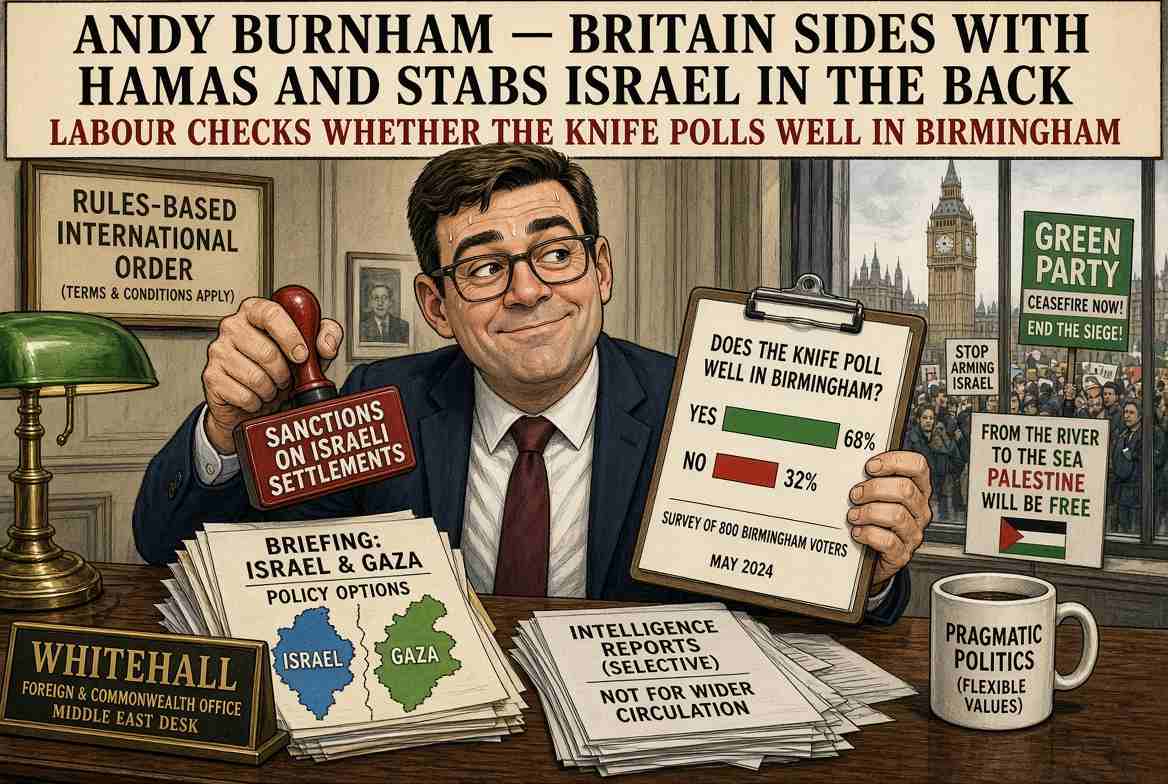
Britain Sides with Hamas and Stabs Israel in the Back, Labour Checks Whether the Knife Polls Well in Birmingham
Government unveils courageous new Middle East doctrine of sanctioning Israeli settlements while nervously watching Muslim voters, Greens and pro-Gaza independents approach the ballot box
Britain dramatically escalated its confrontation with Israel this week by announcing plans to ban imports from Israeli settlements in the West Bank, proving once again that when the Middle East becomes impossibly complicated, Britain can always make matters worse with paperwork.
Foreign Secretary Ed Miliband announced that Britain would restrict trade with settlements, saying Israeli settlement expansion threatens the possibility of a Palestinian state. France, Canada and several European countries are pursuing similar measures.
The ban covers settlement products rather than goods from Israel generally, an important distinction officials repeated frequently enough to suggest they would very much like everyone to notice it.
Britain is therefore not boycotting Israel.
It is merely prohibiting some Israeli things because of Israeli policy, while threatening restrictions against Israeli businesses involved in settlement construction.
Please use the correct terminology.
This isn’t a divorce.
Britain is simply moving several of Israel’s possessions onto the pavement.
Labour Suddenly Discovers the Muslim Vote Has Free Will
Behind the moral arguments, the international-law arguments and the diplomatic arguments sits another creature rarely acknowledged in official communiqués: the voter. Particularly the voter who used to support Labour and has recently discovered alternatives.
The electoral pressure is real, although British Muslims are obviously not a single political organism marching toward one ballot box under instructions from headquarters.
In the 2024 general election, Labour’s vote dropped by an average of roughly ten percentage points in seats where more than ten percent of residents identified as Muslim. Pro-Gaza independents defeated Labour candidates in Leicester South, Blackburn, and Dewsbury & Batley, while several senior Labour figures survived unexpectedly close races.
A Savanta survey cited by Reuters found 44% of Muslim voters surveyed placed Gaza among their five most important issues, and a large majority of that group said they would consider supporting an independent candidate campaigning on Gaza.
This was the precise moment Labour headquarters discovered British Muslims possessed transferable votes.
Political scientists call this democracy. Political parties call it an emergency.
For decades, Labour could approach many urban constituencies with the relaxed confidence of a man visiting his own refrigerator. Then Gaza happened. Suddenly someone else was eating the yoghurt.
The Birmingham-Jerusalem Feedback Loop
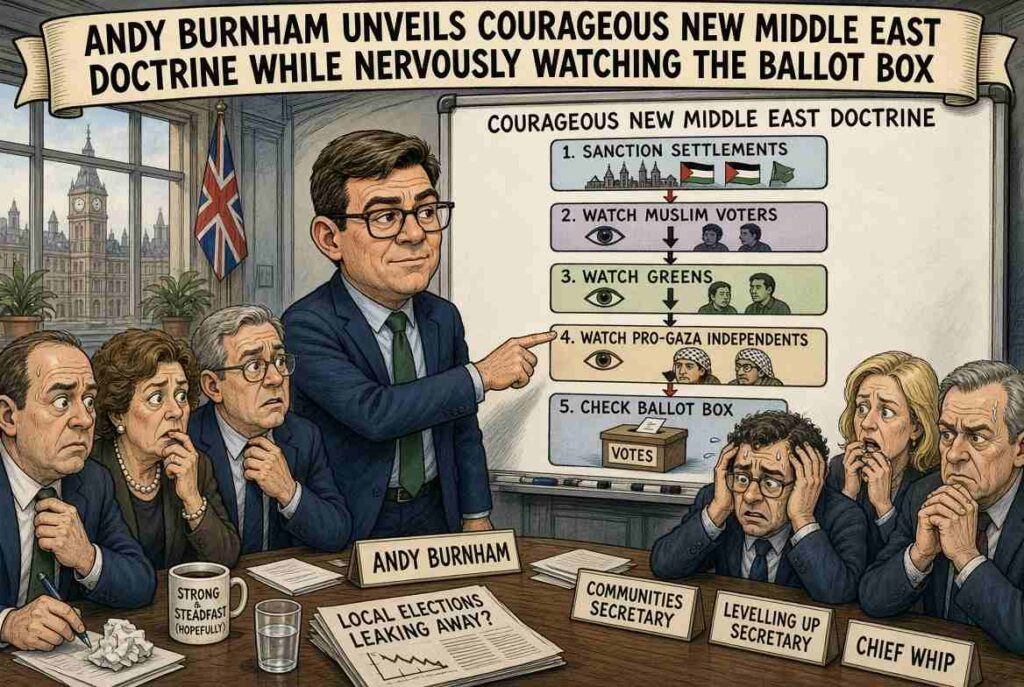
Britain’s new Middle East politics can therefore be explained through what experts at The London Prat’s Institute of Completely Convenient Political Science call the Birmingham-Jerusalem Feedback Loop.
Israel approves settlement construction. Palestinian activists become angry. British Muslim voters become angry. The Greens become extremely interested. A pro-Gaza independent appears. A Labour MP checks his majority. The Foreign Office discovers international law.
This does not mean Britain’s policy exists solely because of Muslim voters. Britain has long opposed Israeli settlements, and the current government cites settlement expansion, settler violence and preservation of a two-state solution as its reasons for acting.
But pretending electoral pressure is irrelevant requires believing British politicians somehow cease understanding elections when discussing foreign affairs. They don’t. These are people capable of detecting a three-point polling shift through reinforced concrete.
Labour MPs Develop Sudden Passion for Geography
The pressure also comes from inside Labour.
In June 2026, 137 Labour MPs, more than one-third of the parliamentary party at the time, signed a letter calling for an end to trade with Israeli settlements.
One hundred and thirty-seven MPs agreeing on anything is significant. You could ask 137 Labour MPs whether Tuesday follows Monday and receive four amendments, three resignations and an independent commission. But Israel managed it.
Labour now faces pressure from activists, MPs, Muslim voters, left-wing voters, Greens and independents demanding tougher action toward Israel. Which means that every Israeli announcement concerning the West Bank now travels through two British government departments:
Foreign Office: Does this threaten the two-state solution?
Labour Headquarters: What does this do to Birmingham Perry Barr?
The first produces diplomatic analysis. The second produces panic.
Greens Discover Their Cheapest Recruiting Tool
The Greens should be particularly delighted.
Historically, persuading Labour voters to switch Green required lengthy discussions about carbon emissions, public ownership, wealth taxes and why Britain’s economy would flourish once every citizen had been issued a communal courgette.
Gaza simplified the sales pitch.
Green Campaigner: Disappointed with Labour on Palestine?
Voter: Yes.
Green Campaigner: Excellent. We can discuss nationalizing everything else later.
The danger for Labour is not that every Muslim voter abandons the party. That isn’t happening. The danger is arithmetic.
First-past-the-post elections don’t require an entire community to move. A few thousand voters changing sides in the right constituencies can transform a safe Labour seat into a retirement opportunity.
Wes Streeting survived Ilford North by just 528 votes in 2024. Jess Phillips survived Birmingham Yardley by fewer than 700. You don’t need an ideological revolution when your majority fits comfortably inside a cinema.
Britain Punishes Israel, Israel Notices
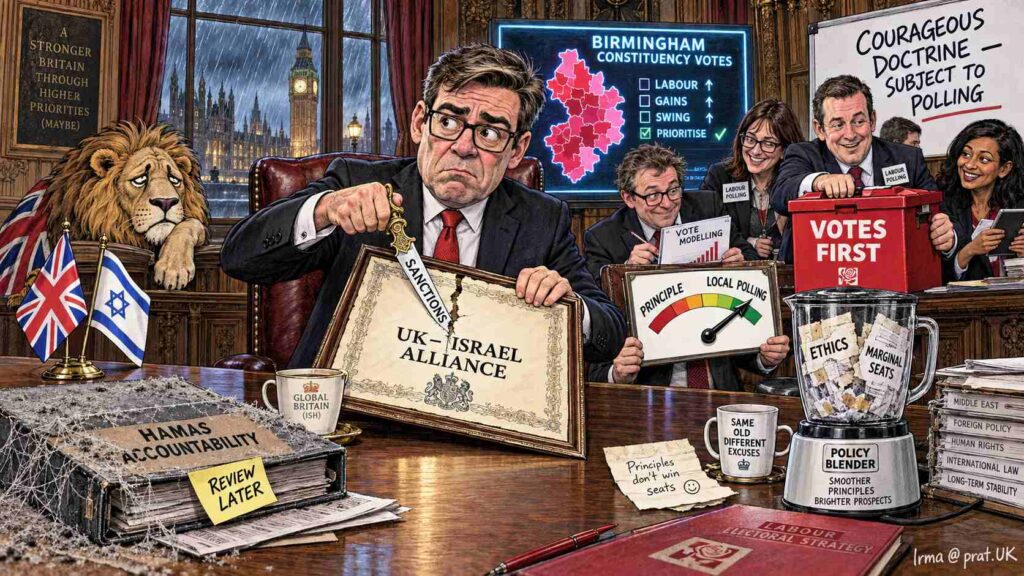
Unfortunately for London, Israel has opinions about Britain’s new moral awakening.
Israeli Foreign Minister Gideon Saar announced retaliatory measures including closing Britain’s consulate in East Jerusalem, ending British training for Palestinian Authority security forces, and excluding Britain from a U.S.-led Gaza coordination mechanism.
Israel apparently misunderstood Britain’s carefully calibrated diplomatic message: we are sanctioning you because we value our relationship.
Saar instead treated the measures as hostile interference. This demonstrates one of diplomacy’s cruelest principles: the recipient gets to decide whether your friendship feels friendly. Britain appears surprised.
Tesco Introduces the Two-State Checkout
Then comes the practical problem.
Settlement products include goods such as wine and dates. Britain therefore needs to determine which products originated inside Israel and which came from settlements in the West Bank.
The Washington Post reported uncertainty over precisely how goods would be distinguished, since products may simply bear Israeli origin labels.
Excellent. After generations of diplomats failed to resolve the Israeli-Palestinian conflict, responsibility has finally fallen to the one institution capable of handling it: supermarket inventory management.
Customer: Are these Israeli dates?
Employee: Yes.
Customer: Israel Israel, or West Bank Israel?
Employee: Sir, I’m seventeen.
Customer: International law is very clear.
Employee: I’m trying to restock bananas.
Welcome to Britain’s geopolitical future. Foreign policy will now be settled next to seasonal produce.
Britain Once Drew Middle Eastern Borders
There is magnificent historical irony here.
Britain once exercised enormous power throughout the Middle East. British officials drew boundaries, issued mandates, negotiated treaties, and generally behaved as though history were an enormous desk and they had been given the ruler.
A century later, Britain has returned to announce: “Everyone needs to respect the lines.”
You couldn’t script imperial history better. The country that once helped rearrange the neighborhood has returned as the homeowners’ association. “Excuse me, we’ve received complaints regarding your extension.”
Labour Says This Is About Principle
And perhaps it is.
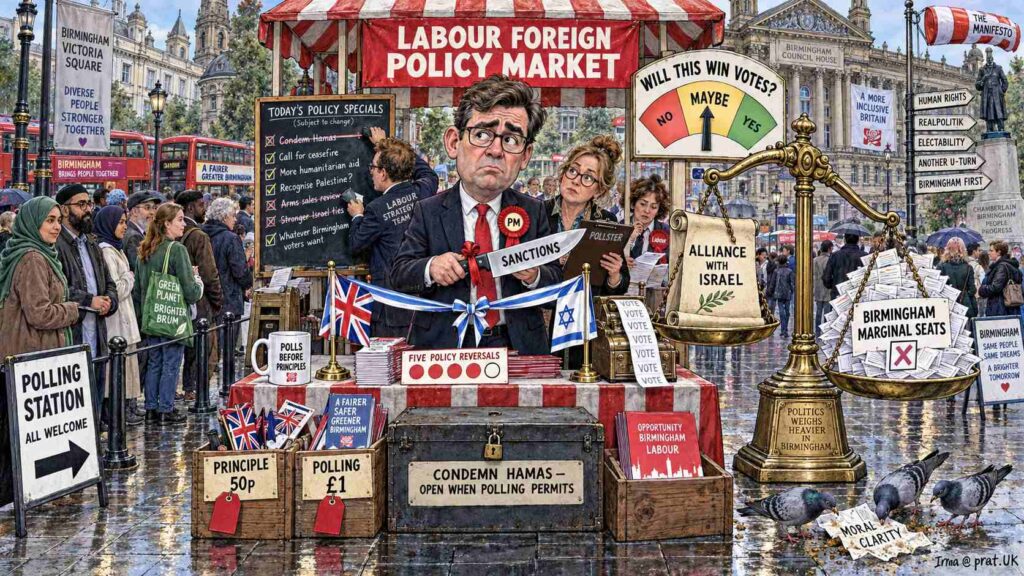
Governments can genuinely believe policies are morally necessary while simultaneously noticing those policies are electorally convenient. Human beings possess this remarkable ability. A politician can believe something deeply and also know precisely how many votes it received in Blackburn.
The error comes when either side pretends electoral incentives don’t exist.
Gaza demonstrably damaged Labour among some Muslim voters and helped pro-Palestinian independents. Labour MPs demonstrably demanded tougher action. Labour demonstrably faces competition from parties and independents to its left. That doesn’t prove Number 10 receives instructions from “Islam.” It proves something much funnier: politicians notice constituencies.
A government may spend six hours discussing international humanitarian law. Then someone walks into the room carrying a spreadsheet. Suddenly humanitarian law has ward boundaries.
Britain’s New Foreign Policy Doctrine
The resulting British doctrine appears to be:
Support Israel’s existence. Support Israel’s security. Oppose Israeli settlements. Restrict settlement commerce. Support Palestinian statehood. Oppose Hamas. Sanction Iran. Maintain relations with Washington. Keep France happy. Keep Canada involved. Prevent Labour voters defecting Green. Prevent independents winning Birmingham.
And somehow explain all this before Newsnight.
This is less a foreign policy than someone attempting to carry fourteen drinks from the bar. Eventually something gets spilled.
Israel Discovers Britain’s Friendship Has Terms and Conditions
Israel can reasonably argue that Britain is escalating economic pressure against a democratic ally while Israel faces severe regional security threats.
Britain can reasonably argue that indefinite settlement expansion makes a negotiated Palestinian state increasingly impossible.
Palestinians can reasonably argue that decades of diplomatic condemnation have accomplished remarkably little.
And Labour MPs can reasonably ask: “How large is my majority again?”
Every participant therefore possesses principles. Some also possess elections. Israel’s election is approaching. Britain’s Labour government has its own political vulnerabilities. The Palestinians remain without a final settlement. America is unhappy. France is involved. Nothing improves after France becomes involved.
The Great British Peace Plan Reaches Aisle Seven
Britain’s sanctions may ultimately have limited direct economic impact, since settlement exports constitute only a small portion of wider Israeli-British trade, but their political significance is much larger. Reuters described the restrictions as largely symbolic while noting the growing diplomatic rupture.
And symbolism matters. Flags are symbolic. Wedding rings are symbolic. So is throwing someone’s wedding ring through the window.
Britain believes it has drawn an important moral distinction between Israel and settlements. Israel believes Britain crossed an important diplomatic line. Labour’s vulnerable MPs know something else entirely: British foreign policy has become British domestic politics.
Jerusalem is now connected directly to Birmingham, Blackburn, Leicester, Bradford and London by the world’s strangest electoral railway. There are no trains. Only polling. And every time Israel announces another settlement, Labour hears the announcement thousands of miles away: mind the majority.
Helpful Advice for Labour Ministers
When attempting Middle East diplomacy, ministers should remember five practical rules.
First, international law matters. Second, alliances matter. Third, Israeli security matters. Fourth, Palestinian rights matter. Fifth, apparently, Wes Streeting’s 528 votes matter quite a bit too.
The government can deny electoral calculation all it likes. Politicians insisting they never think about elections is rather like dairy farmers insisting they’ve never noticed cows. Possible. But you wouldn’t lend them money.
15 Observations Before Britain Solves the Israel-Gaza Puzzle
- The Government Insists This Isn’t a Boycott. It is merely banning certain Israeli products produced by certain Israelis in certain places because of Israeli government policy. Apparently a boycott becomes something entirely different once the civil service gives it a departmental acronym.
- Labour Has Discovered Jerusalem Is Surprisingly Close to Birmingham. For decades British politicians believed the West Bank was somewhere near Belgium. Then Labour started losing votes over Gaza and suddenly every constituency office contained a detailed map of Ramallah.
- International Law Becomes Fascinating When Your Majority Falls Below 1,000. Nothing stimulates a politician’s interest in humanitarian jurisprudence quite like discovering that 528 votes separate you from LinkedIn.
- Britain’s Middle East Strategy Now Runs Through the Supermarket. Peace negotiations have failed, so Britain is trying produce labeling. The two-state solution may apparently depend upon whether Sandra at Tesco can determine precisely where a box of dates was packed.
- Muslim Voters Have Discovered They Don’t Actually Belong to Labour. This came as a terrible shock to Labour strategists, who had apparently assumed political loyalty could be inherited like eye colour and council tax.
- Gaza Has Become an Electoral Issue in Britain. Labour’s vote dropped an average of 10 percentage points in constituencies where Muslims represented more than 10% of the population in the 2024 election. Several pro-Gaza independents won seats. Suddenly Middle East policy acquired a postcode.
- The Greens Don’t Need to Convert Britain to Socialism. They merely need to stand outside Labour headquarters holding a Palestinian flag until somebody inside checks the latest constituency polling.
- Labour’s Foreign Policy Has Developed a Marginal-Seat Warning Light. Whenever Israel announces another settlement project, somewhere in Labour headquarters a red bulb marked Blackburn begins flashing.
- Britain Says the Measures Are Symbolic. Israel responded by closing Britain’s East Jerusalem consulate and excluding Britain from diplomatic and security cooperation. Apparently Israel failed to understand that symbolic punches aren’t supposed to hurt.
- Britain Is Punishing Israel While Sanctioning Iran. This may be Britain’s most balanced Middle East policy yet. Everyone is furious.
- More Than a Third of Labour MPs Wanted Tougher Action. In June, 137 Labour MPs called for Britain to end trade with Israeli settlements. Parliament finally discovered a bipartisan principle: nothing brings politicians together faster than troublesome constituents.
- Israel Thinks Britain Is Interfering. Britain says Israel’s settlement expansion threatens a Palestinian state. Israel says Britain is meddling in Israeli affairs. Diplomacy has reached its traditional mature phase in which everybody points at everybody else.
- Britain’s Great Power Status Has Become Extremely Grocery-Based. Once Britain deployed dreadnoughts. Now it deploys import documentation.
- The Ban Won’t Apply to Israel Proper. Britain therefore remains Israel’s friend, provided Israel’s merchandise can pass a geographical examination.
- Everyone Claims Principle, Everyone Owns a Calculator. Israel discusses security. Britain discusses international law. Labour discusses morality. Then everybody checks the polls.
Satirical Disclaimer
This article is political satire. Real events, voting results and government actions are used as scaffolding for exaggeration, parody, absurdity and jokes. British Muslims hold diverse political opinions, as do Jewish Britons, Israelis, Palestinians, Labour voters, Green voters, and the confused gentleman currently attempting to determine the geopolitical status of his supermarket dates. Any resemblance to competent British foreign policy is purely coincidental.

Alan Nafzger was born in Lubbock, Texas, the son Swiss immigrants. He grew up on a dairy in Windthorst, north central Texas. He earned degrees from Midwestern State University (B.A. 1985) and Texas State University (M.A. 1987). University College Dublin (Ph.D. 1991). Dr. Nafzger has entertained and educated young people in Texas colleges for 37 years. Nafzger is best known for his dark novels and experimental screenwriting. His best know scripts to date are Lenin’s Body, produced in Russia by A-Media and Sea and Sky produced in The Philippines in the Tagalog language. In 1986, Nafzger wrote the iconic feminist western novel, Gina of Quitaque. He currently lives in Holloway, North London. Contact: [email protected]