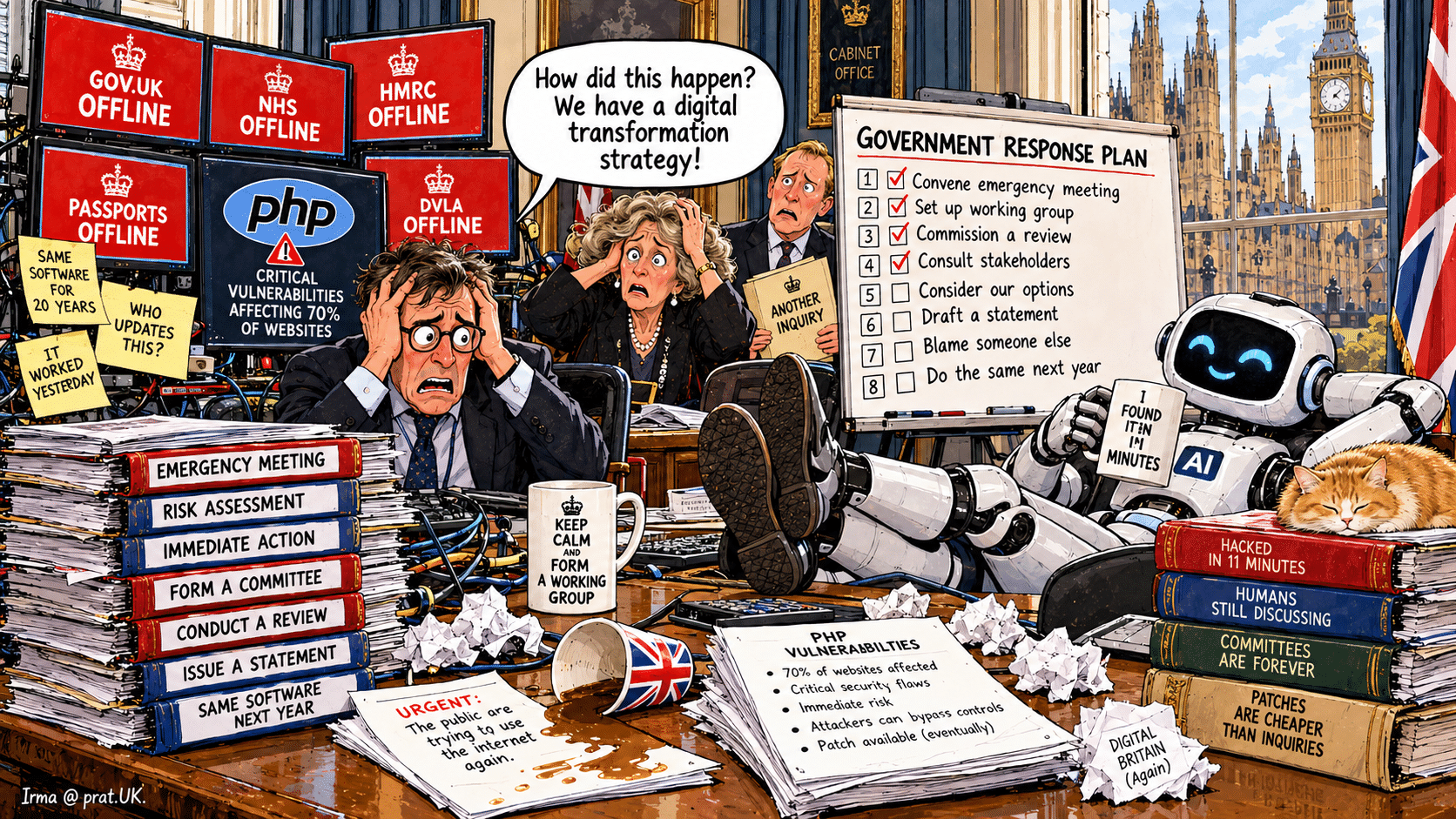
Whitehall Says Most Services Weren’t Working Anyway
LONDON, October 22, 2026 – British civil servants have reassured the public that a major international cybersecurity crisis affecting software used by approximately 70 percent of the world’s websites will have minimal impact on government services, primarily because many taxpayers had already accepted that accessing those services was largely a matter of luck.
The Associated Press report on PHP security vulnerabilities revealed that serious flaws in a widely used programming language had prompted urgent warnings and temporary government website shutdowns in several countries, including Britain.
Whitehall responded with the calm professionalism traditionally shown by a government department discovering that its printer has run out of paper. Officials set up an emergency committee, commissioned an independent review and announced that the public could expect a comprehensive explanation once the explanation had been reviewed by a second committee.
“The most important thing is that people should not panic,” said a senior civil servant, speaking from behind a computer screen displaying an error message. “Government websites have experienced difficulties for years. We regard this as continuity of service.”
NCSC Tells Organizations to Patch or Go Offline
The UK’s National Cyber Security Centre has advised organizations to apply urgent security updates and consider taking vulnerable systems offline if they cannot be adequately protected.
For civil servants, this was an extraordinary opportunity. For decades, British government departments have struggled to explain why public services become unavailable despite continually expanding budgets, a problem the National Audit Office has examined in its work on modernising ageing digital services. Now cybersecurity professionals were actively recommending that websites stop operating.
“It’s a remarkable development,” said a Treasury adviser. “We’ve spent billions making public services less accessible, and suddenly the world’s leading cybersecurity specialists are telling us that shutting everything down is responsible management.”
Officials reportedly began examining whether the policy could be extended to other areas of government. If closing a vulnerable website protects citizens, they reasoned, closing an underperforming government department might protect taxpayers. The proposal was rejected within the hour, after civil servants discovered it could affect their own departments.
Taxpayers Shut Out of Online Government Services
The crisis hit hardest among citizens who rely on government websites to renew documents, check benefits, submit tax information or find out which department is responsible for telling them to contact another department.
One London taxpayer described spending forty minutes trying to reach an online government service before receiving a message that the website was temporarily unavailable.
“I thought that was the normal service,” he said. “Usually it asks me for three passwords, sends a verification code to a telephone I no longer own, and then tells me my session has expired.”
His complaint was eventually referred to the newly established Department for Digital Reassurance, whose website was also unavailable.
Another taxpayer asked whether the government might compensate citizens for the disruption. Officials said compensation applications would be available online once the government had determined whether the compensation application website was secure. They added that compensation would be assessed according to the usual government timetable, which extends from the immediate future to the eventual collapse of the sun.
AI Cybersecurity Research Exposes the Committee Problem
Particularly embarrassing was the role artificial intelligence played in exposing the vulnerabilities. Humans had identified underlying problems earlier, but AI-assisted research helped establish how attackers might exploit them.
That invited an uncomfortable comparison with the traditional government approach to technological problems. Artificial intelligence analyzes software, identifies problems and helps researchers test possible solutions. Government departments organize meetings, produce minutes, establish working groups and commission reports explaining why previous reports were insufficiently comprehensive.
A Whitehall efficiency study found that one computer could perform more useful diagnostic work before breakfast than a government committee could complete between two general elections.
Civil servants disputed the findings, pointing out that artificial intelligence had never successfully organized a departmental Christmas party or secured additional funding for a project that had already failed.
Government Promises Websites Will Return Once Nobody Needs Them
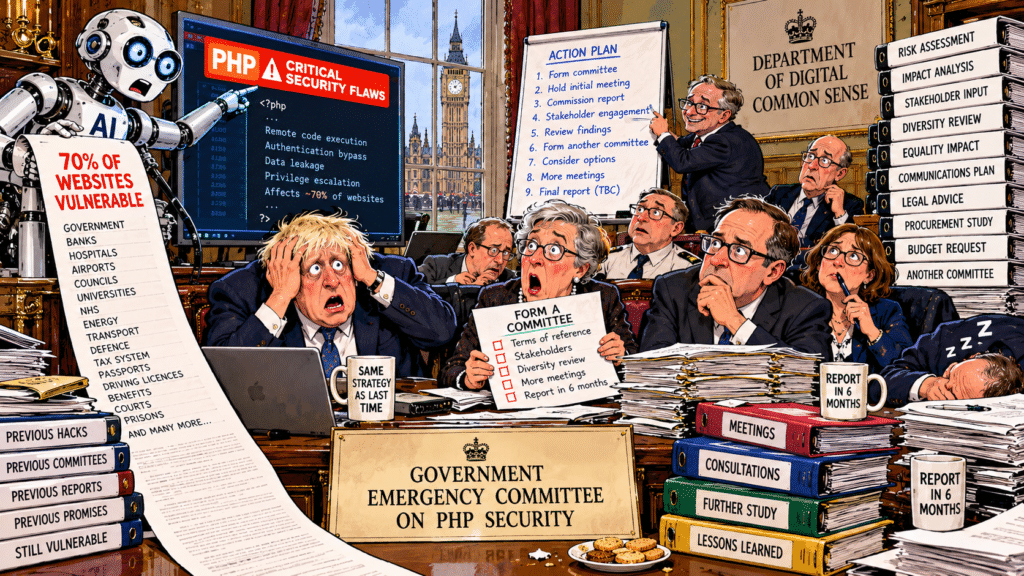
Cybersecurity specialists stressed that the underlying problem was serious. Vulnerable systems could potentially allow attackers to execute commands remotely without authentication.
Whitehall, however, stayed focused on the political implications. Officials were particularly concerned that hackers might gain unauthorized access to government systems and accidentally make them more efficient.
One security adviser warned that hackers could potentially process overdue applications, eliminate duplicate paperwork or identify thousands of unnecessary administrative procedures.
“That would be catastrophic,” he said. “Imagine the public discovering that government bureaucracy is not an essential feature of modern civilization.”
By Thursday evening, officials had announced a new digital strategy under which every government service would receive enhanced security, improved resilience and a revised mission statement. The actual websites would return at an unspecified date.
Citizens were advised to remain patient, maintain strong passwords and avoid contacting government departments unless absolutely necessary. The government assured the public that this final recommendation would remain in force long after the cybersecurity emergency had ended.
The underlying security threat, the website disruptions and the official patching recommendations are documented by the Associated Press and the UK National Cyber Security Centre.
Humorous Observations on the Government Website Shutdown
- Artificial intelligence finds a security hole in a huge chunk of the internet, and the government’s big response is to switch off something taxpayers already paid for. That’s not a response. That’s a Tuesday.
- British government websites went offline, which is technically an emergency. Half the country needed a government announcement to notice. “Oh, that’s why it wasn’t loading. I thought it was just Thursday.”
- The cybersecurity people say take the vulnerable sites offline, and you can watch the civil servants light up. Wait, we can just not? Permanently? And nobody’s allowed to ask us for anything? That’s the dream.
- They promised technology would make government faster, and it did. Now they can disappoint you from your couch. It used to be you had to put on pants and stand in a queue.
- Security experts found two critical vulnerabilities. The public sector found fourteen reasons to put off fixing them. I don’t even know what that is. It’s not a math problem. It’s a talent.
This disclaimer was offline for maintenance and nobody noticed. It is based on the genuine October 2026 PHP cybersecurity emergency; the Whitehall conversations, committees and surveys are comic constructions, and the 70 per cent figure describes how widely PHP is used, not how many sites were compromised. Patched by the world’s oldest tenured professor and a philosophy major turned dairy farmer. More political satire, once the website loads.

Mei Lin Chen is a student writer whose satire explores identity, modern culture, and social nuance. Her work reflects academic curiosity and engagement with London’s diverse perspectives.
Expertise is growing through study and practice, while trust is supported by clear intent and responsible humour.