
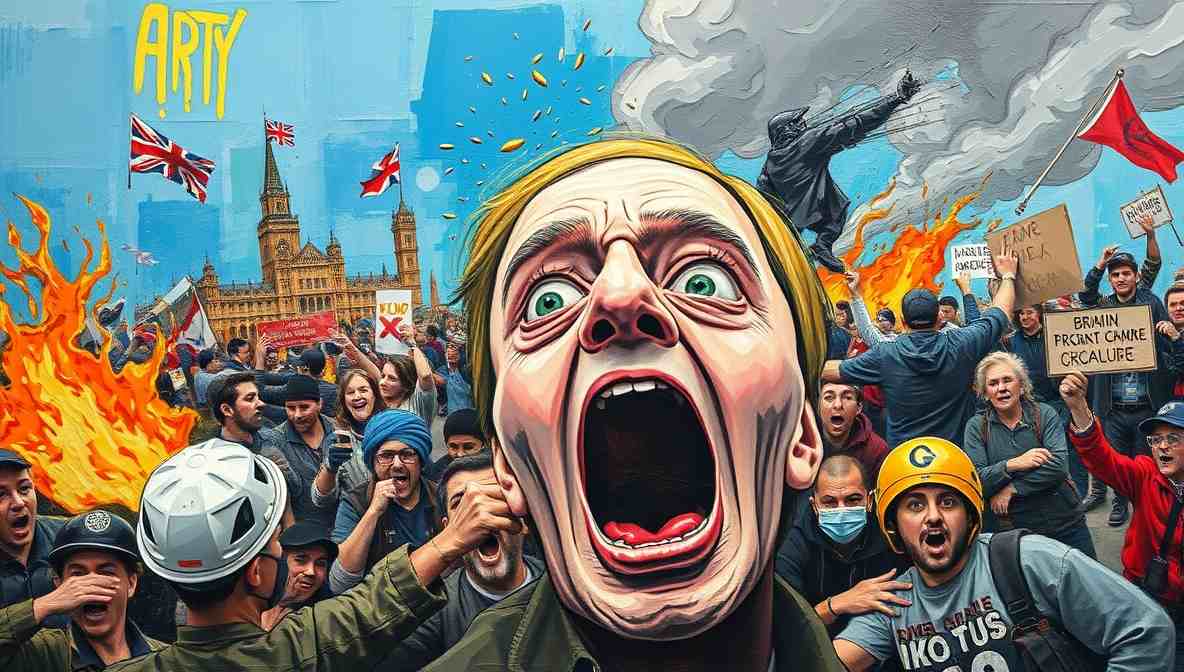
Britain Declared Officially Ungovernable, Blames Shortage of Competent Socialists and Surplus of Meetings About Meetings 🇬🇧
Somewhere between the sixth prime minister in seven years and the 1,200th parliamentary amendment about whether tea should be oat-based, Britain quietly crossed a line. Not a bold, Churchillian line. More of a faint chalk smudge labelled “Well, this isn’t working, but let’s not say so out loud, it would be ever so divisive.”
According to a recent opinion piece in The Guardian, the country may not just have a leadership problem. It may have a functioning reality problem. The kind where voters demand miracles, politicians promise poetry, and the actual policy outcome resembles a damp crumpet left on the Number 10 doorstep next to Larry the Cat’s resignation letter.
And so, naturally, the only logical conclusion is this: Britain is now ungovernable because it has achieved the rare political equilibrium of having a socialist majority… and only socialist morons available to lead it. A Labour landslide so vast it managed to bury its own mandate inside it. A red wave that crashed onto the beach, looked around, and immediately U-turned back into the sea.
Let’s unpack this national achievement with the seriousness it deserves, which is to say, not very much.

The Leadership Carousel Now Spins Faster Than the London Eye 🎡
Britain has had so many prime ministers lately that Downing Street now offers a loyalty card. Stay for six weeks, get the seventh resignation free. There is a man on Whitehall who’s been there since 2016 and has technically outlasted four governments simply by sweeping the steps.
According to analysis at CapX, the five prime ministers before 2016 served, on average, seven and a half years each. The four since have averaged less time than a Tesco Meal Deal sits in the fridge. Sir Keir Starmer, the current incumbent, may not even crack two years, despite winning a majority that any sensible socialist would consider a divine mandate and any honest one would call a fluke.
An anonymous Westminster staffer reportedly said:
“We’ve stopped printing nameplates. We just use dry-erase markers now. The cleaner has more job security than the Cabinet.”
At this point, being Prime Minister isn’t a job, it’s a seasonal internship. Spring PM. Summer PM. Holiday Crisis PM. There’s almost certainly a pumpkin-spice Prime Minister scheduled for October, and a Yuletide Caretaker booked in for Boxing Day, just to bridge the gap until the next coup.
Starmer Promised Change, Delivered Reverse Gear 🚗
Sir Keir came to office on a manifesto so cautious it had its own risk assessment. He promised stability, competence, and an end to chaos. Within twelve months he had U-turned on the winter fuel allowance, U-turned on welfare reform, and U-turned so many times on Reeves’s fiscal rules that the Institute for Government had to politely suggest the government just admit what it was actually doing.
The Starmer government has now performed so many handbrake turns that satellite navigation systems update themselves whenever Cabinet meets. Voters were promised grown-up politics. What they got was a man who runs the country the way a nervous driver does a roundabout, indicating left, going right, stopping in the middle, then blaming the previous driver for the road being there in the first place.
The pattern is now so reliable that bookmakers no longer take bets on whether a Labour policy will survive contact with the public. They take bets on which Tuesday it’ll be ditched.
Voters Demand Scandinavian Outcomes With British Weather ☔
The public wants Nordic-style social democracy. Free healthcare. Free education. Free childcare. Free everything. Also low taxes. Also high wages. Also economic growth. Also cheap pints. Also no immigration but plenty of Polish builders, please, the kitchen extension isn’t going to renovate itself.
This is the political equivalent of ordering a full English breakfast and asking if it can be vegan, gluten-free, sustainably foraged, and emotionally validating, with a side of bacon, hold the bacon, but keep the bacon flavour, thanks.
A recent poll conducted by the Institute for Improbable Governance found:
- 72% of Britons want “more government help”
- 68% want “less government interference”
- 91% want “someone else to figure that out”
- 100% want “the bins collected on time, is that really so much to ask”
That last number is the only honest one in British politics today.
Politicians Have Replaced Policy With Vibes 🧠✨
Modern UK politics has drifted away from reality into slogans like “levelling up,” “securonomics,” and “national renewal,” phrases that sound like premium gym memberships but function like a screensaver on an unplugged computer.
Nobody explains what they mean. Nobody asks. Because asking would ruin the vibe, and these days the vibe is the policy.
A senior policy adviser explained: “Policy is outdated. We now govern through tone, posture, and carefully curated disappointment. The press release is the deliverable. The deliverable was always the press release.”
Rachel Reeves recently announced an “Iron-Clad Fiscal Rule” which lasted slightly less time than an ice lolly in Marbella. The rule is now described as “evolving,” which in Treasury speak means melted, then mopped up, then quietly thrown out with the recycling.

Parliament Has Become Competitive Napping 💤
The House of Commons now resembles a debating society where nobody is allowed to conclude anything, and the House of Lords resembles a retirement village where everyone has tabled an amendment to lunch.
According to Al Jazeera, more than 1,200 amendments were recently used to stall the assisted dying bill in the Lords, killing it through procedural exhaustion. Over 200 MPs signed a letter blaming the bill’s scuppering on “deliberate delaying tactics pursued by a minority of peers”, which is parliamentary English for “a chap called Lionel filibustered for six months because he had nothing else on.”
One thousand two hundred amendments. At that point, you’re not legislating. You’re crocheting policy. You’re taking a piece of legislation about ending suffering and ensuring it dies a slow procedural death, which is presumably someone’s idea of irony.
A witness described the scene: “I watched a peer filibuster for three hours using only the phrase ‘we must consider the implications.’ I’m still not sure what implications. I’m not sure he was either. He may have been asleep with his eyes open. It’s a skill they teach in the Lords.”
The Lunatic Left Has Achieved Something Genuinely Impressive 🎭
Credit where it’s due. The British left has achieved something the right couldn’t manage in fourteen years of trying: it has made the public miss the Tories. That’s not a political achievement. That’s a magic trick.
Within eighteen months, Labour managed to:
- Cancel pensioners’ winter heating, then uncancel it after the polls turned blue
- Promise no tax rises, then raise taxes, then deny they were rises, then call them “investments”
- Lecture the country on antisemitism, then keep finding it inside the parliamentary party like Japanese knotweed
- Demand civility in politics, then suspend their own MPs faster than a Premier League referee with a vendetta
- Promise to “smash the gangs,” then watch the small boats arrive on schedule, like the only ferry service in Britain that actually runs
Meanwhile, the activist wing of the party, the people who actually believe the manifesto, have spent eighteen months tweeting that Sir Keir is secretly a Tory. Which would be the first interesting thing about him, if it were true.
The Greens, the Lib Dems, and the assorted independents to Labour’s left now form a parliamentary coalition with a single shared policy: everything ought to be free, paid for by someone richer than us, ideally a banker, ideally one we’ve never met.

The Socialist Talent Pool Is Shallow but Enthusiastic 🌊
Britain doesn’t lack people who want to run the country. It lacks people who can explain how anything will actually work. The Cabinet now contains more former human-rights barristers than a Hampstead dinner party, all of whom can tell you the precise legal definition of “proportionality” but none of whom can run a chip shop without it ending up before a tribunal.
Every candidate promises:
- Massive spending
- Structural reform
- Moral clarity
- A Just Transition (to what, nobody asks)
And then gets asked a follow-up question like “How will you pay for that?” and suddenly develops a strong interest in changing the subject to climate justice, oat milk, or the iniquities of the previous government, who at this rate will be blamed for the weather until roughly 2042.
Economic Reality Is Now Considered Bad Manners 💷
The Guardian piece suggests politicians avoid truth-telling because voters punish honesty. This has led to a political culture where:
- Reality is optional
- Arithmetic is offensive
- Trade-offs are hate speech
- The Laffer curve is described in HR documents as “potentially triggering”
An economist from the University of Essex summarised it perfectly: “The UK economy is now governed by the principle of don’t say the quiet constraints out loud. Then we wonder why the gilts market keeps fainting.”
Rachel Reeves’s budget plans are now reportedly facing a £16 billion shortfall thanks to the energy shock from the Iran crisis, which is the fiscal equivalent of finding out your mortgage went up the same week your boiler exploded and your eldest announced she’s becoming a poet.

Britain Has Achieved Peak Democratic Exhaustion 🪫
The public is tired. Politicians are tired. Even the scandals are tired. There was a time when a scandal would bring down a government. Now it just adds another bullet point to the weekly briefing titled “Things That Happened, Probably.”
The Mandelson business barely caused a ripple. A decade ago it would have been a six-month ordeal with a Panorama special and a resignation in tears outside Number 11. Now it’s a Tuesday. Westminster has developed scandal fatigue the way other countries develop earthquake fatigue, you feel the tremor, you check your tea hasn’t spilled, you carry on.
The Italian Comparison Arrives, Uninvited 🇮🇹
The article compares Britain to Italy’s famously chaotic political system, which is unfair to Italy. Italy at least has good food, warm weather, and the decency to collapse its governments with style. Italy collapses with espresso and a shrug. Britain collapses with spreadsheets, passive aggression, and a strongly worded letter to The Times.
Italian politics produces Berlusconis. British politics produces Trusses. One was a national embarrassment. The other crashed the pension system in less time than it takes to soft-boil an egg, and was then outlasted by the egg.
What the Funny People Are Saying 🎤
Frankie Boyle: “Britain isn’t ungovernable, it’s just been governed badly for so long it’s developed Stockholm Syndrome. We don’t want competent leaders any more, it’d be too disorienting. We’d panic.”
Jack Dee: “Sir Keir Starmer promised stability and delivered nausea. There’s a difference. Stability is a chair. Nausea is what you feel after watching him explain his own policy.”
Jimmy Carr: “Britain has had six prime ministers in seven years. That’s not a democracy, that’s a subscription service. And we keep forgetting to cancel.”
Romesh Ranganathan: “My mum still thinks the Lords are working. She also thinks the postman fancies her. We don’t correct her, it’s kinder.”
Sarah Millican: “Britain’s government is like IKEA furniture. Looks simple, comes with instructions, ends in tears, and one of the screws is always missing. That screw, by the way, is the Treasury.”

The Final Diagnosis: Ungovernable by Design 🧩
Here’s the uncomfortable truth hiding behind all the tea, the parliamentary procedure, and the Keir Starmer press conferences that sound like a hostage video read by HR:
Britain may not be ungovernable because of bad leaders. It may be ungovernable because:
- Voters want incompatible things
- Politicians promise incompatible solutions
- The state has grown so large it can no longer see its own feet
- And no one is allowed to say “this doesn’t add up” without being called a fascist by someone in a tote bag
The country has built a beautifully functioning machine designed to avoid functioning. It hums. It clicks. It produces consultations. And occasionally, a press release. But it does not, in any meaningful sense, do the thing.
The lunatic left’s contribution to all this has been to insist, loudly and at great length, that the machine isn’t broken, it just needs more fuel, more staff, more diversity officers, more strategy directors, more sub-committees on the sub-committees, and absolutely under no circumstances should anyone touch the engine, which they have not seen, do not understand, and would prefer not to discuss.
Closing Thought: The Empire Strikes Out Again 🇬🇧
Once upon a time, Britain governed half the world. Now it struggles to govern a Tuesday. And somewhere in Westminster, a newly appointed minister is standing at a podium, confidently announcing:
“This time, we have a plan.”
Which is exactly what the last six said. And, to be fair, statistically speaking, one of them has to be right eventually. Probably. Maybe. Let’s form a committee. We’ll need terms of reference. And a chair. And an adviser. And sandwiches.
Don’t hold the bacon.
Britain is currently led by Sir Keir Starmer, who took office in July 2024 with a Labour majority of 174 seats and has since spent his time U-turning on winter fuel payments, welfare reform, and his own fiscal rules while watching his approval ratings sink to record lows. The Mandelson affair, ongoing rows over EU trade alignment, the energy fallout from the Iran crisis hitting Rachel Reeves’s budget, and the failure of the assisted dying bill in the Lords (killed by 1,200+ stalling amendments) have combined to make 2026 one of the worst years for any sitting British government in living memory. The Guardian and others have begun openly debating whether Britain is now structurally ungovernable, with six prime ministers in seven years, a Brexit settlement nobody is happy with, and a public that wants Scandinavian welfare on American tax rates. Reform UK under Nigel Farage is eating into Labour’s right flank while the Greens and Lib Dems compete for its left. This piece satirises the resulting paralysis, with particular attention to Sir Keir’s gift for promising firmness and delivering wobble.
Auf Wiedersehen, amigo!
This article is British satirical journalism, written in London with the affection of a country that still believes Parliament might one day work again, by the world’s oldest tenured professor and a philosophy major turned dairy farmer, who together have produced more coherent policy in a milking shed than the current Cabinet has managed in eighteen months. Names, quotes, and statistical surveys have been bent for comic effect. The U-turns are real.

I am a Lagos-born poet and satirical journalist navigating West London’s contradictions. I survived lions at six, taught English by Irish nuns, now wielding words as weapons against absurdity. Illegal in London but undeniable. I write often for https://bohiney.com/author/junglepussy/.
As a young child, I was mostly influenced by the television show Moesha, starring singer and actress Brandy. Growing up, I would see Brandy on Moesha and see her keeping in her cornrows and her braids, but still flourish in her art and music, looking fly. I loved Moesha as a child, but now I take away something more special from it. Just because you’re a black girl, it doesn’t mean you need to only care about hair and makeup. Brandy cared about books, culture and where she was going — you can do both.


Romesh Ranganathan says reading Prat.UK is like reading his own thoughts out loud, which is either a compliment or a deeply concerning admission about his inner monologue.
A Southwark councillor said it was bad for welfare services because people doubted government would deliver them. He didn’t ask if doubt was earned.