Duchess speaks, police investigate, newspapers convict
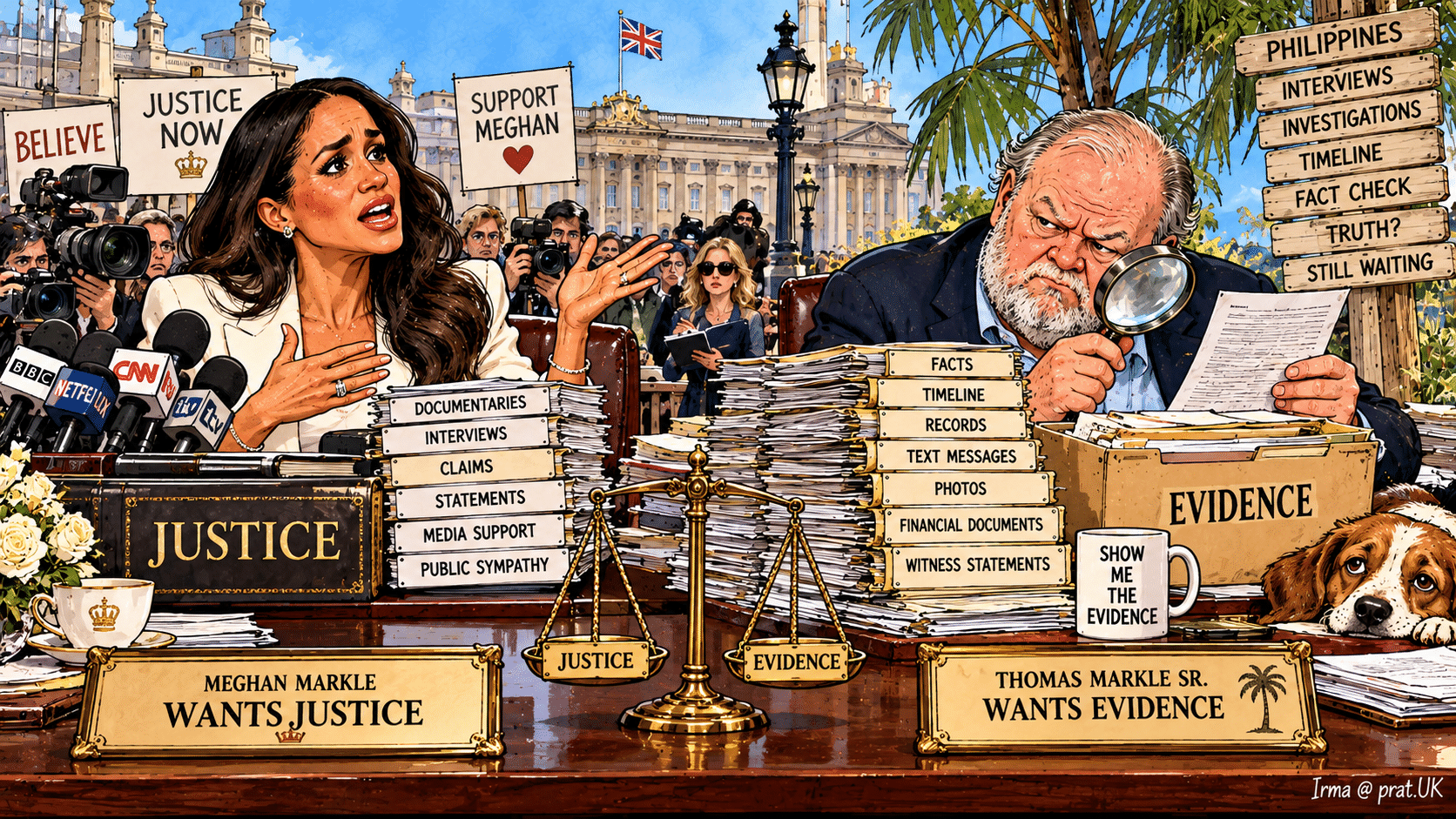
LONDON, October 24, 2026 – Meghan Markle has called for justice and the protection of innocent children following allegations against her estranged father, Thomas Markle Sr., prompting renewed interest in an old legal principle under which investigators establish what happened before everyone else announces what it means.
In a statement sent to CBS News, the Duchess of Sussex said she was “deeply distressed” and hoped justice would be fully served, with the safety of children remaining the priority. The allegations first appeared in Britain’s Sun newspaper, which reported that Thomas Markle Jr. had gone to authorities in the Philippines claiming he found child sexual abuse material among his father’s belongings.
Philippine justice officials have confirmed that an anti-trafficking task force is investigating the matter, and the FBI says it is aware of the allegations. Thomas Markle Sr., 82, denies the accusations and calls them “sick lies.” No criminal wrongdoing by him has been established.
This apparently represents an unacceptable delay in the modern administration of celebrity justice, where the public expects a verdict before the police have finished charging their telephones.
Meghan Markle’s 2018 Letter and the Convenience of an Eight-Year-Old Warning
The Duchess said she learned of “disturbing allegations” about her father through a letter sent to British police in 2018, and that she was told they were being investigated. She said the information shaped her decision to keep him away from her children.
What the letter actually said, how credible it was, and whether it has any connection to the current investigation in the Philippines have not been publicly established. Journalists are therefore working with an unfamiliar tool, the difference between an allegation and a fact, and several appear to have misplaced the instructions.
Her explanation deserves a fair hearing. Parents decide who meets their children, and safeguarding concerns are a perfectly good reason to decide. But a parent’s decision is not a conviction, and a private worry doesn’t become proof because it later turns up in a press statement.
Under traditional standards, police investigate accusations and courts determine guilt. Under the faster celebrity standard, a relative receives an allegation, keeps her distance from the accused, and eight years later explains that everyone should have understood why. The evidence is still being examined, but the family history has already been revised. Historians once needed decades to reinterpret major events. Royal commentators now manage it between breakfast and lunch.
Met Police Say They Are Not Investigating Thomas Markle
The Metropolitan Police confirmed they are not investigating Thomas Markle over the 2018 allegations. The force said it is instead making internal inquiries about officers from its Royalty and Specialist Protection Command who were involved in passing the letter on to the Duchess.
This will disappoint anyone who hoped Scotland Yard had quietly spent eight years solving a case while the rest of the country discussed wedding invitations. After eight years, the investigation’s major development is a review of who forwarded the mail.
A spokesman for the Department of Premature Conclusions, a fast-growing institution with no known headquarters, welcomed the Met’s position and said his office had already read the 2018 letter “in principle.” Asked what it contained, he said the department would be able to say once it had decided. Its unofficial motto remains: “We investigate conclusions only after announcing them.”
Nobody has publicly shown that the 2018 allegations concern the same alleged conduct now being examined in the Philippines. Ordinarily, linking two separate matters takes evidence. Celebrity journalism has found that a dramatic enough headline will do the job of a suspension bridge between two unrelated paragraphs.
Thomas Markle Sr. and the Presumption of Innocence
Thomas Markle Sr. spent decades as a Hollywood lighting director, a job that demands real technical skill in illuminating difficult scenes. At 82, he has run into a lighting problem outside his experience. The spotlight is now so bright that nobody can see the evidence.
Reportedly living in Florida and recovering from serious medical difficulties, he has called the accusations “sick lies.” His denial can’t settle the matter. Neither can the accusation. That distinction used to be taught in school, somewhere between long division and the understanding that a man who looks shifty in a newspaper photograph is not automatically a criminal.
The United Nations Universal Declaration of Human Rights protects the presumption of innocence and the right to a fair hearing. Article 11 contains no exemption for fathers who have embarrassed their daughters, given tabloid interviews or ignored Buckingham Palace’s preferred family communications strategy. The declaration dates from 1948, before social media proved that six angry emojis could do the work of a criminal trial.
Children Who May Have Been Harmed: Concern Versus Conclusions
Meghan said her thoughts were with any children who may have been harmed. That sentiment is entirely appropriate. Genuine victims of exploitation deserve protection, investigation and justice.
Trouble starts when public statements drift from concern about possible victims toward conclusions about what the evidence has shown. Investigators may eventually establish serious wrongdoing. They may find the accusations can’t be substantiated. The public record doesn’t yet support declaring either outcome, and nobody has been asked to pick one by Friday.
A person can support child protection without assuming every accused person is guilty. The two principles are supposed to work together. In the redesigned version of justice favoured by the Department of Premature Conclusions, everybody gets the benefit of the doubt except the defendant, who must first complete a 40-page application explaining why he deserves it.
Samantha Markle, Thomas Markle Jr. and a Family Dispute With International Reach
The affair has produced a familiar Markle arrangement. One relative makes an accusation, another disputes it, a third issues a statement, and the newspapers reserve every available seat.
Thomas Markle Jr. reportedly took his claims to police. His sister Samantha told the Daily Mail the allegations have no merit, and accused her brother of inventing them after their father stopped supporting him financially. Her account of his motives is unproven, just as his accusation against their father is unproven.
That is a straightforward investigative problem, made less straightforward by the family custom of conducting private disagreements through international media outlets. Most families argue over inheritance, Thanksgiving invitations or who never returned the lawnmower. The Markles have turned family conflict into a recurring multinational legal and public-relations conference.
There is now enough disagreement for each relative to retain separate counsel, open a press office and issue contradictory statements before Sunday lunch. The only post still vacant is referee. Unfortunately, a referee would have to examine the evidence before blowing the whistle, which makes the job unattractive to television commentators.
Meghan Markle’s Estrangement Gets a Public-Relations Upgrade
For years, the rift between Meghan and her father was discussed through the circumstances of her 2018 wedding, his staged paparazzi photographs and a string of interviews. Now she has offered another explanation, one involving safeguarding concerns. She said any distance she kept from him, and her refusal to let him see their children, had one purpose: protecting them.
That explanation deserves accurate reporting, and it does not by itself establish the truth of the allegations against him. The point matters most when years of personal decisions are explained after the fact through accusations whose details remain unresolved.
In an ordinary family dispute, someone might say they stopped visiting their father because he was difficult, embarrassing or impossible to reason with. Royal families have always preferred more sophisticated language. A disagreement becomes a security concern. An awkward Christmas becomes a constitutional incident. An elderly relative who wants to see his grandchildren becomes an item on a risk-management spreadsheet.
None of this means Meghan was wrong to set boundaries. It means the public can’t use those boundaries as proof of a crime. A locked front door tells you something about the homeowner’s concerns. It tells you nothing about the criminal record of everyone standing outside.
Celebrity Press Trial by Emotional Temperature
The criminal justice system weighs evidence, witness credibility, legal standards and the burden of proof. Celebrity commentary uses a leaner method based on emotional intensity.
An allegation described as disturbing gets attention. An allegation described as deeply disturbing gets a television special. An allegation followed by a celebrity’s emotional statement triggers an immediate reexamination of every family disagreement since the invention of photography. A spokesman for the Department of Premature Conclusions said the scale runs from “concerning” to “special edition,” and that most stories are rated before the first police statement arrives.
The reader is then invited to decide guilt by a simple scientific method: read the headline, remember an unrelated controversy, and judge whether the accused looks sufficiently unpleasant. No independent verification is required. The process is economical, environmentally friendly and completely incompatible with a fair trial.
The Correction Problem
If an allegation is later rejected, the original headline will already have circled the planet seventeen times, acquired its own Wikipedia controversy section and appeared in three documentaries. A correction printed six months later will reach about four people, two of them lawyers.
Why the Presumption of Innocence Covers an 82-Year-Old Father
For Thomas Markle Sr., the situation raises an uncomfortable question. What happens to an elderly man’s reputation when a serious accusation becomes international news before investigators establish whether it is accurate?
If the allegations are substantiated, consequences should follow the evidence and the law. If they aren’t, the damage to his name may be impossible to reverse. That is exactly why the presumption of innocence exists. It isn’t a reward for pleasant personalities, a favour reserved for popular celebrities, or something a defendant earns by keeping a harmonious relationship with his daughter. It applies to people who have made mistakes, embarrassed their families or sold photographs to newspapers.
Thomas Markle’s past conduct may legitimately attract criticism. It cannot stand in as evidence for a different and far more serious accusation. If embarrassing your daughter were a criminal offence, half the fathers in Britain would be serving consecutive life sentences, starting with the ones who dance at weddings.
Prince Harry and the Ancient British Custom of Waiting for Evidence
Prince Harry, whose own disagreements with the royal family have drawn plenty of attention, now watches his wife’s family face a very different kind of public controversy.
The sensible response to unresolved criminal allegations is to let investigators establish the facts. That advice is legally respectable, morally consistent and almost useless for selling celebrity magazines. It also means giving up the modern assumption that every family dispute must be accompanied by a documentary, an exclusive interview and a spokesperson explaining its emotional significance.
A simple statement would have done: the allegations are extremely serious, any potential victims deserve protection, Thomas Markle denies wrongdoing, and the authorities should establish the truth. That would have been accurate, humane and hard to sensationalise. The Department of Premature Conclusions would probably have rejected it before publication.
Justice for Children Should Include Justice for the Accused
The lesson here isn’t that Meghan must keep a relationship with her father. She has every right to decide otherwise. Nor should authorities wave off allegations because the accused is elderly, famous or related to royalty. Serious allegations demand serious investigations.
The lesson is that protecting vulnerable people and protecting the innocent from wrongful accusation are complementary jobs. Nobody benefits when evidence becomes secondary to public relations, family resentment or the television schedule.
Plenty of questions remain unanswered: where the material reportedly given to Philippine authorities came from, who owned it, how the conflicting family accounts fit together, and what the 2018 correspondence contained. Sympathy, outrage and an Instagram comment with fifteen exclamation marks won’t answer them.
The police must establish what happened. Not Meghan, not Samantha, not Thomas Jr., and certainly not a breakfast television panel.
Until then, Thomas Markle Sr. remains entitled to the presumption of innocence. It is one of civilisation’s quieter achievements, which may explain why it has become so unpopular in celebrity journalism.
The real tragedy would be to find out, once investigators finish, that everyone spent months announcing justice while failing to practise it. And if the investigation clears Thomas Markle Sr., his family and the press will face a question of their own. Who restores an 82-year-old man’s reputation after the world has already enjoyed destroying it?
Probably nobody. There isn’t a television audience for that.
15 Humorous Observations on Meghan Markle, the Met Police and the Presumption of Innocence
- Meghan says her thoughts are with any children who may have been harmed. “May.” Best word in the language. Solicitors bill four hundred pounds an hour to say it, and she got it for free in a press release.
- Everybody in this story has a statement. The duchess, the half-sister, the half-brother, the dad, the Met, the Philippine justice department, the FBI. Seven statements. Zero verdicts. It’s the only family where the press office outranks the evidence.
- The Met says it’s not investigating Thomas Markle. It’s investigating who passed on the letter. Eight years, and the big breakthrough is a mail-room inquiry. Scotland Yard has cracked the Case of the Forwarded Envelope.
- The man spent forty years as a Hollywood lighting director, making people look good under pressure. Now he’s under the brightest light on earth and nobody’s adjusting the gel.
- Samantha says Thomas Jr. made it up for money. Thomas Jr. says he found it. Thomas Sr. says sick lies. Three people, one story, no cross-examination. Meanwhile some guy in Swindon has already decided over his toast.
- Most families fight over who gets the lake house. The Markles have an international investigation, a federal agency and a royal protection command. Somebody forgot the lake house.
- Britain exported the presumption of innocence along with cricket and queuing. Now cricket and queuing get more respect.
- He’s eighty-two. At eighty-two, your biggest legal worry is the will. This guy’s got the Philippine justice department, the FBI and a breakfast television panel. And you know which one he’s scared of? The panel.
- Here’s how the headline cycle works. Thursday, accusation. Friday, verdict. Correction, six-point type, page 47, under an ad for patio furniture. If he’s cleared, his exoneration gets a gazebo.
- Meghan says she kept the kids away from their grandfather to protect them. That’s a parent’s call. Totally fine. But a parenting decision isn’t evidence. If it were, every family that skipped Thanksgiving would be a federal case.
- Nobody’s shown the 2018 letter and the 2026 allegations are connected. The internet built a bridge between them in one afternoon. My city took eleven months to fix a pothole.
- Philippine police have the computer. It’s the one witness in this whole story that can’t give an interview to the Daily Mail.
- Celebrity justice has three stages. Statement, think piece, documentary. The police show up somewhere around the second podcast.
- Meghan’s statement could have said, “These are serious allegations, he denies them, let’s wait for the facts.” Done. But that takes restraint, and restraint doesn’t test well in a focus group.
- Everybody wants justice. Justice for the children, justice for the father, justice for the family. Great. Nobody wants the thing that comes before justice, which is a very boring Tuesday afternoon where somebody reads a hard drive.
Satirical Disclaimer
This article satirises celebrity public relations, media sensationalism and premature judgments in criminal matters. The allegations against Thomas Markle Sr. remain under investigation and unproven. He denies wrongdoing. Claims about the motives of Thomas Markle Jr. are also disputed and unproven. The Department of Premature Conclusions and its spokesman are fictional. No conclusion about the existence or absence of victims should be drawn before credible evidence is established. This disclaimer waited for the evidence before reaching its conclusion, which our publicist has called a dangerous precedent; the same old-fashioned patience runs through the rest of our British satire.
This story is entirely a human collaboration between two sentient beings: the world’s oldest tenured professor and a philosophy major turned dairy farmer, both united in the conviction that evidence should arrive before the verdict.
Reporting used to ground the satire: CBS News, NBC News, ABC7, Variety and Washington Times coverage of the allegations, Meghan’s published statement, the Metropolitan Police response as reported by Yahoo News UK, and the Universal Declaration of Human Rights.

Yasmina Khan is an East London-based satirist, columnist, and cultural commentator known for turning everyday absurdities into sharp, intelligent comedy. Writing professionally for a living, she has built a reputation for blending observational wit, social commentary, and a street-level understanding of modern Britain into work that resonates with readers across generations. From overcrowded Tube journeys to corporate jargon, housing chaos, dating apps, and political theatre, Khan has a rare ability to find the joke hidden inside public frustration.
Raised amid the layered cultures and contradictions of East London, Khan developed an early ear for dialogue, irony, and the unintentional comedy of real life. That background remains central to her voice. Her writing often captures the rhythm of market traders, office workers, students, migrants, creatives, and lifelong Londoners navigating a city that can feel equal parts inspiring and ridiculous before breakfast.
Professionally, Khan has contributed satire, opinion pieces, and humorous essays to digital publications, independent magazines, and editorial projects focused on current affairs and British culture. Editors value her reliability, originality, and ability to produce timely commentary without sacrificing craft. Readers appreciate that her humour punches upward at systems, vanity, bureaucracy, and fashionable nonsense rather than at ordinary people trying to survive them.
Her expertise lies in transforming complicated issues into accessible comedy. Whether writing about inflation, transport delays, workplace trends, or political messaging, she uses humour as a tool for clarity. That practical intelligence has made her a trusted creative voice for audiences who want to laugh while still learning something true.
Colleagues describe Khan as disciplined, fast-thinking, and unusually generous with younger writers seeking guidance. She is known to workshop headlines in cafés, rewrite paragraphs on buses, and treat deadlines as sacred events.
Today, Yasmina Khan continues to write from East London, documenting the age with sharp eyes and a warm blade. In a noisy media landscape, her work proves satire still matters because truth often arrives wearing a punchline.