Heir Alarmed Brother Can Help People Without Supervision
LONDON – Prince William has reportedly urged King Charles to consider stripping Prince Harry and Meghan Markle of their royal titles after the couple visited Nottingham, met disadvantaged families and demonstrated the dangerous proposition that people can do something useful without obtaining advance permission from the heir to the throne.
The allegations emerged in an October 21 report concerning royal tensions following the Sussexes’ charity engagements. According to unnamed sources, William considers the couple’s apparent return to royal-style public appearances unacceptable.
The controversy has raised a troubling question. If a man born into the Royal Family can leave his official duties and still help people, what exactly is the official department responsible for helping people supposed to do?
Palace Investigates Unauthorised Kindness at Nottingham Charities
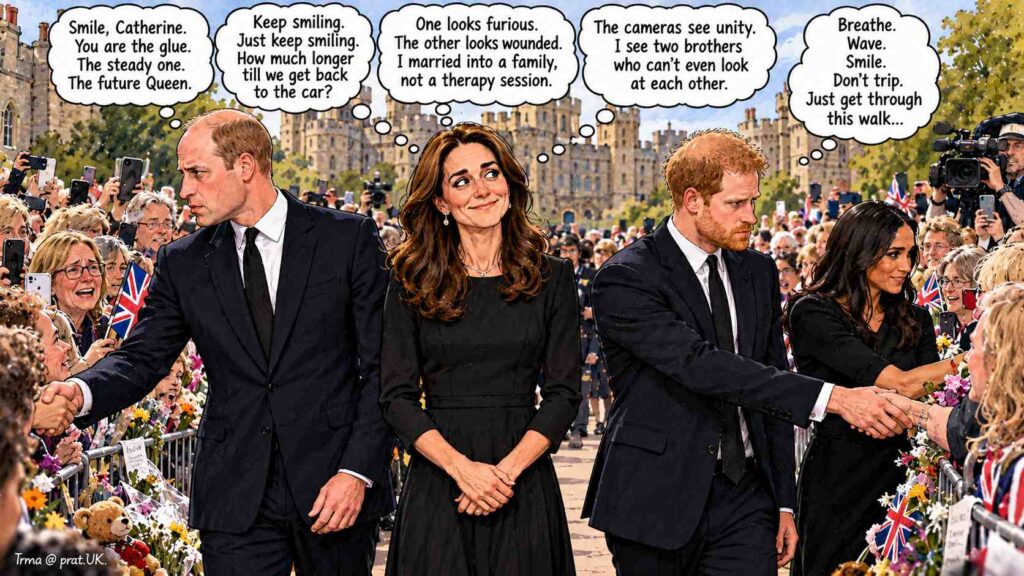
Harry and Meghan visited several Nottingham charities, including the Community Recording Studio, the Himmah food poverty organisation and Epic Partners. Their activities included speaking to volunteers, supporting young people and spending time with residents.
The problem was apparently not what they did. The problem was that they did it without a sufficient number of official people standing behind them, looking as though they had just swallowed an umbrella.
Royal engagements ordinarily involve planning, consultation, protocol, security and a communications strategy intended to ensure that every handshake reflects the dignity of the Crown. Harry and Meghan appeared to have dispensed with some of this machinery and proceeded directly to the handshakes. For a hereditary institution that has survived nearly a millennium, this may constitute an existential threat.
A hypothetical palace regulation would require every charitable smile to be registered with the Royal Office of Approved Goodwill, where applicants would submit proof of eligibility, a recent passport photograph and a written explanation of why their proposed kindness could not be performed by someone higher in the line of succession.
William Faces Competition From Ordinary Human Behaviour
At the heart of the disagreement is the reported belief that Harry and Meghan are presenting themselves as an alternative royal court. This would represent an unusual constitutional development. Traditional rival courts possess competing claims to political authority, powerful aristocratic supporters and occasionally their own armies. Harry’s alleged rival court possesses a charitable foundation, several former royal acquaintances and people willing to take selfies.
The military threat remains modest. In Nottingham, the Sussexes encountered supporters who expressed affection without being ordered to do so. Historically, the Royal Family has regarded this as an advantage. It becomes more complicated when the people receiving affection are not participating in the approved programme.
The Palace could now be forced to establish whether royal popularity is private property. If the affection of the British public belongs to the institution, Harry may have removed several dozen units of goodwill without permission. That could require reimbursement. A small smile might be returned immediately. A hug would attract interest. An enthusiastic wave could be treated as aggravated hereditary enthusiasm.
Royal Titles Become Emergency Disciplinary Instruments
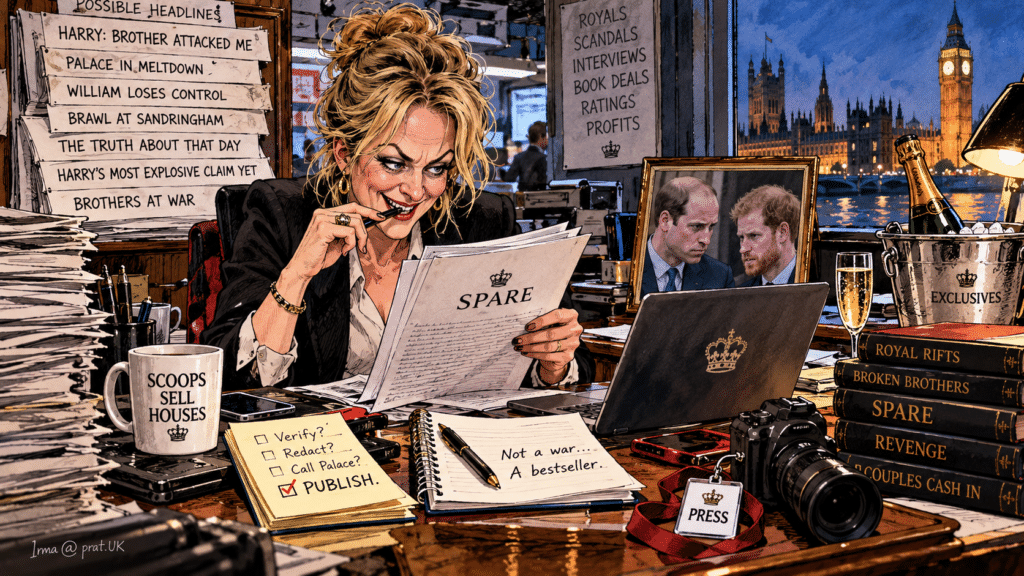
William’s alleged preferred solution is to remove the couple’s titles. Constitutional experts might reasonably point out that changing royal titles is not as simple as cancelling a gym membership. There are legal and constitutional distinctions between titles and styles, and a prince cannot simply march into a palace office and demand that his brother’s stationery be confiscated before lunch.
More importantly, the proposal raises another question. Would losing the titles actually prevent Harry and Meghan from doing anything?
Harry could visit Nottingham as Harry Mountbatten-Windsor. Meghan could meet charity volunteers as Meghan Markle. The sandwiches would remain edible. The volunteers would remain volunteers. The young people would continue needing support. Britain would have devoted enormous constitutional energy to changing what two people are called while achieving absolutely nothing regarding what they do.
It would be the most characteristically British political achievement since forming a government committee to investigate why government committees take so long.
Buckingham Palace Considers National Smiling Restrictions
A policy response might involve limiting former working royals to charitable engagements that cannot be photographed. Unfortunately, this presents operational difficulties. The public now owns mobile telephones. Some even know how to operate the cameras. Preventing photographs would require Harry and Meghan to conduct every charitable visit inside a cupboard.
A further proposal could restrict public appearances to locations where nobody recognises them. Given the international reach of royal celebrity, officials may need to locate a remote Scottish island with no electricity, internet connection or residents under the age of 97. Even then, somebody would probably ask Meghan for a selfie.
There is also the problem that charitable work has no hereditary copyright. Anyone can raise funds. Anyone can volunteer. Anyone can visit a food bank, and the Charity Commission has yet to ask for a royal pedigree. The institution might prefer these activities to receive official recognition, but the people receiving assistance are unlikely to ask whether the individual helping them has been authorised by Buckingham Palace. A hungry family is interested in dinner, not ceremonial precedence.
Prince of Wales Confronts the Problem of Popularity
Royal commentators frequently discuss the monarchy as though it were a corporation defending an exclusive trademark. In that interpretation, Harry has left the company but continues providing customer service. Management wants his uniform back. Unfortunately for management, the customers still recognise him.
The more William is portrayed as objecting to charitable appearances, the more uncomfortable the contrast becomes. One brother appears in photographs meeting people. The other, according to anonymous reports, appears in newspaper stories explaining why the first brother must be stopped. That is a difficult public relations competition to win.
Charles reportedly understands the danger of escalation, which may explain his reluctance to take drastic action. The King has a straightforward choice. He can preside over an institution confident enough to tolerate private charitable work by family members who no longer represent the Crown. Or he can allow a food bank visit to become a constitutional confrontation.
The monarchy has survived civil wars, revolutions, abdications and occasionally the fashion preferences of its own relatives. It ought to survive two people visiting Nottingham. If William wishes to defend the dignity of the Crown, he might begin by explaining why helping people should require a permit.
The answer will presumably arrive in six months, following the completion of a full palace review. Naturally, the review itself will require a royal title.
Five Humorous Observations
- His brother went to a food bank and now there’s a title emergency. I’ve been to a food bank. Nobody checked my bloodline. They checked whether I had a bag.
- You can’t strip somebody’s title like it’s a gym membership. Though honestly, with the Windsors it’d be easier to cancel a gym membership. At least the gym would pick up the phone.
- The plan to stop the smiling is that Harry does charity in a cupboard. A grown man in a cupboard with a casserole. That’s not a punishment, that’s Tuesday in my house.
- “Royal Office of Approved Goodwill.” Somewhere a guy in a lanyard is already designing the form. He’s got the font picked out. He’s thrilled.
- Let’s say they do take the titles. Harry shows up at the food bank as Harry Mountbatten-Windsor. Same face. Same ginger. Nobody in Nottingham’s going, “Who’s that? Never heard of him.”
No titles were stripped in the writing of this disclaimer. The Nottingham charity visits really happened; the reported disagreements and proposed title sanctions rely on attributed sources, not confirmed palace announcements, and the emergency measures are comic exaggeration. For more satire news, no supervision required.

Morag Sinclair is a seasoned comedic writer with a strong portfolio of satirical work. Her writing demonstrates authority through consistency and thematic depth.
Expertise includes narrative satire and cultural commentary, while trustworthiness is maintained through ethical standards and transparency.