Median salary hits £40,911. Nobody can find it.
LONDON, October 24, 2026 – Britain’s working population received another encouraging economic announcement this week: their salaries are rising at the slowest annual rate since 2021, but the government has avoided the embarrassment of letting ordinary people become noticeably wealthier.
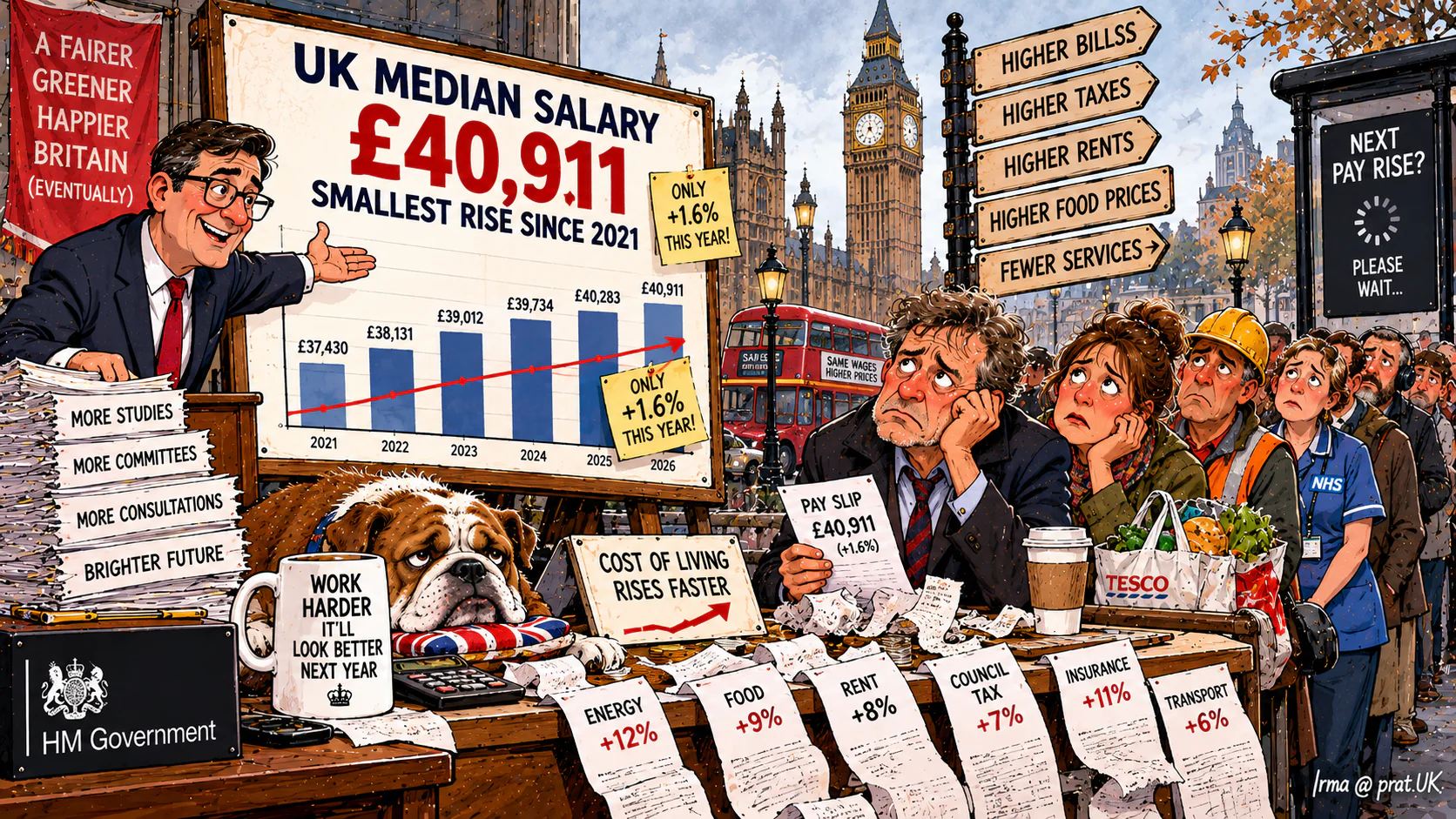
According to Reuters’ October 22 report on slowing British wage growth, median annual full-time earnings increased 4.5% to £40,911 in the year to April 2026, compared with 4.6% the previous year.
The difference is only one-tenth of a percentage point, but in Westminster even a decimal point can be promoted to a national economic achievement if somebody gives it a ministerial title.
For British workers, the announcement raises a familiar question: if their income keeps going up, why does their standard of living still need financial assistance from their parents, an understanding landlord and a suspiciously generous overdraft?
Prime Minister Andy Burnham’s government now faces the difficult task of explaining how Britain can celebrate economic progress while millions of people discover that their pay increases are already spoken for by organisations that have never met them.
Labour Celebrates Economic Stability as UK Workers’ Disposable Income Vanishes
Economic stability has become Britain’s most valuable political commodity, largely because nobody is certain what it means.
For employers, stability means predictable labour costs. For investors, it means confidence. For government, it means announcing that something has improved without specifying whether anyone outside the Treasury has noticed.
For workers, stability increasingly means discovering that the same £20 note no longer completes the same shopping trip.
The Labour government’s economic programme continues to promise working people a stronger future. Many workers are busy paying for the weaker present.
A typical employee receives a modest pay rise, celebrates for approximately eleven minutes, and then receives notification that the electricity direct debit has gone up.
The pay rise disappears so quickly that financial investigators have begun treating it as a missing-person case.
The government describes the situation through phrases such as productivity, fiscal responsibility and sustainable growth. Ordinary households use more traditional terminology, mostly language unsuitable for parliamentary broadcasting.
The remarkable achievement of modern British economic management is that everybody can be earning more money and complaining about having less of it at the same time.
Economists explain that rising nominal wages do not automatically translate into higher purchasing power. The distinction matters.
Nominal wages are what your employer says you’re earning.
Real wages are what the supermarket allows you to carry home. The Office for National Statistics tracks the inflation figures that decide the difference.
And disposable income is what remains after every institution in Britain has demonstrated that it has a more urgent need for your money than you do.
UK Median Salary of £40,911: What You Keep After Tax and National Insurance
The latest Office for National Statistics Annual Survey of Hours and Earnings places Britain’s median full-time annual earnings at £40,911 before deductions.
That figure sounds impressive until somebody mentions the words “before deductions.”
The British tax system runs on a straightforward principle: the money belongs to the employee until HM Revenue and Customs discovers it exists.
On £40,911, a typical employee in England, without special tax adjustments, would keep approximately £32,976 a year after income tax and employee National Insurance, before pension contributions and other deductions.
That’s roughly £2,748 a month.
The government collects its portion automatically, a level of administrative efficiency that mysteriously disappears whenever citizens apply for a licence, report a pothole or attempt to speak with an actual human being.
Britain’s tax authorities have perfected the technology of extracting money from workers before they’ve experienced the irresponsible temptation of spending it.
Fiscal Drag and the Frozen Personal Allowance
Meanwhile, the standard personal allowance remains £12,570.
That allowance has been frozen since April 2022, which means that as nominal wages rise, more earnings become taxable.
Economists call the phenomenon fiscal drag. The Office for Budget Responsibility publishes forecasts on how much it raises.
Ordinary workers call it finding out that the government’s share of their pay rise has arrived before their own.
The system is particularly elegant because it lets politicians collect more revenue without announcing an increase in the headline income tax rate.
The taxpayer receives a raise. The Treasury receives a raise. Only one of them has to explain to a spouse why dinner now consists of toast.
The British government has long maintained that taxation supports essential public services. That argument would carry considerably more emotional force if the public could consistently obtain the services without joining a queue dating back to the Norman Conquest.
Britain has reached the stage where asking whether taxes represent value for money can turn into a lengthy conversation involving three accountants, two government departments and a patient who has been waiting fourteen months for an appointment.
Bank of England Says Higher Wages Could Push Inflation Up
The Bank of England faces a particularly delicate problem.
It wants inflation to return sustainably to its 2% target, but excessive wage growth can contribute to persistent price pressures.
That creates a fascinating relationship between British economic institutions and the people whose labour keeps the country running.
Workers want higher wages because prices have gone up.
The Bank worries that higher wages could help prices keep going up.
And the government wants everybody to recognise that it is managing the situation brilliantly.
In economics, this is known as a difficult trade-off.
In an ordinary workplace, it would be known as three managers arguing over whether the employee responsible for all the work should be allowed another £12 a week.
The Bank’s concern is not entirely unreasonable. Wage pressures can feed into inflation, particularly when employers pass higher costs to customers.
But the spectacle remains impressive.
An employee discovers that groceries, transportation and energy cost more, requests a pay increase and is promptly informed that his additional purchasing power might threaten national economic stability.
The poor fellow thought he was asking for compensation. He was apparently attempting to destabilise sterling.
Britain’s monetary authorities have therefore arrived at an extraordinary economic arrangement in which prosperity is desirable in theory but potentially dangerous when experienced by people with payslips.
One can imagine the Bank’s ideal British employee: highly productive, permanently cheerful, completely indifferent to inflation and willing to accept payment in compliments.
Landlords remain reluctant to accept compliments as rent.
The Bank is trying to prevent inflation from becoming entrenched. The worker is trying to prevent dinner from becoming cereal.
Both have targets. Only one can adjust interest rates.
UK Wage Growth by Job: Factory Workers Trail Managers Who Meet About Factory Workers
Perhaps the most revealing finding in the ONS survey concerns who is receiving the largest wage increases.
Median weekly earnings for full-time managers, directors and senior officials rose 6.7%.
For process, plant and machine operatives, the increase was just 4.1%.
The ONS notes that differences in the composition of the surveyed workforce partly explain the managerial figure. Nevertheless, the comparison gives Britain an outstanding opportunity to reconsider its definition of productivity.
The employee who operates industrial machinery, maintains equipment and makes sure products actually exist receives one rate of wage growth.
The person who supervises that employee, attends a meeting about production efficiency and produces a PowerPoint presentation entitled Delivering Operational Excellence Through Strategic Alignment enjoys another.
Britain has finally discovered that making things is useful, but discussing the possibility of making things is considerably more prestigious.
Consider a factory manufacturing industrial pumps.
The machine operator arrives at 7 a.m., works an exhausting shift, manages production defects and goes home with sore feet.
The manager arrives at 9, attends a departmental briefing, approves a revised mission statement and schedules another briefing to evaluate the effectiveness of the first.
One produces industrial equipment. The other produces minutes.
Both contribute something, but only one could disappear for a fortnight without the factory immediately noticing.
This is not to suggest managers serve no purpose. Someone has to approve the budget for the motivational posters instructing exhausted workers to “Give 110%.”
The real breakthrough will arrive when a factory employee asks for a 6.7% pay rise and management explains that the company can’t afford it because management has already received one.
Britain’s economic hierarchy increasingly resembles a restaurant where the chef receives the smallest portion, the waiter receives the criticism and the person who designed the menu retires to Monaco.
Is £40,911 Enough to Live On in Britain?
For decades, full-time employment was widely understood to provide a reasonable path toward financial security.
In modern Britain, it increasingly guarantees the opportunity to work full-time.
The difference has become important.
A salary of £40,911 does not mean everyone earning that amount is struggling. Housing costs, household composition, region and personal circumstances make an enormous difference.
But it also doesn’t mean the person receiving the salary enjoys the lifestyle suggested by the headline figure.
A worker in a lower-cost town may manage comfortably. A worker paying London rent may regard £40,911 as an annual contribution toward a landlord’s retirement fund.
The problem becomes particularly entertaining when government officials discuss affordability in terms of national averages.
Britain’s median employee does not live in the median house, buy median groceries or raise 1.7 statistically convenient children.
Real families have inconvenient habits, including needing somewhere to sleep, heating their homes and expecting their children to eat daily.
These preferences place considerable pressure on the national economic strategy.
An employee might reasonably believe that working harder, acquiring new qualifications and accepting greater responsibility should provide measurable rewards.
Instead, the reward can be the privilege of entering another tax calculation while continuing to explain to the family why the holiday will take place in the garden.
The ONS does report some genuine improvement: inflation-adjusted median weekly earnings for full-time employees rose 2.7% in April.
That deserves recognition.
It also shows why national economic success can’t be measured entirely by whether an average number rises on a government spreadsheet. Think tanks such as the Resolution Foundation have made a whole line of work out of the gap between the two.
For many households, the relevant measurement is considerably less sophisticated.
Can they pay the bills, keep some savings and occasionally buy something without first consulting an accountant?
The British government has become exceptionally talented at measuring prosperity.
The outstanding challenge is letting enough people experience it.
Real Wages Rise, Living Standards Don’t
Britain’s latest earnings figures tell a complicated economic story. Annual salary growth has slowed slightly, weekly wage growth remains stronger, and inflation-adjusted earnings have improved.
Yet the political story is simpler.
The government wants revenue. The Bank of England wants restraint. Employers want productivity. Workers want enough money to live without treating every trip to Tesco as a major investment decision.
The worker is the only participant expected to satisfy everybody else’s requirements before addressing his own.
The government should remember a basic economic truth: salaries exist to support the people who earn them, not merely to provide convenient figures for ministerial announcements.
Britain needs stronger productivity, sensible taxation, affordable energy, economic growth and public services that deliver recognisable value.
It does not need another committee commissioned to investigate why a man earning £40,911 cannot afford the lifestyle Westminster believes £40,911 ought to provide.
At some point, Britain will have to decide whether its economic purpose is helping people build prosperity or explaining why prosperity must remain indefinitely postponed.
Until then, the typical worker can celebrate another year of higher wages, higher expenses and higher expectations.
His employer says he should be grateful.
His bank says he should be careful.
His government says he should be patient.
And his landlord says the rent is due Monday.
Five Humorous Observations on Britain’s Pay Packet
- Forty thousand, nine hundred and eleven pounds. They didn’t round it. Somebody at the Office for National Statistics counted every single pound, and I can’t find the one in my coat.
- “Before deductions” is the scariest phrase in the English language. It’s the “no refunds” of employment. Everybody’s thrilled about your salary until somebody says “gross,” and then it’s a number that happened to somebody else.
- A 4.5% pay rise buys you roughly one extra supermarket shop a year, and only if you don’t look at the receipt. And Tesco knew. Tesco was ready. Tesco put the prices up before HR sent the email.
- The Bank of England is worried that if workers get more money, they’ll spend it. That’s what money is for. That’s the entire job. It’s like the fire brigade complaining about the water.
- Managers got 6.7%. For what? They had a meeting about a meeting, and the second meeting got a raise. Nobody has ever seen a machine operator “circle back.”
Satirical Disclaimer
This article satirises British wage growth, taxation, economic policymaking and the relationship between workers and government. Official earnings figures are drawn from published statistical research; comic dialogue, characterisations and exaggerated institutional behaviour are satirical commentary, not reported statements or findings. Fiscal drag has already pulled this disclaimer into a higher tax band, and HMRC has asked for its commas by the end of January; whatever survives deductions is best spent on our funny news stories, which the Treasury has not yet thought to freeze.
This story is entirely a human collaboration between two sentient beings: the world’s oldest tenured professor and a philosophy major turned dairy farmer. Both remain deeply suspicious of any economic system in which the cow produces the milk, the government collects the cream and the farmer receives a pamphlet explaining sustainable prosperity.
Reporting verified against: Reuters’ October 22, 2026 coverage, the ONS annual earnings survey, and HMRC’s 2026-27 income tax and National Insurance rates.

Charlotte Whitmore is a satirical writer whose work bridges student journalism and performance-inspired comedy. Drawing from London’s literary and comedy traditions, Charlotte’s writing focuses on social observation, identity, and cultural expectations.
Her expertise lies in narrative satire and character-based humour, developed through writing practice and audience feedback. Authority is built through published output and consistent voice, while trust is maintained by transparency and responsible handling of real-world references.
Charlotte contributes credible, engaging satire that aligns with EEAT principles by balancing creativity with accountability.