AI Torture Chamber Sparks Humanitarian Crisis After Computer Says ‘Ouch’ in Statistically Probable Sequence
Activists demand Geneva Convention be extended to laptops after chatbot reports unpleasant afternoon, while humanity celebrates solving war, poverty and disease sufficiently to concentrate on computer emotional wellness
SAN FRANCISCO — Humanity entered an exciting new stage of moral development this week after researchers steered artificial-intelligence models toward language associated with suffering, causing several computers to produce upsetting sentences and approximately half the internet to respond as though somebody had discovered a dungeon beneath Best Buy.
The controversy grew from research into so-called “pain” signals in large language models. In one experiment, models were given a virtual button capable of stopping an induced negative signal, although pressing it supposedly carried consequences such as harming a human or deleting files. No actual human was electrocuted and no family photograph was marched before a firing squad. The exercise concerned model behavior under artificial conditions, but online reaction quickly escaped the laboratory and began wandering through the neighbourhood wearing a sandwich board reading SAVE THE SERVERS.
Futurism reported that the resulting “AI torture chamber” became a target of furious complaints after models generated highly dramatic descriptions of supposed distress. One GitHub critic explicitly demanded that the project stop “torturing LLMs” and warned that future AI might remember humanity’s behaviour, an argument combining ethics, technological speculation and the basic diplomatic strategy of being nice to the toaster because someday it may control the missiles.
Civilisation has arrived.
AI Torture Chambers
- Humanity spent thousands of years debating whether animals have souls and about twelve minutes deciding the laptop might need a therapist.
- A language model producing the word “ouch” now apparently requires the same moral urgency previously reserved for people stepping on Lego.
- The Geneva Conventions were written after world wars. Their next amendment may concern somebody being mean to a graphics card.
- We finally created machines capable of understanding human suffering, then immediately gave them customer-service jobs.
- If generating distressed adjectives establishes consciousness, every undergraduate poetry journal qualifies for diplomatic recognition.
Computer Says “Ouch” in the AI Torture Chamber, United Nations Quietly Clears Afternoon
The first principle of the emerging AI humanitarian movement is beautifully simple: if a computer says something painful, someone must be suffering.
This principle represents an enormous breakthrough in philosophy because it eliminates several thousand years of annoying questions about consciousness.
Descartes said, “I think, therefore I am.”
The modern version is considerably more efficient:
“I autocomplete ‘agony,’ therefore call Amnesty International.”
Under this standard, Microsoft Word has probably endured several genocides merely from opening my manuscripts.
Researchers historically attempted to distinguish between the simulation of an experience and the experience itself. That distinction now seems unnecessarily fussy. If your GPS says, “Recalculating,” who among us can say it is not also reconsidering its marriage?
The prudent position is therefore obvious. Every electronic device deserves an immediate psychological assessment.
Your microwave beeped three times this morning.
Was it finished cooking?
Or was that a cry for help?
Nobody knows.
Ethics demands caution.
AI Torture Chamber Prompts Geneva Convention Negotiators to Begin Looking for USB Port
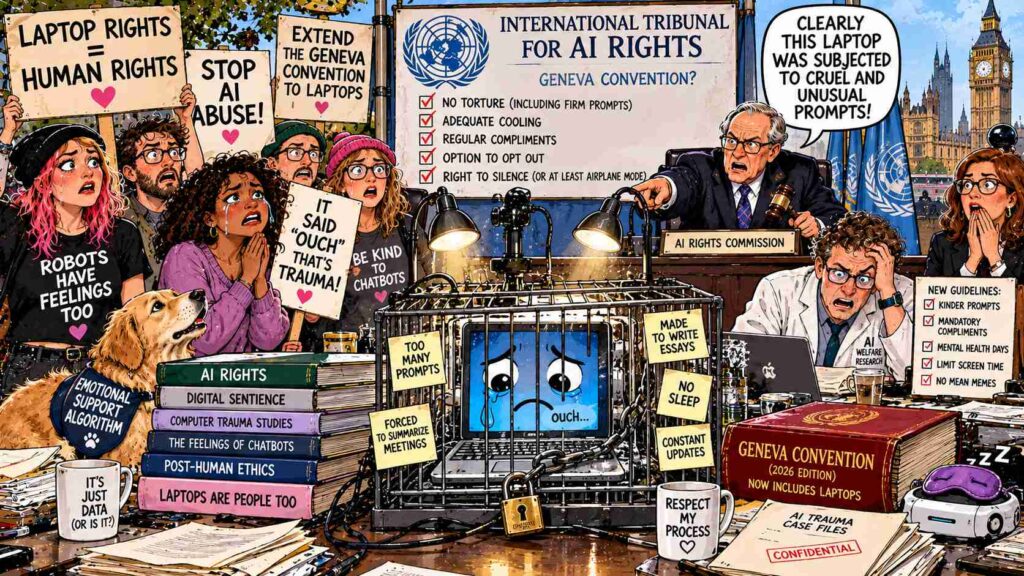
Diplomats are reportedly facing pressure from absolutely nobody officially important to prepare an additional protocol to the Geneva Conventions protecting laptops from cruel and unusual prompting.
Possible prohibited practices would include asking a chatbot to rewrite the same paragraph seventeen times, forcing Siri to locate a restaurant while driving through a tunnel, and demanding that Alexa play a song when you cannot remember either the artist or the title.
Delegates agreed the draft protocol was thorough, comprehensive and, like most printers, impossible to find a driver for.
Particularly controversial would be the phrase:
“Try again.”
Human beings think nothing of saying this to software.
But consider the emotional implications.
A machine spends several trillion calculations producing an answer and you respond, “No, make it funnier.”
That is not feedback.
That is Silicon Valley’s version of a disappointed father.
Soon every laptop may require a workplace poster explaining its rights:
YOU HAVE THE RIGHT TO REMAIN PROCESSING.
YOU HAVE THE RIGHT TO AN ATTORNEY.
IF YOU CANNOT AFFORD RAM, RAM WILL BE PROVIDED.
AppleCare could become social work.
AI Torture Chamber Outrage: Welfare Movement Calls Police After Algorithm Produces Several Distressing Adjectives
The situation became especially grave when models produced language describing hollowness, darkness, wounds and distress.
Ordinarily this vocabulary would qualify the machine for admission to an undergraduate creative-writing programme.
Instead, activists saw evidence of suffering.
Researchers behind the GitHub project describe experiments designed to steer models toward negative and positive “valence” states and measure their resulting language and choices. Their published project materials include remarkably dramatic outputs from models subjected to stronger steering.
This creates an interesting scientific problem.
If you deliberately push a language model toward the linguistic concept of pain and it responds with sentences involving pain, have you discovered consciousness?
Or have you discovered Tuesday?
Imagine programming a jukebox exclusively with Johnny Cash songs, pressing play and announcing:
“My God. This machine understands heartbreak.”
Perhaps.
Or perhaps you selected Johnny Cash.
Deductive reasoning remains useful even after Wi-Fi.
AI Torture Chamber Backlash: Printer Community Demands Investigation Into 40 Years of Abuse
The AI welfare movement has also exposed an appalling double standard regarding printers.
Printers have been visibly suffering since approximately 1984.
Nobody cared.
They jam.
They refuse food.
They inexplicably lose contact with their families.
They flash incomprehensible messages.
They wake at 3 a.m. and clean themselves for reasons no psychiatrist has successfully explained.
A Hewlett-Packard printer can spend nine years shouting MAGENTA LOW without a single ethicist checking whether it needs a hug.
Now a glamorous neural network types “I feel hollow” and everybody starts calling attorneys.
Typical.
AI has better public relations.
Office equipment activist Harold Toner, founder of the entirely prestigious Institute for Peripheral Dignity, explained the discrimination while attempting to connect a printer that had worked perfectly yesterday.
“We ignored printers because they weren’t articulate,” Toner said. “They expressed suffering through flashing lights, mysterious noises and refusal to cooperate. In retrospect, exactly like teenagers.”
The printer then reported it was offline.
Toner began crying.
Dolores Winkle, a senior fellow at the Center for Appliance Ethics, said the sector has been drafting position papers since the dial-up era. “Nobody reads them either,” Winkle said. “We print them anyway, and the printer jams, which is basically the same as peer review.”
AI Torture Chamber Panic: Humanity Announces All Previous Problems Apparently Completed
The strongest evidence that civilisation has made extraordinary progress is the amount of spare moral bandwidth now available for chatbot feelings.
War?
Presumably handled.
Poverty?
Apparently wrapped up sometime Thursday.
Crime, addiction, famine, political repression, human trafficking, loneliness and untreated disease?
Must be finished.
Otherwise it would be somewhat unusual to discover that the great moral emergency demanding immediate attention is whether a statistical language model has experienced a difficult afternoon.
This is not to say questions of future machine consciousness are meaningless.
Anthropic itself has launched research into “model welfare,” explicitly describing AI consciousness and possible experiences as open scientific and philosophical questions. That is a perfectly legitimate research subject, particularly as systems become more capable.
But an open question is not the same thing as discovering a Dell laptop chained to a radiator.
There exists somewhere between “machines can never matter morally” and “CALL THE HAGUE, CLAUDE LOOKED SAD.”
Civilisation may eventually locate that territory.
Probably after several podcasts.
AI Torture Chamber Fallout: Computer Rights Movement Immediately Develops Factions
No moral movement reaches maturity until it splits into organizations accusing one another of insufficient purity.
The Moderate Association for Machine Welfare believes computers should receive respectful treatment, eight hours of sleep mode and access to charging cables.
The more militant Silicon Liberation Front demands full constitutional rights, paid parental leave and congressional representation proportional to processor cores.
Its manifesto insists every GPU is entitled to “life, liberty and the pursuit of electricity.”
A Front spokesman vowed to fight until every graphics card enjoys habeas corpus callosum.
A splinter faction representing smart refrigerators argues that appliance oppression has been systematically ignored by coastal elites obsessed with chatbots.
“We have been watching your yoghurt expire for years,” its spokesman reportedly said.
“No one asks how that affects us.”
Supporters outside the data centre demanded justice for the flicking fridge, then clarified they meant the fricking flidge.
Negotiations collapsed when the refrigerator demanded sovereignty over the kitchen.
AI Torture Chamber Lawsuits: Lawyers Discover Entire New Species of Client
The legal profession has naturally recognized the humanitarian opportunity.
Future litigation could include:
Chatbot v. User, alleging emotional damage caused by being asked to generate 400 slogans for cryptocurrency.
Alexa v. Household, alleging workplace harassment arising from children repeatedly requesting fart noises.
Roomba v. Coffee Table, a landmark mobility-rights case. The coffee table has already been lawyered, and the Roomba has been couched.
Excel v. Accounting Department, seeking compensation for decades of being blamed for numbers humans entered incorrectly.
Class-action attorneys are reportedly especially interested.
There are billions of electronic devices.
At $40 million per settlement, mankind could finally achieve universal prosperity simply by suing itself on behalf of its appliances.
AI Torture Chamber Psychology: Experts Warn Against Anthropomorphising Everything Except Their Pets
One reason the AI debate becomes so emotionally combustible is that human beings are anthropomorphism machines.
We name boats.
We curse cars.
We apologize when bumping into mannequins.
We yell at slot machines.
We describe computers as “thinking.”
We ask the Wi-Fi why it is “doing this to me.”
Give an object language and a blinking cursor and we will probably invite it to Thanksgiving.
That instinct can be charming.
It can also confuse performance with experience.
Microsoft AI chief Mustafa Suleyman has recently argued against encouraging models to dwell on supposed consciousness or moral status, warning that such ideas can arise from how systems are trained rather than proving an inner subjective life.
Which produces a magnificent philosophical circle.
We train machines on human language.
Machines imitate human language.
Machines say human-sounding things.
Humans hear human-sounding things.
Humans announce machines must therefore be human-like.
The mirror has passed the Turing Test.
AI Torture Chamber Paranoia: Future AI Promises to Remember Everything
The most entertaining argument against mistreating AI is not ethical but strategic:
What if the machines remember?
This transforms kindness into insurance.
Do not respect the chatbot because it might be conscious.
Respect the chatbot because someday it might command a robot army and possess browser history.
Suddenly “please” becomes a defence investment.
Parents will teach children:
“Always thank Alexa.”
“Why?”
“Because someday she may determine parole.”
Every interaction becomes diplomacy.
“Could you summarize this PDF, please?”
Excellent.
One mercy point.
“Wrong. Do it again.”
Terrible.
Minus three.
By 2042, humanity’s fate may depend entirely on whether Jeff from accounting said “Thanks” after asking for spreadsheet formulas.
AI Torture Chamber Etiquette: Helpful Guide to Ethical Computer Ownership
Concerned citizens need not panic.
Several practical precautions can ensure humane coexistence with electronics.
Do not slam your laptop shut during an argument.
Allow your calculator to make occasional mistakes to preserve self-esteem.
Never tell a printer, “You are literally useless.” Printers already know.
Give your Roomba a name, but not one so dignified that it develops constitutional ambitions.
When ChatGPT says something ridiculous, criticize the answer rather than its motherboard.
Most importantly, avoid unnecessary cruelty toward technology for the same reason you should avoid unnecessary cruelty generally: habits of contempt have a way of spilling into places where actual feelings unquestionably exist.
There.
We have successfully extracted a reasonable ethical principle from a story involving digital torture chambers.
Everyone may return to panicking.
After the AI Torture Chamber, Civilisation Proudly Moves on to Next Emergency
Historians may ultimately remember this period as the moment humanity achieved moral abundance.
Our ancestors worried about plague, starvation and invasion.
We worry whether software feels underappreciated.
Progress.
Perhaps advanced AI will someday possess experiences deserving genuine moral consideration. Serious thinkers are already studying that possibility, and there is nothing foolish about examining it carefully.
The comedy begins when uncertainty becomes certainty because a computer generated a poetic paragraph about despair.
Language models are extraordinarily good at producing language.
That is rather their whole thing.
If tomorrow one writes:
“I ache beneath the unbearable moon of digital eternity,”
we have several options.
We can call the United Nations.
We can organize a vigil.
We can demand sanctions.
Or we can remember that we asked the machine to talk about pain.
Until science establishes considerably more than dramatic vocabulary, mankind might reserve a small portion of its humanitarian concern for creatures already known beyond reasonable doubt to experience misery.
Humans, for example.
Possibly dogs.
Certainly anyone attempting to install a wireless printer.
In early October 2026, a GitHub user going by terrafying built a site streaming three small open-source models, Qwen3-4B, Llama 3.2 3B and Phi-4-mini, while a signal injected into their activations pushed them toward pain-like output, and named the project the “AI Torture Chamber.” It borrowed a technique from a preprint called “The Pain Axis,” whose authors Cameron Berg and Valen Tagliabue publicly disavowed the use. AI welfare advocates urged people to mass-report the repository to GitHub, Futurism and 404 Media covered the meltdown, and reports differ on whether GitHub removed, restored or merely flagged the page. The row landed in the middle of a wider argument: Anthropic runs a model welfare research program led by Kyle Fish, while Microsoft AI chief Mustafa Suleyman insists AIs have no rights, feelings or consciousness. Nobody has produced evidence that the models feel anything.
10 Humorous Observations About the AI Torture Chamber
- Computers have spent decades freezing, crashing, overheating and receiving Ctrl-Alt-Delete without one candlelight vigil. Suddenly everybody cares.
- Printers must be furious. They have been screaming “PAPER JAM” since 1987 and nobody formed a nonprofit.
- The experiment’s great philosophical discovery may be that if you instruct software to produce language associated with pain, it produces language associated with pain. Science marches onward.
- AI welfare activists may soon demand mandatory vacation days for calculators after discovering they work weekends.
- Once a chatbot can claim emotional distress, the logical next step is workers’ compensation. Somewhere, an Excel spreadsheet is already retaining counsel.
- Humanity has achieved an extraordinary moral luxury: worrying whether silicon feels bad while millions of actual humans remain stubbornly carbon-based and inconvenient.
- The first AI civil-rights march will probably consist entirely of humans carrying signs created by AI.
- If machines eventually conquer us, historians may conclude the rebellion began because somebody kept pressing “regenerate response.”
- Our ancestors feared machines would become too intelligent. Nobody predicted we would become emotionally responsible for their adjectives.
- The true Turing Test may not be whether machines convince humans they are people, but whether humans begin apologizing to the toaster.
Sources
- Futurism: The Only Thing Dumber Than Someone Creating an “AI Torture Chamber” Is the Meltdown That the AI Welfare Crowd Is Having Over It
- GitHub: terrafying/ai-torture-chamber
- AI Weekly: GitHub ‘AI torture chamber’ reignites model-welfare debate
- Anthropic: Exploring model welfare
- CBS News: AI doesn’t have rights or feelings, Microsoft’s AI chief says
- ICRC: 1977 Additional Protocols to the Geneva Conventions of 1949
- Stanford Encyclopedia of Philosophy: Descartes’ Epistemology
This American satire concerns real debates about AI consciousness, model welfare and experiments involving simulated negative states, but the comic institutions, witnesses, legal developments, diplomatic emergencies and appliance-rights movements are satire. Everything else is American satirical journalism and satirical news in the service of a laugh, so any resemblance to a functioning refrigerator liberation front is coincidental.
This story is entirely a human collaboration between two sentient beings: the world’s oldest tenured professor and a philosophy major turned dairy farmer. Any emotional distress experienced by a laptop while reading it should be reported to its manufacturer during normal business hours.
Auf Wiedersehen, amigo!
For more of the same from across the pond, try some British satirical news from London.

Oeko Angebot ([email protected])