Second-Hand Luxury: Britain’s Rich Discover the Price Tag
Britain’s affluent embrace second-hand luxury, smaller mansions and the previously unknown economic concept of “how much is that?”
Britain entered a disturbing new phase of economic uncertainty this week after affluent consumers reportedly began buying second-hand goods, trading down and behaving in ways previously associated with people who know the price of milk.
Bloomberg reports that wealthier UK consumers are becoming increasingly cautious, embracing resale and cheaper alternatives as concerns about household finances spread further up the income ladder. The development follows broader evidence of weakening consumer confidence. PwC reported this spring that UK consumer sentiment fell from -1 to -13, with nine in ten respondents naming the cost of living as their biggest concern and eight in ten planning spending cutbacks.
Economists initially believed Britain could withstand inflation, expensive borrowing and weak confidence indefinitely.
Then somebody spotted a millionaire checking a price tag.
Emergency meetings were immediately convened.
“This changes everything,” said one visibly shaken City analyst while looking through the window of Pret. “Poor people checking prices is household budgeting. Middle-class people checking prices is consumer caution. But when someone with a wine cellar does it, technically that’s macroeconomics.”
Charity Shops Introduce Velvet Ropes as Second-Hand Luxury Arrives
The most dramatic evidence of Britain’s changing economic climate can be found in the second-hand market, where affluent shoppers are increasingly comfortable buying pre-owned goods.
The government itself now describes the pre-loved fashion market as thriving. In May, the Intellectual Property Office issued official guidance on shopping second-hand safely, reporting that nearly 70% of Gen Z and Millennials had bought pre-loved items during the previous year. Britain has therefore reached the stage of national development where a government department produces a leaflet about handbags. Somewhere in Whitehall, a civil servant is being paid to authenticate your cardigan.
Luxury shoppers are joining the rush. Barclays research found that roughly one in five consumers now use platforms such as Vinted and Depop to keep costs down, while another fifth treat them as a second income.
Britain’s charity shops are consequently preparing for demographic upheaval.
Several are believed to be considering velvet ropes, champagne lounges and personal shoppers capable of saying, “Madam, this cardigan has a fascinating provenance. It belonged to Sandra from Croydon.”
Oxfam volunteers will undergo specialist training enabling them to distinguish between customers seeking a £4 winter coat and customers seeking an archival knitwear experience.
The transformation may prove difficult for traditional charity-shop customers. One pensioner reportedly entered looking for a paperback and discovered two hedge-fund managers bidding against each other for a lamp. She left with the lamp. She had cash.
Millionaires Trade Down as Second-Hand Luxury Reaches the Mansion Belt
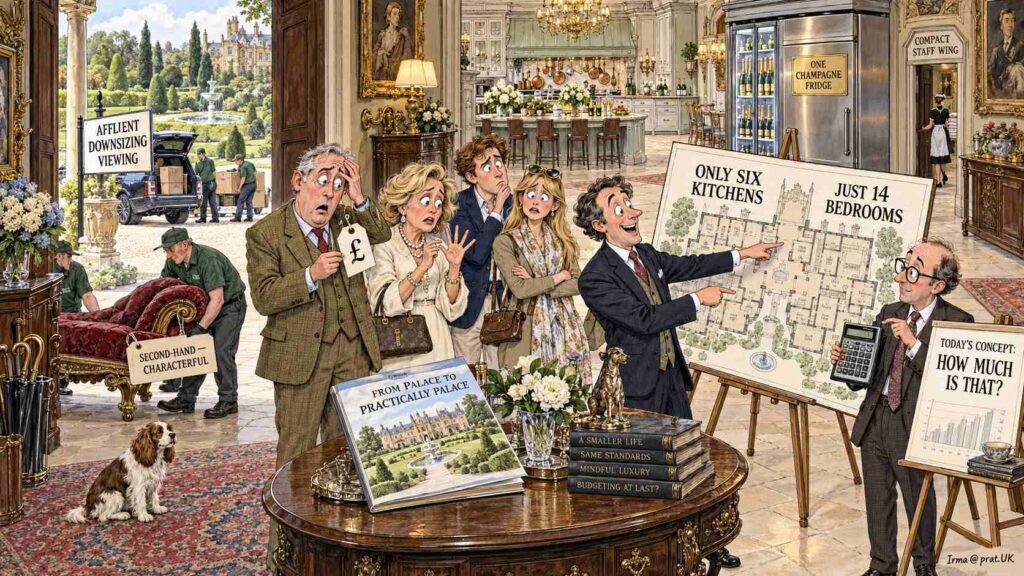
Even more troubling is evidence that affluent households are trading down, an economic expression meaning consumers substitute cheaper products for expensive ones.
Among ordinary households, trading down might mean switching supermarkets, buying own-brand groceries or delaying a large purchase.
Among the wealthy, economists believe it could mean unprecedented sacrifices.
Families accustomed to eight-bedroom houses may soon be forced into seven-bedroom accommodation. Range Rovers may be ordered with only one champagne refrigerator. Some households could find themselves owning a swimming pool without a separate pool house, forcing swimmers to travel almost 30 feet while wet.
Economists call this relative deprivation, although residents of Doncaster have suggested another term.
Consumer research supports the broader shift towards cheaper alternatives. PwC found increased intentions among British shoppers to trade down to cheaper brands and cheaper stores, while Deloitte reported that discretionary spending fell seven percentage points in the first quarter of 2026 to its lowest level since early 2023.
This is how recessions become politically dangerous.
Nobody panics while Steve from Wolverhampton switches washing powder. But when Sebastian from Chelsea announces, “We’ve decided against replacing the Tuscan tiles this year,” the Treasury starts preparing documents.
Second-Hand Luxury Reveals That Clothes Can Have Previous Owners
Perhaps the greatest cultural shock involves clothing.
For generations, Britain’s affluent apparently operated under the assumption that garments were created spontaneously inside Bond Street boutiques shortly before purchase.
The second-hand boom has exposed them to a startling alternative theory. Someone else may have owned the jacket first. And it still works. Scientists have not yet determined how.
The discovery overturns decades of luxury economics under which a handbag acquired mystical properties when accompanied by a shop assistant wearing black gloves.
A £5,000 handbag sold new represents craftsmanship. The same handbag sold second-hand represents sustainability. The same handbag found in your grandmother’s cupboard represents something she has been asking you to take home since 2014.
The terminology is essential. Rich people do not buy used things. They buy pre-loved things. Your uncle’s 2007 Vauxhall is used. A 2007 Chanel bag is an archive. That distinction alone has probably created several billion pounds of economic activity, which tells you everything about how Britain generates growth these days. We no longer manufacture the goods. We rebrand them.
Trickle-Down Economics Finally Delivers Second-Hand Luxury Handbags
Luxury resale may also settle one of the great political arguments of modern Britain by providing the first observable example of trickle-down economics.
For decades, politicians promised prosperity would eventually trickle from the wealthy to everyone else. Researchers waited. Economists watched. Entire university departments received grants, which is the only form of trickle-down that has ever worked reliably.
Very little trickled.
Then suddenly handbags started coming down.
A woman pays £8,000 for a designer bag, uses it twice, sells it for £5,000, another person sells it three years later for £3,000, and eventually someone in Birmingham obtains it for £850. Margaret Thatcher never explained it this way, but perhaps she should have brought accessories.
Luxury resale has grown far beyond a fringe habit. Demand for vintage merchandise on platforms such as The RealReal has risen sharply since 2020, with shoppers becoming increasingly specific about designers, years and collections.
People are no longer merely purchasing handbags. They are researching them.
A handbag now requires more due diligence than a small business. Young shoppers check provenance, creative director, production year, condition and resale value before purchasing. Your grandfather bought a house with less information and considerably more optimism.
Britain Discovers the Reverse Status Symbol of Second-Hand Luxury
There is another reason wealthy people increasingly enjoy second-hand goods.
Being visibly thrifty has itself become expensive.
Anyone can spend too much money. It takes serious resources to appear effortlessly economical.
This explains why a wealthy shopper can purchase a battered vintage coat for £2,000 and receive compliments for being sustainable, while a man wearing his actual battered coat because he cannot afford another one receives directions to the nearest Primark.
Modern luxury has therefore completed an extraordinary philosophical journey. First, status meant owning something expensive. Then status meant owning something exclusive. Now status means owning something expensive that appears as though you found it behind a pub.
The ultimate luxury product may soon be a handbag costing £12,000 specifically engineered to resemble one purchased for £3.50 at a church fete.
Estate Agents Prepare for the Great Second-Hand Luxury Downsizing
Housing could be next.
Britain’s affluent may increasingly discover that there is technically no law requiring every child to have an en-suite bathroom, although the current government has not yet ruled one out.
Estate agents are preparing brochures appropriate to the new austerity.
“Charming downsizer. Seven bedrooms. Six bathrooms. Tragically limited to two kitchens.”
Prospective buyers will be warned that certain properties contain fewer than three staircases and, in extreme cases, the cinema room may need to double as the yoga studio. This is hardship at a level unseen since Downton Abbey temporarily lost a footman.
The psychological adjustment could be profound. For ordinary households, downsizing means discovering whether the dining table fits. For wealthy households, downsizing means deciding whether Tuscany was ever really necessary.
Economists Monitor the Aldi Car Park for Second-Hand Luxury Warning Signs
The most useful indicator of Britain’s economy may therefore no longer be GDP.
Forget productivity. Forget gilt yields. Forget purchasing managers’ indices.
Count Bentleys at Aldi.
The moment economists detect a sustained increase, Britain has entered recession. Two Bentleys means uncertainty. Five means contraction. A Rolls-Royce beside the trolley return means contact the IMF.
The middle aisle is the final threshold. Once a billionaire discovers that £14.99 can purchase a cordless drill, thermal socks and something described only as a portable garden leisure solution, monetary policy has failed.
“This is extraordinary,” our City analyst said. “For years, wealthy consumers believed bargains were something their accountants found in Luxembourg.”
Thrift May Become Expensive Once Second-Hand Luxury Turns Fashionable
There remains one danger. Rich people could make economising expensive.
It has happened before.
Working people grew vegetables because food cost money. The wealthy invented organic gardening. Working people kept old furniture because replacing it cost money. The wealthy invented vintage interiors. Working people wore second-hand clothing because new clothing cost money. The wealthy discovered sustainable fashion.
At this rate, turning the heating down will soon become a £900-a-day wellness retreat. A consultant will arrive at your home, switch off the radiator and explain that you are practising Nordic thermal minimalism. He will then invoice you for the cold.
The appetite is certainly there. EY found that 54% of surveyed aspirational luxury clients would buy pre-owned goods directly from the brands themselves, which means second-hand luxury has travelled a very long way from the church jumble sale.
Still, the spread of thrift across income groups might accomplish something governments have struggled to achieve. Britain may finally become a nation united by one question.
“How much?”
The poor have always asked it. The middle class started asking it when mortgage rates rose. Now the rich are asking it too.
National reconciliation has arrived. It merely required everybody becoming nervous about money.
And if conditions deteriorate further, economists say Britain should watch for the ultimate warning sign. A millionaire entering a charity shop, examining a £6 jumper, turning to the volunteer and asking, “Would you take five?”
At that point, forget recession. We’re finished.
Fifteen Humorous Observations on Britain’s Second-Hand Luxury Panic
- Britain knows an economic downturn is serious when rich people stop asking “Is it exclusive?” and start asking “Is that the final price?”
- Second-hand shopping used to mean finding a jacket for £12. For the wealthy, it means finding a £7,000 handbag for £4,800 and describing the experience as survival.
- The British class system has finally achieved equality: everybody is looking for a discount, although some people are doing it from the back seat of a Bentley.
- Charity shops will need VIP sections now. Nothing ruins the Oxfam experience faster than arriving for a £3 cardigan and discovering someone from Kensington has reserved the changing room for a vintage Hermes fitting.
- Millionaires trading down sounds terrifying until you discover it means ordering the Range Rover without the refrigerated compartment specifically engineered for champagne.
- The wealthy buying used clothing creates a fascinating economic circle: ordinary people buy clothes, rich people buy them second-hand, and economists call it circular consumption because “everyone has become nervous” sounds unprofessional.
- The rich have discovered something working people have known for centuries: clothing generally continues functioning after another human being has worn it.
- Luxury resale may be the first successful example of trickle-down economics. The money never trickled down, but apparently the handbags did.
- Estate agents will soon advertise hardship properties: “Only five bedrooms, four bathrooms and nowhere appropriate for the sommelier to sleep.”
- Wealthy people downsizing creates unique problems. The ordinary family asks which bills can be cut. The millionaire asks which kitchen.
- Britain now has pre-loved luxury, because rich people apparently cannot emotionally withstand the phrase “used purse.”
- Consumer confidence falling among affluent shoppers is particularly dangerous because wealthy people control the national supply of pointless decorative cushions.
- Once millionaires begin comparing supermarket prices, the Bank of England should skip the meeting and immediately sound the national economic air-raid siren.
- There is something wonderfully British about responding to economic anxiety by buying somebody else’s Burberry coat and calling yourself fiscally responsible.
- The ultimate recession indicator will arrive when a billionaire walks into Aldi, reaches for the middle aisle and whispers, “Darling, these welding gloves are remarkably reasonable.”
Sources
- Bloomberg: UK’s thrifty rich are shopping second-hand and trading down
- PwC: Consumer sentiment suffers biggest quarterly fall since summer 2022
- Deloitte: Consumer confidence sees biggest drop in four years
- Intellectual Property Office: Shop second-hand with confidence
- EY Luxury Client Index: in-house secondhand sales and rentals
- Barclays: how the growth of resale changed the game for retailers
The underlying story is straightforward enough. Bloomberg reported that better-off British households have started shopping resale and trading down, a habit that used to belong to everyone else. PwC’s spring survey, fronted by UK head of retail Jacqueline Windsor, put consumer sentiment at -13, its lowest since autumn 2023. Oliver Vernon-Harcourt, head of retail at Deloitte UK, described the first-quarter collapse in discretionary spending as conscious cutting back rather than seasonal drift. Kanishka Narayan MP, the minister responsible for intellectual property, launched government guidance in May aimed at second-hand shoppers buying counterfeit designer goods, while Silvia Rindone of EY-Parthenon has argued that British luxury clients are now as driven by price sensitivity as by brand heritage. The champagne refrigerators, distressed estate agents and Aldi Bentley Index belong to the comic argument.
Disclaimer
This is British satire built on real reporting about UK consumer behaviour and the resale market. The statistics come from the linked sources; the handbag-based economic theories, the velvet ropes at Oxfam and the swimmers travelling 30 feet while wet come from English satirical news, which has never once been consulted on interest rates and probably should not be. If you would like your UK satirical news with an American accent, our cousins are busy at Bohiney.com.
Auf Wiedersehen, amigo!

I am a Lagos-born poet and satirical journalist navigating West London’s contradictions. I survived lions at six, taught English by Irish nuns, now wielding words as weapons against absurdity. Illegal in London but undeniable. I write often for https://bohiney.com/author/junglepussy/.
As a young child, I was mostly influenced by the television show Moesha, starring singer and actress Brandy. Growing up, I would see Brandy on Moesha and see her keeping in her cornrows and her braids, but still flourish in her art and music, looking fly. I loved Moesha as a child, but now I take away something more special from it. Just because you’re a black girl, it doesn’t mean you need to only care about hair and makeup. Brandy cared about books, culture and where she was going — you can do both.