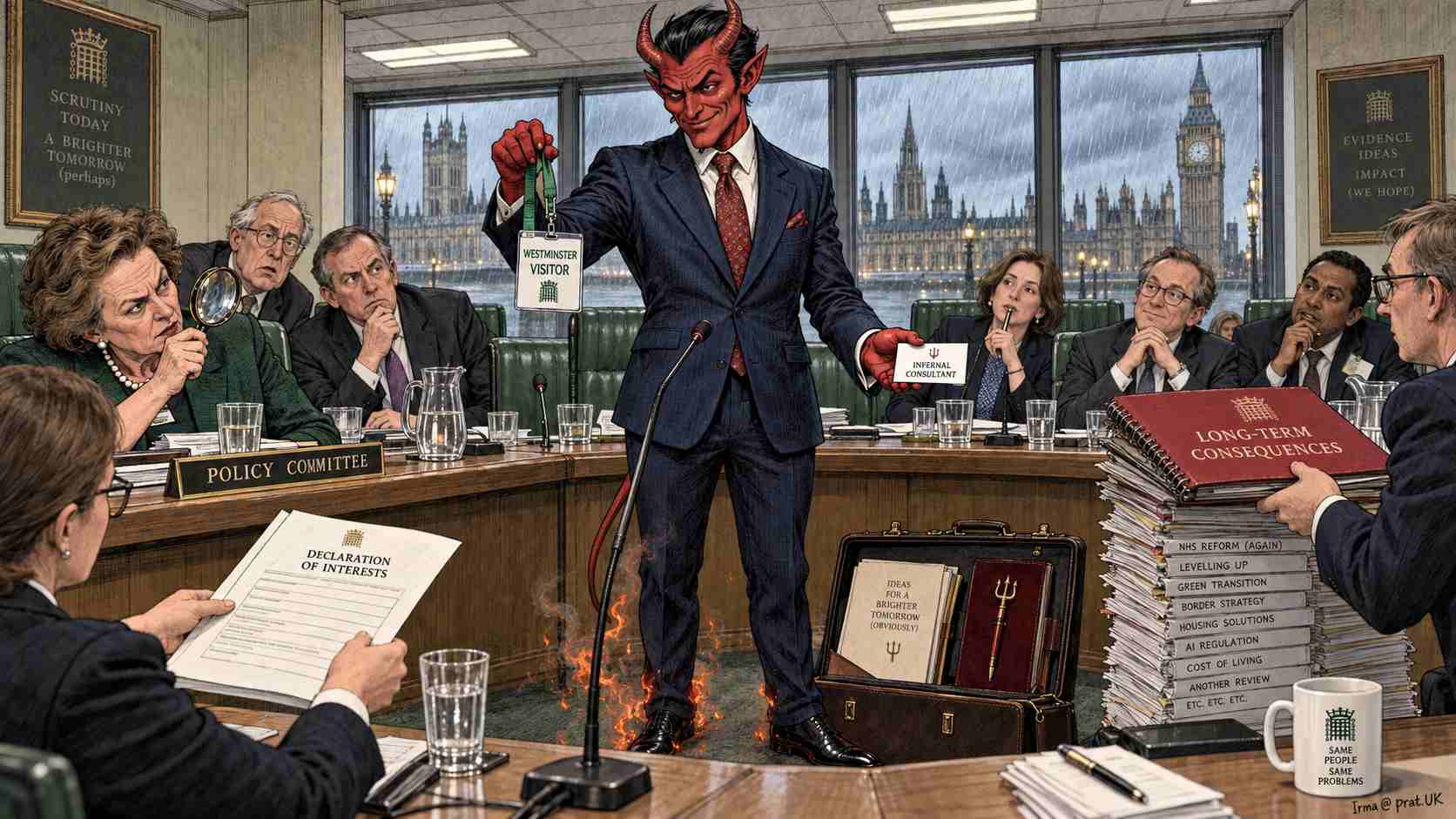
Demon Summoned in Westminster Immediately Registers as Lobbyist
Ancient Prince of Darkness discovers Parliament already has a visitor pass system — and it’s more efficient than a Faustian bargain
Summoned in Flames, Registered by Lunchtime
A demon summoned inside Westminster during an occult ceremony has registered as a parliamentary lobbyist after concluding that eternal corruption would be easier through normal channels, the kind now formally logged on the official Register of Consultant Lobbyists.
Azrath the Devourer appeared in a committee room Tuesday surrounded by flames, smoke and the smell of sulphur. Security asked whom he was visiting. “Your souls belong to me,” Azrath thundered. The receptionist requested a surname. After several minutes, the demon was issued a temporary pass. Within two hours he had business cards. By lunchtime he was representing a consortium of infrastructure companies.
Evil Discovers Stakeholder Engagement
Azrath originally planned to corrupt politicians individually. He abandoned the idea after learning about breakfast receptions. “This is far more efficient,” he said. “In the old days I had to tempt a man for years with riches, ambition and forbidden knowledge. Here somebody gives you a lanyard.”
The demon’s first policy seminar was titled Unlocking Growth Through Infernal Partnerships. Attendance was strong. Participants received coffee and pastries. Azrath described eternal damnation as “a long-term stakeholder outcome.”
Professor Harriet Blight, an expert in political theology, said demons traditionally exploit vanity, greed and fear. “Westminster was therefore an obvious growth market,” she explained. Several MPs rejected that characterisation. One later asked Azrath whether he was available for a constituency fundraiser.
Lobbying the Abyss
Azrath has modernised his methods. Contracts written in blood have been replaced with PDFs. Faustian bargains now require data-protection notices consistent with the ICO’s UK GDPR guidance. Possession is available only by appointment. “Compliance is exhausting,” the demon said. “I miss monasteries.”
His greatest frustration has been parliamentary procedure. After demanding immediate dominion over mortal civilisation, he was told his proposal would first require a consultation. He submitted written evidence. A committee requested clarification. He sent 46 pages. The committee thanked him and announced it would publish findings next spring. “I have tortured kings,” Azrath said quietly. “This is worse.”
The Public Reacts, Mostly With Confusion
The public appears unconcerned. In a survey outside Parliament, respondents were asked whether they trusted a literal demon working as a lobbyist. Thirty-two percent said no. Twenty-nine percent said yes. Thirty-nine percent asked which company he represented.
Azrath has already become a familiar Westminster figure. He attends receptions. He speaks on panels. He has written an opinion piece arguing that hellfire could help Britain meet long-term energy needs, a proposal not entirely dissimilar to submissions found on the Department for Energy Security and Net Zero’s own consultation portal. Industry groups described the proposal as “interesting.” A think tank called it “bold.” The Treasury asked for modelling.
Democracy: More Resilient Than Damnation
Azrath now admits his original plan to destroy democracy may have been unnecessary. “Democracy contains its own procedures,” he said. Asked whether he still intends to steal souls, the demon smiled. “Of course.” He then handed reporters a QR code.
Disclaimer
This article concerns demons, lobbying and the uncomfortable discovery that eternal corruption may require fewer supernatural powers than expected. It is satire, created entirely through a human collaboration between two sentient beings: the world’s oldest tenured professor and a philosophy major turned dairy farmer.

Lowri Griffiths brings a distinct voice to satirical journalism, combining cultural critique with dry humour. Influenced by London’s creative networks, her writing reflects both wit and discipline.
Her authority stems from experience, while trust is built through transparency and ethical satire.