Suffolk Airbase Unexpectedly Central To American Assassination Drama, Locals Baffled
It is a well-established rule of British life that nothing of consequence happens in Suffolk, and yet here we are, watching RAF Mildenhall play a supporting role in what may or may not be a genuine attempt on the life of the President of the United States.
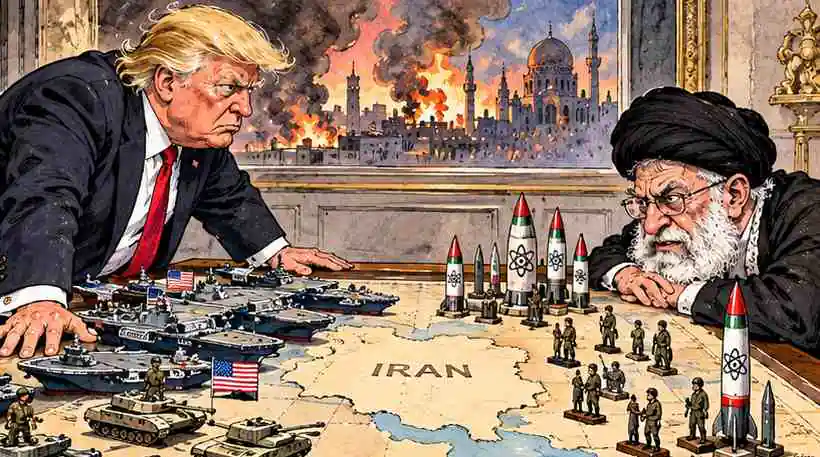
The facts: Israel has told America that Iran has drawn up a fresh plan to kill Donald Trump. America has responded by rerouting an aeroplane through a Suffolk airbase best known, until Tuesday, for absolutely nothing. Everything, we are assured, is fine.
“If I Go, You Go” — Career Guidance, American Style
Asked about the credibility of the threat, Mr Trump offered what can only be described as a masterclass in workplace reassurance: “I have a threat all the time. I’m number one on their list, before you. But if I go, you go. So, perhaps — perhaps some of you want to change professions.” One imagines an HR department somewhere quietly updating its exit-interview template to include the phrase “mutual assured departure.”
Nigel, doing the working-men’s-club circuit out of Ipswich, put it thus: “Only the Americans could turn ‘you might die’ into a motivational seminar. Over here we just say ‘mind how you go’ and put the kettle on.” The room nodded solemnly into its bitter.
The Plane That Cried Wolf, Twice, With Receipts
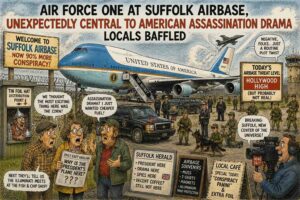
The President, homeward bound from the NATO summit in Ankara, apparently swapped his brand-new Qatari-gifted jumbo for an older model somewhere over Europe, parking the shiny one at RAF Mildenhall while he took the scenic route in the spare. This is, in fact, the second time this trick has been pulled — a 2024 campaign stop reportedly used a decoy plane belonging to a since-appointed envoy, with staff apparently only twigging the boss had switched aircraft when they clocked his empty window seat. Twice now, the aeroplane has performed the role of body double in a production nobody asked for.
The White House communications director then explained the swap wasn’t about safety at all, but strategy: “We use every tool at our disposal — including distraction and misdirection.” One is reminded of the great British tradition of insisting the burnt toast was “meant to be like that” — except here they’ve also filed a press release confirming it.
Independent costings on the new jet’s rush-job retrofit range from roughly £300 million to £700 million, reportedly borrowed in part from a nuclear-missile modernisation budget, delivered in under a year for a job that normally takes two. A commendable pace, assuming the missile countermeasures actually made it aboard rather than being left, as it were, at the gate.
Rutte Cheers From the Touchline
NATO Secretary General Mark Rutte, never one to miss an opportunity for enthusiastic agreement, declared the American strikes “absolutely necessary” — the diplomatic equivalent of clapping loudly from the stands while somebody else does the actual running, then taking a modest bow regardless.
The Ghost at the Top
In Tehran, Iran’s new Supreme Leader is said to be governing largely by written memo, having not appeared in public since the strike that reportedly disfigured him — a leadership style one might call government by spoonerism, in that nobody is entirely sure who’s holding the pen. It makes for a droll contrast: one head of state ranking his own murder threats like a chart position on breakfast television, the other apparently running a nation from behind a filing cabinet.
A Vape Pen, A Napkin, And The Limits Of Statecraft
Court footage of one alleged Iranian plotter shows him laying out his grand scheme using nothing more than a vape pen on a napkin, telling undercover agents, “This is the target. How will it die?” — before accepting a modest advance and confirming, when told “now we’re bonded,” a simple “yes.” It rather undercuts the menace of six-day funerals and English-language death chants to learn the actual operational planning meeting could have taken place in a Wetherspoons.
Blinds Down, Britain
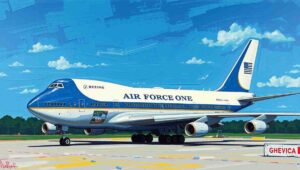
Reporters travelling with the President were reportedly told to keep their window blinds shut — for their own good, naturally, “because you’re, you know, probably on a dangerous flight, because of the sleazebags that we have to deal with.” Whether “sleazebags” referred to Iran, the press pool, or the general concept of Tuesday remains, as ever with this administration, a fine anagram of clarity — all the same letters, none of the sense.
Meanwhile the underlying intelligence that started all this remains, depending on the official, either urgently specific, politely vague, or — in the words of one Washington analyst — “more aspirational than operational,” which is roughly how the British describe most New Year’s resolutions.
And so Suffolk finds itself, however briefly, backdrop to a genuine international incident — somewhere between a NATO summit and a funeral procession, with a runway doing far more work than any RAF press officer signed up for. The locals, one assumes, will simply put the kettle on and carry on, which remains the only sensible national response available.
Sources: The Times of Israel, The Daily Beast, CNN, Axios
For the American telling of the same story — considerably more Miami, considerably less tea — see our sister publication Bohiney.com.
Auf Wiedersehen, amigo!

10 Observations on the Plan To Confuse Iran
1. The plan was so secret even the explanation had to queue outside its own press briefing.
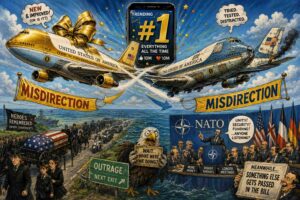
The White House says the aircraft swap was designed to confuse Iran, which is impressive because it first confused reporters, then allies, then aviation experts, then half of Suffolk, then finally wandered into the press room wearing a lanyard marked “classified vibes.”
2. “Distraction and misdirection” is what Westminster calls a Tuesday.
In America, it is a daring anti-assassination tactic. In Britain, it is what happens when a minister is asked where the money went and suddenly starts talking about apprenticeships in Wolverhampton.
3. The strategy appears to be stealth by administrative fog.
Old stealth technology hides from radar. New stealth technology hides inside contradictory explanations, a communications statement, a patriotic photo opportunity, and one sentence so vague it could have been written by the Department for Levelling Up.
4. This was not a flight plan. It was a parliamentary answer with wings.
Nobody quite knows what happened, nobody can explain why it happened, and the official response somehow includes both “security” and “magnificent.” In Britain, that would be sent to committee, renamed “Air Mobility Resilience,” and delayed until 2038.
5. The shell game at 40,000 feet now has an RAF tea service.
Two giant presidential jets shuffled over Europe like cups on a pavement in Leicester Square, except this time the walnut was democracy, the dealer had nuclear codes, and the spectators at RAF Mildenhall were wondering whether anyone had put the kettle on.
6. The plane swap was both an anti-assassination tactic and a military show-and-tell.
That is the genius. One explanation says “deadly serious national-security manoeuvre.” The other says “magnificent jet for the troops.” It is the first military doctrine jointly authored by the Secret Service and a man unveiling a restored Jaguar at a village fête.
7. Iran was supposedly confused, but so was everyone in a blazer within 500 miles.
Enemy radar operators may have been baffled, but so were journalists, pilots, retired intelligence officials, and every British local councillor who saw two Air Force Ones and immediately wondered if either required a parking permit.
8. Somewhere in Tehran, a radar crew allegedly asked whether the Americans had introduced devolution.
“Sir, there are two presidential planes.”
“Which one has the president?”
“The statement says distraction.”
“What does that mean?”
“It means we wait for The Telegraph to explain it with a map.”
9. Suffolk locals handled the crisis in the traditional British manner: bafflement followed by tea.
Two enormous American presidential aircraft appeared, vanished, swapped, or possibly emotionally rebranded themselves, and the local response was almost certainly, “That’s odd,” followed by a biscuit and a quiet complaint about noise.
10. The final proof of success is that no one understands whether it succeeded.
No Iranian official has admitted being confused, which the White House appears to treat as evidence of devastating confusion. By that logic, Britain’s rail timetable is not broken. It is conducting psychological warfare against commuters.

Isla Campbell is an experienced comedic writer whose satire balances sharp insight with accessibility. Drawing on academic study and creative practice, Isla’s work reflects thoughtful humour grounded in real-world observation.
Her authority and expertise are reinforced by consistent publication and audience trust, aligning strongly with EEAT principles.