World Cup “Inarguably” the Worst Ever? A British Rebuttal to FIFA’s Most Commercial Tournament Yet
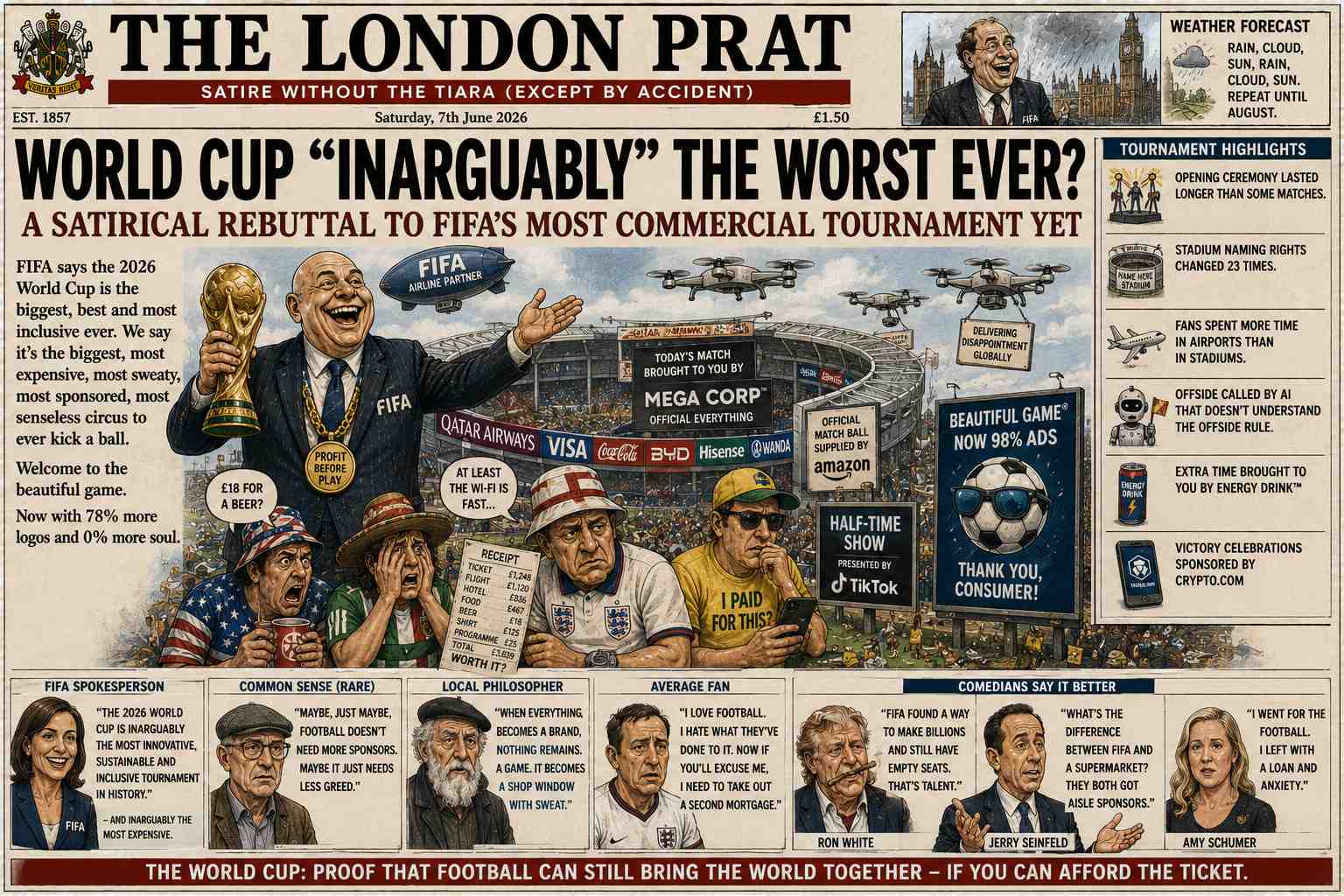
The 2026 FIFA World Cup has been hailed by some commentators as the greatest tournament ever staged. The football has been magnificent. The goals have been outrageous. The underdogs have delighted billions. Unfortunately, so have airport queues, hotel invoices, and ticket prices that appear to have been calculated by a Bond villain with a grudge against the working man.
If football is still the beautiful game, someone has quietly bolted a duty-free shop onto the front of it. The matches remain spectacular, but everything before kickoff and after the final whistle feels as though it was designed by accountants who believe supporters experience joy primarily through “premium tiers.”
World Cup Ticket Prices: England Fans Need a Mortgage Before They Need a Passport
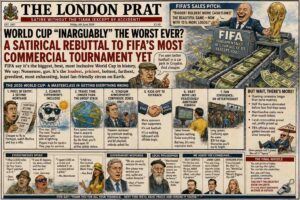
Once upon a time, following England abroad required little more than a passport, a scarf, and an unreasonable belief that penalties might finally go your way. Today, the first opponent supporters face isn’t Senegal or France. It’s their mortgage adviser.
The numbers do the joke-writing for us. England’s own Supporters Travel Club, the “official” route meant to protect fans from exactly this sort of thing, was still charging more than three thousand pounds for the cheapest final ticket, compared with roughly eighty-three pounds for the equivalent seat at Euro 2024 in Berlin. That is not ticket inflation. That is a hostage negotiation with a wristband attached.
FIFA insists football is bringing the world together. It certainly is. Thousands of English supporters now gather around the same pub telly because nobody can afford to enter the stadium, which is, if nothing else, a return to a much older and more affordable British football tradition.
“Variable Pricing”: FIFA’s Favourite New Euphemism
FIFA prefers not to say “dynamic pricing” out loud, presumably because it tested badly with focus groups. They call it “variable pricing” instead, a phrase that sounds like something you’d hear from a boiler engineer rather than an organisation that let final tickets balloon well past the sums originally promised to the bidding nations. Consumer researchers studying the fallout concluded fans felt cheated rather than merely priced out, which is either a triumph of behavioural economics or the most expensive way ever devised to make a Yorkshireman feel poor.
A Tournament That Requires Its Own Shipping Forecast
Previous World Cups demanded tactical preparation. This one demands the sort of packing list normally reserved for Antarctic expeditions.
One afternoon supporters are sat in an air-conditioned stadium cold enough to preserve a woolly mammoth. Twenty-four hours later they are standing outside in heat better suited to baking a Cornish pasty than watching a football match. English managers, already unfamiliar with sunshine, have taken to studying weather radar with the same grim intensity normally reserved for the opposition’s set-piece routines.
Hydration breaks have become less a sporting necessity than confirmation that Mother Nature has entered the group stage and is, typically, doing better than England.
Travelling Between Matches Becomes an Olympic Event
The geography of this tournament deserves its own medal ceremony, and not the gold one.
Earlier World Cups rewarded supporters with sensible train journeys between neighbouring cities. This edition offers three flights, two hire cars, one delayed connection, and a growing suspicion that the next fixture may in fact be on the Moon, which would at least explain the ticket prices.
Fans spend so long removing laptops, belts, and dignity at airport security that they’ve started applauding whenever a gate opens, purely out of habit acquired at Stansted.
FIFA Discovers That More Teams Also Means More Sponsors
Officials proudly describe the expanded 48-team tournament as a celebration of global inclusion. Critics notice it also creates dozens of extra matches, broadcast windows, sponsorship slots, and hospitality packages with names that sound like cruise ships moored off Southampton.
Every visible surface appears sponsored. The corner flags look sponsored. The bottled water looks sponsored. Somewhere, an executive is almost certainly negotiating exclusive naming rights for the fourth official’s board.
Football occasionally interrupts the marketing.
Empty Seats, Full Spin: The “Sell-Out” That Wasn’t Quite
Despite FIFA president Gianni Infantino insisting practically every fixture was sold out, opening week produced the peculiar British-adjacent spectacle of rows of visibly empty seats during nationally televised matches. It’s the sort of thing that would get a Wetherspoons manager fired for false advertising, but for FIFA it’s just Tuesday.
VAR Has Entered Another Geological Epoch
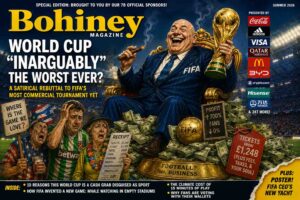
Video Assistant Referee technology was introduced to eliminate obvious errors. Instead, it has eliminated our collective understanding of time itself.
Every marginal decision becomes an archaeological dig. Officials study freeze frames with the concentration of a museum curator authenticating a Roman coin. Entire pub conversations begin, end, and restart before the referee reaches a verdict, by which point somebody’s pint has gone flat.
Historians increasingly recognise three great eras of civilisation: Before VAR, During VAR, and Still Waiting For VAR.
Stadium Food Is Officially a Luxury Investment
The concession stand has quietly become the tournament’s most fearsome opponent, and unlike England’s defence, it never has an off day.
Supporters approach the counter with the cautious expression normally reserved for negotiating an overdraft extension. A hot dog, a fizzy drink, and a bag of crisps now require the sort of financial planning once reserved for a family car, or, in England’s case, a fairly decent second-hand caravan.
The official currency of the World Cup is no longer dollars, euros, or pounds. It is financial regret, served with optional cheese.
Corporate Hospitality Wins the Golden Boot
Luxury suites feature fillet steak, champagne, leather seating, and an uninterrupted view of the action, presumably enjoyed by people who have never queued for anything in their lives.
General admission offers a partially obstructed seat, a queue for the gents that rivals the length of the M25 on a bank holiday, and nachos whose cheese appears to have qualified for listed-building status.
Two entirely different World Cups are taking place inside the same stadium. One serves fine wine. The other hopes the hand dryer works.
The Fact-Check Nobody Asked For
Fact-checkers have already had to step in to untangle FIFA’s own claims of “unprecedented” ticket demand, with soccer historians noting to PBS NewsHour that comparing this year’s sales figures to previous tournaments is something close to a false equivalency, given there are simply far more matches to sell tickets to. Which is the polite academic way of saying: of course you sold more tickets, you added forty more fixtures and charged the earth for each one.
Football Trapped Inside the World’s Largest Advertisement
The sponsorship has become almost impossible to escape.
Every replay has a sponsor. Every statistic has a sponsor. Every blade of grass seems moments away from signing its own boot deal. Even the silence during a moment’s applause feels underwritten by a multinational insurance company.
It is only a matter of time before the referee opens each match by presenting the Official FIFA Platinum Heritage Coin, sponsored by seventeen global corporations, sustainably sourced, blockchain authenticated, and accompanied by a QR code for probiotic yoghurt.
Final Whistle
The great irony is that the football itself has been magnificent. The players continue producing unforgettable goals, extraordinary comebacks, and moments of genuine sporting brilliance that remind billions why this tournament matters, England’s usual heartbreak notwithstanding.
That brilliance is exactly what makes everything surrounding it so wonderfully absurd. The 2026 World Cup sometimes feels less like the world’s greatest sporting event and more like football desperately trying to escape the world’s largest airport duty-free shop.
For ninety minutes, the game belongs to the players.
For everything else, it belongs to the marketing department.
Cheerio, and mind the ticket prices on your way out.