
Britain Offers to Send a Strongly Worded Letter and One Mine-Hunting Drone to the Strait of Hormuz
By Our Defence Correspondent, who is hiding under a desk in Whitehall
The United States has asked Britain, France, Germany, Japan, China, South Korea, Australia, and essentially everyone with a boat to deploy warships to the Strait of Hormuz immediately. Britain has responded by announcing it is “intensively looking” at the situation, which in diplomatic terms means Keir Starmer has found a very comfortable chair and intends to remain in it.
The proposal, now emerging with some urgency from Washington, is elegant in its ambition: ships wishing to receive a U.S. Navy escort through the world’s most dangerous shipping lane will be required to first purchase war risk insurance from the U.S. Development Finance Corporation — a federal agency previously best known for lending money to build roads in Rwanda. President Trump has thus created, in the middle of an active shooting war, both a naval protection racket and a government insurance subsidiary. Lloyds of London is believed to be weeping quietly into its underwriting ledger.
Keir Starmer Explains What Britain Will Not Be Doing, SOON!
Asked by reporters whether the United Kingdom would be joining a naval coalition to escort oil tankers through a waterway upon which approximately 20 percent of the world’s energy supply depends, Prime Minister Starmer delivered one of the most exquisitely calibrated statements in recent British political history.
“Let me be clear,” he said, with the measured tone of a man who has spent considerable time being clear about very little. “That won’t be, and it’s never been envisioned to be, a NATO mission. We will not be drawn into the wider war.”
Britain would, however, be prepared to consider deploying its mine-hunting drones. These are drones. That hunt mines. In a strait Iran has reportedly been seeding with mines. The Ministry of Defence confirmed that the drones are “assets already in the region,” which is the institutional equivalent of pointing out that you do have a plaster, though it won’t help with the arterial bleeding.
Energy Secretary Ed Miliband assured the nation that the government was “intensively looking with allies at what can be done.” France has said it will only consider escorts after the war ends. Germany has said it will not participate “so long as the war continues.” Britain has said it will not be “drawn in,” which splits the difference by not saying anything at all. Between the three of them, they have produced enough diplomatic hedging to insulate a mid-sized semi-detached in Basingstoke.
America’s Slight Capacity Problem
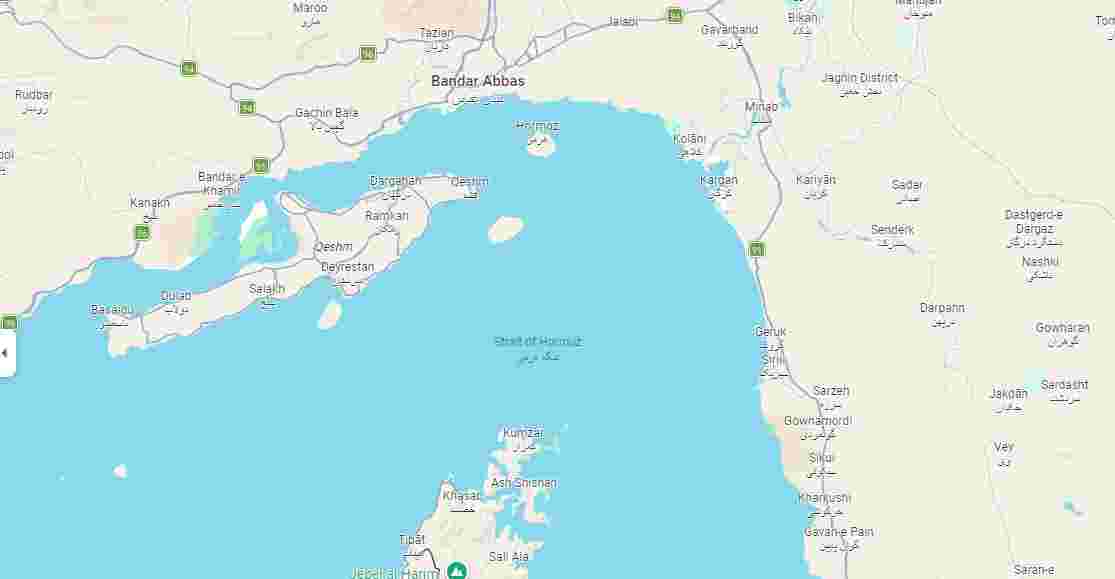
Adding a degree of texture to the situation, the U.S. Navy has itself acknowledged it does not currently have the vessels available to escort ships through the Strait of Hormuz, which, as anyone with a maritime atlas will confirm, is approximately 21 miles wide at its narrowest point — just large enough for a supertanker and not quite large enough for a supertanker and a destroyer and an incoming Iranian drone.
Washington has nine guided-missile warships in the Arabian Sea, three Littoral Combat Ships in Bahrain, and a carrier strike group simultaneously conducting Tomahawk strikes on Iran. Military analysts estimate that a single convoy requires between seven and ten destroyers to provide adequate air cover. The arithmetic, as one unnamed naval official apparently noted before being told to stop doing arithmetic in public, is not straightforward.
President Trump has nonetheless announced that “numerous countries have told me they’re on the way,” declining to specify which countries, or indeed, on their way from where. Secretary of State Marco Rubio has been tasked with making a formal announcement. The nation waits.
The Insurance Scheme Nobody Asked For
The DFC insurance programme raises questions that Washington has not yet answered. What is the premium? How does it compare to the private market, which stopped insuring ships in the Persian Gulf the moment the shooting started? Has the DFC ever insured anything in an active combat zone? Is “development finance” a term that naturally encompasses wartime maritime underwriting?
Salar Ghahramani of Penn State University noted with academic restraint that “how much insurance premium is charged may indicate the level of risk the DFC sees” in the region. This is the geopolitical equivalent of reading the small print and noticing the clause about thermonuclear exclusions.
Meanwhile, crude oil is hovering around $100 a barrel. About 1,000 tankers are anchored outside the Strait, going nowhere. India has invoked emergency powers to protect 333 million households dependent on cooking gas. The Centre for Strategic and International Studies has warned that global food security is at risk due to fertiliser supply chain disruption. The UN humanitarian chief has said “millions of people are at risk.”
Britain is “intensively looking” at all of this.
Rachel Reeves Expresses Frustration, Which Is Something
Chancellor Rachel Reeves told journalists that the absence of any concrete plan to reopen the Strait of Hormuz was “frustrating.” This is the most direct statement to emerge from Whitehall since the crisis began, and it represents a significant escalation from “intensively looking.” Reeves did not elaborate on what, beyond frustration, she intended to do about a waterway controlled by Iran, contested by the U.S. Navy, and apparently guarded by mine-hunting drones.
Foreign Secretary David Lammy, who was briefly spotted in Brussels, has not yet confirmed whether the United Kingdom’s diplomatic position is (a) studied neutrality, (b) alarmed helplessness, or (c) both simultaneously, which is the traditional British foreign policy configuration whenever something extremely serious happens in a place that used to be on the Empire’s maps.
What Happens Next
Iran’s new acting Supreme Leader, Mojtaba Khamenei — son of Ayatollah Ali Khamenei, who was killed on the first day of the U.S.-Israeli strikes — has indicated the Strait will remain closed as leverage during the conflict. The IRGC has struck oil tankers, Kuwaiti port facilities, Omani alternative routing infrastructure, and a fuel depot at Dubai International Airport. Iran’s Foreign Minister says the Strait is open to anyone who isn’t American or Israeli, a category that, inconveniently, covers most of the world’s major shipping lines.
Trump, boarding Air Force One, told reporters: “Whether we get support or not — we will remember.” He did not elaborate on what form this remembering would take, though given recent trends, it will almost certainly involve a Truth Social post and a tariff.
Britain, for its part, will continue to look. Intensively.
As Rory Bremner once observed about British foreign policy: “We always know exactly what we should have done. About three weeks later.”
Auf Wiedersehen, amigo!
The Strait of Hormuz crisis erupted on 28 February 2026, when the United States and Israel launched Operation Epic Fury — a sustained military campaign of strikes against Iran’s military, nuclear and naval infrastructure. Iran responded by closing the Strait of Hormuz to vessels from the U.S., Israel and their allies, triggering the worst disruption to global oil and gas supplies since the Arab oil embargo. Approximately 20 percent of the world’s oil and significant volumes of liquefied natural gas and fertiliser precursors transit the Strait annually. The U.S. Development Finance Corporation — normally a foreign-aid lending institution — has been pressed into service as a maritime war risk insurer, while the Trump administration has called on allies including the UK, France, Germany, Japan, China, South Korea and Australia to send warships. All have declined or expressed serious reservations. UK Prime Minister Keir Starmer has ruled out a NATO mission while indicating the UK may deploy mine-hunting drone assets already in the region. Oil prices have risen 40–50 percent since the conflict began. Mojtaba Khamenei, son of the slain Supreme Leader, has signalled the Strait will remain closed as a negotiating lever.
SOURCES:
https://bohiney.com/worlds-first-war-zone-insurance-company/
https://appledaily.uk/strait-of-hormuz-naval-escorts/

Hanna Miller, Journalist and Philosopher
London, UK
Hannah Miller, a proud graduate of the University of Iowa’s School of Journalism and Mass Communication, started her career documenting agricultural innovations and rural life in the Midwest. Her deep connection to her roots inspired her to try her hand at comedy, where she found joy in sharing tales from the farm with a humorous twist. Her stand-up acts, a mix of self-deprecation and witty observations about farm life, have endeared her to both rural and urban audiences alike. She is a four-year resident to London and the UK.



My kid asked if this was real. I said “sort of.” She accepted that. That’s the right answer for anything about London.
A voter said “The London Prat is spot on. You council people are incompetent morons. Stop pretending.”
My mate’s in the civil service. I’m not showing him this. He’s got enough problems.