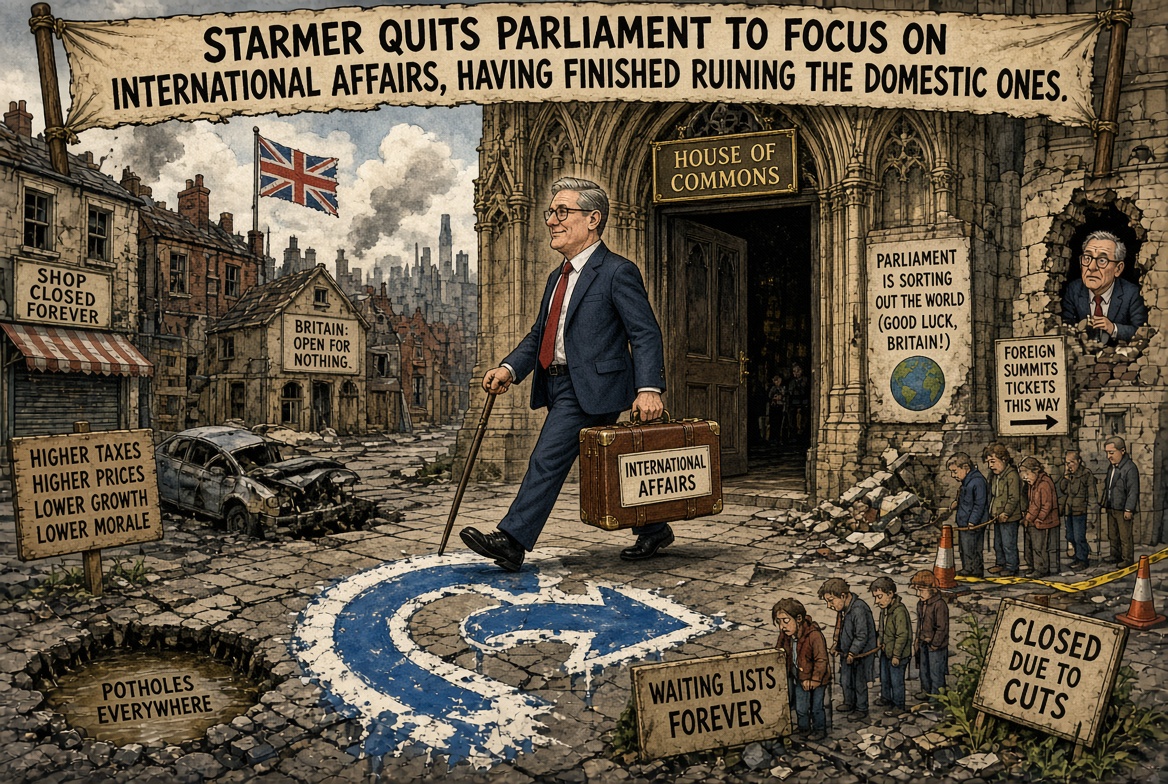
Starmer Quits Parliament to Focus on International Affairs, Having Finished Ruining the Domestic Ones
Former prime minister performs final U-turn out of the Commons as Andy Burnham praises the government’s strong momentum and taxpayers prepare to finance the getaway
LONDON — Sir Keir Starmer has announced that he is leaving Parliament to concentrate on international affairs, having surveyed domestic Britain and concluded that there was nothing left requiring damage. The former prime minister had previously promised to remain MP for Holborn and St Pancras until the next general election, but has now performed a final U-turn directly out of the House of Commons.
Starmer Quits Parliament With One Last Reverse Gear
Starmer says he intends to work on defence, security, trade and technology in a rapidly changing world. These are all areas in which foreign countries still possess functioning examples, making overseas work considerably more convenient. He told the Camden New Journal that after eleven years representing the constituency it was the right moment to pass the baton to a successor.
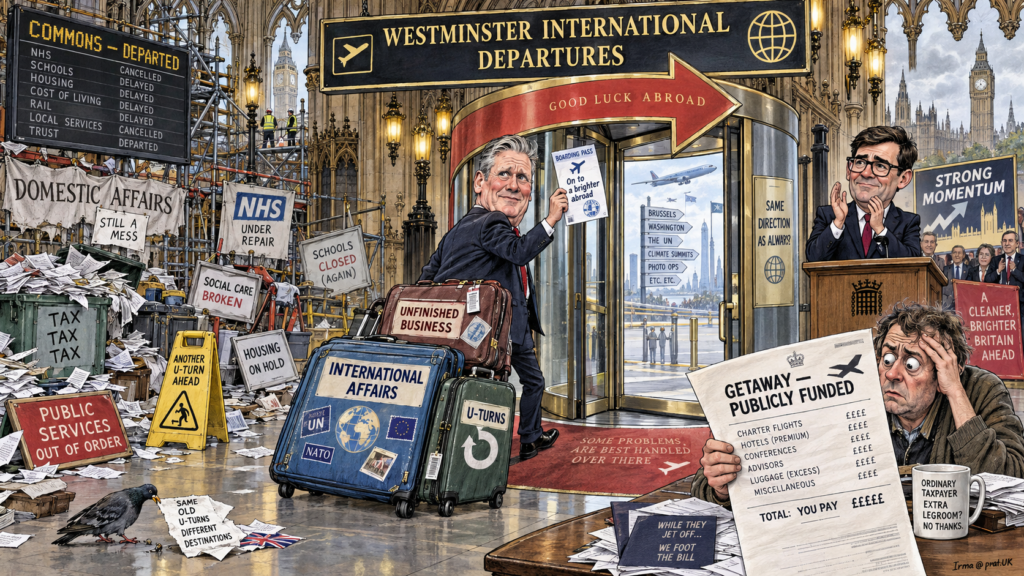
“I have solved Britain to the full extent permitted by the warranty,” Starmer reportedly told aides while reversing a removal van down Whitehall. “It is time to bring my proven combination of caution, consultation and sudden abandonment to nations that have not yet experienced it.”
The announcement follows his departure from Downing Street at the end of July. At that time, Starmer assured constituents that he would remain their MP. Political scientists define a Starmer assurance as a firm declaration of intent made during the brief administrative interval before circumstances, colleagues or lunchtime change it.
A U-turn is normally understood as a 180-degree change in direction. Under Labour’s revised Highway Code, however, it is described as forward-facing policy renewal with enhanced rearward momentum.
Conservative party chairman Kevin Hollinrake observed that it was fitting for a man who pledged to stay to leave by reversing. This is the rare case of an opposition attack landing so accurately that it qualifies as a public service announcement.
Burnham Discovers Momentum The Moment Starmer Quits Parliament
Prime Minister Andy Burnham praised his new government for establishing a strong sense of momentum, a claim immediately confirmed when Starmer shot past the Cabinet Room carrying two boxes, a laptop and the remaining credibility of the 2024 manifesto.

Burnham says the British public has noticed a change of pace. This is correct. Bills arrive sooner, trains are cancelled earlier and governments now collapse before voters have finished learning the names of the ministers.
Downing Street has unveiled a six-point positivity strategy consisting of optimism, hope, local levers, good growth, additional optimism and a photograph of Burnham looking determined beside infrastructure someone else paid for. The prime minister, who has spent six weeks touring the country before facing a single question in the Commons, is expected to argue that greater public control of water, energy and transport will drive growth. Britain last tried this and produced a decade of paperwork, three inquiries and a canal.
“The country wants hope,” a government spokesperson explained. “Fortunately, hope does not appear in the Treasury accounts and can therefore be offered without a spending review.”
The economic background is less buoyant. Long-term government borrowing costs have reached their highest level since March 1998, with the 30-year gilt yield pushing past 5.88 per cent, while official figures show public borrowing reached £56.7 billion in the financial year to July, some £2.3 billion above forecast, according to the Office for National Statistics public-finance figures.
Treasury officials nevertheless insist that the high cost of borrowing proves lenders remain strongly interested in Britain, much as bailiffs demonstrate sustained interest in your furniture.
“Markets are displaying tremendous confidence,” said one official. “They are confident enough to demand considerably more money.”
Burnham has also promised to unlock a feeling of positivity and possibility in every part of the country, alongside a £2 bus fare cap, VAT removed from energy bills and a second Downing Street in Manchester. Critics call No 10 North an expensive gimmick. Supporters call it decentralisation. Taxpayers call it two of everything and one of the money.
Constituents Receive One Final Invoice Because Starmer Quits Parliament
Starmer’s resignation triggers a byelection in Holborn and St Pancras, where he previously held a majority of 11,572. Residents will now enjoy the privilege of paying for a democratic replacement after their last representative changed his mind about representing them.
Labour described the byelection as an exciting opportunity for local voters to select another first-class candidate capable of promising to remain in the job until an attractive international foundation telephones.
The Conservatives called the resignation another costly U-turn. This criticism was welcomed as expert testimony from Britain’s most experienced manufacturer of costly U-turns.
Green Party leader Zack Polanski is understood to be weighing a run at the seat. His proposed campaign will recycle Labour leaflets, compost Starmer’s promises and replace the abandoned constituency office with a bicycle lane leading directly to a podcast studio.
A Prat Institute survey of 1,002 local residents found that 61 percent wanted an MP who would complete a full term, 24 percent wanted lower rent, and 15 percent asked whether the pollster could move because he was blocking the Tube entrance.
“This is democracy at its most advanced,” said café owner Margaret Wilkes, an eyewitness to three Labour activists measuring her front window for posters. “We vote for someone, he leaves, and then we pay to vote again. It is like a subscription service where the only programme is disappointment.”
Taxi driver Colin Mercer said he saw Starmer’s official car turn left, signal right and continue straight ahead.
“That,” Mercer explained, “is the first time I’ve seen his entire premiership performed at one junction.”
A Commons doorman confirmed that the former prime minister surrendered his parliamentary pass but asked whether it remained valid at international conferences, television studios and airports with executive lounges.
American tourist Debbie Walker witnessed the departure and expressed admiration for British efficiency.
“In our country, politicians spend years pretending they aren’t leaving for a consultancy,” she said. “Your guy has luggage.”
Passing The Baton: Starmer Quits Parliament And Keeps The Receipt
Starmer says he is ready to pass the baton to a successor. This sporting analogy has reassured the country, except for the discovery that Britain is competing in a relay race against compound interest.
Professor Alan Nafzger, a local philosopher observing events from a pub that accepts both cash and declining government bonds, offered a deductive explanation.
“If Starmer promised to stay and then left, the promise was temporary,” Nafzger said. “If every promise is temporary, the only permanent Labour policy is departure. Therefore Burnham’s government truly has momentum, although nobody has established whether it is heading toward prosperity or the Channel.”
The baton itself was last seen outside the Treasury, where officials were attempting to have it valued as a national asset.
Three comedians responding to the resignation reached similar conclusions. One said Starmer was focusing on foreign affairs because domestic affairs had blocked his number. Another said he had not abandoned his constituents, he had merely given them the freedom to find someone new. The third observed that Parliament should install revolving doors, because Labour’s current exits are placing unacceptable pressure on the hinges.
Circuit veteran Dickie Pemberton put it more plainly at a Camden club on Monday night. “He didn’t resign,” Pemberton said. “He Starmered off.”
A Helpful Guide For Taxpayers Now That Starmer Quits Parliament
Citizens wondering how to prepare for the byelection have been advised to take several practical precautions.
First, keep your wallet accessible. Democracy remains free at the point of voting but increasingly expensive at every other point.
Second, read each candidate’s promise to serve a full term. If the sentence contains the words absolutely, categorically or for the avoidance of doubt, begin planning the next byelection immediately.
Third, ask whether the candidate intends to focus on international affairs. This phrase traditionally means the politician has located an organisation overseas willing to provide an office, a title and fewer constituency surgeries.
Finally, remain positive. Burnham has specifically requested it, and positivity may soon become compulsory for anyone questioning tax rises, prison releases or why national prosperity requires another communications unit.
Britain’s New Export Industry After Starmer Quits Parliament
Starmer’s pivot abroad represents an important opportunity for British trade. The country may no longer export enough cars, steel or manufactured goods, but it retains a globally competitive surplus of former prime ministers offering advice.
Foreign governments can now purchase the complete Starmer package: strategic patience, managerial vocabulary, a carefully costed plan and an unexpected announcement that the plan has changed.
The Department for Business is reportedly developing an export label reading: “Designed in Britain. Reconsidered without notice.”
Burnham, meanwhile, will continue unlocking positivity while Chancellor John Healey searches behind the Treasury sofa for the defence budget. Labour officials say the new government has turned the page, although taxpayers have noticed it remains the same book and somebody has increased the cover price.
Starmer departs insisting that public service has been an honour. His constituents will mark that honour with a fresh campaign, another polling day and one final invoice.
Britain therefore says goodbye to a former prime minister who promised to remain, remained long enough to repeat the promise and then left to advise the world.
International affairs has been warned.
Fifteen Humorous Observations On The Day Starmer Quits Parliament
- Starmer says he will focus on international affairs because Britain has apparently been completed and may now be left unattended.
- He promised to remain an MP until the next election, demonstrating that a Starmer pledge carries the same warranty as a seaside umbrella.
- Andy Burnham says the government has strong momentum. Starmer has supplied most of it by running through the nearest exit.
- Labour calls this a transition. Ordinary people call it leaving before the bill arrives.
- Starmer wants to pass the baton, although the British economy appears to have been using it as a walking stick.
- The former prime minister now plans to advise foreigners, proving Britain still exports things it no longer wants at home.
- Holborn and St Pancras gets a byelection, allowing taxpayers to purchase another politician without receiving a refund on the previous one.
- Starmer’s final parliamentary act is a U-turn, providing satisfying narrative symmetry for anyone who stopped expecting policy consistency.
- Government borrowing costs have reached a 28-year high, but Downing Street says national optimism remains completely interest-free.
- Burnham wants to unlock positivity, presumably after Labour accidentally locked it in a cupboard during the election campaign.
- Starmer leaves domestic politics to pursue defence, security and trade abroad, three subjects Britain had hoped he might practise before exporting his expertise.
- Labour insists the country has noticed its change of pace. It has: everything is becoming unaffordable much faster.
- The Greens may contest Starmer’s seat, hoping to recycle both the constituency and Labour’s abandoned promises.
- Starmer leaves behind ten breakfast clubs, thousands of disappointed voters and one enormous lunch bill marked public.
- Britain has finally discovered a renewable source of political energy: prime ministers revolving through the door.
Sir Keir Starmer confirmed on Tuesday that he is standing down as MP for Holborn and St Pancras, telling the Camden New Journal that after eleven years it was time to concentrate on international affairs including defence, security, trade and technology, along with continued work on violence against women and girls. He resigned as prime minister in July and was succeeded by Andy Burnham, who took office on 20 July and faced the Commons for the first time on the same day Starmer announced his exit. The resignation triggers a byelection in the central London seat, where Green leader Zack Polanski is considering a run, and it lands as 30-year gilt yields hit their highest level since March 1998 ahead of the October Budget. Conservative party chairman Kevin Hollinrake described the departure as a final U-turn.
Sources
- The Guardian politics live blog, 1 September 2026
- Former UK prime minister Keir Starmer to stand down as MP to focus on world affairs
- Associated Press: UK leader Burnham faces lawmakers for first time since taking office
- The London Economic: what Burnham will tell Parliament
- GB News: borrowing costs rise to highest level since 2008
- CNBC: global bond yields soar to multi-decade highs
- Office for National Statistics public sector finances, July 2026
Disclaimer
This is British satire, produced in London by people who believe UK satirical news should cost the taxpayer nothing and the powerful quite a lot. Quotes, surveys and eyewitnesses in this satirical journalism are comic inventions. Any resemblance to a stable government is purely the result of poor eyesight.
Across the Atlantic, our American cousins are covering their own revolving doors at Bohiney.com.
Auf Wiedersehen, amigo!

Alan Nafzger was born in Lubbock, Texas, the son Swiss immigrants. He grew up on a dairy in Windthorst, north central Texas. He earned degrees from Midwestern State University (B.A. 1985) and Texas State University (M.A. 1987). University College Dublin (Ph.D. 1991). Dr. Nafzger has entertained and educated young people in Texas colleges for 37 years. Nafzger is best known for his dark novels and experimental screenwriting. His best know scripts to date are Lenin’s Body, produced in Russia by A-Media and Sea and Sky produced in The Philippines in the Tagalog language. In 1986, Nafzger wrote the iconic feminist western novel, Gina of Quitaque. He currently lives in Holloway, North London. Contact: [email protected]