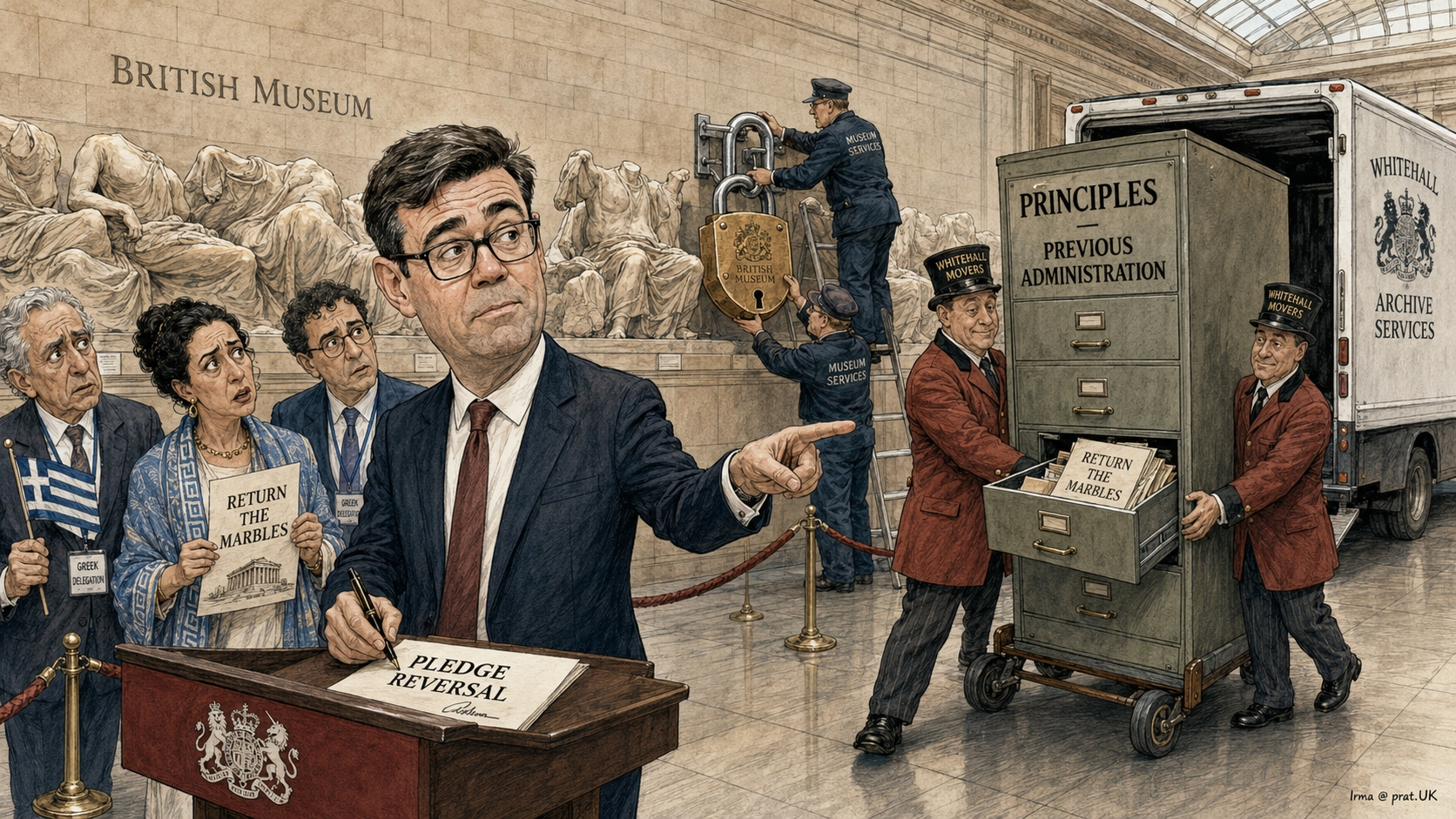
Andy Burnham Abandons Pledge to Return Parthenon Marbles, Says His Principles Belong to Previous Administration
Prime Minister Completes the First Major Restoration of His Political Flexibility While Greece Is Offered a Long-Term Loan of Burnham’s 2023 Parthenon Marbles Opinion
LONDON — Prime Minister Andy Burnham has reversed his support for returning the Parthenon Marbles to Greece after government experts discovered that statements made before entering Downing Street are not legally classified as promises.
Burnham declared in 2023 that the sculptures should be sent back with no strings attached. Now prime minister, he says the matter ultimately rests with the British Museum, an institution whose trustees possess the rare constitutional power to become entirely independent whenever a politician needs somewhere to leave a difficult decision.
“It is not a reversal,” explained a Downing Street official. “The prime minister still passionately believes everything he believed in 2023. He simply no longer supports doing any of it.”
The official described Burnham’s position as dynamic ethical continuity, defined as continuing to own a principle while ensuring it never reaches the dangerous stage of becoming policy.
Parthenon Marbles Pledge Goes From No Strings to the Entire British Rope Department
Burnham’s original position could scarcely have been clearer. As mayor of Greater Manchester, he said the Marbles should be returned permanently and without conditions. He had the confidence common to politicians discussing objects located 200 miles outside their jurisdiction.
Once inside Downing Street, however, no strings became trustees, statutes, diplomatic considerations, unintended consequences, cultural partnerships, conservation assessments and a working group expected to report shortly after the Acropolis has eroded naturally into the Aegean. The government did not cut the strings. It simply promoted them to stakeholders.
The government now points to the British Museum Act 1963, which sharply restricts the museum’s power to dispose of objects. This is an especially convenient obstacle because Parliament possesses no known constitutional mechanism for changing an Act of Parliament.
Legal scholar Sir Crispin Folder told reporters that Westminster could theoretically amend the law, but doing so would establish a dangerous precedent under which elected governments might be expected to govern.
“The British constitution is based on parliamentary sovereignty,” Folder explained. “Parliament may make or unmake any law, except one that could embarrass the prime minister before lunch.”
The case is particularly awkward because Burnham was among seven MPs who introduced legislation in 2002 that would have amended the 1963 Act. At the time, he apparently believed Parliament could alter legislation. Twenty-four years of political experience have since corrected this youthful misunderstanding.
Parthenon Marbles Leadership Successfully Delegated to Trustees the Prime Minister Appoints
Burnham told the Financial Times that returning the sculptures is ultimately an issue for the British Museum. Downing Street celebrated the statement as a breakthrough in responsibility-neutral leadership.
The prime minister appoints a majority of the museum’s trustees under the 1963 Act, but officials stressed that this does not give him influence. It merely allows him to choose many of the people over whom he has no influence.
It is the political equivalent of selecting the jury, appointing the judge and then announcing that the verdict is none of your business.
The British Museum’s official Parthenon Sculptures position calls for a new partnership with Greece and says constructive discussions continue. Constructive discussions is diplomatic language for two sides building increasingly sophisticated explanations of why the meeting produced no construction.
Athens wants the surviving sculptures reunited in the Acropolis Museum’s Parthenon Gallery. London proposes lending some of them to Greece, provided Greece acknowledges British ownership. This resembles a neighbour borrowing your lawnmower, keeping it for 200 years and eventually offering to let you use it for a weekend if you sign a form confirming it belongs in his garage.
Greece Offered Burnham’s Earlier Parthenon Marbles Opinion Instead of the Sculptures
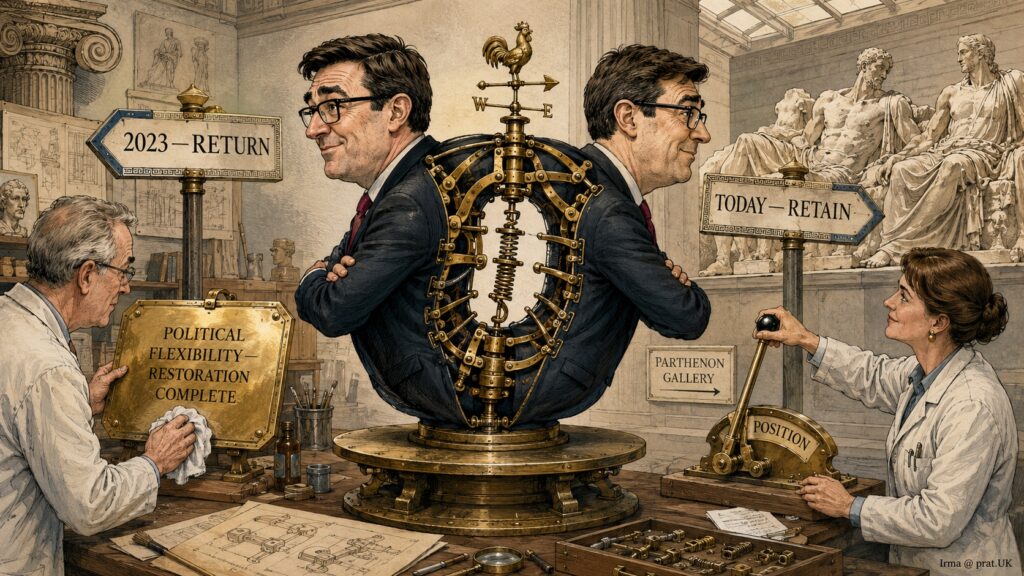
Greek officials have reportedly asked whether Britain might return Burnham’s 2023 opinion instead, reasoning that it originated in Britain, was exported without permission and now belongs to a vanished civilisation.
The proposal is being studied by conservators, who fear the position has deteriorated badly since July.
One curator described the opinion as fragile, incomplete and missing its supporting structure. Another said it could still be displayed beside other famous British promises, including affordable housing, controlled immigration and the temporary introduction of income tax.
Camden stand-up Dermot Cavanagh has been closing his set with it all month. “Andy Burnham promised to give the Marbles back, then got the top job and remembered he keeps his spine in the same cabinet as the sculptures,” Cavanagh said. “Locked, climate-controlled, and nobody can find the key.”
A survey of 1,204 London commuters conducted outside closed Underground ticket barriers found that 68% supported returning the Marbles, 21% preferred keeping them and 11% believed the Parthenon was a new Greek restaurant in Shoreditch.
Of those supporting restitution, 94% agreed Britain should return important foreign treasures, beginning with whichever ones they had not planned to visit this weekend.
“I think Greece should have them back,” said eyewitness Nigel Pritchard while leaving the museum gift shop with a miniature Rosetta Stone made in China. “Cultural property belongs in its country of origin. Anyway, I bought this.”
Tourist Evelyn Marsh offered a more traditional British argument.
“We have looked after the sculptures for two centuries,” she said. “If you leave something at our house for more than six months, legally it becomes part of the hallway.”
The Science of Political Restoration: How a Parthenon Marbles Promise Is Cleaned and Relit
Researchers at the Institute for Applied U-Turns studied Burnham’s movement from send them back, no strings to this is a matter for the trustees. They classified it as a complete ideological rotation performed without visible movement of the lips.
Lead researcher Dr Helena Pivot compared the manoeuvre to restoring an ancient statue.
“First, the politician’s original position is carefully removed,” she explained. “The embarrassing sections are cleaned away, missing qualifications are added, and the result is displayed under soft lighting as though it had always looked like that.”
According to the institute, politicians reverse positions for three principal reasons: new evidence, changing circumstances and discovering that they are now personally responsible for the consequences.
Burnham’s transformation falls into the third category, medically known as Acute Downing Street Perspective. He did not change his mind. He was simply re-housed, re-lit and re-labelled by his own curators.
Manchester residents recognised the condition immediately. Local philosopher Barry from Salford said Burnham’s values had not changed; their postcode had.
“When Andy was mayor, returning the Marbles was George Osborne’s problem,” Barry observed. “Now it’s Andy’s problem, so naturally it has become the trustees’ problem. That is the circle of political life.”
Deductive reasoning supports Barry’s analysis. Burnham supported restitution when he lacked power. He became prime minister and withdrew that support. Therefore, power has once again cured a politician of his convictions.
Parthenon Marbles Cultural Diplomacy Without the Inconvenience of Culture Moving
Burnham insists he strongly favours British cultural diplomacy. Officials say this could involve exchanges, exhibitions and photographs of leaders standing beside contested objects while describing the discussion as frank and constructive.
The government’s preferred solution may be a long-term loan. Britain would send some sculptures to Athens, Greece would lend Britain other antiquities and everyone would avoid using the word return, which can trigger severe allergic reactions in museum boards.
The arrangement would permit Britain to appear generous without surrendering ownership and allow Greece to display its own heritage without technically possessing it. Treasury officials immediately expressed interest in applying the model to taxpayers’ salaries.
Political analyst Alan Nafzger called the controversy the purest surviving example of imperial administration.
“The Greeks built the Parthenon, Elgin took the sculptures, Britain passed a law preventing their return, and Burnham blamed the people appointed under that law,” Nafzger said. “You could not design a better system unless your goal was to make responsibility itself disappear.”
Practical Guidance for Returning Parthenon Marbles You Have Kept Since 1817
Government advisers have released helpful instructions for anyone facing a similar dispute.
First, acknowledge the other person’s emotional connection to the property. Second, explain that possession is governed by complex legislation you wrote and could rewrite. Third, establish a commission. Fourth, offer to lend the property back under conditions. Finally, describe the failure to resolve anything as a promising new phase in bilateral relations. Whitehall calls this a road map, which is accurate, because it shows you every route and takes you nowhere.
Britons are advised not to attempt this approach with library books, rental cars or hotel towels, since ordinary citizens lack cultural-diplomacy privileges.
The government has also encouraged empathy. Greece should understand that Britain would find returning the sculptures emotionally difficult. Britain, in turn, promises to understand why Greece finds their removal emotionally difficult. This balanced exchange of understanding should eliminate any remaining need for action.
The Parthenon Marbles Remain a Monument to Flexible Principles

The Parthenon sculptures have survived war, pollution, imperial decline, decapitation and British museum catering. They are likely to survive Andy Burnham.
His 2023 declaration remains preserved in the historical record, where it can be admired by scholars but never permitted to influence the present. Like the Marbles themselves, it is an impressive fragment from an earlier age.
Downing Street says the prime minister’s position is now stable. Greece has therefore been advised to act quickly before Burnham returns to Manchester and starts supporting restitution again.
For the moment, the sculptures remain in London, the law remains unchanged and responsibility rests everywhere except with the man occupying Britain’s most powerful elected office.
It is an elegant British compromise: Greece keeps the moral argument, Britain keeps the Marbles, the museum keeps negotiating and Andy Burnham keeps every position he has ever taken, just never at the same time.
Fifteen Humorous Observations on Andy Burnham and the Parthenon Marbles
- Andy Burnham’s principles are like museum exhibits: beautifully displayed, historically significant and unavailable for practical use.
- In 2023, Burnham wanted the Marbles returned with no strings. In Downing Street, he discovered strings are what hold a government together.
- Returning cultural property is easy when you are mayor of Manchester because Manchester does not possess it.
- Burnham says the decision belongs to British Museum trustees, several of whom are appointed by the prime minister. This is known as delegating responsibility to people whose appointments mysteriously arrive on your desk.
- Greece has waited two centuries for the sculptures. It can probably survive another government consultation and three ministerial lunches.
- The Marbles have remained consistent for 2,500 years, giving them a decisive advantage over Burnham.
- Britain calls the dispute cultural diplomacy, meaning everybody receives tea before nothing happens.
- As an MP in 2002, Burnham tried to change the law preventing restitution. As prime minister, he has discovered laws are immovable objects, especially when moving them might require leadership.
- The British Museum wants a Parthenon partnership, the museum-sector equivalent of saying, “We should definitely have coffee sometime.”
- Greece wants its sculptures permanently reunited. Britain prefers a loan arrangement allowing Greece to borrow its own inheritance.
- Burnham has not abandoned his old position. He has merely placed it in climate-controlled political storage.
- The prime minister believes culture can transform Britain’s reputation, provided no artefacts, statutes or opinions have to move.
- Lord Elgin removed the sculptures from Athens. Burnham has now removed himself from the decision.
- The Marbles lost arms, legs and heads over the centuries, yet still possess more backbone than modern government.
- Britain conquered much of the world, brought the interesting pieces home and then invented museum administration to prevent anybody collecting them.
Sources
- The Art Newspaper: UK Prime Minister Andy Burnham reverses position on returning Parthenon Marbles to Greece
- The British Museum: The Parthenon Sculptures, the Trustees’ statement
- British Museum Act 1963, Section 5: Disposal of objects
- British Museum Act 1963, full text as published by the British Museum
- British Committee for the Reunification of the Parthenon Marbles welcomes Prime Minister Andy Burnham
- Acropolis Museum: The Parthenon Gallery
- The Art Newspaper: Five key challenges facing Andy Burnham’s culture ministry
Andy Burnham, who became prime minister in July 2026 after a decade as mayor of Greater Manchester, told the Financial Times that the fate of the Parthenon Marbles is a matter for the British Museum. In February 2023, at the reopening of the Manchester Museum, he said that George Osborne, then chair of the British Museum, should give the sculptures back, and repeated on social media that they should be sent back with no strings. The sculptures were removed from the Parthenon by Lord Elgin while he served as ambassador to the Ottoman court and have been at the British Museum since 1817. The museum maintains it is barred from returning them by the British Museum Act 1963, the same statute Burnham sought to amend as one of seven MPs behind the 2002 Museums Bill, which was dropped. Museum director Nicholas Cullinan has suggested the Bayeux Tapestry loan agreed between Sir Keir Starmer and Emmanuel Macron could offer a template for lending the Marbles to Athens, while warning of unintended consequences if the 1963 Act were amended. Greek Prime Minister Kyriakos Mitsotakis has long pressed for permanent reunification at the Acropolis Museum.
More British satire, London comedy and UK satirical news is filed daily at UK government satire, and our American cousins run the same racket at Bohiney.
Disclaimer
This story is satire. It is English satirical news in the grand London tradition of British satirical journalism, and it is entirely a human collaboration between two sentient beings, the world’s oldest tenured professor and a philosophy major turned dairy farmer.
Auf Wiedersehen, amigo!