

New screening method requires only one newspaper, two government announcements and five minutes contemplating your energy bill
LONDON – Research reported this week says 59 percent of high blood-pressure cases in England may be undiagnosed, while only about half of GP-treated patients have their condition adequately controlled. Researchers described England’s approach as inadequate and warned that hypertension substantially increases the risk of heart disease and stroke, according to guidance from bodies including the British Heart Foundation and the NHS.
Fortunately Britain possesses an enormous national blood-pressure testing apparatus. It is called the news.
- High blood pressure is called a silent killer because apparently even Britain’s illnesses have learned not to make a fuss.
- Researchers say millions may not know they have hypertension. Reading three consecutive British government announcements should speed diagnosis considerably.
- Blood-pressure machines ought to offer a special British setting marked “Before News / After News.”
The National Diagnostic Method

The procedure is remarkably simple. Sit comfortably. Place feet flat on the floor. Rest your arm on a table. Open newspaper. Read government borrowing figures. Wait thirty seconds. Read railway cancellation notice. Wait twenty seconds. Read mortgage renewal quotation. Your GP now has enough information.
High blood pressure is often called a “silent killer” because people can have it without obvious symptoms while the condition contributes over time to serious cardiovascular problems. This makes hypertension unusually British. It causes trouble quietly, avoids drawing attention to itself and apparently doesn’t want to bother anyone. Were hypertension French, it would block a motorway. British hypertension simply raises one eyebrow and damages an artery.
The Cardiovascular Journalism Scale
At the National Institute for Cardiovascular Journalism, researchers developed an alternative diagnostic scale. Reading the weather forecast: 118/76. Reading football transfer rumours: 126/82. Trying to cancel broadband: 147/93. Calling HMRC and hearing “your call is important to us”: machine requests immediate hospitalisation.
The problem with ordinary blood-pressure screening is that many people feel perfectly well. This is why medical professionals encourage adults to know their numbers and get checked, particularly as risk increases with age and other health factors. But the modern British citizen naturally mistrusts anything called a “silent killer.” Britain prefers its killers noisy. A falling piano. A tiger. Possibly a Range Rover entering a mini-roundabout incorrectly. Something you can point at. Blood pressure just sits there doing paperwork internally.
Operation Calm Down Britain
Researchers have also highlighted a treatment gap: even among people diagnosed and treated through primary care, control rates remain disappointing. This naturally suggests a government initiative. Operation Calm Down Britain. Citizens will receive advice including: exercise regularly; reduce excessive salt; follow medical advice; limit unnecessary stress; do not attempt to book a GP appointment at 8:01 a.m. That last recommendation alone could save thousands.
The NHS could also place blood-pressure cuffs in stressful locations. Airports. Railway stations. Council planning departments. Anywhere involving password-reset procedures. Football stadiums should install them immediately outside VAR rooms. An Arsenal supporter entering with perfectly normal blood pressure could emerge legally classified as a steam engine.
What Actually Raises the Numbers
Our Bohiney Institute survey asked 1,000 adults what caused the greatest increase in cardiovascular agitation. Twenty percent said finances. Nineteen percent said work. Fourteen percent said family responsibilities. Forty-seven percent said, “Your password must contain one uppercase letter, one number, a symbol, a hieroglyph and cannot resemble any password used since 1998.” Medical science declined to comment.
The serious point is simple: hypertension deserves attention precisely because many people do not know they have it. Proper measurement and professional medical advice matter far more than symptoms alone.
But public-health messaging could still benefit from British honesty. Instead of KNOW YOUR NUMBERS, try: YOU MAY FEEL FINE. CHECK ANYWAY. Britons understand that. It’s the same principle used for boilers. Everything works beautifully until 2:15 on Christmas morning. Then somebody arrives carrying equipment and asks why nobody had it serviced.
Self-Checkout Machines Identified as Leading Cause of British Blood Pressure Spikes, NHS Yet to Confirm Salt Is Even Involved
Researchers say the phrase “unexpected item in the bagging area” now carries more cardiovascular risk than a full English breakfast
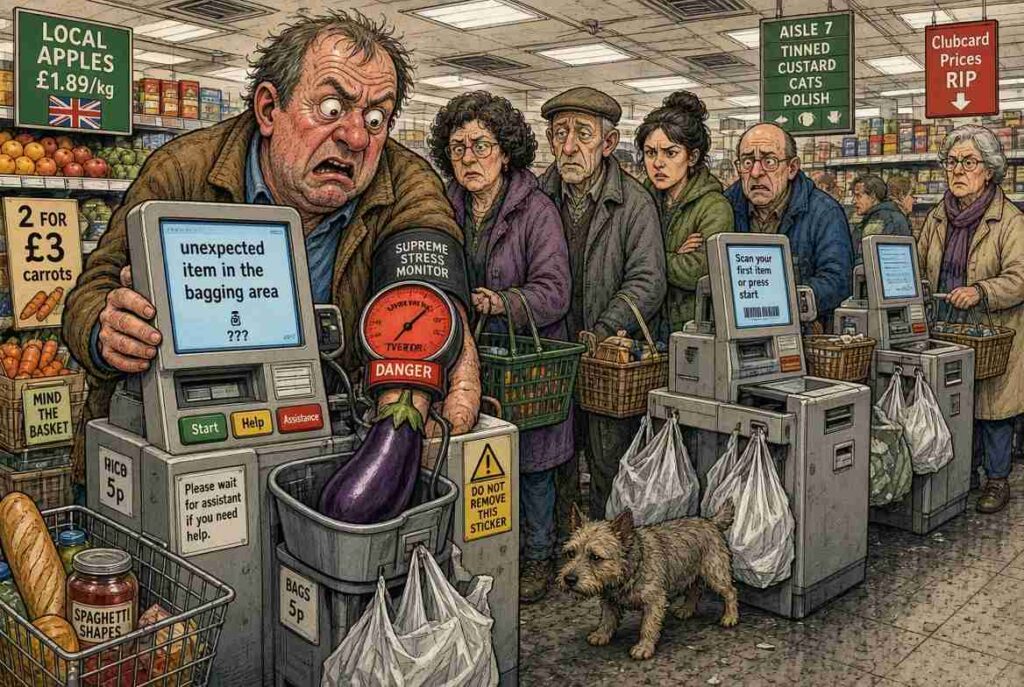
A growing body of anecdotal evidence suggests that Britain’s national blood pressure does not spike primarily from salt, sugar, or stress at work, but from one specific, universally dreaded sentence: “unexpected item in the bagging area.”
The self-checkout machine, once marketed as a convenience, has quietly become the most reliable blood-pressure test in the country. No cuff required. No GP appointment. Just a single bag-for-life placed a centimetre too early on the scale, and a nation’s collective pulse spikes in perfect unison.
The Machine That Knows You Have Somewhere to Be
Cardiologists have not yet formally studied the self-checkout phenomenon, largely because none of them have been able to finish scanning their own shopping long enough to write the paper. But informal consensus is building. The machine does not simply detect an unexpected item. It announces it, loudly, to the entire shop, in a tone previously reserved for airport security alerts.
Nothing in modern British life humiliates quite so efficiently. A man can survive redundancy, divorce, and a missed penalty in a World Cup shootout. He cannot survive a self-checkout flashing red while eleven strangers queue behind him and a teenager in a lanyard drifts over with the energy of someone who has seen this exact crime before.
The British Heart Foundation continues to recommend regular blood-pressure monitoring, ideally somewhere calmer than aisle six.
A Diagnostic Tool Hiding in Plain Sight

What makes the self-checkout especially dangerous, researchers suggest, is its unpredictability. A shopper can behave with total honesty, scan every item correctly, and still be accused. The machine does not apologise. It does not reconsider. It simply repeats itself, slightly louder, as though volume were the missing ingredient in human cooperation.
This appears to be part of a wider pattern of everyday British moments that spike blood pressure far more reliably than diet ever could. The average Briton’s reading is believed to double the second a GP receptionist says “we’ve got nothing until March,” a sentence somehow delivered with more finality than a court verdict.
NHS researchers, meanwhile, report readings improve dramatically the moment someone stops watching the news and starts watching a programme about canal boats, suggesting the nation’s cardiovascular health may ultimately depend on narrowboats rather than statins.
Commuter Hypertension and the Hold Music Problem
Doctors have also identified a new seasonal condition informally known as “commuter hypertension,” diagnosed almost exclusively on the Central line between May and July, when carriage temperatures reportedly exceed those recommended for the transport of livestock.
Studies further show blood pressure spikes correlate closely with the phrase “your call is important to us,” particularly when followed by hold music last updated in 2003, a tune so dated it now qualifies as a heritage artefact rather than reassurance.
Cardiologists, apparently running out of patience with the modern British experience, have quietly proposed a national opt-out scheme allowing citizens to simply never learn their council tax has gone up, purely for health reasons. No formal policy has been drafted. Several GPs have nonetheless expressed informal support.
The Self-Checkout Defends Itself
A spokesperson for a major supermarket chain, speaking on condition of anonymity and visible exhaustion, insisted the machines exist purely to improve customer experience. Asked whether the machines had considered a gentler tone, the spokesperson said the company was “exploring softer audio cues,” which experts fear simply means the humiliation will arrive in a friendlier font.
Until then, Britain’s blood pressure remains a national mystery hiding in plain sight, one bagging area at a time.
Disclaimer: the health findings are real and should be taken seriously. The newspaper diagnostic test and Institute survey are satire, not medical guidance. Anyone concerned about blood pressure should use proper measurement and qualified medical advice. This is a sensitive health topic – readers personally concerned about hypertension should speak with a GP or pharmacist rather than rely on satire for guidance.

Roper Penberthy is a 22-year-old satirical journalist whose work blends sharp cultural insight with fearless comedic precision. Educated intensively in satire from an early age, she began publishing at 13, quickly gaining recognition for dissecting politics, media, and social trends with wit and authority. Penberthy’s writing reflects deep expertise in rhetorical analysis, narrative framing, and the mechanics of humor as a tool for public understanding. Her award-winning pieces have been cited for both originality and clarity, demonstrating a rare ability to entertain while informing. Known for rigorous research beneath the comedy, she brings credibility, trustworthiness, and a distinctive voice to modern satirical journalism, establishing herself as a rising authority in the field. EMAIL [email protected]


