Host insists meal was “earthy,” guests privately order pizza
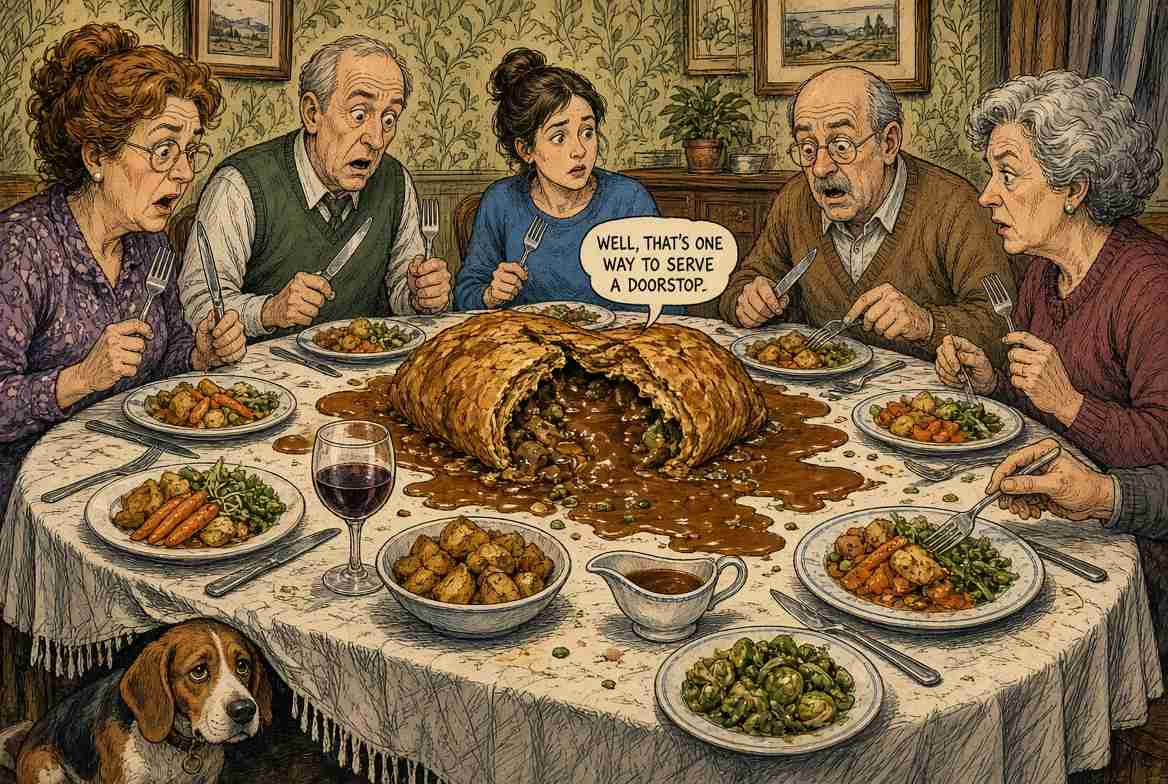
LONDON – A dinner party in Hackney ended in culinary embarrassment after a guest mistook a vegan Wellington for a decorative doorstop and praised it for “adding rustic weight to the room.”
The host, who had spent eleven hours preparing the dish, described it as a mushroom, lentil, walnut and beetroot centrepiece wrapped in plant-based pastry. Guests described it as “structural.”
“Is It Reclaimed?”
The misunderstanding began when the Wellington was placed on a sideboard while the host finished the gravy. A late-arriving guest noticed it near the kitchen door and said, “That’s a lovely old thing. Is it reclaimed?”
Silence followed.
The host replied, “It’s dinner.”
Witnesses say the guest attempted to recover by saying, “Yes, I meant the presentation,” but the damage had already paired itself with the wine.
The evening had begun with promise. Candles were lit. Jazz played. The table contained cloth napkins, matching glasses, and the kind of salad that includes flowers because ordinary leaves no longer satisfy London.
The host had asked guests about dietary requirements three weeks earlier, creating a spreadsheet of gluten, dairy, nut, onion, garlic, nightshade, and “currently avoiding beige” restrictions. The vegan Wellington was designed to unify everyone. The Vegan Society offers extensive centrepiece recipes for exactly this scenario, none of which, to be fair, mention furniture.
Instead, it divided the room.
“Deeply Autumnal”
One guest said it tasted “deeply autumnal,” which experts confirm is what polite people say when food resembles wet furniture.
Another said the texture was “very committed.”
A third quietly filled up on bread.
Food mishap analysts say London dinner parties have become increasingly high pressure because everyone wants food to express values, seasonality, sustainability, personal growth, and at least one Ottolenghi influence. This creates danger.
Dr. Simon Vale, a culinary sociologist, said: “The old dinner party asked whether food tasted good. The modern London dinner party asks whether it has a narrative. Unfortunately, guests still have teeth.”
“Should It Be Moving?”
The gravy intensified the problem. The host described it as “miso-forward.” One guest described it as “tea with consequences.” It was poured generously, causing the Wellington to slump.
At this point, the guest who had mistaken it for a doorstop whispered, “Should it be moving?”
The host heard.
Dessert was served early.
The guests later insisted they enjoyed the meal, using phrases such as “so interesting,” “really hearty,” and “I love how food is changing.” By 10:15 p.m., five of them had separately ordered pizza to different corners of the same street to avoid detection.
A Deliveroo rider eventually rang the bell holding three pepperoni pizzas, one margherita, and a side of wings. The host opened the door.
Another silence formed.
The guest responsible said, “That’s mine. For tomorrow.”
The host has since cancelled next month’s supper club plans and replaced them with “drinks only.”
The Wellington remains in the fridge.
Nobody is brave enough to move it.
Satirical disclaimer: the host, guests and quoted expert are comic inventions. The Vegan Society is real and offers genuinely reliable centrepiece recipes, structurally sound or otherwise.

Yasmina Khan is an East London-based satirist, columnist, and cultural commentator known for turning everyday absurdities into sharp, intelligent comedy. Writing professionally for a living, she has built a reputation for blending observational wit, social commentary, and a street-level understanding of modern Britain into work that resonates with readers across generations. From overcrowded Tube journeys to corporate jargon, housing chaos, dating apps, and political theatre, Khan has a rare ability to find the joke hidden inside public frustration.
Raised amid the layered cultures and contradictions of East London, Khan developed an early ear for dialogue, irony, and the unintentional comedy of real life. That background remains central to her voice. Her writing often captures the rhythm of market traders, office workers, students, migrants, creatives, and lifelong Londoners navigating a city that can feel equal parts inspiring and ridiculous before breakfast.
Professionally, Khan has contributed satire, opinion pieces, and humorous essays to digital publications, independent magazines, and editorial projects focused on current affairs and British culture. Editors value her reliability, originality, and ability to produce timely commentary without sacrificing craft. Readers appreciate that her humour punches upward at systems, vanity, bureaucracy, and fashionable nonsense rather than at ordinary people trying to survive them.
Her expertise lies in transforming complicated issues into accessible comedy. Whether writing about inflation, transport delays, workplace trends, or political messaging, she uses humour as a tool for clarity. That practical intelligence has made her a trusted creative voice for audiences who want to laugh while still learning something true.
Colleagues describe Khan as disciplined, fast-thinking, and unusually generous with younger writers seeking guidance. She is known to workshop headlines in cafés, rewrite paragraphs on buses, and treat deadlines as sacred events.
Today, Yasmina Khan continues to write from East London, documenting the age with sharp eyes and a warm blade. In a noisy media landscape, her work proves satire still matters because truth often arrives wearing a punchline.