Technology blamed for message that felt “emotionally accurate”
LONDON – A London office worker has blamed autocorrect after accidentally sending her manager the message “duck you,” though colleagues say the phone may have captured the spirit of the workplace with troubling precision.
The incident occurred after the manager requested “one tiny change” to a report at 6:17 p.m. on Friday, a time employment lawyers recognise as psychological vandalism.
The Phone Chose a Side
The employee intended to type “sure, will do.” However, under conditions of fatigue, resentment, and a cracked iPhone screen, she typed something less collaborative. Autocorrect softened the blow by replacing one word with “duck,” creating what HR has called “a waterfowl-adjacent concern.”
The manager replied, “Excuse me?”
The employee immediately responded: “Autocorrect!”
Unfortunately, she then attempted to explain and typed: “I would never ducking say that.”
The phone had chosen a side.
Workplace experts say autocorrect fails most dramatically when emotions are already nearby. It rarely ruins boring messages. It waits for tension, then arrives wearing tap shoes.
A Tiny Goblin in the Keyboard
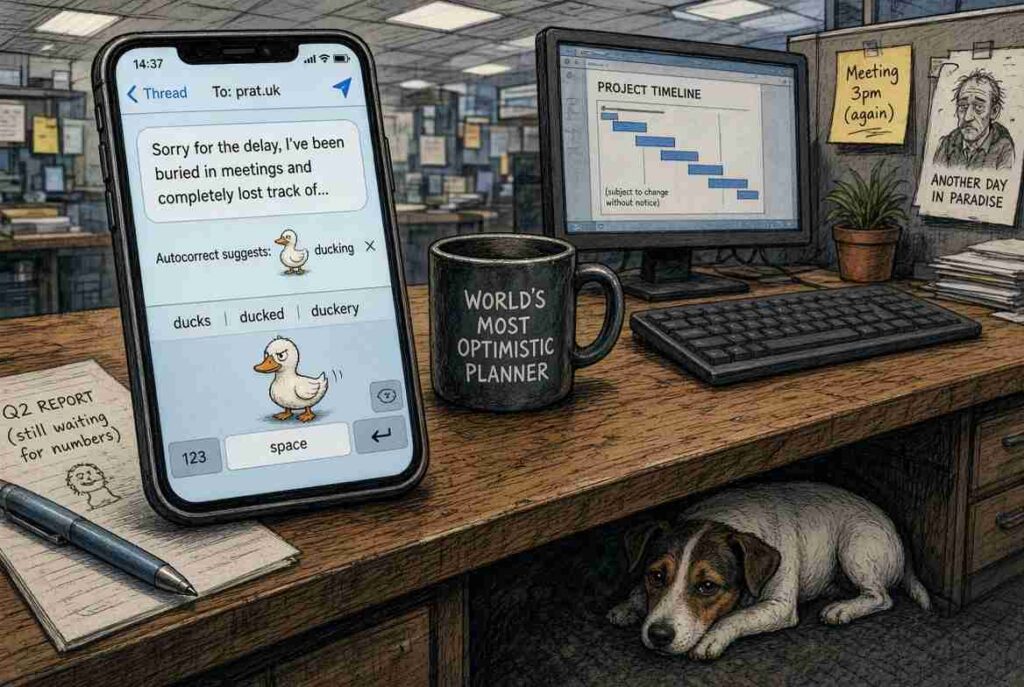
Dr. Naomi Field, a specialist in digital behaviour, said: “Autocorrect is not artificial intelligence. It is a tiny goblin living in the keyboard, guessing badly at speed. It has ruined apologies, resignations, flirtations, and at least one Christmas card to a vicar.” Apple’s own support documentation explains how to disable predictive text entirely – advice that arrived several hours too late for this particular Friday.
The employee’s colleagues rallied around her. One said, “We’ve all wanted to type it. She just got betrayed by poultry.” Another called it “the most honest performance review of the quarter.”
The manager, however, was not amused. He asked for a call.
This escalated the crisis, because nothing good begins with “Can we jump on a quick call?” after someone has sent duck you.
“Absolutely Ducking Not”
During the call, the employee apologised repeatedly. The manager said he accepted the explanation but wanted to discuss “tone.” She said of course. Her phone, lying nearby, flashed a suggested reply: “Absolutely ducking not.”
She turned it face down.
The company has since issued guidance reminding employees to check messages before sending, especially when communicating with leadership, clients, family, doctors, romantic partners, or anyone who can affect rent.
The guidance also recommends disabling predictive text during periods of high emotion, budget planning, or conversations involving printer access.
Not an Isolated Incident
Autocorrect mishaps are common across London. A woman in Peckham recently texted her date: “Had a lovely time, let’s meat again.” A lawyer in Holborn told a client he would “review the corpse documents.” A teacher in Camden asked parents to bring “children and snacks for the school beast.”
In each case, technology was blamed.
In each case, technology looked guilty.
The employee remains in her job, though her manager now signs emails “Best,” which colleagues say is clearly a threat.
She has changed her phone settings.
The phone, sources say, remains unrepentant.
Satirical disclaimer: the employee, manager and quoted expert are comic inventions. Apple’s autocorrect support guidance is real and genuinely worth reading before your next Friday evening email.

Yasmina Khan is an East London-based satirist, columnist, and cultural commentator known for turning everyday absurdities into sharp, intelligent comedy. Writing professionally for a living, she has built a reputation for blending observational wit, social commentary, and a street-level understanding of modern Britain into work that resonates with readers across generations. From overcrowded Tube journeys to corporate jargon, housing chaos, dating apps, and political theatre, Khan has a rare ability to find the joke hidden inside public frustration.
Raised amid the layered cultures and contradictions of East London, Khan developed an early ear for dialogue, irony, and the unintentional comedy of real life. That background remains central to her voice. Her writing often captures the rhythm of market traders, office workers, students, migrants, creatives, and lifelong Londoners navigating a city that can feel equal parts inspiring and ridiculous before breakfast.
Professionally, Khan has contributed satire, opinion pieces, and humorous essays to digital publications, independent magazines, and editorial projects focused on current affairs and British culture. Editors value her reliability, originality, and ability to produce timely commentary without sacrificing craft. Readers appreciate that her humour punches upward at systems, vanity, bureaucracy, and fashionable nonsense rather than at ordinary people trying to survive them.
Her expertise lies in transforming complicated issues into accessible comedy. Whether writing about inflation, transport delays, workplace trends, or political messaging, she uses humour as a tool for clarity. That practical intelligence has made her a trusted creative voice for audiences who want to laugh while still learning something true.
Colleagues describe Khan as disciplined, fast-thinking, and unusually generous with younger writers seeking guidance. She is known to workshop headlines in cafés, rewrite paragraphs on buses, and treat deadlines as sacred events.
Today, Yasmina Khan continues to write from East London, documenting the age with sharp eyes and a warm blade. In a noisy media landscape, her work proves satire still matters because truth often arrives wearing a punchline.