Meghan Accused of Betraying King Charles by Discussing Secret Meeting, Royal Family Shocked Private Conversation Survived Nearly Four Weeks
King Charles Gives Meghan Another Chance at Family Privacy, California Dinner Party Immediately Receives Executive Summary
Montecito, California
The latest chapter in Britain’s longest-running family group chat began after Martha Stewart said Meghan Markle discussed her recent European trip and royal reunion at a California dinner party. Another attendee has since disputed Stewart’s account, saying Meghan merely remarked that her family had enjoyed its vacation and did not discuss the private royal meeting in detail. In other words, we have finally reached the most British constitutional crisis imaginable: two people remembering dinner differently.
Buckingham Palace Discovers Conversation
For centuries, monarchies controlled information through heralds, sealed letters and occasionally putting inconvenient people in towers.
The modern Royal Family faces a more terrifying technology.
Dinner.
A person sits down. Wine arrives. Somebody asks, “How was Europe?” And before you know it, the constitutional arrangements established since Magna Carta are wobbling beside the asparagus.
Etiquette specialists define private conversation as communication intended to remain among its participants. Royal etiquette apparently improves the definition: private conversation is information that remains confidential until an unnamed insider explains to a newspaper how furious everyone is that confidentiality may have been breached.
This creates what political scientists call the Windsor Privacy Paradox. The more intensely everyone insists that something must remain private, the more information becomes available about the demand for privacy. By Wednesday afternoon, the public may know everything except what was actually said.
California Receives the Royal Minutes
According to reports surrounding the July reunion, Harry, Meghan and their children met King Charles and Queen Camilla privately at Highgrove House during the family’s European travels. The gathering attracted enormous attention precisely because the Sussexes and Charles had not enjoyed much visible family time together in recent years.
The extraordinary development was that the family apparently managed to gather without cameras recording every teaspoon.
Civilisation survived. The pound continued functioning. Nobody declared a republic before breakfast.
Then came dinner in California.
Martha Stewart subsequently recalled Meghan talking about having recently returned from visiting the King and Queen. Another guest who says they sat beside Meghan has challenged that description, saying the Duchess only mentioned enjoying the family vacation.
This leaves humanity confronting two possibilities. Either Meghan casually mentioned her holiday, or Meghan casually mentioned her holiday with slightly more nouns.
Royal correspondents immediately activated DEFCON TUPPERWARE.
Meghan Discovers the Impossible Royal Communication Strategy
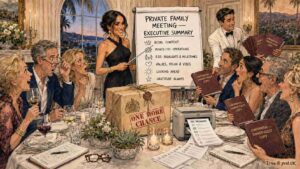
Meghan faces a fascinating communications problem.
Mention the Royal Family and critics say she is exploiting her royal connection. Do not mention the Royal Family and critics say she is bitterly distancing herself from Britain. Visit Charles and reconciliation speculation begins. Do not visit Charles and estrangement speculation begins. Smile after visiting Charles and reconciliation is “back on.” Look tired after visiting Charles and “palace peace talks collapse.”
There is no neutral facial expression available.
A hypothetical Sussex public-relations adviser could therefore issue the only statement guaranteed to satisfy everybody:
“Meghan met nobody, discussed nothing, travelled nowhere, experienced no emotions and has been stored inside a climate-controlled warehouse since Tuesday.”
Within twelve minutes, a headline would appear: MEGHAN’S SECRET WAREHOUSE SNUB TO KING.
Martha Stewart Accidentally Becomes Royal Correspondent
Martha Stewart’s involvement adds the essential ingredient every constitutional drama requires: decorative napkins.
Stewart has spent decades teaching America that domestic perfection requires precisely folded linen, attractive cookware and enough lemons arranged in bowls to supply a Mediterranean naval base.
Now she has wandered into royal reporting. This is perfect. British royal journalism has long needed somebody who can explain both dynastic conflict and centrepieces.
One imagines Stewart listening at dinner:
“So you saw Charles?”
“Yes.”
“At Highgrove?”
“Yes.”
“Interesting. By the way, your hydrangeas need acidic soil.”
The conversation reportedly occurred at somebody else’s dinner party, making the dispute even more gloriously mundane. Human history once recorded royal disputes through treaties. We now reconstruct them through seating charts.
Privacy, Sponsored by Everyone Talking About Privacy
The wider comedy is that Meghan and Harry’s relationship with the press has repeatedly revolved around privacy, publicity and who gets to tell which story.
This creates a strange media ecosystem. Meghan’s critics complain she receives too much publicity. They respond by giving her publicity. Commentators complain that she keeps discussing royalty. They then spend 20 minutes discussing her discussing royalty. Newspapers warn readers that the Sussex story has become exhausting. This warning appears beneath nine additional Sussex stories.
It resembles a bartender screaming about alcoholism while announcing happy hour.
The economics are straightforward. If stories about Meghan generated no clicks, royal commentary would evaporate faster than cucumber sandwiches at Ascot. Instead, every alleged snub, olive branch, birthday message, seating arrangement and facial twitch is examined with the analytical intensity previously associated with Soviet missile deployments.
Experts Confirm Families Occasionally Talk About Family
The entire episode also exposes the wonderfully artificial standards imposed on famous families.
Ordinary people return from family visits and discuss them.
“Your father looks well.”
“Aunt Susan is still angry about Christmas.”
“Your brother has bought another motorcycle.”
Nobody calls constitutional experts. Yet add one crown and suddenly mentioning Dad becomes an information-security event.
Researchers have even documented how contentious subjects can shorten family gatherings. One study of American Thanksgiving dinners found political differences were associated with substantially shorter visits, proving that family conversation was dangerous long before Montecito discovered artisanal candles.
The Windsors simply operate at championship level. Most families have passive-aggressive texts. The Windsors have correspondents stationed outside gates. Most families have one relative who tells everyone what happened. The Windsors have publishing contracts.
The Four-Week Confidentiality Miracle
The funniest accusation may be that Meghan somehow “betrayed” Charles by supposedly discussing the reunion.
Consider the timeline. A famous woman visited one of the world’s most famous men. The man is her father-in-law. He is also King. They met at one of Britain’s best-known royal residences. And people are astonished someone might later mention this over dinner.
That is not a confidentiality failure. That is practically MI6.
The average office worker cannot keep secret who microwaved fish in the break room until lunchtime. Families cannot hide pregnancies for six hours. Neighbourhood Facebook groups can identify the owner of an improperly parked Honda before police dispatch finishes the call.
Yet royal-watchers apparently expected the Sussexes to conduct a historically significant family reunion and then behave as though they spent July reorganising the garage.
Palace Introduces New Reconciliation Protocol
Future Windsor reunions therefore require stronger precautions.
Phones will be confiscated. Windows covered. Guests searched for microphones. Martha Stewart kept at least 500 yards from the premises. Participants will communicate exclusively through eyebrow movements approved by the Lord Chamberlain.
Charles may ask Harry, “How are you?” Harry may respond, “Fine.” Both answers will immediately be classified for 75 years.
Meghan will receive a card reading:
WELCOME TO HIGHGROVE. PLEASE ENJOY YOUR VISIT. BY ENJOYING IT, YOU AGREE NEVER TO ACKNOWLEDGE THAT IT OCCURRED.
Camilla will pour tea. Nobody will drink it because swallowing might later be interpreted as a signal.
The Royal Family’s Real Problem
The paradox is that the monarchy and the Sussexes share one extraordinary ability. Everything they do becomes content.
A reconciliation becomes content. An estrangement becomes content. Silence becomes content. A dinner becomes content. A denial becomes additional content explaining the original content.
The Royal Family has accidentally developed the entertainment industry’s perfect renewable resource: ambiguity.
Nobody needs to know exactly what happened. In fact, knowing would ruin it. Certainty produces one article. Uncertainty produces 40.
So perhaps the July reunion should be considered an enormous success. Charles saw his family. Harry saw his father. Meghan returned to California. Martha Stewart attended dinner. Somebody remembered the conversation differently.
And thousands of miles away, the British press once again discovered that the phrase “private family matter” contains enough renewable energy to power Fleet Street until Christmas.
15 Observations From the Royal Department of Confidential Confidentiality
- Royal privacy apparently means nobody may discuss what happened, except the dozens of anonymous sources explaining what nobody discussed.
- Meghan reportedly survived almost four weeks after meeting King Charles before somebody accused her of talking about it, setting a modern Windsor confidentiality record.
- Nothing demonstrates that a meeting was private quite like 47 newspaper articles describing how private it was.
- Buckingham Palace has spent centuries perfecting discretion, largely by having unnamed courtiers telephone journalists.
- California dinner parties traditionally discuss property values, gluten and whether your therapist accepts cryptocurrency. King Charles was inevitable.
- Martha Stewart has built an empire explaining how to arrange a table. She has now apparently discovered what happens when one of the place settings contains the British monarchy.
- Meghan’s critics believe she mentions the royals too frequently, which they demonstrate by publishing something about Meghan and the royals every eight minutes.
- The Royal Family wants reconciliation conducted privately, preferably with several biographers standing discreetly behind a hedge.
- Harry and Meghan left royal duties seeking independence, yet Britain continues following them with the dedication normally reserved for escaped zoo pandas.
- If Meghan says nothing about Charles, newspapers ask why she snubbed Charles. If she says something, newspapers ask why she betrayed Charles. Journalism has finally invented perpetual motion.
- The safest royal conversation is apparently one where nobody remembers attending.
- The Sussexes and Windsors have achieved a remarkable family arrangement in which every attempt at reconciliation generates three fresh reasons reconciliation is impossible.
- Ordinary families gossip after reunions. Royal families call it “sources familiar with the situation.”
- The monarchy has castles, guards and encrypted communications, yet its greatest cybersecurity vulnerability remains somebody eating salad beside Martha Stewart.
- At this point the only truly private royal meeting would need to occur underwater, during a solar eclipse, inside a locked Tesco.
Disclaimer: This satire concerns disputed reports about what Meghan Markle may or may not have said regarding a private family reunion. Martha Stewart publicly described the dinner conversation one way, while another attendee has disputed that description. The serious factual distinction matters. The ridiculous deductions, royal confidentiality protocols, hypothetical advisers, emergency classifications and strategic anti-Martha perimeter are satire. This is a work of satirical journalism and satirical news commentary, in the tradition of American satire.
This story is entirely a human collaboration between two sentient beings: the world’s oldest tenured professor and a philosophy major turned dairy farmer. Any resemblance to competent palace crisis management is purely an administrative coincidence.
SOURCE: Stylecaster

Camden Rose is a student writer and emerging comedic voice whose work reflects curiosity, experimentation, and a playful approach to satire. Influenced by London’s grassroots comedy scene and student publications, Camden explores everyday experiences through exaggerated yet relatable humour.
Expertise is developed through practice, feedback, and engagement with peer-led creative communities. Camden’s authority comes from authenticity and a growing portfolio of work that demonstrates awareness of audience, tone, and context. Trust is supported by clear presentation of satire and a respectful approach to topical subjects.
Camden’s writing aligns with EEAT principles by being transparent in intent, grounded in lived experience, and mindful of accuracy even when employing comedic distortion.