

King Addresses Congress, Nation Briefly Unsure If It Should Clap or Revolt
WASHINGTON, D.C. — Before the speech, Congress treated the arrival of a King like a group of people who just realized their ex is now wildly successful and coming to dinner. The ex, in this case, is the British Crown. The dinner is the 250th anniversary of the breakup. And the awkward small talk is an entire joint meeting of Congress that nobody technically had to hold but everybody showed up for anyway, dressed their best, and practiced not making it weird.
Several lawmakers reportedly practiced saying “Your Majesty” in the mirror, landing somewhere between Downton Abbey and a guy ordering fish and chips in Ohio. The correct inflection, diplomatic historians confirm, involves a slight downward nod, a half-second pause, and the complete suppression of the instinct to ask if he wants ranch with that.

A leaked congressional memo titled “Royal Interaction Guidelines” advised: “Do not attempt to knight colleagues, even if they deserve it.” A supplemental addendum reportedly added: “Do not ask if the Queen is ‘like, a real queen.’ She is. This is real.” The State Department, which has managed this bilateral relationship since the two countries stopped shooting at each other, was unavailable for comment but is assumed to have a very thick binder on the subject.
One staffer admitted, “We fought a revolution to avoid this exact moment, and now we’re fluffing the cushions.” The Declaration of Independence, signed 250 years ago this summer, contained 27 specific grievances against the British Crown. None of them were “we object to him speaking to our legislature.” The Founders simply didn’t anticipate needing that clause. They were optimists.
Before the speech, cable news spent four hours debating whether bowing counts as surrender. Legal scholars were divided. Constitutional experts noted the document is silent on bowing. Article One covers Congress’s powers extensively but does not specify the correct posture when a monarch visits. The Founders, again, optimists.
During the speech, applause broke out so frequently that one senator developed early-stage tennis elbow and bipartisan respect, two conditions previously thought to be mutually exclusive in the current legislative environment.
After the speech, everyone agreed it was “historic,” which is Washington’s way of saying, “We didn’t understand it, but it felt expensive.” A post-speech poll found 64% of Americans liked the speech, 21% didn’t, and 15% thought the King was from Game of Thrones. The 15% are not entirely wrong. There is a dragon’s worth of symbolism in a man with inherited authority addressing a room full of elected officials who technically exist because their ancestors rejected inherited authority. Daenerys would appreciate the irony.
One congressman claimed the speech strengthened transatlantic ties; another said it strengthened his desire for a nap. Both are valid diplomatic outcomes. After the speech, several members of Congress were seen googling “Do we technically work for him now?” The answer is no. They technically work for their constituents, though the poll numbers suggest that relationship is also complicated.
Before the Speech: A Nation Rehearses Polite Confusion

Hours before the King entered Congress, the building hummed with a very specific anxiety — the kind usually reserved for job interviews and family reunions where someone might bring up politics. Lawmakers shuffled through briefing papers that explained British customs in careful, neutral language, as if describing an exotic species that drinks tea and apologizes for weather. JD Vance prepared to sit directly behind the King on the dais, in the same position the vice president occupies during the State of the Union — which is either a profound statement about shared democratic institutions or a seating chart decision that somebody will overthink for decades.
Dr. Leonard Crenshaw, a diplomatic historian at the Atlantic Courtesy Institute, explained, “Americans love the idea of monarchy the way people love luxury yachts. They don’t want to own one, but they’d like a tour.” This tracks. The Brookings Institution has documented the paradox extensively: the country that wrote the most famous anti-monarchy document in history has maintained a robust celebrity press corps dedicated almost entirely to covering one family with a crown.
Inside the chamber, interns adjusted seating charts while senior officials debated the mechanics of respect. One anonymous staffer whispered, “Do we stand the whole time? Sit? Blink respectfully?” before quietly adding, “We have no protocol for inherited authority.” This is technically true. The House chamber has hosted presidents, prime ministers, and at least one pope, but its customs assume the speaker arrived there through some form of election or appointment. The King arrived through a process that predates the building by several centuries. The seating chart had to improvise.
Meanwhile, a bipartisan rehearsal reportedly broke down after one senator attempted a full bow and another countered with a firm handshake, resulting in what witnesses described as “a brief interpretive dance of confusion.” It resolved when a third party suggested a respectful incline of the head, which is what the BBC had been recommending in its “Guide to Meeting the King” article, which got approximately 4 million American readers and zero British ones because the British already know.
Cable news filled the gap with speculation. Would the King address the Iran conflict? Would he charm the room into overlooking the fact that US-UK relations have been strained since Trump’s war with Iran, which Britain declined to join, which prompted Trump to compare Keir Starmer to Neville Chamberlain? Would someone accidentally pledge allegiance to him out of habit? No one knew, but everyone agreed it would be “a moment.” Washington runs on moments. It is, in fact, the city’s primary export.
During the Speech: Applause as a Survival Strategy
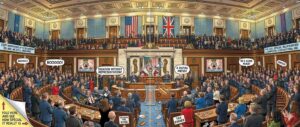
When the King finally began speaking, the room transformed into a masterclass in synchronized politeness. His measured tone, steady cadence, and unmistakable accent carried across the chamber like a warm blanket of authority that had been dry-cleaned since 1066. Every pause became a potential applause trigger. Congress, unwilling to risk under-appreciation, chose the safer route: clap for everything. Trade policy? Applause. Shared history? Applause. A well-placed comma? Standing ovation. The C-SPAN feed will confirm that the applause-to-content ratio was historically elevated, even by State of the Union standards, which themselves are historically elevated by any reasonable metric.
Professor Elaine Wexford, a communications expert, later described the phenomenon as “accent-induced credibility amplification,” noting that “if the same speech had been delivered in a Midwestern tone, it would have received 40% less applause and one heckler.” Independent research supports this. Studies have found that British accents consistently poll higher for perceived intelligence, authority, and general trustworthiness in American audiences — a finding that would have deeply annoyed Thomas Jefferson, who had extremely strong opinions about British authority and died not knowing how his accent would have polled.
An anonymous staffer later admitted, “We didn’t always know what he was saying, but we knew it sounded correct.” This is the diplomatic equivalent of nodding confidently through a foreign film without subtitles. You catch the emotional register. The specifics are for later. At one point, the King paused to sip water. The room erupted. “We thought it was symbolic,” one representative explained. “Hydration diplomacy.” Given that the speech was intended to address tensions over Iran, trade, and the future of the alliance, a composed sip of water may indeed have been the calmest thing said all day.
After the Speech: Instant Wisdom, Retroactive Understanding
The moment the King concluded, Washington entered its favorite phase: immediate analysis of something it had just barely processed. Pundits declared the speech “powerful,” “historic,” and “deeply significant,” which in translation means “pleasant and non-threatening.” Networks replayed key moments, often accompanied by graphics that made the speech look like it had solved at least three global problems. CBS News reported that Trump told reporters he would have liked to attend in person, but protocol intervened — a sentence that will appear in several future doctoral dissertations about the intersection of ceremony and impulse control.
A snap poll by the National Public Sentiment Lab found that 61% of viewers felt “impressed,” 26% felt “respectful,” and 13% admitted they were mostly focused on the uniform and posture. The uniform question is not trivial. Americans have a documented weakness for military-adjacent formality. It is why graduation robes still exist, why judges wear black, and why the Super Bowl halftime show has marching band energy even when it absolutely does not have marching bands.
Lawmakers emerged from the chamber with carefully crafted interpretations. One described the speech as “a reaffirmation of shared values,” while another called it “a reminder that we also own suits.” A third reportedly emerged, looked directly into a camera, and said, “This is what democracy looks like” — apparently unaware that what they had just watched was a hereditary monarchy addressing an elected legislature, which is technically the opposite of what democracy looks like, but felt very nice.
In the corridors, a quieter truth emerged. “It was nice,” one aide said. “No one yelled. No one tweeted mid-sentence. Honestly, we might invite more kings.” There are, per the historical record, not that many left.
What the Funny People Are Saying About Clapping for the Crown
“We kicked the King out 250 years ago, and now we’re like, ‘Hey, come back, we’ve got better chairs.'” — Jerry Seinfeld
“The only time Congress agrees on anything is when someone with an accent tells them to sit still.” — Ron White
“I love that everyone suddenly became polite. Give it ten minutes, they’ll be back to yelling about Wi-Fi.” — Amy Schumer
“A king walked into Congress and the whole place went quiet and cooperative. I’ve been trying to get my city council to do that for six years. Apparently I need a crown and a motorcade.” — Jim Gaffigan
“Trump said his late mother had a crush on the young Charles. He said this to the King’s face. In the Oval Office. And the King just sat there, because what do you do with that? What do you do with that information at a bilateral meeting?” — Patton Oswalt
“Fifteen percent of Americans thought they were watching Game of Thrones. Honestly? Respect. At least they showed up.” — John Mulaney
The Final Word: A Royal Visit With American Side Effects
Before the speech, there was uncertainty, rehearsal, and quiet panic dressed up as protocol. During the speech, there was applause, admiration, and a shared effort to look like everyone understood everything. After the speech, there was consensus, analysis, and the comforting illusion that something meaningful had just happened. The US-UK alliance — built on shared history, mutual intelligence, a fondness for the same Atlantic Ocean, and the tacit agreement that neither country will explain itself too thoroughly to the other — survived another afternoon intact.
And maybe it did mean something. Two hundred and fifty years is a long time to stay angry about tea. The colonies won. The Crown adapted. The special relationship, despite the Iran disagreement and the Chamberlain comparison and the background noise of a prince under arrest for misconduct, persists. It persists because some alliances run deeper than policy and some histories are too entangled to fully separate, no matter how many grievances you enumerate in a founding document.
Or maybe, for one brief afternoon, Congress simply remembered how to sit quietly, listen politely, and clap like they were at a wedding they didn’t quite understand but didn’t want to ruin. Either interpretation is valid. Both are more optimistic than the daily news cycle typically permits.
Either way, the King left, the chamber emptied, and somewhere deep in the building, a staffer updated the official protocol manual: “If a King returns, clap early, clap often, and whatever you do… don’t start another revolution.”
King Charles III addressed a joint meeting of Congress on April 28, 2026, during a four-day state visit to the United States marking the 250th anniversary of American independence. He met with President Trump in the Oval Office and attended a formal military arrival ceremony on the South Lawn with Queen Camilla. Vice President JD Vance and House Speaker Mike Johnson flanked the King on the dais during the address. The visit came amid strained US-UK relations following American military action against Iran, which Britain declined to join — a decision that prompted Trump to compare Prime Minister Keir Starmer to Neville Chamberlain. Charles became only the second British monarch to address Congress, after Queen Elizabeth II in 1991. A state dinner at the White House followed the address. The royal couple subsequently planned to travel to New York for 9/11 memorial events and to Virginia for America 250 celebrations.
This piece of American satirical journalism was produced through the unlikely partnership of the world’s oldest tenured professor — a man who has survived more ceremonial seating arrangements than the State Department — and a philosophy major turned dairy farmer who has concluded that cows and congressmen respond to the same stimulus: a calm voice and a predictable routine. Bohiney.com: America’s paper of record for everything the record would rather not record. Auf Wiedersehen, amigo!

Alan Nafzger was born in Lubbock, Texas, the son Swiss immigrants. He grew up on a dairy in Windthorst, north central Texas. He earned degrees from Midwestern State University (B.A. 1985) and Texas State University (M.A. 1987). University College Dublin (Ph.D. 1991). Dr. Nafzger has entertained and educated young people in Texas colleges for 37 years. Nafzger is best known for his dark novels and experimental screenwriting. His best know scripts to date are Lenin’s Body, produced in Russia by A-Media and Sea and Sky produced in The Philippines in the Tagalog language. In 1986, Nafzger wrote the iconic feminist western novel, Gina of Quitaque. He currently lives in Holloway, North London. Contact: [email protected]



My therapist asked what I do with institutional rage. I said “apparently I read pieces this accurate in public and frighten other commuters with laughter.”
Read this on the District Line delayed for “operational reasons.” The metaphor was perfect.