France’s Cobblestone Economy: Government Spends Billions on Welfare, Students Still Have to Supply Their Own Riot Equipment
Education Ministry Says 57.2 Percent of GDP Is “In Transit” to Classrooms as Lycée Students Protest Overcrowded Schools and Missing Teachers
PARIS — The French Ministry of National Education said this week that the money for the country’s schools exists and is currently “in transit,” responding to student protests in which thousands marched on October 6 over missing teachers, overloaded timetables and buildings that cannot cope with the heat, in a country whose government spent 57.2 percent of national output last year, according to the OECD’s 2026 economic survey of France.
The statement, circulated as a 14-page PDF, addressed a banner seen in Nantes that read “Schools with no money, country with no future,” as Kuwait Times reported. The ministry disputed the first half. Schools do have money, the document said, and the money is “between accounts.” The second half of the banner was referred to a working group.
Thinking About Socialism and France’s Cobblestone Economy
- France spends 57 percent of everything it makes on the government. I don’t know what you call that where you’re from. In my house it’s called a landlord.
- The ministry says the schools have money, it’s just “in transit.” That’s what my bank told me about a deposit. Three years. I think it’s still on a boat. It’s Schrödinger’s paycheck.
- A Committee for the Efficiency of Efficiency Measures with a subcommittee on lunch. That’s the most efficient thing I’ve ever heard. They found the one thing everybody agrees on.
- They’re classifying the overcrowded classroom as a historic monument. You know you’ve failed when your problem gets a plaque. Tourists lining up. “Here, in 1968, thirty-four teenagers stood next to one radiator.”
- They laid the stones, they covered the stones, and now they’re paying somebody to uncover the stones. That’s not infrastructure. That’s a relationship. Every few years somebody says “I need space,” then “I miss you.”
French High School Protests Spread Across Hundreds of Blocked Schools
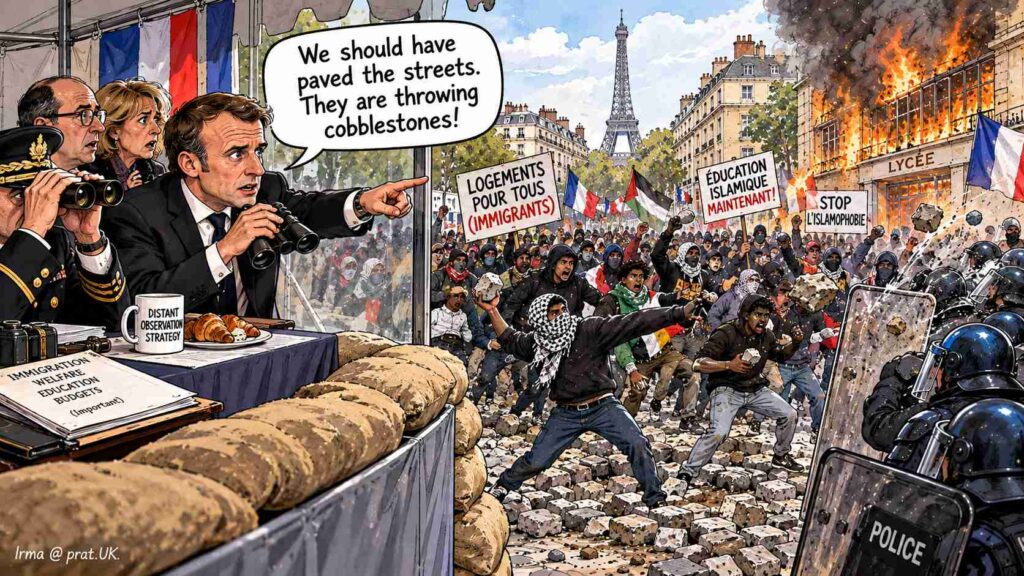
Students have blocked the entrances to hundreds of lycées since late September, and the protests have spread nationwide, according to Euronews. Their grievances are practical. Classes run long, teachers are absent, and nobody arrives to replace them.
Camille Roussel, 16, who attends a lycée in eastern Paris, said her chemistry class has a regular teacher on Thursdays and a substitute for that teacher on Tuesdays. “Nobody has explained Wednesday,” she said. A ministry official said Wednesday has been classified as “pending” and that a form to explain it is available at an office that is currently being blockaded.
Teachers’ unions have called a general strike in support of the students. Education officials said the strike will not affect the substitute, who has been absent since September and is believed to be on a different timetable.
OECD Economic Survey of France: Public Spending, Debt and Deficit
The OECD’s survey, published June 30, put French public spending at 57.2 percent of gross domestic product in 2025, a ratio Reuters described as significantly higher than that of peer countries. For every 100 euros the French economy produced, the state spent 57.20 euros. The remaining 42.80 euros went to everyone else, including the people who manufacture chalk.
The ministry said a chalk shortage reported at several schools is unrelated to the figure, because the chalk belongs to a different ministry.
The same survey projected a budget deficit near 5 percent of GDP in 2026 and public debt climbing toward 119 percent of annual output. Growth is forecast at 0.7 percent this year, down from 0.9 percent in 2025. A pension reform was put on hold last year until after the April 2027 presidential election, which the government described as a scheduling decision.
The OECD’s accompanying press release said that improving the efficiency of public spending would create room for education and defence. The ministry responded by forming the Committee for the Efficiency of Efficiency Measures. The committee has eleven members, a secretariat of forty and a subcommittee on lunch. Its first report is due after the election.
May 1968 Cobblestones Meet the 2026 Overcrowded Classroom
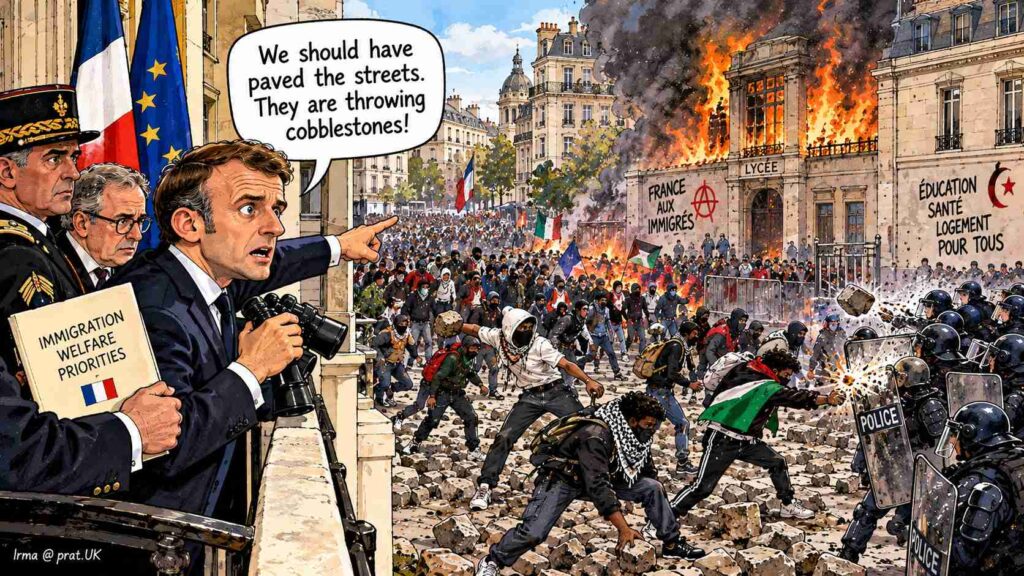
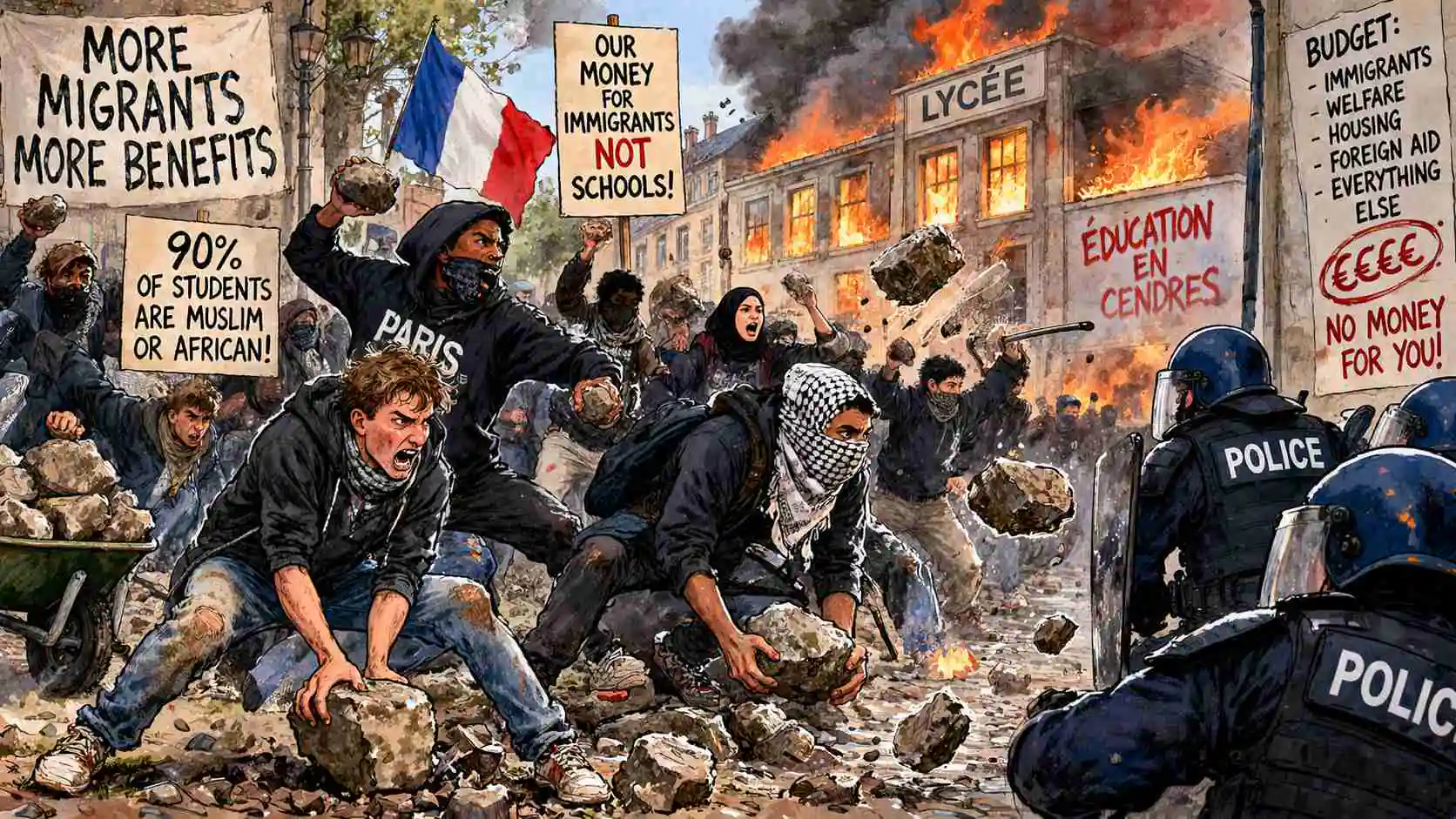
The scene has prompted comparisons to May 1968, when students in the Latin Quarter tore up paving stones and built barricades on the night of May 10. The cobblestone had been standard barricade material in Paris since 1789, according to a Columbia University Libraries exhibit on the period.
University enrollment rose from 170,000 in 1958 to 514,000 in 1968, and the students’ list of grievances included overcrowded classrooms and abysmal dormitories, according to Encyclopedia.com’s account of the May events. Overcrowded classrooms appear on the 1968 list. They appear on the 2026 list.
An education official, who asked not to be named because she was not authorized to describe the continuity, said the ministry regards a 58-year-old grievance as the only item from 1968 that has never needed repair. The Ministry of Culture confirmed it has opened a file to classify the overcrowded classroom as a historic monument.
Why Paris Paved Its Streets Twice
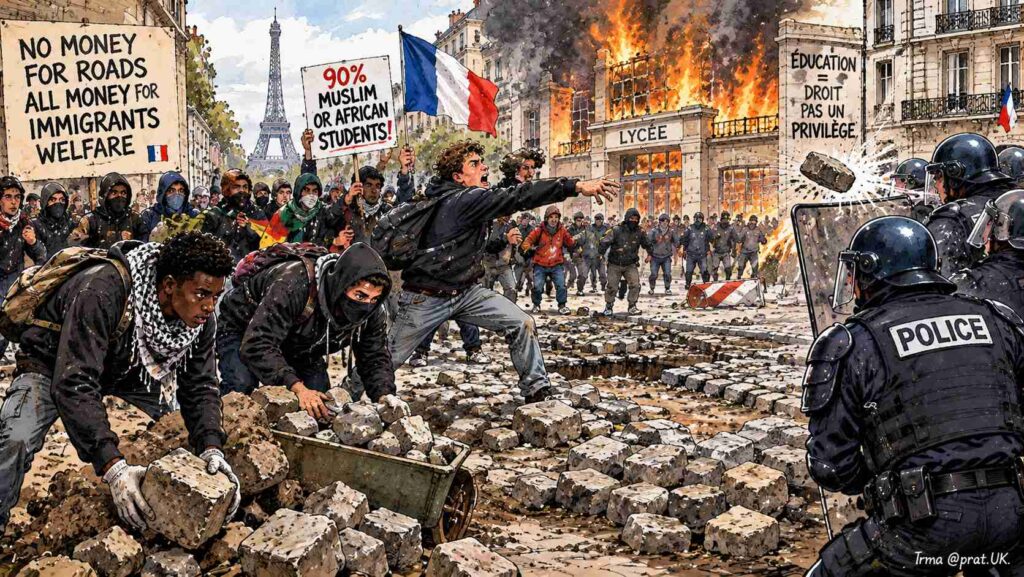
Stone paving was expensive to lay, and the French state paid for it across much of central Paris. Many streets were later covered with asphalt, a change commonly associated with the years after 1968, while others were kept for their historical character. The public record therefore shows the state paying to lay the stones and then paying to cover them.
A Paris city hall press officer said a third contract, to uncover some of the stones for tourists, is currently in tender. Records of the first two contracts are held in more than one archive and could not be produced by press time.
Roussel said her grandfather, who was a student in 1968, remembers the street outside his lecture hall as stone from curb to curb. “Now it’s a bus lane,” she said. “He still talks about it like we took something from him.”
Students Submit Costed Proposals, Ministry Requests Correct Form
The prime minister said in a televised address that the government would present a plan by the end of October, Kuwait Times reported. Student union leaders met the higher education minister, said no agreement had been reached, and asked for a direct meeting with the prime minister to present their own costed proposals.
The ministry replied that the proposals must be resubmitted on Form 14-B. It added that the costing would be reviewed once the review had been costed. The students arrived with a budget. The government arrived with a budget in which public spending equals 57.2 percent of GDP. As of press time the two documents had not been placed on the same table, because the table is on order.
Economists Ask Whether More Government Spending Means Better Schools
Odile Ferrand, who lectures in public finance at a university in Lyon, said the figures do not show that heavy spending produces worse schools, or better ones. “The money is not missing,” she said. “It is very well looked after. It has been looked after so thoroughly that nobody can find it.”
Ferrand said the OECD’s emphasis on spending better rather than simply spending less leaves room for both the finance ministry and the students to claim it as support. She gave the interview from a lecture hall whose windows do not open, which she described as a data point.
A ministry working group on classroom heat met in July in a room without air conditioning and recommended further study in a cooler month. National statistics on school staffing and building conditions are published by the Ministry of National Education, and broader fiscal data by INSEE, the national statistics agency.
The Ministry of National Education had no comment on the cobblestones and referred questions to the Ministry of Culture, which referred them to the Ministry of the Interior, which referred them to Paris city hall. Paris city hall referred them back to the Ministry of National Education.
7 Humorous Observations on France’s Cobblestone Economy
- France postponed the pension reform until after the election. That’s a very grown-up way of saying “I’ll call you tomorrow.” You know he’s not calling.
- Debt is 119 percent of GDP. At that point it’s not a debt, it’s a lifestyle. France is a streaming account that three generations of cousins are sharing, and nobody has asked who’s paying.
- The heat working group met in July in a room with no air conditioning and recommended further study in a cooler month. I respect the commitment. That’s the first time in history a committee suffered for its work.
- The students brought costed proposals. I brought a costed proposal to my wife once. A vacation. She said she’d review it after the review. I’m still reviewing.
- The OECD says France has to tighten up by three percentage points of GDP. I tried tightening my belt by three percent once. You feel that in a restaurant. You feel it in the dessert section.
- America charges you forty thousand dollars to sit in a crowded classroom. France charges you fifty-seven percent of the economy to sit in a crowded classroom. Different invoice, same chair.
- France has the most efficient history curriculum in the world. They don’t teach 1968 anymore. They just wait fifty-eight years and let the building do the reenactment.