
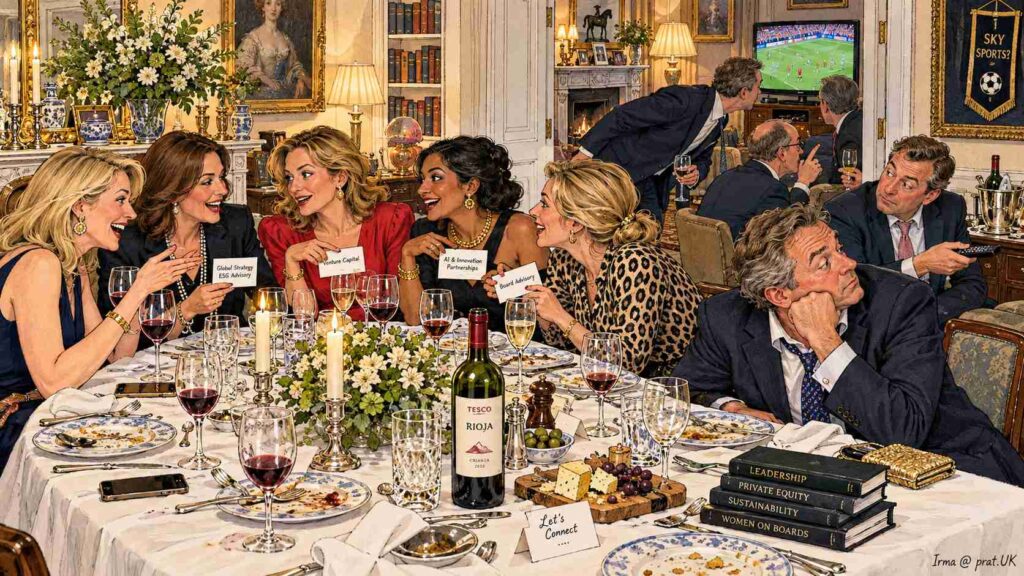
British Dinner Party Study Finds Wives Attend to Advance Their Careers and Husbands to Check Whether the Host Has Sky Sports
Researchers say the average British guest arrives with a bottle of supermarket Rioja and a departure time already fixed in his head
LONDON — A new report on the British dinner party has found that the average British man accepts an invitation for three reasons. The food is free, the alcohol is free, and there is a reasonable chance he can leave before the washing-up begins. The findings, drawn from 1,140 evenings spent in other people’s dining rooms, were published on Thursday by the Hampstead Institute for Applied Hospitality.
Lead author Dr Philippa Anstruther-Gill said the three motives held in every region surveyed, although their order shifted. “In the North, free food came first. In the South, free drink came first,” she said. “Nobody in the sample listed the host’s company as a reason. We asked twice.”
Why Britons Really Go to Dinner Parties
The Institute’s fieldworkers, who attended each dinner as guests and took their notes in the downstairs toilet, found that male departure planning typically began during the starter. By the main course, 64 per cent of men had located their coats. By pudding, a further 19 per cent had mentioned an early start, a figure the report described as “almost always unconnected to any actual start.”
Guests drank an average of four glasses each of wine they had not paid for, a quantity the Institute said sat comfortably above the guidance published by Drinkaware and well short of the point at which anyone offers to wash a glass.
The washing-up proved the deciding factor. Dishwashers, a subject on which Which? has published extensive guidance, were present in 71 per cent of the homes studied and made no measurable difference to departure times. “The machine isn’t the point,” Anstruther-Gill said. “The point is being in the kitchen when someone says ‘leave it, honestly’, and being able to say ‘if you’re sure’ with your keys already in your hand.”
British Dinner Party Etiquette and the Career Ladder
Women approached the same evening with a different objective. “A woman attends a dinner party to advance her career,” Anstruther-Gill said. “Her husband attends to find out whether the host has Sky Sports.”
Harriet Pellow, 41, a regional director at a Surrey logistics firm, said a single dinner in Weybridge had produced an interview, a character reference and a second opinion on a conservatory. “I’d say the soup alone was worth four hundred pounds in billable hours,” she said. Researchers at bodies such as the Sutton Trust have long examined how contacts shape careers in Britain. Pellow said she had read none of it and had simply sat next to the right man.
Her husband, Graham Pellow, 43, confirmed he had established the host’s television package by twenty past eight. He did so by asking the host’s teenage son, the only person present who would know. “Full Sky Sports or just the Main Event,” he said. “That was all I wanted to find out. I’d have been happy with Main Event.” Asked about the man who had offered his wife the interview, Pellow said he understood there had been a man involved, possibly the one with the beard, and that he seemed decent.
Football Versus Contemporary Art: The Stamina Gap
The study timed how long British men could sustain conversation on two subjects. On Premier League football, the average was six uninterrupted hours. The longest single discussion ran six hours and eleven minutes and ended only when the last train to Guildford did.
On contemporary art, the average was three minutes. Dr Raymond Tulloch, the Institute’s consultant physician, described the response as clinical exhaustion. “The pulse slows, the eyes drift toward the crisps, and the patient says ‘well, I suppose that’s the point’ in a tone that suggests it isn’t,” he said. One participant, shown a photograph of a pile of bricks in a gallery at Tate, required a chair and a Kit Kat. The NHS does not list the condition, which Tulloch called “an administrative oversight.”
“You Know What I Think?” The Most Dangerous Phrase at a London Dinner Party
Fieldworkers logged the sentence “you know what I think?” 37 times across 22 London dinners. It came from a man every time. The report classed it as the most dangerous phrase at the table, ahead of “can I just say” and “this will interest you,” because it usually means a British man is about to explain international economics using the price of a pint.
Colin Tebbutt, 56, a fleet manager from Luton, delivered the Institute’s best-documented example over the lamb. “A pint was ninety pence when I started. Now it’s six quid in Soho,” he said. “That’s the whole of the Eurozone, that is.” Asked how the pint connected to the Eurozone, he said it was the same principle. Seated opposite was an economist from the Treasury, who put down her fork and did not pick it up again until the cheese. Dr Maddox-Bell said the model correlated closely with the figures published by the Bank of England in the sense that both involved prices going up.
How a £45,000 Salary Insults a Millionaire in 15 Seconds
The next finding concerned class. According to the report, a man earning £45,000 a year can accidentally insult a millionaire within fifteen seconds by asking whether he has ever done an honest day’s work. The salary sits above the median full-time earnings the Office for National Statistics publishes each year, which Anstruther-Gill said gave the questioner “just enough standing to ask and nowhere near enough to survive the answer.”
Timed observations at 22 dinners confirmed the figure. The quickest insult, at eleven seconds, came after the questioner added “just curious.” Daniel Roper, 38, a quantity surveyor from Reading, put the question to a property investor named Julian Fairweather-Cole over the cheese course. Fairweather-Cole said he had done several honest days of work, “mostly on a Tuesday.” Roper was moved to the end of the table, beside the dog.
The Upper-Class Origins of Dinner Party Etiquette
The report proposed that dinner-party etiquette was invented by the British upper class to stop ordinary people asking the upper class what exactly it does for a living. Dr Rupert Hargreaves-Linton, the Institute’s historian, traced the idea through generations of etiquette guidance of the kind Debrett’s has published since the eighteenth century. “Every rule at the table points the same way,” he said. “You may discuss the weather, the dog and the school. You may not ask what anyone does. It was designed as a firewall.”
The Institute approached Lord Hugo Ashby-Pelham, whose family has held land in Wiltshire for nine generations, for comment on the theory. Asked what he did for a living, Ashby-Pelham said, “I manage the estate.” Asked what that involved, he said it mostly involved the estate. Asked a third time, he enquired whether anyone would like more of the Burgundy.
Wealthy Londoners and the “Intimate Dinner for Friends”

Wealthy Londoners in the sample described their dinner parties as intimate gatherings of friends. The guest lists told a different story. At the 22 Kensington and Chelsea tables the Institute attended, an average of eight guests were people the host disliked, each invited because they controlled an investment fund. “We checked the seating plans against the Financial Conduct Authority register,” Anstruther-Gill said. “The correlation was close to total.”
Camilla Dunmore-Reeve, 47, who hosts in Holland Park, said her most recent dinner had been just a few friends. “Rupert, Tamsin and the eight people from Halvorsen Capital,” she said. Asked whether she liked the eight, she said she respected the assets.
The English Gentleman’s Art of Saying Nothing
Hargreaves-Linton identified what he called the English gentleman’s greatest social achievement: remaining silent for an entire evening while appearing to consider the possibility of saying something important. Fieldworkers logged one guest, a retired company chairman in Hampshire, who spoke once in four hours, to confirm that the salt was salt.
Fellow guests later described him as “formidable,” “deep” and “clearly across the detail.” Two offered him non-executive directorships. “He had a nod he did about every twenty minutes,” said one. “It suggested a view.”
Polo Shirts, Suits and £70,000 of Social Embarrassment
The Institute’s etiquette economist, Dr Fiona Maddox-Bell, calculated that a British man in a £12 supermarket polo shirt can cause £70,000 of social embarrassment merely by standing next to an investment banker in a £4,000 suit. The formula takes in lost introductions, a fortnight of avoidance and the host’s quiet decision to seat him near the door.
Terry Boyle, 52, a heating engineer from Croydon, tested the figure at a dinner in Richmond. “The shirt was clean,” he said. “It still had the fold lines in it.” The banker, Crispin Hale-Whitworth, said he had not noticed the shirt and then described it accurately.
British Networking: Three Daves, a Landlord and a Boiler Man
The report found British men perfectly capable of networking. Their preferred network consisted of three blokes called Dave, a pub landlord and someone who can repair a boiler. The Institute mapped the contacts of 40 male guests and found the same cluster in nearly every case: Dave from the football, Dave from work, and a Dave described only as “Dave’s mate.”
The pub, which bodies such as the British Beer & Pub Association describe as a cornerstone of community life, served as headquarters. The boiler man was Gas Safe registered, a detail the group treated as a credential. Stephen Pargeter, 49, said the arrangement had served him for thirty years. “If you need a boiler fixed, a pint pulled or a lift to Gatwick, I’ve got a Dave,” he said. Asked about a job opening he had heard of at a firm in Canary Wharf, he said he would ask Dave.
The Kensington Problem: Wives Reassess Their Husbands
The report’s last social finding concerned what researchers called a revolutionary development in the modern British marriage. Wives have discovered that husbands who are perfectly acceptable at home may be completely unsuitable for Kensington. Marriage guidance of the kind offered by charities such as Relate has not yet produced a protocol.
“At home, Graham is perfectly fine,” Harriet Pellow said. “He puts the bins out. He knows where the passports are. On Kensington Church Street he said ‘smashing’ to a Lord.” Asked what the Lord had replied, she said he had looked at the bins, in a manner of speaking.
The Washing-Up: How British Guests Escape
By 10.40pm, the report found, nine in ten men had either left or were standing in the hallway discussing leaving. Sandra Whitcombe, 54, who hosted the Institute’s final fieldwork dinner in Guildford, said the evening followed its usual course. “They all say they’ll stay and help,” she said. “Then there’s a great deal of looking for coats.” Her dishwasher was running by eleven. She had loaded it herself.
Anstruther-Gill said a follow-up study of the British barbecue would begin in spring, subject to someone else bringing the charcoal.
Humorous Observations on the British Dinner Party
- The invitation says “seven for seven-thirty.” That isn’t a time, it’s a negotiation. Nobody arrives at seven. Nobody arrives at seven-thirty. The only guy who turns up on the dot is the one who thinks it’s a different night.
- Every host says “don’t bring anything.” So you bring nothing, and now you’re the man who brought nothing. They’ll mention it at your funeral. Show up with a bottle of Rioja from the Co-op and you’re on the list until 2041.
- Nobody in Britain says “I’m leaving.” It’s “Well.” Then “Right.” Then “We should probably.” Then forty minutes in the hallway with your coat on, still talking about the starter, until somebody says “safe journey” to a man who lives two doors down.
- “Just leave the washing-up” is the most dangerous sentence in the English language. The host means “please start now.” The guest hears “I’m free.” Both of them are being polite, and only one of them goes home to a sink.
- Every married woman in Britain has a husband she’s proud of at home and a husband she’s praying for at a dinner in Kensington. It’s the same man. He just changed rooms.

Mei Lin Chen is a student writer whose satire explores identity, modern culture, and social nuance. Her work reflects academic curiosity and engagement with London’s diverse perspectives.
Expertise is growing through study and practice, while trust is supported by clear intent and responsible humour.