
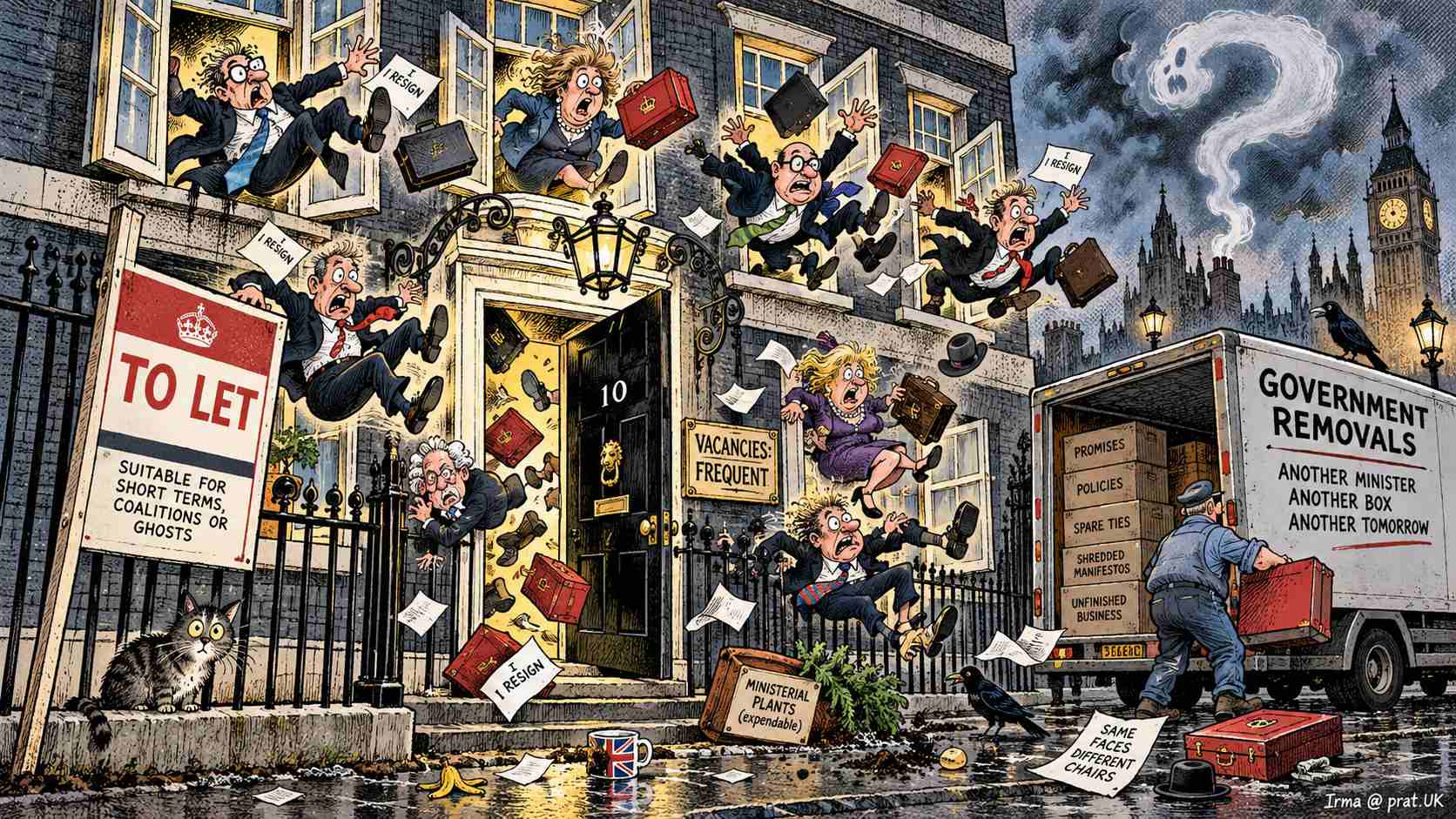
Haunted Downing Street Declared Official After Latest Cabinet Reshuffle
Residents report unexplained resignations, sudden disappearances and a building that seems to eat its own ministers
WESTMINSTER — Paranormal investigators touring Whitehall this Halloween have reportedly identified Number 10 Downing Street as the most active haunted site in central London, beating out the Tower of London on the strength of one simple metric: nobody who goes inside seems to stay very long.
The evidence, admittedly, is compelling. Earlier this year, four parliamentary private secretaries resigned within days of each other, swiftly followed by four junior ministers, including one Minister of Safeguarding and one Victims Minister, both departing a government whose own back benches were, by that point, openly calling for the Prime Minister to set a departure date. Around eighty Labour MPs reportedly wanted him gone. In any other building, this would be called an exorcism. In Westminster, it is called Tuesday.
The case for a haunted Downing Street
Classic haunted house indicators are all present and correct. Doors appear to open and close of their own accord, in the sense that ministerial doors open for new arrivals roughly as fast as they close behind the departing ones. Strange noises echo through empty corridors, in the sense that most of those corridors are now echoing because there is nobody left in post to answer the phone. And there is, unmistakably, an oppressive sense that something invisible and historic is slowly draining the life out of everyone who enters, which career civil servants have been calling “the departmental brief” for decades.
A Camden-based satirist working the political circuit this autumn offered his own diagnosis from the stage: “They keep saying Number 10 isn’t haunted, but four private secretaries and four junior ministers didn’t just wander off because the tea was cold. Something in that building doesn’t want you to finish your term. I’d get a priest in. Failing that, get an exit poll.”
A building with previous form
To be fair to the current administration, Downing Street has form on this long before the present occupant arrived. The building has quietly absorbed and expelled prime ministers on a schedule that would concern any risk assessor, with one recent tenant lasting a matter of weeks before the invisible forces, or possibly the bond markets, moved her along. Bonfire societies around the country have, not entirely in jest, taken to burning effigies of the shortest-serving among them each November, on the reasonable basis that if the country is going to torch a historical villain every autumn, it may as well pick one from this century for variety.
A haunted Downing Street with a long memory
Number 10 has, in fairness, always had a reputation for swallowing people whole. The building has hosted prime ministers who arrived promising stability and left within weeks, communications directors who resigned mid-term without warning, and deputy prime ministers whose departures came so abruptly that Westminster’s usual gossip network barely had time to update its odds before the next resignation landed on top of it. If a location can accumulate enough sudden, unexplained departures to earn a haunted reputation on television, Downing Street cleared that bar some years ago and has simply kept adding to the tally since.
Tour guides working the Whitehall beat this Halloween have reportedly started fielding genuine questions from visitors about which window belonged to which short-lived occupant, treating the building’s ministerial turnover the way other cities treat a genuine ghost story, complete with dates, names and a faint sense that nobody fully understands why it keeps happening. Nobody has yet proposed an actual seance in the Cabinet Room. Given the year Westminster has had, nobody would be especially surprised if one were quietly scheduled.
Trick, treat, or reshuffle
Whitehall sources insist there is a rational explanation for all of it, something to do with polling numbers, party discipline and the ordinary churn of government under pressure, rather than any actual supernatural activity. This is, notably, exactly what people trapped in haunted houses always say right before the lights go out entirely.
For readers who prefer their political turnover explained without the fog machine, Latest Story UK has the fuller, more conventional account of this year’s reshuffle and what triggered it.
Whatever is or isn’t lurking in the walls of Number 10, one thing is measurable and on the public record: the building has changed occupants with a frequency that would unsettle even the most seasoned estate agent, and the current tenant’s own backbenchers spent much of the spring publicly discussing an exit date that wasn’t his to give.
Sources
Wikipedia: 2026 British cabinet reshuffle and Wikipedia: 2025 British cabinet reshuffle.
This has been a piece of London satire for a government that seems to shed ministers the way old houses shed plaster, brought to you in the finest tradition of British satirical news about buildings that eat their own staff. For the American edition of a haunted seat of government, visit Bohiney.com.
Auf Wiedersehen, amigo!

Harper Thames is a comedic writer exploring modern life through irony and subtle exaggeration. Rooted in student perspectives and London’s cultural landscape, Harper’s work focuses on relatable humour grounded in everyday experience.
Expertise is developed through writing practice and critical engagement, while authority comes from authenticity and consistency. Trust is reinforced by transparent satire and ethical humour choices.


