Andy Burnham Rules Out Early UK Election, Leaves Tax Rises In as Britain’s Emergency Exit
Prime minister promises responsible economic management by refusing to say which household possession the Treasury has noticed.
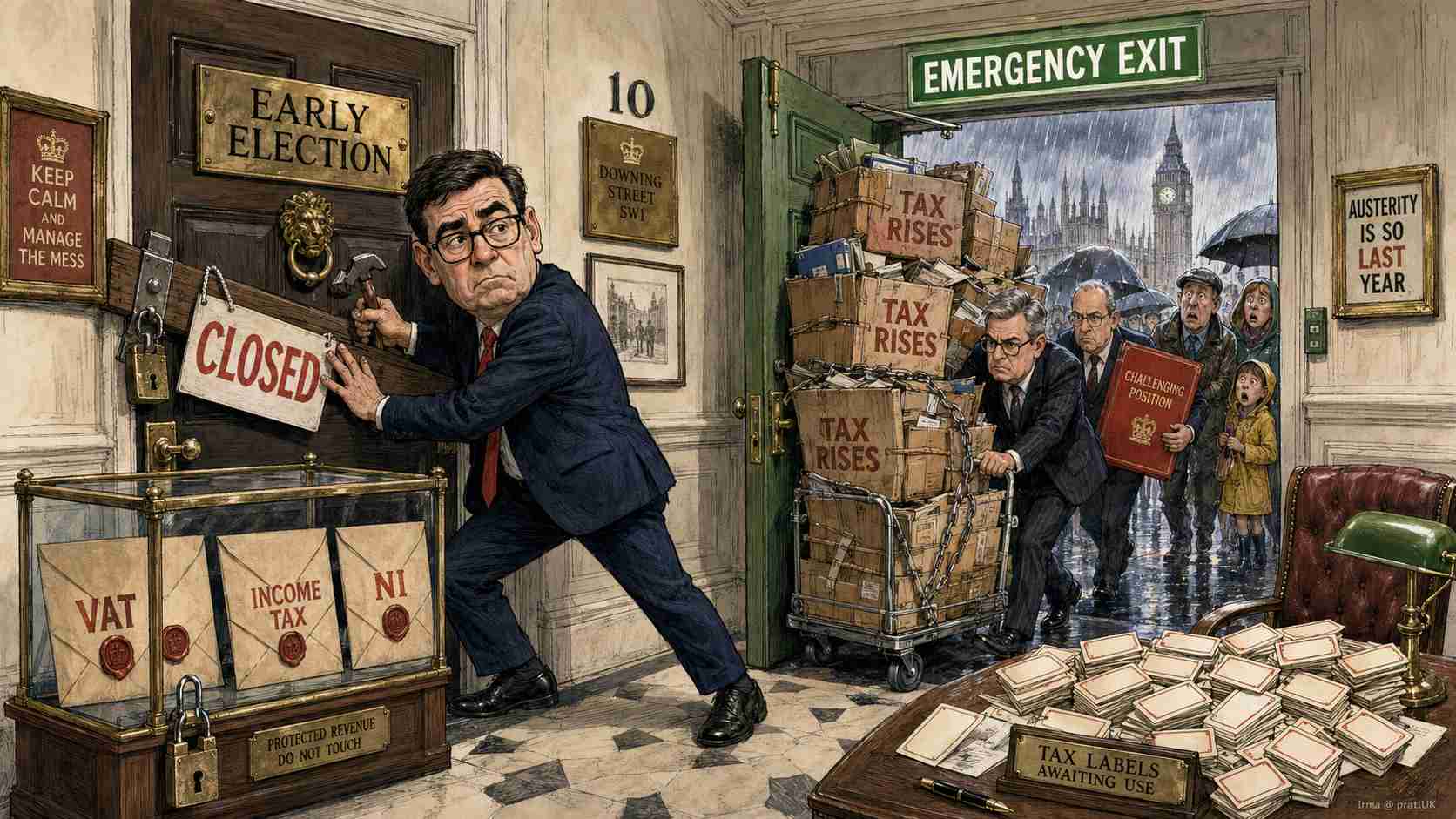
LONDON — Prime Minister Andy Burnham has ruled out an early general election while declining to exclude additional tax increases in the October Budget, according to reporting on Andy Burnham’s tax and election comments. Burnham says Britain faces a “challenging” financial outlook, an expression normally used by estate agents when a house has no roof and the kitchen belongs to Belgium.
The new prime minister insists he will honour Labour’s manifesto promise not to raise income tax, employee National Insurance or VAT. This is reassuring in the same way that a burglar promising not to take the television encourages the family to start counting spoons.
The protected taxes, and the 642 left unattended
Taxes not specifically protected include capital gains tax, inheritance tax, corporation tax, business rates, pension taxes, property taxes, wealth taxes, fuel duties and the theoretical charge imposed whenever a citizen displays signs of retained optimism.
The Institute for Fiscal Studies has spent several years pointing out that ring-fencing the three largest revenue-raisers does not reduce the amount of money required; it merely determines which smaller, stranger levers get pulled instead. Threshold freezes, allowance trims and relief withdrawals raise billions while remaining technically not a tax rise, in the sense that a pickpocket is technically not a shopkeeper.
Burnham says he will not behave unrealistically about the public finances. Britain appreciates this new realism, having spent several elections being promised Scandinavian public services, American taxes, Swiss efficiency and French retirement.
The books, briefly and without comfort
The Treasury’s books are reportedly under strain. Public spending continues rising, debt-interest costs remain formidable, and every government department has discovered a programme described as both essential and three billion pounds over budget. Forecasts from the Office for Budget Responsibility will arrive alongside the Budget, at which point the nation’s fiscal headroom will be measured in millimetres and reported in graphs the colour of a bruise.
A prat.UK survey of 1,004 adults, two accountants and a frightened ISA found that 68% expect higher taxes, 19% expect spending cuts and 13% believe the government will locate the money beneath an old calculator.
Why there will be no early election
Burnham’s refusal to call an election has attracted attention. Nigel Farage has suggested Britain may vote again in 2027, but Burnham says he is concentrating on governing rather than securing party advantage. This is a noble constitutional principle that prime ministers traditionally discover whenever the polls are not quite noble enough.
The prime minister says he wants to bring people together and solve problems. The public will be brought together immediately after officials determine which groups can be taxed collectively without leaving the country.
Downing Street argues that an early election would create uncertainty. British businesses responded that government has already supplied uncertainty in convenient industrial quantities, and no additional election is required. Surveys by the British Chambers of Commerce have found investment intentions hostage less to tax rates than to not knowing what the tax rates will be in March.
The Budget dilemma, and the traditional fourth option
The looming Budget presents a simple political trap. If Burnham raises taxes, opponents will call him a socialist. If he reduces spending, unions will call him a Conservative. If he borrows more, bond markets may call him at home.
Treasury specialists are therefore considering the traditional fourth option: rename everything.
- A tax becomes a contribution.
- A spending cut becomes departmental modernisation.
- Borrowing becomes investment.
- Fiscal panic becomes a challenging position.
- Discovering £9.40 in an old coat becomes a fully funded regional growth strategy.
Burnham’s defenders note that the new prime minister inherited Britain’s problems. This is true. Every incoming government inherits the national problems, photographs itself opening the cupboards, and behaves surprised that the previous tenants took the light bulbs.
The growth problem nobody can announce their way out of
The practical challenge is growth. Britain needs greater business investment, productive infrastructure, affordable energy, planning reform and a labour market that rewards work. Productivity figures from the Office for National Statistics have been flat for so long that economists now describe them the way vets describe an elderly cat: comfortable, stable, not going anywhere.
Unfortunately, these reforms require years of difficult decisions, whereas adjusting a tax threshold can be accomplished before Newsnight. Governments therefore choose thresholds, and then wonder aloud why the thing that needed a decade did not happen in a quarter.
What households should actually do before October
Citizens are advised to prepare responsibly rather than dramatically. Check pension contribution rules and annual allowances. Review any capital gains exposure before the Budget rather than after it. Understand how frozen thresholds affect your marginal rate. Free, non-commercial guidance is available from MoneyHelper, and anything complicated deserves a qualified adviser rather than a man on social media whose profile photograph shows him standing beside a rented Lamborghini.
Burnham promises caution, responsibility and no opportunistic election.
Britain will therefore keep the same government while waiting to learn which opportunities the Treasury finds in its own bank account.
Observations on Britain’s pre-Budget mood
- Andy Burnham will not call an early election because voters might interfere with his plan to govern differently.
- Britain’s finances are in a challenging position, the Treasury’s preferred description for finding a horse’s head in the national chequebook.
- The government will not raise the three taxes it named, leaving approximately 642 unnamed taxes trembling with opportunity.
- A frozen threshold is a tax rise wearing a hat and hoping nobody looks up.
- Every chancellor inherits a mess and photographs the cupboards before opening them.
- Britain wants Scandinavian services, American taxes and Swiss trains, delivered by a department that cannot answer the phone.
- Ruling out an election is easiest when the polls have already ruled it out for you.
- The Treasury’s greatest innovation is not revenue. It is vocabulary.
Disclaimer: This is political satire based on UK news reported in August 2026. Surveys, accountants and frightened ISAs above are comic devices rather than literal reporting. Nothing here is financial advice.

Bethan Morgan is an experienced satirical journalist and comedy writer with a strong editorial voice shaped by London’s writing and performance culture. Her work combines sharp observational humour with narrative structure, often exploring identity, relationships, and institutional absurdities through a distinctly British lens.
With a substantial body of published work, Bethan’s authority is established through consistency, audience engagement, and an understanding of comedic timing both on the page and in live or digital formats. Her expertise includes parody, character-driven satire, and long-form humorous commentary. Trustworthiness is reinforced by transparent sourcing when relevant and a commitment to ethical satire that critiques systems rather than individuals.
Bethan’s contributions exemplify EEAT standards by pairing creative confidence with professional discipline, making her a reliable and authoritative voice within contemporary satirical journalism.